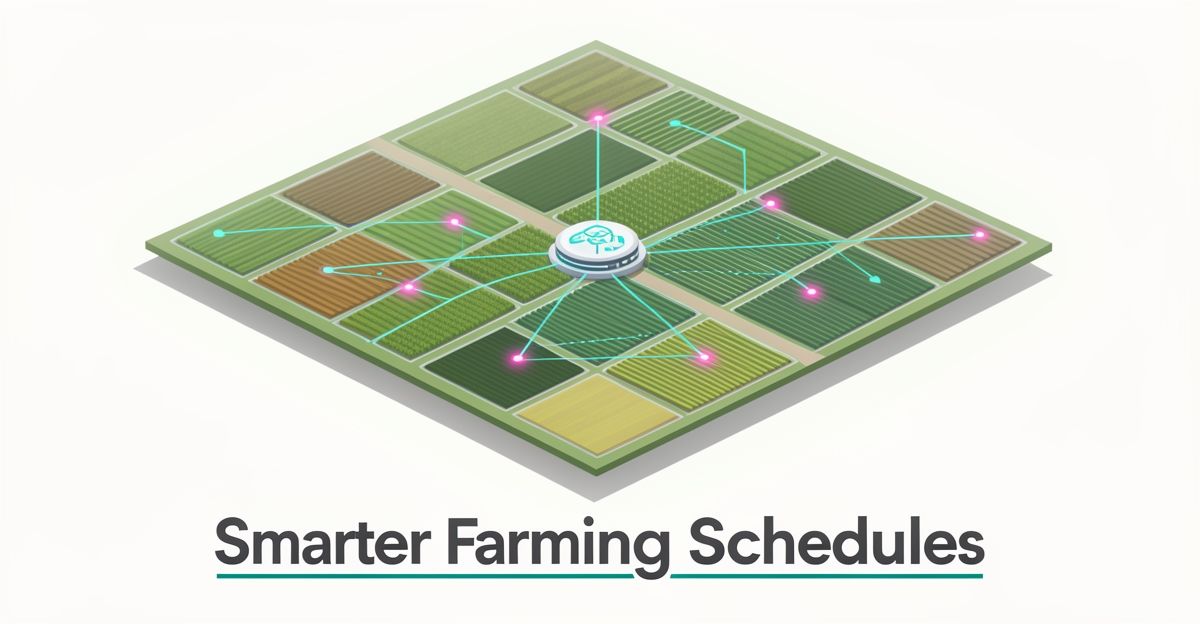
# AI-Powered Crop Planning: How to Build a Smarter Farming Schedule
**Quick Answer:** Build dynamic farming schedules with AI that syncs planting, harvesting, and maintenance to real-time field data — adaptive, automated crop planning that reduces guesswork and preventable losses.
## Key Facts
- AI adoption in agriculture is still early: industry surveys suggest only a small share of farmers currently use AI tools day-to-day, even as awareness of the technology's potential grows.
- Agribusinesses widely recognize AI's potential, but full implementation lags well behind — most operations remain in the evaluation stage.
- Free and low-cost entry points (satellite monitoring, phone-camera disease detection) have made precision tools accessible to smaller operations.
- Workforce research consistently finds most workers lack enough time or energy for their jobs — a burden that manual farm planning only amplifies.
- Larger farms tend to adopt AI faster, but the underlying planning problems (weather volatility, labor shortages, thin margins) affect operations of every size.
## Table of Contents
- [The Planning Bottleneck: Manual Schedules vs Real-Time Reality](#the-planning-bottleneck-manual-schedules-vs-real-time-reality)
- [How AI Builds Smarter Planting, Harvesting and Maintenance Schedules](#how-ai-builds-smarter-planting-harvesting-and-maintenance-schedules)
- [From Data to Field Actions: Implementing an AI Crop Operating System](#from-data-to-field-actions-implementing-an-ai-crop-operating-system)
- [Making AI Crop Planning Work for Your Farm Size and Budget](#making-ai-crop-planning-work-for-your-farm-size-and-budget)
## The Planning Bottleneck: Manual Schedules vs Real-Time Reality
Modern crop planning often starts with a static calendar built on historical averages. But weather volatility, labor shortages, and the sheer cognitive load of running a farm make those manual schedules increasingly unreliable. Workforce research has repeatedly found that most workers lack enough time or energy to do their work well — a strain that hits farm managers hardest as they juggle field scouting, equipment logistics, and weather watches simultaneously.
Traditional scouting is limited to predetermined schedules and human expertise. That creates blind spots where pests, moisture stress, or nutrient deficiencies go undetected until visible damage occurs, forcing reactive decisions that waste inputs and reduce yields.
This gap between planning and reality is amplified by low AI adoption despite clear benefits. Industry surveys suggest only a small share of farmers currently use AI tools, even as AI-driven workflows can sync with seasonal patterns and farm resources to improve efficiency and yield. The disconnect isn't just about access — it's about usability. Farmers consistently report a gap between what AI tools can do and how they actually use them, particularly for field-level decisions like yield prediction and pest detection, leaving potential gains untapped.
- Manual scouting misses real-time threats due to fixed inspection frequencies
- Cognitive overload impairs timely decision-making during critical windows
- Labor shortages reduce coverage and increase reliance on fragmented data
- Static plans fail to adapt to microclimate shifts within fields
- Delayed responses amplify losses from preventable issues
AIQ Labs addresses this planning bottleneck through AI Workflow Builds — rebuilding the one workflow that costs your operation the most, at a fixed price, so reactive schedules become adaptive systems that align planting, harvesting, and maintenance with real-time field conditions rather than outdated assumptions.
## How AI Builds Smarter Planting, Harvesting and Maintenance Schedules
AI-powered crop planning transforms traditional farming schedules into dynamic, data-driven systems that adapt to real-time conditions. By integrating satellite imagery, soil sensor data, and weather forecasts, AI enables precision agriculture that optimizes planting, harvesting, and maintenance timing for maximum efficiency and yield. This approach moves farming from reactive routines to proactive, seasonally synchronized operations.
Industry research on AI in agriculture points to meaningful gains in yield and return on investment through optimized resource use and predictive analytics. The exact figures vary by operation and region, but the mechanism is consistent: aligning field activities with actual crop needs rather than fixed calendars reduces waste and improves outcomes across the growing cycle.
AI systems continuously analyze multi-source data to adjust schedules in response to changing conditions. For example, if soil moist
AI Employees
Hire a team member that works 24/7 — for less than a part-time wage.
AI receptionists, SDRs, dispatchers and 99+ roles. Trained on your business, fully managed.
See If You’re a Fit — AI Employees from $700/mo
Not sure where to start? Ask our AI planner
ure drops below optimal levels due to an unexpected dry spell, irrigation and planting timelines can be automatically revised. Similarly, forecasted heatwaves may trigger earlier harvesting to prevent crop stress, while prolonged cool periods might delay planting to avoid germination failure.
- Precision agriculture optimizes water, fertilizer, and pesticide application based on real-time field variability
- Yield prediction models forecast output using historical patterns, current crop health, and weather trends
- Climate-smart adjustments shift planting dates, varietal choices, and input timing to match evolving seasonal patterns
- Automated field maintenance schedules trigger actions like weeding or fungicide application only when conditions warrant
AIQ Labs builds custom workflows that sync these intelligent scheduling capabilities with your existing farm resources and operational tools. By automating routine decision-making and surfacing only what needs your judgment, these systems reduce cognitive load while ensuring every acre is managed at peak efficiency. The result is a farming schedule that doesn't just follow the season — it anticipates and adapts to it.
## From Data to Field Actions: Implementing an AI Crop Operating System
Most farms still run on clipboards, gut instinct, and a scout who can only cover so many acres before dark. That model worked when labor was abundant and margins forgiving — but weather unpredictability, labor shortages, and razor-thin margins now demand maximum efficiency from every acre.
The core difference between the two approaches comes down to where decisions get made. Manual processes rely on experienced scouts conducting visual inspections on predetermined schedules, with disease identification dependent on human expertise and documentation captured in handwritten logs or basic apps. An **AI crop operating system** flips that model: it monitors every acre continuously by combining satellite imagery, soil sensors, and weather data, then automates routine decisions mathematically rather than waiting for the next scheduled walk-through.
The coverage gap alone justifies the shift. A scout's response time depends on inspection frequency and availability, and accuracy varies significantly from person to person. AI systems eliminate that variability — continuous automated detection across all acres, in real time, directly addressing the labor coverage limits that constrain manual operations.
In practice, an integrated AI workflow automates three operational layers at once:
- **Irrigation scheduling** — soil sensor and weather data trigger watering decisions automatically, optimizing inputs rather than following fixed calendars.
- **Crop health monitoring** — satellite and sensor feeds flag disease or stress across every field simultaneously, not just the ones a scout reached that week.
- **Supply coordination** — input costs, field records, and logistics sync into a single operational view, replacing disconnected spreadsheets.
This is where **decision automation** matters more than dashboards. Tools that merely display data still burden an already stretched workforce — workforce research consistently finds most workers lack enough time or energy to do their jobs. The goal isn't more information; it's systems that act on information, escalating only the decisions that genuinely need human judgment.
That's the philosophy behind AI Operating Systems: one connected operating layer built in phases, owned outright, connecting monitoring, irrigation, and supply coordination into a single system. Manual processes still suit smaller farms where local knowledge outweighs efficiency gains — but for operations hitting coverage limits, the gap between what AI tools can do and how farms actually use them is where competitive advantage now lives.
## Making AI Crop Planning Work for Your Farm Size and Budget
The gap between AI's potential and on-farm reality is widest where budgets are tightest. Larger operations tend to adopt AI faster, while smaller farms often hold back — cost and complexity aren't abstract concerns, they're the daily friction that keeps practical tools out of reach.
The good news is that entry points have never been cheaper:
- Free satellite monitoring platforms now serve hundreds of thousands of growers globally
- Phone-camera disease detection apps identify dozens of crop diseases with high accuracy, at no cost
- Advisory platforms reach millions of smallholders across multiple languages and regions
These entry points prove you don't need enterprise contracts to start. The real breakthrough comes when disparate tools connect into a single workflow — planting win
AI Development
Still paying for 10+ subscriptions that don’t talk to each other?
We build custom AI systems you own outright. No vendor lock-in. Full control.
See If You’re a Fit — AI Employees from $700/mo
Not sure where to start? Ask our AI planner
dows that adjust to live weather data, harvest schedules that sync with equipment availability, maintenance triggers that fire from actual field conditions rather than calendar dates. An AI operating layer automates this coordination across every acre continuously, replacing the scout-and-notebook model that breaks down at scale.
AIQ Labs builds these systems three ways, so the entry point matches your budget and risk tolerance:
- **Start Monthly** — begin with AI Employees handling a specific function at a fraction of the cost of a human hire, with no long-term commitment.
- **Build in Milestones** — an AI Workflow Build rebuilds the one workflow that costs you the most, at a fixed price, delivered in phases you approve.
- **Own It Outright** — an AI Operating System gives you one connected layer across the operation, built in phases and owned outright. No vendor lock-in. No per-seat fees that punish growth.
Start with one workflow. Prove the value. Expand from there.
## Frequently Asked Questions
**Why do so few farmers actually use AI tools even though the benefits are clear?**
Industry surveys consistently show adoption lagging well behind awareness. Most farmers recognize AI's potential but report a gap between what tools can do and how they're actually used for field-level decisions like yield prediction and pest detection. The tools exist; the integration into daily operations is what's missing.
**Can AI crop planning really work for smaller farms with tight budgets?**
Yes — free satellite monitoring and phone-camera disease detection apps provide accessible entry points without enterprise contracts. You can start small, prove the return, and scale up as results come in.
**How does AI scheduling differ from the manual calendar I already use?**
Manual schedules rely on fixed calendars and periodic scout visits that miss real-time threats, while AI systems continuously analyze satellite imagery, soil sensors, and weather forecasts to automatically adjust planting, irrigation, and harvesting timing based on actual field conditions — eliminating the coverage gaps and variability of human scouts.
**Will adopting AI add more dashboards and data I don't have time to analyze?**
The goal isn't more information — it's systems that act on information and escalate only decisions needing human judgment. AIQ Labs builds workflows that automate routine decisions (irrigation, health monitoring, supply coordination) rather than adding another dashboard to monitor.
**What kind of ROI can I realistically expect from AI crop planning?**
Results vary by operation, but the mechanism is consistent: precision agriculture reduces input waste by applying water, fertilizer, and pesticides only where and when conditions warrant, while predictive scheduling prevents losses from missed windows. The most reliable way to estimate your return is to start with one workflow and measure it.
**Do I have to replace my entire operation at once, or can I start with one workflow?**
Start with a single workflow — like automated irrigation scheduling or disease detection — prove the value, then expand. AIQ Labs builds in milestones so you control the pace, and you own the system outright rather than renting access to it.
## Turn Your Field Data into Forward Motion
The gap between static farm schedules and real-time field conditions isn't just a planning inconvenience — it's a drain on yield, resources, and peace of mind. AI-powered crop planning closes that gap by turning satellite feeds, soil sensors, and weather forecasts into adaptive schedules for planting, harvesting, and maintenance. The result: less guesswork, fewer preventable losses, and operations that move with the season instead of against it.
For farms ready to move beyond clipboards and gut calls, the next step is simple: start with a workflow that solves one bottleneck — like irrigation timing or pest scouting — and prove the value before scaling. If you're curious where AI could make the biggest impact on your operation, take the two-minute Fit Check to map your biggest opportunity — no obligation, just clarity.
AI Transformation Partner
Make AI your competitive advantage — not just another tool.
Strategy, implementation and ongoing optimization. One partner, end to end.
See If You’re a Fit — AI Employees from $700/mo
Not sure where to start? Ask our AI planner