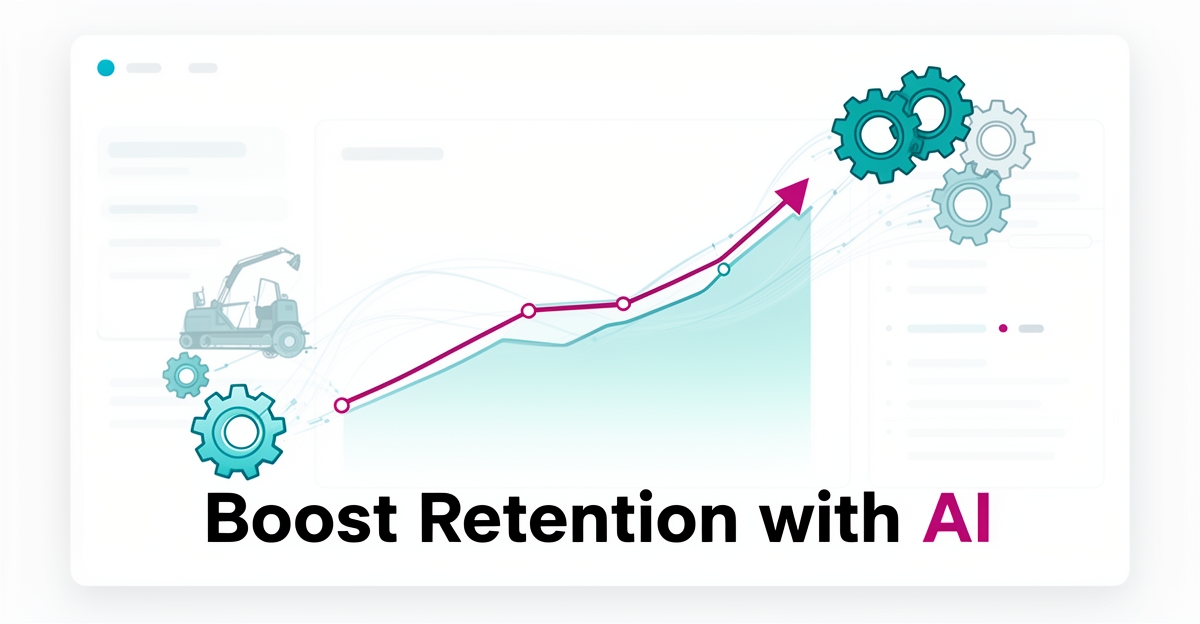
AI-Powered Customer Retention: How Equipment Dealers Can Keep Returning Clients
Key Facts
- Acquiring a new customer is widely cited as costing several times more than retaining an existing one—commonly referenced at five to twenty-five times more, depending on industry
- Well-implemented AI retention programs are typically associated with net revenue retention above 100%, meaning existing customers grow more valuable over time
- AI churn prediction models generally outperform traditional rule-based methods, with published implementations often reporting high accuracy on at-risk accounts
- Customers are far more likely to buy their next piece of equipment from the same dealer when they receive the right message at the right point in the ownership cycle
- Targeted AI retention strategies are typically credited with reducing annual churn by a few percentage points while lifting intervention success rates substantially
- AIQ Labs has deployed 200+ multi-agent systems and runs four live SaaS products daily—retention workflows are a core use case
Hire a team member that works 24/7 — for less than a part-time wage.
AI receptionists, SDRs, dispatchers and 99+ roles. Trained on your business, fully managed.
Not sure where to start? Ask our AI planner
Why Equipment Dealers Are Losing Customers (And What It’s Costing Them)
Most equipment dealers focus heavily on the initial sale, but the real profit lies in the years of service, parts, and repeat purchases that follow. When those returning clients quietly drift away, the financial impact is far more severe than many realize.
The economics of retention are stark. Industry research has long held that acquiring a new customer costs several times more than keeping an existing one—figures of five to twenty-five times are commonly cited. For equipment dealers operating on tight margins, that means losing a single long-term client requires winning multiple new ones just to break even.
The cost of churn extends far beyond the immediate loss of a service contract. When a customer defects to a competitor, dealers lose the predictable revenue stream from maintenance, parts, and eventual equipment upgrades. Well-run retention programs are typically associated with net revenue retention above 100%—existing customers actually grow more valuable over time. Without proactive retention, dealers forfeit that expansion revenue entirely.
Traditional retention methods rely on lagging indicators that signal trouble only after the relationship has soured. Dealers typically notice churn when it's too late:
- Missed scheduled maintenance appointments
- Declining parts orders or service requests
- Unresolved complaints or support tickets
- Payment delays or contract non-renewals
By the time these signals appear, the customer has often already begun evaluating competitors. Reactive retention strategies fail because they attempt to win back clients who have mentally checked out weeks or months earlier.
The stakes are particularly high given customer loyalty trends. Dealership data consistently shows customers are far more likely to buy their next piece of equipment from the same dealer when they receive the right message at the right point in the ownership cycle. Yet most dealers lack the systems to identify these critical moments before it's too late.
Silent churn represents the greatest threat. Unlike vocal complainers, these customers simply stop engaging—skipping service intervals, delaying upgrades, and eventually disappearing without warning. Targeted AI retention strategies are typically credited with reducing annual churn by a few percentage points, but only by identifying these at-risk clients before they reach the breaking point.
For equipment dealers, the path forward requires shifting from reactive firefighting to proactive relationship management. AIQ Labs builds systems that analyze customer behavior patterns to flag retention risks early, allowing dealers to intervene with personalized offers and maintenance alerts before clients consider alternatives. The cost of waiting until customers leave is simply too high to ignore.
How AI Predicts Churn Before It Happens
Churn doesn't announce itself with a cancellation notice. It shows up first in quiet signals — a skipped service window, declining equipment usage, a shift in tone after support calls. AI-powered retention systems catch those signals weeks or months before a customer walks away.
Modern AI agents analyze hundreds of data points simultaneously, including service history, usage patterns, billing behavior, and communication sentiment. That multi-factor view is what lets well-trained models flag at-risk accounts far earlier and more reliably than traditional rule-based systems. Published implementations frequently report strong predictive accuracy, though exact figures vary by data quality and industry—treat any specific accuracy claim with scrutiny until you've validated it on your own customer base.
For equipment dealers, the advantage is timing and relevance. Instead of reacting after a missed payment or complaint, the system flags a client whose machine hours dropped or whose maintenance interval slipped, then triggers a timely, personalized intervention. Dealerships using AI receptionists and automated follow-up typically report meaningful lifts in service revenue, because routine outreach stops falling through the cracks.
The shift from reactive to proactive changes how retention campaigns are built. AI continuously updates retention scores in real time and segments customers by risk and value, so high-value at-risk accounts receive executive attention while routine outreach runs automatically.
Predictive models focus on the behaviors that precede churn:
- Usage patterns such as declining feature adoption or reduced equipment utilization
- Support interactions with increased ticket volume or negative sentiment
- Billing signals including payment delays or modification requests
These inputs allow dealers to move from generic mass marketing to automated, multi-channel campaigns tailored to specific risk profiles. Because acquiring a new customer costs far more than retaining one, early intervention is a direct profit lever. AIQ Labs builds systems that learn from past interactions and proactively recommend service renewals or upgrades, closing the gap between scattered outreach and consistent engagement.
When retention is data-driven, dealers can deliver the right message at the right point in the ownership cycle—and that timely relevance is what keeps customers coming back for the next purchase.
From Prediction to Profit: Implementing AI Employees and Workflow Automation for Retention
Turning churn prediction into measurable profit requires more than accurate models—it demands data, intelligent agents, and automated workflows that work in concert. AIQ Labs offers three entry points depending on where you're starting from. AI Employees are managed AI staff—receptionists, SDRs, dispatchers, and 99+ other roles—that handle routine retention outreach at roughly 80% less cost than a human hire. A Workflow Build rebuilds the one workflow that costs you the most, at a fixed price and in phases. And an AI Operating System connects everything into one operating layer you own outright.
Successful implementation starts with integrating disparate data sources—CRM, service history, usage patterns—into a unified customer view. Models generally need a substantial window of historical data (often in the range of two to three years) before they detect reliable churn patterns, which is why the first step is always data integration. Once trained, these models power dynamic segmentation, automatically grouping customers into categories like "high-value at-risk" or "recovery candidates" so intervention strategies match both risk level and lifetime value.
Workflow automation then turns insight into action: when an AI employee flags declining equipment usage, the system sends a tailored service offer via SMS or email, and simultaneously schedules a follow-up call if no response arrives within 48 hours. This closed-loop approach ensures consistent engagement without adding headcount. Payment is straightforward too—start monthly, build in milestones, or own the system outright. No fake prices, no invented case-study numbers: you measure the results on your own book of business, and the numbers either hold up or they don't.
Measuring What Matters: Tracking Retention Lift, ROI, and Lifetime Value Growth
Implementing AI retention tools is only half the equation; measuring their impact with precision is what separates experimentation from enterprise value. Dealers who move beyond vanity metrics and anchor their strategy in gross revenue retention, net revenue expansion, and lifetime value growth gain a clear line of sight into profitability. Well-run AI retention programs are typically associated with net revenue retention above 100%, signaling that existing customers are not just staying but spending more.
- Churn reduction of a few percentage points annually through predictive risk scoring
- Lifetime value growth through personalized, timely intervention
- Higher intervention success rates on at-risk accounts versus generic outreach
- Shorter acquisition payback periods as retention revenue compounds
These outcomes stem from the shift from reactive outreach to proactive intelligence. When an AI employee analyzes service history, usage patterns, and sentiment to flag a declining account weeks before a human would notice, the dealer can deploy targeted offers or executive outreach that actually lands. AIQ Labs helps dealers instrument these KPIs from day one, embedding dashboards that track retention lift, churn velocity, and LTV expansion so leadership can see exactly where AI moves the needle. With 200+ multi-agent systems deployed and four live SaaS products running daily, the measurement discipline is built in—not bolted on.
Still paying for 10+ subscriptions that don’t talk to each other?
We build custom AI systems you own outright. No vendor lock-in. Full control.
Not sure where to start? Ask our AI planner
Frequently Asked Questions
How much does it actually cost a dealer to lose a customer?
Can AI really predict which customers are about to leave?
What warning signs does an AI retention system look for?
What kind of ROI can equipment dealers expect from AI retention tools?
How much historical data do I need before AI churn prediction works?
Will AI replace my service team or just handle the routine work?
Stop Losing Your Best Customers in Silence
The shift from reactive firefighting to proactive retention isn't just a technological upgrade—it's a fundamental restructuring of how equipment dealers protect their most valuable asset: the customers they already have. By using AI to analyze usage patterns, service history, and communication sentiment, dealers can identify at-risk clients early and intervene weeks before churn occurs. AIQ Labs builds these systems—whether that's AI Employees handling routine outreach, a Workflow Build targeting your most expensive broken process, or a full AI Operating System you own outright—turning retention from a cost center into a scalable profit engine. Ready to protect your revenue and unlock the full lifetime value of your customer base? Start the Fit Check at https://aiqlabs.ai/apply—a two-minute assessment that leads to a free 30-minute strategy call where we'll map your biggest retention opportunities. If there isn't a clear win, we'll tell you that too.
Make AI your competitive advantage — not just another tool.
Strategy, implementation and ongoing optimization. One partner, end to end.
Not sure where to start? Ask our AI planner