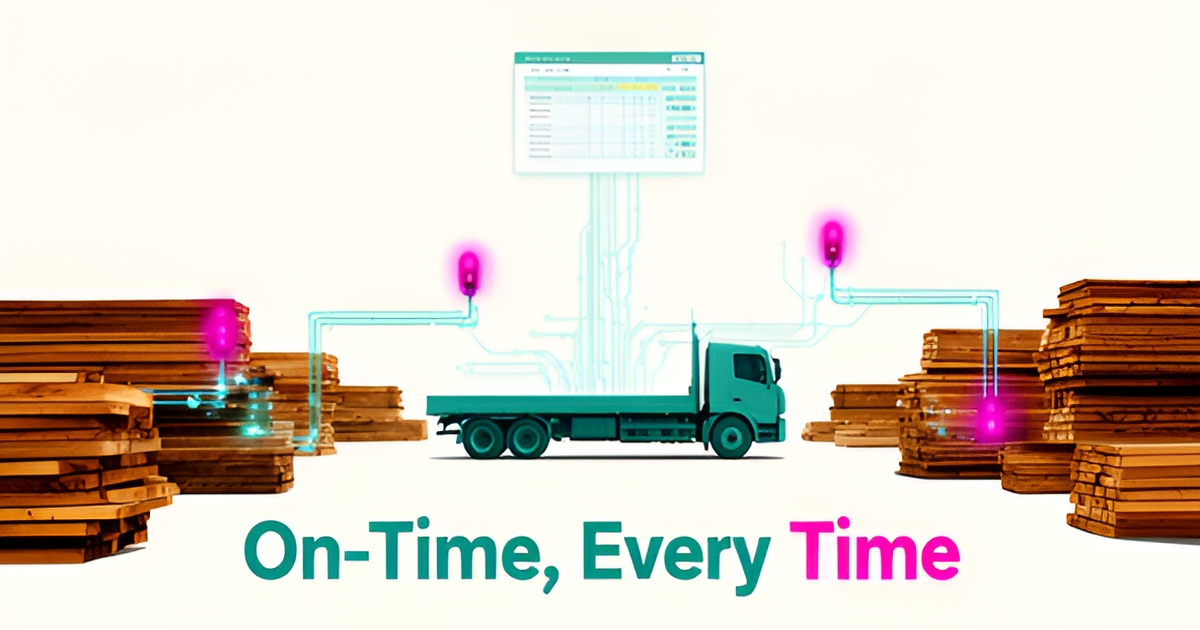
AI-Powered Delivery Scheduling: How to Reduce Late Deliveries in a Lumber Yard
Key Facts
- Industry benchmarks suggest manual routing can waste roughly a quarter of fuel spend on suboptimal paths according to delivery operations analyses
- Each failed delivery typically carries meaningful rescheduling, labor, and customer service overhead based on fleet performance data
- A large share of customers never return after a single delivery failure representing substantial potential lost revenue
- AI route optimization can cut planning time dramatically versus manual dispatch as reported in mid-sized operations
- UPS's ORION system has been widely reported to save roughly 100 million miles annually across its fleet with hundreds of millions in cost savings
- A Singapore logistics firm reported a 30% cost reduction within 12 months with AI automation through phased implementation
- AI scheduling can free up dozens of dispatcher hours weekly freeing staff for exception management
Hire a team member that works 24/7 — for less than a part-time wage.
AI receptionists, SDRs, dispatchers and 99+ roles. Trained on your business, fully managed.
Not sure where to start? Ask our AI planner
Why Manual Dispatch Fails Lumber Yards
Manual dispatch in lumber yards operates like a game of chance with heavy consequences. Dispatchers juggle static routes while managing truckloads of lumber that require special handling, tight delivery windows, and precise job-site access—often navigating narrow residential streets or active construction zones. This rigid approach ignores real-time variables like traffic congestion, weather delays, or last-minute schedule changes, turning every delivery into a gamble where late arrivals, failed attempts, and frustrated customers become the norm. The hidden costs pile up fast: wasted fuel from inefficient routing, labor spent rebuilding schedules by hand, and the slow erosion of dispatcher morale under constant pressure.
These inefficiencies are not just frustrating—they're expensive. Industry analyses suggest manual routing can waste roughly 25% of fuel on suboptimal paths that dynamic optimization could avoid. Failed deliveries carry real, recurring costs in rescheduling, labor, and customer service overhead. Worse, a large share of customers—some reports put it near 43%—never return after a single delivery failure, turning operational hiccups into lasting revenue loss. For lumber yards relying on repeat contractors and builders, this churn threatens long-term viability far more than the immediate cost of a missed drop-off.
These failures are amplified by lumber yard-specific constraints that static routing simply cannot address. Heavy, oversized loads demand routes that accommodate weight restrictions and low-clearance bridges—details manual planners often overlook until a truck is already en route. Narrow delivery windows, common when coordinating with busy job sites, leave zero tolerance for error; a 15-minute delay can mean missing the entire pour window for concrete foundations. Additionally, job-site access frequently changes daily as construction progresses, requiring routes that adapt to new gates, temporary roadblocks, or shifting delivery zones—variables no static map can predict. When dispatchers rely on clipboards and gut instinct, they're not just optimizing routes; they're betting the yard's reputation on guesswork.
- Fuel waste increases operational costs without improving service reliability
- Failed deliveries trigger direct expenses and lasting customer loss
- Dispatcher burnout rises as manual rescheduling consumes hours daily
- Lumber-specific constraints turn small delays into major job-site disruptions
- Static routing ignores real-time variables that AI systems process continuously
The result is a cycle where inefficiency begets inefficiency: burned-out dispatchers make rushed decisions, leading to more failed deliveries, which further strain customer relationships and team morale. In an industry where trust is built on reliability—showing up on time, with the right materials, ready to install—manual dispatch doesn't just fail to optimize; it actively undermines the foundation of lumber yard operations. Breaking this cycle requires moving beyond human-limited planning to systems that can process complexity in real time, turning delivery scheduling from a liability into a competitive advantage. AIQ Labs helps lumber yards make this shift through AI Workflow Builds that rebuild the dispatch workflow around every variable—from truck availability to job-site access—so deliveries arrive not just on time, but as promised.
How AI Scheduling Solves the Core Variables
Traditional dispatch boards and static route sheets collapse the moment real-world variables shift — traffic congestion, a truck's weight limit, a customer's narrowing delivery window, or a load of dimensional lumber that won't fit the assigned trailer. AI scheduling replaces that brittleness with three interconnected systems that process millions of data points in real time: predictive traffic modeling, dynamic constraint management, and continuous optimization loops. Together, they turn a daily guessing game into a living, self-correcting plan.
- Predictive traffic modeling ingests historical congestion patterns, live sensor feeds, weather alerts, and construction data to forecast segment-level travel times minutes or hours ahead.
- Dynamic constraint management simultaneously evaluates truck capacity, axle-weight limits, delivery-window commitments, load dimensions, and driver hours-of-service rules — adjusting assignments the instant any variable changes.
- Continuous optimization loops re-run the entire schedule every few minutes, swapping stops, re-sequencing routes, and rebalancing loads across the fleet without human intervention.
The impact shows up in hard numbers. UPS's ORION system has been widely reported to optimize its fleet daily, saving on the order of 100 million miles annually with hundreds of millions in cost savings. DHL's risk platform has been credited with strong predictive accuracy for shipment arrival times. A regional grocery chain that adopted AI-powered routing reported cutting fuel spend by roughly 23% and lifting on-time delivery from 81% to over 97%. For a lumber yard, those same engines handle the added complexity of mixed-load dimensions, job-site access restrictions, and the cascade effect when one delayed framing package stalls an entire framing crew.
AIQ Labs builds this class of multi-agent scheduling system into custom AI workflows that sit on top of existing dispatch, ERP, and telematics platforms — no rip-and-replace required. The result is a schedule that stays feasible from the yard gate to the last drop-off, even when the day refuses to follow the plan.
Implementation Roadmap: From Pilot to Full Deployment
Implementing AI-powered delivery scheduling requires a structured, phased approach to ensure smooth adoption and measurable results. Begin with a comprehensive data audit of GPS tracking, historical delivery logs, and customer delivery windows to establish a baseline for performance. This foundational step enables the AI system to learn from past patterns and identify immediate optimization opportunities, such as reducing idle time or improving route sequencing based on real-world constraints.
Launch a pilot program covering 10-15% of the fleet to test the AI scheduling engine under real conditions, focusing on key KPIs like on-time delivery rate, fuel consumption per mile, and dispatcher planning time. As illustrated in a Singapore logistics case study, this phased approach can yield significant outcomes—the firm reported a 30% cost reduction within 12 months when combined with human-in-the-loop oversight for exception handling. During the pilot, integrate the AI solution with existing dispatch or ERP systems to ensure seamless data flow and avoid operational silos.
Equip drivers with mobile tools that provide real-time route updates, delivery confirmation, and exception reporting, enabling dynamic adjustments when traffic delays or customer availability changes occur. This continuous feedback loop enhances the AI's predictive accuracy over time while maintaining human oversight for complex scenarios. Finally, establish governance guardrails to monitor model performance, data quality, and compliance, ensuring the system scales reliably across the full fleet while supporting sustainable improvements in delivery precision and customer satisfaction. AIQ Labs supports this end-to-end transformation through fixed-price, milestone-based workflow builds and ongoing optimization.
Measuring What Matters: KPIs That Prove ROI
The true value of AI-powered delivery scheduling emerges when operational improvements translate directly into financial outcomes. Tracking the right metrics ensures that optimization efforts deliver measurable business impact rather than just technological sophistication.
For lumber yards, the core KPIs center on delivery reliability and cost efficiency. On-time delivery rates in the high 90s become achievable through real-time AI rerouting, typically outperforming the industry average of 85-90% according to industry benchmarks. This improvement directly protects revenue, since a large share of customers never return after a delivery failure representing substantial potential lost revenue.
Cost per delivery typically drops meaningfully with AI route optimization, driven by reduced fuel consumption and labor efficiency based on fleet performance data. Fleets using AI routing have reported driving substantially fewer miles per delivery cycle, lowering operational expenses and environmental impact as demonstrated in regional implementations. Dispatcher hours saved can reach dozens per week, freeing skilled personnel for higher-value tasks like exception management and customer relationship building as reported in mid-sized operations.
- Constraint violation rate (leading indicator for schedule feasibility)
- Re-optimization frequency (measures adaptability to real-time changes)
- Average delivery time variance (predicts customer satisfaction trends)
- Truck utilization percentage (optimizes asset efficiency)
- Customer retention correlation with on-time performance
These metrics create a closed-loop system where leading indicators like constraint violation rates alert teams to emerging issues before they impact on-time performance. AIQ Labs integrates these KPIs into custom dashboards that provide real-time visibility into delivery economics, ensuring AI scheduling delivers sustained ROI rather than temporary gains. The focus remains on translating technical capabilities into lumber-yard specific outcomes: protecting margins, strengthening customer loyalty, and building operational resilience against market volatility.
Still paying for 10+ subscriptions that don’t talk to each other?
We build custom AI systems you own outright. No vendor lock-in. Full control.
Not sure where to start? Ask our AI planner
Frequently Asked Questions
How much can AI delivery scheduling reduce fuel costs for lumber yards?
What does a failed delivery cost in lumber yard operations?
Can AI scheduling really improve on-time delivery rates for lumber yards?
How much time can AI save dispatchers in lumber yard operations each week?
What happens if a lumber yard ignores delivery failures and keeps using manual dispatch?
Is it necessary to replace existing systems to implement AI delivery scheduling in a lumber yard?
From Guesswork to Guaranteed: The Future of Lumber Yard Deliveries
The shift from manual dispatch to AI-powered scheduling represents more than an operational upgrade—it's a fundamental reimagining of how lumber yards build trust with contractors and builders. By replacing static routes and gut instinct with systems that process traffic patterns, load constraints, and job-site variables in real-time, yards can reach the on-time delivery rates that protect margins and customer relationships. The reported results are consistent: operations implementing these systems see substantial reductions in miles driven and dispatcher time reclaimed for higher-value work. AIQ Labs helps lumber yards make this transition through AI Workflow Builds that integrate with existing dispatch systems—no rip-and-replace required. Start by auditing your current delivery performance: track your true cost per failed delivery and dispatcher hours spent on manual rescheduling. When you're ready to explore what AI scheduling could save your operation, take the 2-minute Fit Check and book a free 30-minute strategy call to map your highest-ROI automation opportunity.
Make AI your competitive advantage — not just another tool.
Strategy, implementation and ongoing optimization. One partner, end to end.
Not sure where to start? Ask our AI planner