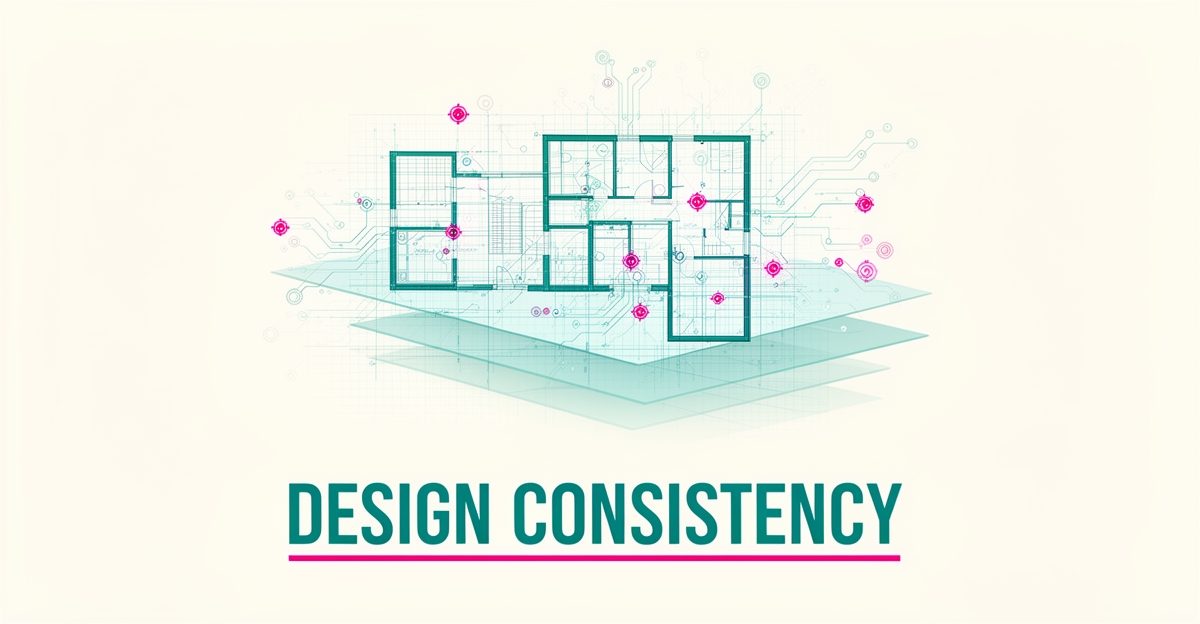
# AI-Powered Design Consistency: How Architects Can Standardize Schematics and Deliverables
**Quick Answer:** AI can learn your firm's drawing standards directly from historical projects and enforce them on new work — flagging deviations in real time, cutting rework, and keeping deliverables consistent across teams and offices.
## Key Facts
n
- Inconsistent deliverables are a leading driver of rework, slow onboarding, and eroded client trust in architecture practices
- AI systems can extract annotation, dimensioning, and detailing patterns from a firm's historical schematics and apply them automatically to new work
- Designers and developers widely expect AI to be essential to their future success, and adoption of generative AI across creative fields has grown steadily through 2026
- Design consistency becomes an operational asset when standards are enforced automatically rather than checked manually at the end of a process
## Table of Contents
- [The Hidden Cost of Inconsistent Design Workflows](#the-hidden-cost-of-inconsistent-design-workflows)
- [How AI Learns and Enforces Design Standards from Historical Projects](#how-ai-learns-and-enforces-design-standards-from-historical-projects)
- [Implementing AI for Design Consistency: From Pilot to Firm-Wide Adoption](#implementing-ai-for-design-consistency-from-pilot-to-firm-wide-adoption)
## The Hidden Cost of Inconsistent Design Workflows
Inconsistent design workflows silently erode firm profitability through avoidable errors and rework. When deliverables vary in style, detail, or format across projects, teams waste time reconciling discrepancies instead of advancing designs. This inconsistency directly impacts client trust, as stakeholders receive unpredictable outputs that undermine confidence in the firm's reliability. For architecture practices, these hidden costs compound with every new project, draining resources that could otherwise fuel innovation or growth.
Inconsistent processes also hinder team productivity and onboarding efficiency. Without consistent templates, naming conventions, or layer standards, new team members face steep learning curves, often requiring weeks to internalize firm-specific nuances that should be intuitive. This delay not only slows project starts but increases the likelihood of early-stage mistakes that propagate through design development.
The financial toll becomes evident when examining rework cycles triggered by inconsistent deliverables. Misaligned elevations, conflicting detail callouts, or varying material schedules force teams to backtrack, consuming billable hours that clients rightly question. When AI systems analyze historical projects to detect and enforce design patterns — such as line weights, annotation styles, or title block layouts — they eliminate variability at the source. This proactive standardization reduces errors before they reach review stages, cutting rework costs while preserving design intent.
Beyond immediate project impacts, inconsistent workflows impede knowledge transfer and scalability. Firms relying on tribal knowledge for deliverable standards struggle to onboard talent quickly or maintain quality across multiple simultaneous projects. AI-driven document processing addresses this by continuously learning from a firm's approved schematics, elevations, and details to enforce uniformity. By embedding these standards into automated checks, teams spend less time correcting preventable issues and more time refining design solutions. For architecture businesses seeking to scale without sacrificing quality, resolving these inconsistencies isn't just operational hygiene — it's a prerequisite for sustainable growth. AIQ Labs' workflow builds help firms turn these fragmented workflows into repeatable, reliable processes at a fixed price.
## How AI Learns and Enforces Design Standards from Historical Projec
AI Employees
Hire a team member that works 24/7 — for less than a part-time wage.
AI receptionists, SDRs, dispatchers and 99+ roles. Trained on your business, fully managed.
See If You’re a Fit — AI Employees from $700/mo
Not sure where to start? Ask our AI planner
ts
Architects are sitting on years of project files, and AI can finally turn that archive into a living standard. Instead of manually checking each new floor plan against past decisions, systems learn the patterns a firm already uses and apply them automatically to new deliverables.
AI learns by ingesting a firm's historical schematics, elevations, details and specifications. It maps recurring decisions around annotation style, line weights, room labeling, material callouts and grid conventions. From that corpus the model builds a firm-specific design language that reflects real practice, not generic templates.
Once the patterns are mapped, the system enforces consistency in active work. As designers draft new plans, the AI flags deviations from established standards and suggests corrections in real time. This reduces rework and protects brand identity across teams and offices.
The workflow impact is tangible: professionals across design and creative fields consistently report that AI tools speed up their work and improve output quality, and adoption of generative AI has become mainstream as of late 2026. That acceleration matters when deliverables must be uniform across large project sets.
In practice, AI learns and enforces standards through:
- Pattern extraction from historical projects to identify recurring annotation, dimensioning and detailing rules
- Style modeling that captures firm-specific linework, sheet layouts and naming conventions
- Auto-correction of new floor plans and elevations against the learned standard
- Continuous feedback loops that refine the model as approved projects are added to the portfolio
This approach also simplifies onboarding. New team members inherit a system that already knows how the firm draws, reducing tribal knowledge loss. AIQ Labs builds custom systems that learn from a firm's portfolio to ensure uniformity across projects and simplify onboarding for new team members.
The result is fewer errors, faster reviews and deliverables that feel authored by one consistent hand, even across distributed teams. **Design consistency becomes an operational asset**, not a manual check at the end of the process.
## Implementing AI for Design Consistency: From Pilot to Firm-Wide Adoption
Design consistency breaks down when knowledge lives in individual files and tribal memory. Architecture firms need a repeatable way to enforce style, notation, and documentation standards across teams and projects.
Start with a workflow assessment to map where inconsistency costs time. Identify the deliverables that repeat across projects — floor plans, elevations, sections, detail sheets — and audit current templates, naming conventions, and annotation rules. This baseline reveals the patterns an AI system can learn from.
Data preparation determines success. Consolidate past projects into a clean, structured archive with consistent metadata, layer naming, and file formats. The archive becomes the training corpus that teaches the model a firm's visual language and documentation standards.
Pilot testing keeps risk low and trust high. Run a limited pilot on one project type or one team. Use the pilot to validate pattern detection, style enforcement, and error reduction in real deliverables. Teams typically see the speed benefit of automation once repetitive checks are handled by the system rather than by hand.
- Assess current workflows and define consistency rules for schematics and deliverables
- Prepare a curated portfolio dataset with clean metadata and standardized file structures
- Pilot AI pattern detection on a single project type with human-in-the-loop review
- Train teams on the AI assistant and integrate it into existing project management tools
- Measure error reduction, review cycles, and onboarding speed, then scale firm-wide
Scaling requires training and governance. Document how the AI interprets standards and where human review is required. When new staff join, the system provides instant access to approved examples and automated checks, reducing onboarding friction. Contin
AI Development
Still paying for 10+ subscriptions that don’t talk to each other?
We build custom AI systems you own outright. No vendor lock-in. Full control.
See If You’re a Fit — AI Employees from $700/mo
Not sure where to start? Ask our AI planner
uous optimization follows usage data to refine style rules and catch edge cases.
Adoption accelerates when teams see measurable impact. Designers and developers broadly expect AI to be essential to their future success, and generative AI use across creative professions has become the norm rather than the exception as of 2026.
AIQ Labs builds custom systems that learn from a firm's portfolio to ensure uniformity across projects and simplify onboarding for new team members. Work is delivered in phases — you can start monthly, build in milestones, or own the system outright — so there's no vendor lock-in and the firm keeps what's built. For firms that want consistency baked into everything, an AI operating system connects these checks into one layer across the whole practice. The first step is a two-minute Fit Check, followed by a free 30-minute strategy call to map where inconsistency costs the most.
## Frequently Asked Questions
**How does inconsistent design work actually hurt an architecture firm?**
Inconsistent deliverables create rework, slow onboarding, and erode client trust. Teams waste billable hours reconciling mismatched elevations, details, and schedules instead of advancing designs.
**Can AI really learn our firm's specific drawing standards from old projects?**
Yes. AI ingests historical schematics, elevations and details to map recurring annotation styles, line weights, and sheet layouts, then builds a firm-specific design language for new work.
**Will AI enforcement slow my team down or create more edits?**
It speeds work up. By flagging deviations in real time before review, the system catches issues early — when corrections are cheapest — rather than at final QA.
**Is AI for design consistency just a trend or are firms actually adopting it?**
Adoption has moved from experimentation to standardization. Generative AI use across design and creative professions is now mainstream as of 2026, and firms are applying it to documentation standards, not just concept imagery.
**What's the first step to standardize schematics with AI without risking a whole project?**
Start with a workflow assessment and a limited pilot on one project type. Clean, curated historical projects become the training corpus, then validate pattern detection with human-in-the-loop review before scaling.
**How does design consistency help with hiring and remote teams?**
AI enforces standards automatically so new staff inherit a system that already knows how the firm draws. This reduces tribal knowledge loss and supports quality across distributed teams.
## Turning Design Consistency into Competitive Advantage
Architects who standardize their design workflows with AI don't just reduce errors — they build a scalable foundation for growth. By learning from historical projects, AI systems enforce firm-specific standards in real time, cutting rework, accelerating onboarding, and ensuring deliverables feel unified across teams and offices. This isn't about replacing creativity; it's about removing preventable friction so architects can focus on what matters most: design excellence. For firms ready to move beyond fragmented processes, the next step is assessing where inconsistency costs the most time and quality. Start with the two-minute Fit Check and a free 30-minute strategy call to map your biggest bottlenecks — and see how a custom AI system can turn your portfolio into a living standard, owned outright, integrated with your tools, and built for long-term impact.
AI Transformation Partner
Make AI your competitive advantage — not just another tool.
Strategy, implementation and ongoing optimization. One partner, end to end.
See If You’re a Fit — AI Employees from $700/mo
Not sure where to start? Ask our AI planner