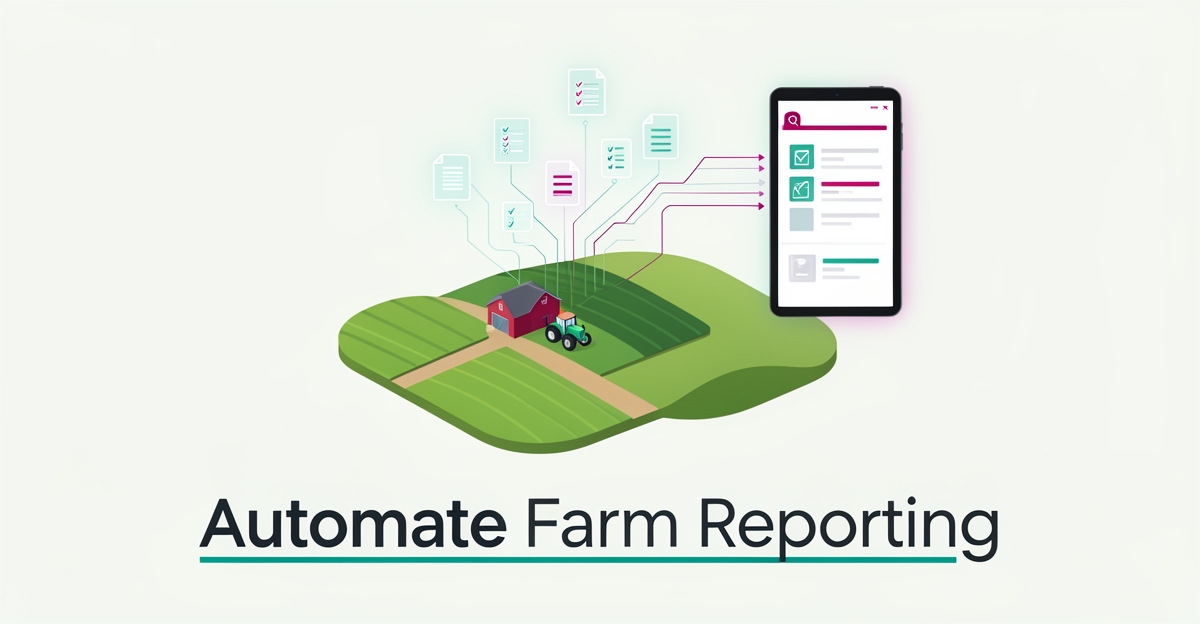
AI-Powered Farm Reporting: Automating Daily Logs and Compliance Documentation
Hire a team member that works 24/7 — for less than a part-time wage.
AI receptionists, SDRs, dispatchers and 99+ roles. Trained on your business, fully managed.
Not sure where to start? Ask our AI planner
Key Facts
- Farm managers commonly spend 15–20 hours every week manually compiling reports across disconnected platforms.
- Manual documentation is error-prone — industry comparisons suggest AI-driven reporting can reach roughly 95% accuracy versus 60–70% for manual processes.
- AI can cut manual effort in evidence collection and documentation by up to 90%, eliminating pre-audit scrambles.
- AI-powered compliance reporting processes data in minutes to hours, compared to days or weeks for manual methods.
- The Congressional Research Service tracks thousands of new final rules annually, making manual compliance tracking unsustainable.
The Hidden Cost of Manual Farm Documentation
Farm operators know the drill: Friday afternoon arrives, and the weekend gets swallowed by spreadsheets. The data lives everywhere — John Deere Operations Center, Climate FieldView, Granular — each speaking a different language. Stitching it together manually consumes 15–20 hours every week, pulling managers away from the fields where decisions actually move the needle.
Accuracy suffers when humans bridge disconnected systems. Manual processes typically achieve 60–70% accuracy, while AI-driven documentation can reach around 95%. That gap isn't academic — it shows up as missed pesticide windows, incomplete harvest records, and fertilizer logs that don't match what the spreader actually applied. When auditors arrive, the scramble begins: teams pull all-nighters compiling evidence that should have been organized months ago.
Regulatory complexity compounds the problem. The Congressional Research Service tracks thousands of new final rules every year, a volume no manual tracker can sustain. Each rule change ripples through daily logs, nutrient management plans, and worker safety records. Missing one update means non-compliance before the ink dries.
- Fragmented platforms create data silos that resist consolidation
- Manual entry errors cascade into flawed yield projections and input orders
- Audit preparation pulls key personnel from revenue-generating work
- Regulatory churn outpaces any spreadsheet-based tracking system
- Institutional knowledge walks out the door when experienced staff leave
AIQ Labs builds AI systems that ingest data from every platform, standardize it, and generate audit-ready reports automatically — turning a weekly fire drill into a background process that runs while you sleep. That's the idea behind our AI Workflow Builds: rebuild the one workflow that costs you the most, at a fixed price, in phases.
How AI Transforms Compliance Documentation
Compliance documentation has long been a reactive scramble, with teams pulling logs and evidence together only when an audit looms. AI shifts that pattern from crisis mode to continuous readiness.
AI-powered compliance reporting can process data in minutes to hours, compared to days or weeks for manual methods according to industry research. That speed gain comes from real-time monitoring and automated evidence trails that assemble themselves as operations run, not after the fact.
The manual effort reduction is substantial. AI can cut manual effort in evidence collection and documentation by up to 90% as reported in compliance comparisons. Farm operations managers who historically spend 15–20 hours weekly on manual report compilation see that burden drop sharply with automated syncs.
Continuous audit readiness replaces pre-audit scrambling. Automated compliance provides continuous audit readiness with automated evidence, where manual systems require a scramble before audit to compile evidence. Systems can monitor regulatory updates in real time, flag anomalies, and issue alerts before issues escalate.
Human oversight remains central. The optimal approach combines automation for repeatable processes with human oversight for strategic decisions and nuanced regulatory interpretation as highlighted in efficiency comparisons. Automation handles data discovery, documentation assembly, and monitoring while people focus on judgment calls.
Adoption reflects confidence in that balance. Over 80% of compliance professionals acknowledge the benefits of AI technologies in recent surveys of the field, and more than half now use AI tools regularly for data analysis, screening, and policy management.
For agriculture, the shift is practical. Daily logs, health records, and input use can be captured from disconnected platforms like John Deere Operations Center and Climate FieldView and mapped into standardized compliance records without manual transcription. AI systems can:
- Automate data syncs and standardization across farm platforms
- Generate automatic reports and compliance documentation assembly
- Detect anomalies in logs and trigger real-time alerts
- Maintain continuous, audit-ready evidence trails
This is the core of compliance documentation automation, where AI generates daily reports, health logs, and compliance records automatically. AIQ Labs builds systems that ensure accurate, audit-ready documentation without manual effort, supporting the move from reactive reporting to ongoing assurance.
The result is less rework, faster responses, and stronger governance. Teams spend less time compiling and more time interpreting, with automated evidence trails that stand up under scrutiny.
Real-World Impact: AI Documentation in Agriculture
Early agricultural adopters reveal a consistent pattern: farms that automate documentation and data correlation don't just save time — they unlock insights that change their economics. Published agricultural AI case studies and industry research point to gains in input efficiency, disease response, and forecasting accuracy, though specific figures vary by operation and should be validated against your own baseline.
Precision farming operations using AI-driven variable-rate application report meaningful reductions in fertilizer and pesticide spend, with every input decision documented automatically for regulatory compliance. The same systems typically improve sustainability metrics and yield consistency, showing that automated documentation supports both compliance and profitability.
Vineyards and specialty crop growers demonstrate how continuous monitoring transforms disease management. AI systems have reportedly detected disease outbreaks days to two weeks earlier than manual scouting by correlating weather patterns, humidity data, and historical disease models — generating targeted treatment protocols that reduce fungicide use while protecting crop quality.
Larger operations and cooperatives show AI's impact on forecasting. Automated reporting that correlates satellite imagery, equipment telemetry, and weather data can materially improve yield prediction accuracy, enabling tighter logistics planning and better-timed harvests across member farms.
These results align with broader agricultural trends. Research indicates that AI agriculture implementations can achieve yield increases and reductions in pesticide use through similar automated monitoring approaches. The technology also addresses the 15–20 hours weekly that farm managers typically spend compiling reports manually, according to agricultural operations research.
Key operational capabilities demonstrated include:
- Real-time correlation of crop health, weather patterns, and equipment performance data
- Automated generation of audit-ready compliance documentation without manual data entry
- Predictive analytics that flag disease and pest risks before visible symptoms appear
- Variable-rate input optimization that reduces chemical usage while maintaining yield targets
AIQ Labs implements these architectures through custom AI systems that integrate directly with existing farm management platforms. Rather than forcing operations to abandon familiar tools, these systems automatically sync data from platforms like John Deere Operations Center and Climate FieldView, creating unified audit trails while maintaining the detailed records required for USDA, EPA, and state-level compliance. With 200+ multi-agent systems deployed, the pattern is proven: documentation that satisfies regulators while providing the operational intelligence needed to compete in modern agriculture.
Implementing Automated Farm Reporting: A Practical Roadmap
Manual farm reporting bleeds time and creates compliance risk every season. Operations managers are still spending 15–20 hours weekly on manual report compilation across disconnected platforms like John Deere Operations Center, Climate FieldView, and Granular, according to agriculture automation research.
The shift starts with mapping high-burden workflows. Daily logs, health logs, input applications, and regulatory records are ideal first targets because they are repetitive, data-heavy, and audit-sensitive. Identifying where data lives and who touches it reveals the manual handoffs that drive errors and delays.
A practical roadmap balances automation with oversight. Automate repetitive collection and assembly, keep humans for interpretation and sign-off. Modern automated compliance platforms can be deployed in days to weeks with guided setup workflows, while full implementation typically requires weeks to months depending on complexity, notes compliance automation analysis.
The hybrid approach works because AI handles scale and speed while people handle nuance. The optimal strategy combines automation for repeatable processes like data discovery, compliance monitoring, and report generation with human oversight for strategic decisions and nuanced regulatory interpretation, as described in manual vs automated compliance research.
Implementation follows a clear sequence:
- Audit current logs and compliance records to map data sources, formats, and regulatory requirements.
- Standardize data ingestion from equipment telemetry, sensors, and farm management tools with automated syncs.
- Build automated report generation and anomaly detection for daily logs and compliance documentation.
- Establish human-in-the-loop review for exceptions, approvals, and audit-ready finalization.
Speed and accuracy gains are immediate. AI-powered compliance reporting can process data in minutes to hours compared to days or weeks for manual methods, and AI can achieve up to 95% accuracy compared to 60–70% for manual processes, per AI vs manual compliance reporting research. AI can cut manual effort in evidence collection and documentation by up to 90%.
Farm-specific automation delivers similar impact. Automating reports and analytics can reduce manual effort by 70–85% while delivering real-time insights, according to farm reporting automation analysis. This frees teams from spreadsheet assembly to focus on interpreting data and making strategic decisions that impact yield and profitability.
Integration is critical for adoption. AIQ Labs designs custom AI systems that integrate with existing farm management tools to deliver audit-ready documentation without manual data entry. Whether you start with an AI Employee handling routine reporting, a single Workflow Build for your highest-cost reporting process, or a full AI Operating System connecting your whole operation, the systems maintain continuous audit readiness with automated evidence rather than scrambling before an audit.
The result is a documentation system that is consistent, traceable, and owned outright. Staff move from repetitive data entry to strategic decisions and regulatory planning, while the farm retains full control of its data and workflows.
Frequently Asked Questions
How much time do farm managers actually spend on manual reporting each week?
Is AI documentation really more accurate than manual logs?
Can AI pull data from the farm platforms we already use?
How fast can AI produce compliance reports compared to manual methods?
Will automating reports replace my farm staff?
What kinds of savings have farms seen with AI-powered reporting?
From Friday Fire Drills to Continuous Readiness
Manual farm reporting is costing operations 15–20 hours every week and leaving compliance gaps that auditors expose under pressure. AI shifts documentation from a reactive scramble to continuous readiness by syncing data from John Deere Operations Center, Climate FieldView and other platforms, standardizing logs, and generating audit-ready reports automatically. The result is higher accuracy, real-time anomaly alerts, and evidence trails that are built as you work, not compiled the night before an audit. Farms that automate this workflow free managers to interpret data and make decisions that move yield and profitability instead of chasing spreadsheets. Start with a focused mapping of daily logs, input applications and health records, then automate collection and assembly while keeping human review for exceptions and sign-off. AIQ Labs builds AI systems that integrate with the tools you already use to deliver owned, audit-ready documentation without manual transcription. Take the two-minute Fit Check at aiqlabs.ai/apply, then book a free 30-minute strategy call at aiqlabs.ai/book to map your highest-ROI automation opportunity. Prefer email? Reach the team at [email protected].
Make AI your competitive advantage — not just another tool.
Strategy, implementation and ongoing optimization. One partner, end to end.
Not sure where to start? Ask our AI planner