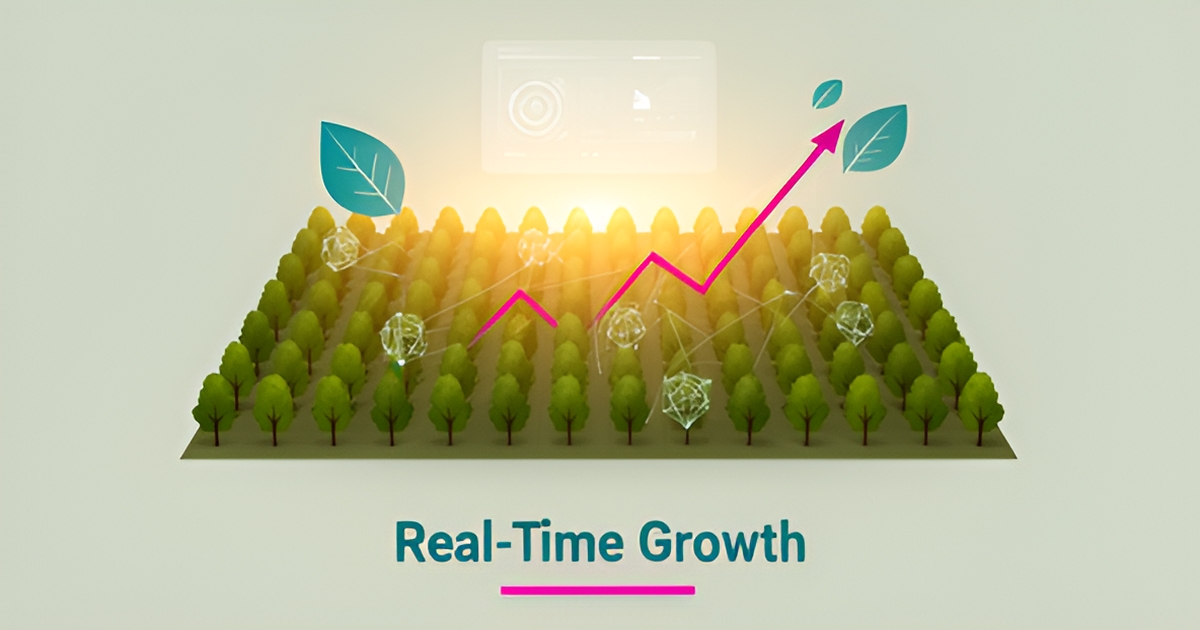
AI-Powered Growth Tracking: How Tree Farms Can Monitor Plant Development in Real Time
Key Facts
- AI-powered growing systems can process thousands of data points per plant daily, making decisions on intervals as short as 15 minutes, according to industry guides on AI-driven growing.
- Growers using AI monitoring typically report meaningful yield improvements alongside significant water savings, though exact figures vary by crop, climate and baseline practices.
- Automated monitoring can reduce manual data-collection labor substantially — often by as much as 80% — freeing workers for grafting and quality control.
- Industry guides suggest AI growing systems can reach ROI in roughly 6-18 months through water savings, yield gains, and labor reduction, though timelines depend on farm size and existing infrastructure.
- The smart agriculture market has been growing steadily through the mid-2020s, with projections showing continued expansion through 2030 as of late 2026.
- AI monitoring can track 20+ environmental parameters simultaneously, including soil moisture, pH levels, and light intensity.
- A large majority of global organizations have adopted AI for at least one business function, per widely cited McKinsey survey data.
Hire a team member that works 24/7 — for less than a part-time wage.
AI receptionists, SDRs, dispatchers and 99+ roles. Trained on your business, fully managed.
Not sure where to start? Ask our AI planner
Why Manual Growth Tracking Fails Modern Tree Farms
Every week, crews walk rows of saplings with clipboards and measuring tapes, recording heights that may already be outdated by the time the data reaches a spreadsheet. This manual approach to growth tracking is quietly costing tree farms far more than they realize.
The core problem is inconsistency. Human measurements vary by observer, weather conditions, and time of day, creating data that is difficult to compare across seasons or even across a single growing cycle. When decisions about irrigation, fertilization, and harvest timing depend on these unreliable numbers, farms end up reacting to problems after they appear rather than preventing them.
The labor burden compounds the issue. Manual tracking demands significant person-hours that scale directly with acreage, and the work itself is repetitive and error-prone. Industry guides on AI-driven growing suggest automated monitoring can reduce labor time by as much as 80%, freeing skilled workers for higher-value tasks like grafting, pest management, and quality control.
Beyond labor costs, manual methods limit how much a farm can actually know. A worker with a tape measure captures one data point per plant per visit. AI-powered systems, by contrast, can process thousands of data points per plant each day, adjusting decisions every 15 minutes based on real-time environmental changes and growth patterns.
This gap between what manual tracking captures and what modern operations need shows up in several ways:
- Inconsistent measurements that undermine trend analysis
- Delayed detection of stress, disease, or nutrient deficiency
- Reactive irrigation and fertilization schedules based on guesswork
- Labor hours consumed by data collection instead of crop improvement
The financial impact is measurable. Growers adopting AI-driven monitoring typically report yield improvements in the range of 30-50% alongside water savings — sometimes as high as 90% — though exact results depend on crop, climate, and how manual the baseline was. These are not marginal gains; they represent the difference between a farm that survives market fluctuations and one that thrives through them.
The broader industry context reinforces this shift. Global AI spending has climbed sharply through the mid-2020s, with agriculture and forestry among the sectors accelerating adoption. A large majority of organizations worldwide have already integrated AI into at least one business function, signaling that real-time monitoring is becoming standard practice rather than experimental technology.
For tree farms still relying on clipboards and intuition, the question is no longer whether to modernize but how quickly they can close the gap. AIQ Labs builds custom monitoring systems — through AI Workflow Builds — that track plant height, leaf count, and health trends continuously, replacing reactive guesswork with proactive, data-driven decisions. The farms that move first will set the yield benchmarks everyone else chases.
How Real-Time AI Monitoring Transforms Plant Development Tracking
Manual growth tracking is time-consuming and inconsistent, often leading to delayed interventions and missed optimization opportunities in tree farm operations. Real-time AI monitoring transforms this process by continuously capturing and analyzing plant development metrics with precision that surpasses manual methods. AIQ Labs deploys custom AI systems that integrate multi-sensor data to track height, leaf count, and health indicators, enabling proactive adjustments to planting and harvesting cycles based on live growth trends.
These systems can process thousands of data points per plant daily, drawing from continuous streams of visual, spectral, and environmental inputs to build dynamic growth models that update predictions in real time. By fusing data from LiDAR scanners, RGB cameras, and multispectral sensors, the AI detects subtle changes in canopy structure and pigmentation that indicate stress or accelerated growth long before they become visible to the human eye. This level of detail allows farms to shift from reactive to preventive care, reducing losses and improving resource allocation.
Environmental context is critical to accurate growth interpretation, which is why the system monitors 20+ parameters simultaneously — including soil moisture, temperature, humidity, light intensity, and nutrient levels — to correlate plant responses with external conditions. Industry research on AI-driven growing suggests this multi-variable analysis can deliver substantial yield gains while cutting water use and labor time significantly. The continuous learning capability ensures models refine themselves daily, adapting to seasonal shifts, species-specific patterns, and microclimate variations across the farm.
- Height tracking via LiDAR and stereoscopic imaging with sub-centimeter precision
- Leaf count and canopy density analysis using computer vision models
- Health indices derived from NDVI, PRI, and chlorophyll fluorescence sensors
- Daily model retraining using incoming sensor and image data
- Environmental correlation engines linking growth to 20+ external variables
By anchoring growth predictions in both biological and environmental data streams, AI monitoring delivers actionable insights that optimize irrigation, fertilization, and canopy management. This approach not only enhances uniformity and quality across tree lots but also supports sustainable practices by minimizing over-application of inputs. The result is a scalable, self-improving system that turns raw sensor data into strategic foresight — giving tree farms the intelligence to grow smarter, not harder.
From Data to Decisions: Proactive Planting and Harvesting Cycles
Real-time plant data stops being interesting when it stays on a dashboard. For tree farms, the value shows up when height, leaf count and health trends trigger irrigation, nutrition and harvest decisions before stress becomes visible.
AI-driven growing systems can process thousands of data points per day per plant, making decisions every 15 minutes based on environmental changes and growth patterns. That frequency turns manual spot checks into continuous monitoring, and continuous monitoring into proactive operations.
Water use is the first business outcome to move. AI growing systems can reduce water consumption substantially — some operations report savings up to 90% — by matching irrigation to actual soil moisture, evapotranspiration and growth stage rather than fixed schedules. Less water waste means lower pumping costs and protected yields during drought windows.
Nutrient timing tightens around real development, not the calendar. With sensors tracking soil pH, moisture and light intensity alongside image-based growth metrics, systems adjust feeding as trees enter rapid growth phases. The result is higher resource efficiency and fewer corrective applications.
Harvest scheduling gains predictability when growth models learn from the farm itself. AIQ Labs deploys custom AI systems that continuously learn and update growth models, enabling proactive decision-making in planting and harvesting cycles. That learning loop supports proactive planting and harvesting cycles aligned to market windows and labor availability.
The financial case is strengthening as the market scales. The smart agriculture market has grown steadily through the mid-2020s, with projections showing continued expansion through 2030. Adoption is also accelerating at the farm level, with AI growing systems typically delivering meaningful yield gains and large reductions in manual labor time.
ROI follows quickly for operations that move from reactive to real-time. Industry guides on AI-driven growing note these systems can achieve a return on investment in roughly 6-18 months, driven by water savings, yield gains and labor reduction — though the exact timeline depends on your starting point.
Proactive decisions that real-time tracking enables include:
- Irrigation triggered by soil moisture and growth rate, cutting water waste
- Nutrient applications timed to leaf count and height velocity, improving uptake efficiency
- Harvest windows forecasted from health trends, reducing spoilage and labor spikes
- Replanting plans adjusted by zone performance, balancing risk and cash flow
When insights flow from sensors and image data into daily operations, tree farms shift from monitoring plants to managing outcomes. Real-time business monitoring in agriculture means decisions are data-led, timely, and tied directly to cost and revenue.
Deploying Custom AI Systems That Learn Your Farm's Unique Patterns
Deploying a custom AI system begins with understanding that every tree farm operates on its own rhythm — soil composition, microclimate, species mix, and harvest cycles create patterns no off-the-shelf tool can capture. The implementation path moves from sensor deployment through model training on historical farm data, then integrates directly with existing ERP, inventory, and labor planning workflows so insights drive action without new manual steps. AI-driven growing systems can process thousands of data points per day per plant, making decisions every 15 minutes based on environmental changes and growth patterns.
The first phase installs ruggedized sensors across representative blocks — measuring height via LiDAR, leaf count through computer vision, and health indicators via multispectral imaging. These feed a training pipeline built on your farm's historical records: past yield maps, weather logs, irrigation schedules, and pest pressure notes. Unlike SaaS platforms that lock you into generic models, this approach produces a production-grade system you own outright, with full control over customization and future development. The smart agriculture market's steady growth through the mid-2020s reflects exactly this demand for owned, adaptable intelligence.
Integration happens through deep two-way API connections — not fragile webhooks — so growth forecasts automatically adjust planting schedules, trigger inventory reorders, and optimize crew dispatch. AIQ Labs architects these systems using enterprise-grade multi-agent frameworks where specialized agents handle sensor fusion, anomaly detection, and predictive modeling in concert. Each growing season refines the model further: new data retrains the system, edge cases expand its decision boundaries, and performance metrics feed continuous improvement loops. This is the AI Operating Systems approach — one connected layer, built in phases, owned outright.
- Sensor networks calibrated to your species and terrain
- Models trained exclusively on your historical farm data
- Native ERP and labor system integration
- Season-over-season model refinement with full code ownership
The result is a living growth intelligence that evolves with your operation — not a static dashboard, but a system that learns when to thin, when to fertilize, and when to harvest based on patterns only your land produces.
Still paying for 10+ subscriptions that don’t talk to each other?
We build custom AI systems you own outright. No vendor lock-in. Full control.
Not sure where to start? Ask our AI planner
Frequently Asked Questions
How much water and labor can AI monitoring actually save on a tree farm?
What kind of ROI can we expect and how quickly does the system pay for itself?
Will this replace our existing crew or require hiring data scientists to run it?
How is this different from off-the-shelf sensors or SaaS platforms we've seen?
Is AI adoption in agriculture actually proven, or is this still experimental?
What does deployment actually look like — how long until we see usable insights?
From Guesswork to Growth: The Future of Tree Farming Is Already Here
Manual growth tracking with clipboards and tape measures has long been the norm for tree farms, but it's a method built on inconsistency, delayed insights, and avoidable labor costs. As this article explored, AI-powered monitoring transforms that reality by continuously capturing thousands of data points per plant daily — tracking height, leaf count, and health trends with precision that enables proactive irrigation, fertilization, and harvesting decisions. Farms adopting these systems aren't just saving time; they're building models that learn and improve with each growing season, cutting water waste and freeing skilled workers for the work that actually adds value. For tree farms ready to move beyond reactive practices and into data-driven operations, the path forward starts with understanding where AI can deliver the highest impact. Take the first step with a free, no-obligation strategy session to explore how custom AI systems can be built around your farm's unique rhythms — soil, species, and cycles included. Start the 2-minute Fit Check to see where intelligent automation can begin driving real, measurable outcomes for your operation.
Make AI your competitive advantage — not just another tool.
Strategy, implementation and ongoing optimization. One partner, end to end.
Not sure where to start? Ask our AI planner