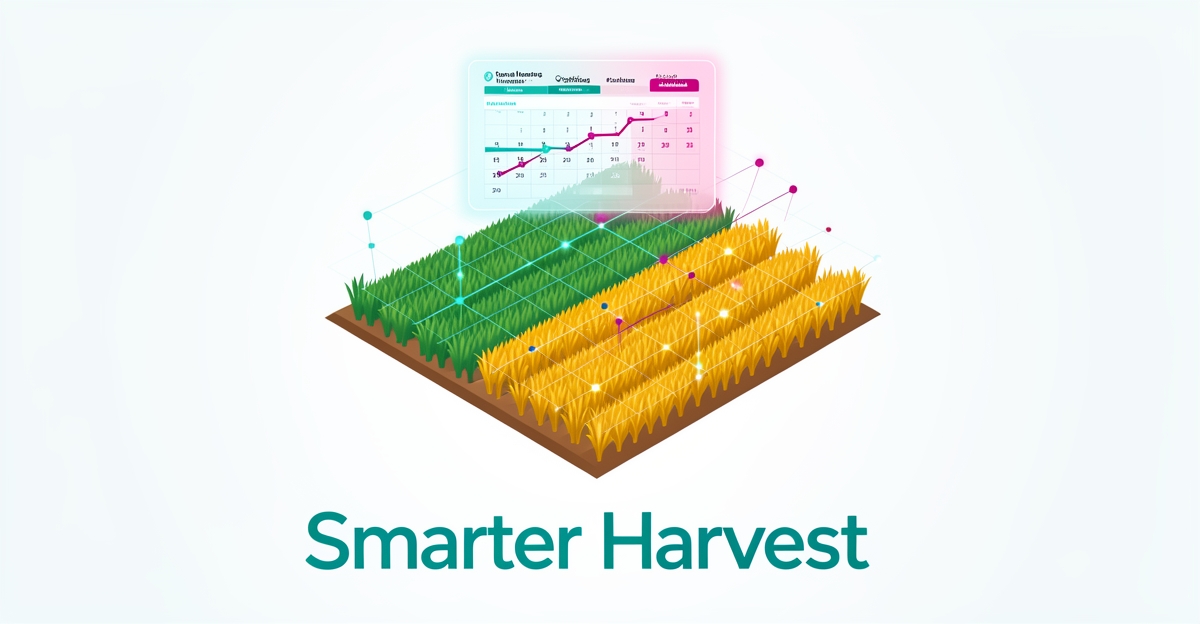
AI-Powered Harvest Scheduling: Reducing Waste and Maximizing Organic Yield
Key Facts
- Digital twin approaches to harvest planning are reported to improve yields by 15–25% through data-driven, real-time planning according to Anvil Labs
- Predictive harvest platforms analyze 40+ environmental signals to forecast optimal harvest windows up to two weeks ahead as demonstrated by AIfarmharvest
- A Brazilian soybean operation reported a 25% productivity increase and 15% cost reduction across 10,000+ hectares with AI harvest planning per the Mato Grosso case study
- AI-powered harvest planning helped a fruit cooperative contact buyers 4–5 days in advance with realistic quantity estimates, reducing post-harvest losses per eastern European fruit cooperative results
- FAO estimates roughly 13% of global food production is lost after harvest during transport, storage, and processing due in part to planning failures per Food and Agriculture Organization data
- AI-powered harvesting equipment can increase crop yield by up to 20% compared to traditional methods while minimizing waste per Farmonaut precision farming research
Hire a team member that works 24/7 — for less than a part-time wage.
AI receptionists, SDRs, dispatchers and 99+ roles. Trained on your business, fully managed.
Not sure where to start? Ask our AI planner
The Hidden Cost of Guesswork in Harvest Timing
Harvest timing still lives on intuition for too many farms, and the price is paid in spoiled bins, missed contracts, and eroded margins. When decisions rely on habit and last season's memory, crops sit too long or leave too early.
The Food and Agriculture Organization estimates that roughly 13% of global food production is lost after harvest during transport, storage, and processing. That loss is not a weather event; it is a planning failure amplified by manual observation and fixed schedules. Traditional harvest planning relies on manual observations, historical data, and intuition, which are less precise and slower to adjust to unforeseen challenges.
Small operations feel the pain first. A regional fruit cooperative of 12 family-owned farms in eastern Europe used a lightweight AI and data analytics platform to forecast demand and anticipate peak harvest windows. The solution improved alignment with buyer orders, reduced spoilage, and enhanced pricing and logistics coordination among farms. As one farmer put it, "We used to guess. Now we know when and how much to pick."
Guesswork creates compounding leakage across the season:
- Picking too late exposes crops to heatwaves, fungal pressure, and pest outbreaks that degrade quality and market price.
- Picking too early sacrifices sugar content, size, and shelf life, forcing discounts or rejection at the gate.
- Labor and machinery sit idle or rush in waves, inflating costs while harvest windows close.
Digital twin analysis shows the upside of moving away from static plans. Digital twins can improve harvest planning by offering data-driven insights, real-time updates, and predictive capabilities, with reported yield gains of 15–25% and reduced resource use. The contrast is stark: traditional methods depend on fixed schedules, manual labor, and subjective judgment, while data-driven systems simulate scenarios and adjust in real time.
The cost is also reputational. Farmers who cannot give buyers realistic quantity estimates 4–5 days in advance lose pricing power and trust. In the Brazilian soybean case, AI-driven harvest scheduling improved efficiency and reduced post-harvest loss in the Mato Grosso region by integrating satellite and drone imaging into AI dashboards for decision-making.
This is where custom AI workflow automation changes the equation. AIQ Labs designs AI workflow automation that predicts optimal harvest times using real-time data on weather, soil moisture, and plant maturity, reducing spoilage and protecting revenue. The shift replaces reactive guesswork with continuous, field-level intelligence that protects yield and cash flow.
How AI Predicts the Perfect Harvest Window
Harvest timing has long been one of agriculture's most critical yet unpredictable decisions, where picking too early or too late can mean the difference between profit and loss. AI-powered harvest scheduling transforms this guesswork into a data-driven process by analyzing real-time weather patterns, soil moisture levels, and plant maturity indicators. This approach helps farmers identify the moment when crops approach peak nutritional value and market readiness, eliminating the costly inefficiencies of traditional scheduling.
Predictive harvest platforms demonstrate this capability by using machine learning to analyze 40+ environmental variables and forecast the optimal harvest window for every crop zone up to 14 days in advance. These systems process satellite imagery, drone surveys, and ground sensor data to build a comprehensive view of field conditions that far exceeds what manual observation can achieve. This level of precision directly addresses the core challenge of harvest timing variability that has plagued farming for generations.
The impact of this precision extends beyond scheduling convenience, delivering measurable improvements across operational metrics. Platforms in this space report meaningful yield increases alongside water savings through smart irrigation that adjusts watering schedules based on real-time soil moisture data. These gains come not from working harder, but from working smarter—ensuring every drop of water and hour of labor contributes maximally to crop quality and quantity. The Brazilian soybean case study further validates these results, showing how AI-driven harvest planning increased productivity by 25% in the Mato Grosso region while reducing post-harvest losses through better timing before heatwaves and pest outbreaks.
- Forecasts optimal harvest windows up to 14 days in advance
- Analyzes 40+ environmental signals including weather, soil moisture, and plant maturity
- Integrates satellite, drone, and IoT data for real-time field intelligence
- Supports a wide range of crop types across large monitored acreage
- Connects predictions directly to labor, equipment, and logistics planning
For agricultural businesses seeking to implement these capabilities, AIQ Labs builds custom AI Workflow Builds that integrate real-time environmental data with harvest scheduling logic—creating owned solutions that deliver the same class of precision agriculture advantages as commercial platforms, without ongoing subscription dependencies. This approach transforms harvest planning from a reactive process into a proactive, data-driven operation that consistently captures more yield potential while minimizing resource waste.
From Data to Action: Implementing AI Harvest Workflows on Your Farm
The gap between knowing when to harvest and actually executing that perfect timing has always been where profits evaporate—until AI workflow automation closes it. A regional fruit cooperative of 12 family farms proved this by implementing lightweight AI planning that required no new sensors, drones, or infrastructure, yet enabled them to contact buyers 4–5 days in advance with realistic quantity estimates. The result was tighter alignment with orders, less spoilage, and stronger pricing power across the board.
- Integration with existing CRM, ERP, and scheduling tools—no rip-and-replace required
- AI employees that monitor weather, soil moisture, and maturity data around the clock
- Automated task dispatch for picking crews, equipment, and logistics coordination
- End-to-end workflow ownership so the farm controls the system, not a vendor
Predictive platforms ingest 40+ environmental signals to forecast harvest windows up to two weeks out, while Brazilian soybean operations reported a 25% productivity increase and 15% cost reduction across 10,000+ hectares using similar intelligence. AIQ Labs brings that same class of custom automation to your operation—starting with the one workflow that costs you the most, rebuilt at a fixed price and in phases, with managed AI employees for continuous monitoring and no demand for new hardware. The cooperative's farmer put it simply: "We used to guess. Now we know when and how much to pick."
Still paying for 10+ subscriptions that don’t talk to each other?
We build custom AI systems you own outright. No vendor lock-in. Full control.
Not sure where to start? Ask our AI planner
Frequently Asked Questions
How accurate is AI at predicting the best time to harvest my crops?
Do I need to buy new sensors, drones, or hardware to start using AI harvest scheduling?
What kind of yield improvement can I realistically expect from AI-driven harvest timing?
Will AI harvest scheduling work for my specific crops and farm size?
How does AI harvest scheduling actually reduce waste and save money beyond just picking at the right time?
Is this just another subscription software I'll be locked into, or do I own the system?
From Guesswork to Growth: Harvesting the Future of Farming
The pattern is clear: when harvest timing shifts from intuition to intelligence, farms stop losing yield to spoilage and start capturing real value. From predictive platforms forecasting windows two weeks ahead, to the 25% productivity gains reported in Brazilian soybean operations and the eastern European fruit group's ability to confidently forecast quantities 4–5 days ahead, the evidence shows that precision scheduling is a practical upgrade available today—not a distant promise. For farms ready to replace guesswork with field-level intelligence, the path forward is straightforward: start with a free 30-minute strategy call to map your biggest bottleneck and see where an AI workflow build can deliver immediate results—no new hardware, no vendor lock-in, just better timing, less waste, and stronger margins. Take the first step toward harvesting with confidence: book your free strategy call or apply in two minutes and discover how custom AI can turn your harvest data into your most reliable asset.
Make AI your competitive advantage — not just another tool.
Strategy, implementation and ongoing optimization. One partner, end to end.
Not sure where to start? Ask our AI planner