Back to Blog

AI-Powered Job Estimation: How Scaffolding Rentals Can Offer Faster, More Accurate Quotes

AI Business Process Automation > AI Workflow & Task Automation18 min read

AI-Powered Job Estimation: How Scaffolding Rentals Can Offer Faster, More Accurate Quotes

Key Facts

  • Firms using AI-driven leads see a 310% higher bid win rate.
  • AI adoption is linked to 20% higher overall profitability.
  • Automation can raise estimate accuracy by 25%.
  • AI reduces estimation errors by up to 50%.
  • Contractors see a 15% reduction in project cost deviations.
  • AI cuts quantity takeoff labor by nearly 30%.
  • 45% of firms have no AI deployment, leaving 1% fully scaled.
AI Employees

What if you could hire a team member that works 24/7 for $599/month?

AI Receptionists, SDRs, Dispatchers, and 99+ roles. Fully trained. Fully managed. Zero sick days.

The Estimating Bottleneck: Why Manual Takeoffs Are Costing You Bids

In the scaffolding rental industry, speed and precision are the primary drivers of profitability. Yet, many providers remain trapped in a cycle of manual takeoffs that drain resources and delay critical revenue. When estimators spend days measuring square footage from blueprints, they aren’t just losing time—they are losing bids to competitors who respond faster.

This inefficiency creates a significant competitive disadvantage in a fast-moving market. Clients expect instant quotes that account for complex site variables, material specifications, and current pricing. Traditional methods simply cannot keep pace with these demands, leading to missed opportunities and eroded margins.

According to Infrrd’s industry research, firms using AI-driven project leads experience a 310% higher bid win rate. This statistic highlights a stark reality: the market is shifting toward those who can deliver accuracy instantly. Manual processes, by contrast, are becoming a liability rather than a standard operating procedure.

Consider a mid-sized contractor in Texas who previously required two estimators three days to analyze 2D drawings. By implementing AI to automate the takeoff process, they reduced that workload to under two hours. This dramatic reduction in labor allows teams to focus on high-value activities like client relationship management and complex risk assessment, rather than tedious measurement.

The core issue lies in the nature of manual estimation itself. It is prone to human error, inconsistent interpretation of drawings, and an inability to quickly adapt to design changes. When a client modifies a project scope, a manual estimator must restart the calculation process from scratch. This rigidity slows down the entire sales cycle and frustrates customers who expect real-time updates.

Key inefficiencies in manual estimating include:

  • Time-Intensive Calculations: Tasks that once took days now appear instant with AI.
  • High Error Rates: Manual measurements often lead to costly material discrepancies.
  • Delayed Response Times: Slow quotes cause potential clients to choose faster competitors.
  • Inconsistent Pricing: Difficulty in integrating real-time material cost fluctuations.

Research from A3Logics indicates that AI-powered tools can cut labor in takeoff processes by nearly 30%. Furthermore, systems like Buildxact have been shown to raise estimate accuracy by 25%. These improvements are not just incremental; they fundamentally change the economics of how scaffolding rentals are priced and sold.

When estimates are inaccurate, the financial impact is severe. BLDOn’s analysis, citing McKinsey & Company, found that AI-driven cost estimating can reduce estimation errors by up to 50%. For scaffolding rentals, where material waste and rental duration directly affect profit, this level of precision is invaluable. It prevents the "leakage" that occurs when underbidding fails to cover actual material and logistics costs.

Beyond speed, AI offers the ability to learn from historical data. Unlike a human estimator who might forget the specific conditions of a project from three years ago, an AI system remembers every past job, material price shift, and vendor delay. It acts as a supercharged assistant that uses this collective memory to guide new estimates, ensuring consistency and competitive pricing every time.

Despite these clear benefits, adoption remains surprisingly low. A 2025 RICS/ProjectFlux survey noted that 45% of firms have no AI deployment, and only 1% have scaled it across projects. This gap represents a massive opportunity for forward-thinking scaffolding providers who are ready to modernize their operations.

By overcoming the bottleneck of manual estimation, businesses can unlock significant value. The transition from intuition-based guesswork to data-driven prediction is no longer optional; it is essential for survival. As we move into the next section, we will explore exactly how AI analyzes site details to generate these instant, accurate quotes.

The AI Advantage: Speed, Accuracy, and Profitability

For scaffolding rental businesses, the margin between profit and loss often hinges on the precision of the initial quote. Traditional estimation relies on manual takeoffs that are slow, prone to human error, and unable to adapt to real-time material fluctuations. AI transforms this critical "pressure point" into a competitive advantage by shifting from intuition-based guesswork to data-driven predictive modeling.

By leveraging computer vision to analyze site blueprints and machine learning to forecast costs, companies can generate instant, accurate quotes. This technological shift not only accelerates workflow but fundamentally changes how scaffolding providers win bids and manage project profitability.

Key benefits include: * Drastic reduction in estimation time from days to hours * Significant improvement in bid accuracy and win rates * Real-time adaptation to material cost changes

The quantitative impact of AI on bidding outcomes is transformative, particularly for scaffolding firms competing in tight markets. Manual estimating is often a bottleneck that delays responses and introduces calculation errors. AI-powered systems eliminate these delays by processing complex site details instantly.

According to industry analysis, firms using AI-driven project leads have seen a 310% higher bid win rate according to Infrrd. This dramatic increase stems from the ability to quote faster and more accurately than competitors relying on manual methods. When a scaffolding company can provide a precise quote within hours rather than days, they capture opportunities that might otherwise be lost to slower rivals.

Furthermore, the financial reliability of these quotes improves significantly. A 2023 study by McKinsey & Company found that AI-driven cost estimating can reduce estimation errors by up to 50% as reported by BLDOn. For scaffolding rentals, where material quantities and rental durations are critical, reducing error is directly linked to protecting profit margins.

Specific performance metrics include: * 310% increase in bid win rates with AI leads * 50% reduction in estimation errors through automation * 20% higher overall profitability associated with AI adoption

Beyond winning bids, AI optimizes the internal efficiency of the estimation workflow. Tasks that previously consumed days of manual labor can now be completed in a fraction of the time. This speed allows estimators to focus on high-value activities like client relationship management and risk assessment rather than tedious quantity takeoffs.

AI automated quantity takeoff devices can cut labor in takeoff processes by nearly 30% according to A3Logics. For example, a mid-sized contractor in Texas reduced a task that took two estimators three days to under two hours using AI to analyze 2D drawings according to Infrrd. This efficiency gain is particularly valuable for scaffolding firms handling multiple concurrent site evaluations.

Additionally, AI systems provide real-time adaptability. If a site design changes or material costs fluctuate, the AI can immediately recalculate costs. Contractors using AI-powered estimating tools experienced a 15% reduction in project cost deviations compared to those using traditional methods as reported by BLDOn. This precision ensures that quotes remain profitable even when project scopes evolve.

Efficiency improvements include: * 30% reduction in labor hours for quantity takeoffs * 15% reduction in project cost deviations * Ability to recalculate costs instantly upon design changes

While AI drives speed and accuracy, it does not replace the seasoned judgment of human estimators. The most successful scaffolding companies adopt a hybrid model where AI handles data processing while human experts manage risk and client trust. AI acts as an "apprentice" that remembers every past project and material price shift to guide new estimates according to Infrrd.

This collaboration ensures that while AI provides the data-driven baseline, human estimators can apply nuanced insights regarding supplier reliability or site-specific complexities. By integrating AI with existing BIM and ERP systems, scaffolding firms create a single source of truth that enhances decision-making. This strategic balance allows businesses to scale operations without proportionally increasing headcount, securing a sustainable competitive advantage.

Embracing this AI-driven workflow positions scaffolding rental businesses to deliver faster, more reliable quotes that win more business.

How It Works: Computer Vision and Predictive Modeling for Scaffolding

Transforming scaffolding rentals from manual guesswork into data-driven, predictive modeling requires a sophisticated blend of computer vision and machine learning. This technology shift allows companies to move beyond intuition-based estimates, enabling instant, accurate quotes that drive profitability.

By leveraging AI to analyze site details, material types, and job complexity, businesses can generate precise calculations in minutes rather than days. This automation reduces human error significantly while increasing customer trust through transparency and speed.

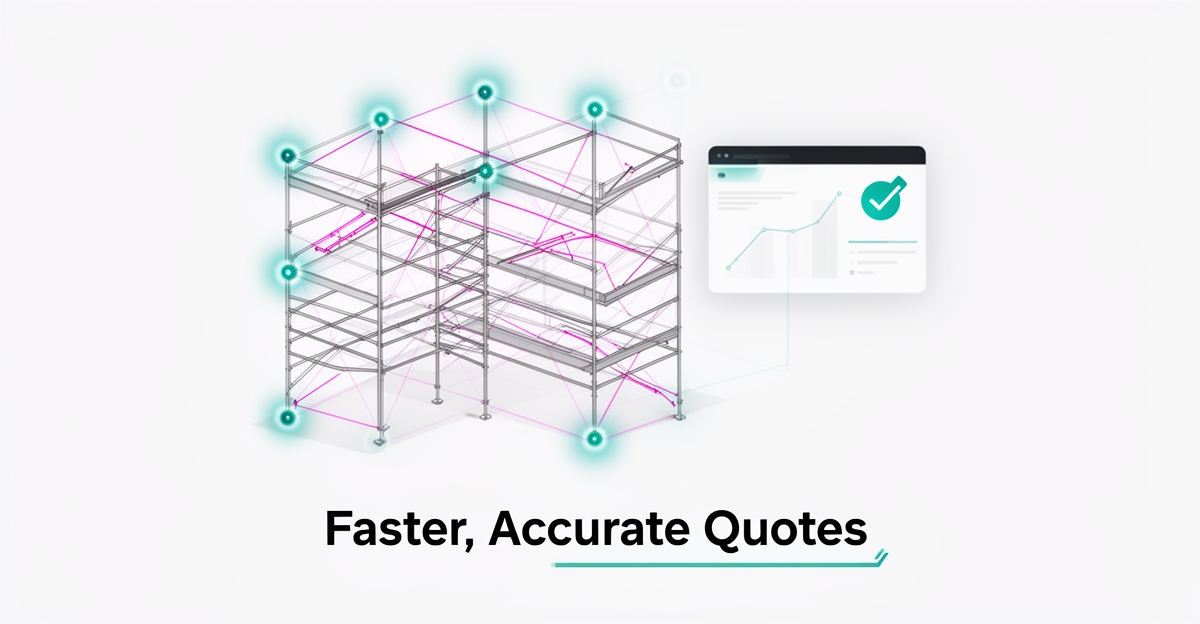
Computer vision acts as the "eyes" of the estimation engine, analyzing blueprints, BIM files, and site photos to automatically detect objects and measure dimensions. For scaffolding specifically, this means the AI can instantly calculate required surface areas and footprints from complex site plans without manual measurement.

This automation drastically reduces the labor required for initial quantity takeoffs. A mid-sized contractor reduced a task that took two estimators three days to under two hours using AI to analyze 2D drawings, according to Infrrd. The system identifies structural elements and calculates material needs with precision, eliminating the tedious and error-prone process of manual counting.

Key benefits of automated takeoffs include:

  • Rapid Dimension Extraction: AI reads 2D drawings and BIM models to identify scaffolding zones instantly.
  • Error Reduction: Automated measurement cuts labor in takeoff processes by nearly 30%, as reported by A3Logics.
  • Scalability: Systems handle complex formats, including tolerance values and inconsistent scales, without human fatigue.
  • Consistency: Every quote uses the same rigorous measurement standards, removing variability from human estimators.

While computer vision determines what is needed, predictive modeling determines how much it costs. AI engines ingest historical project data and integrate with real-time supplier pricing APIs to forecast costs accurately. This ensures quotes reflect current market conditions, avoiding the pitfalls of underbidding due to material cost fluctuations.

The system acts as a "supercharged assistant" that remembers every past project and vendor delay. It adjusts estimates dynamically when design changes occur, calculating the delta in material, labor, and overhead costs within seconds. This real-time adaptability is crucial for scaffolding rentals where rental duration and material availability fluctuate.

Impact on business metrics includes:

  • Higher Profitability: AI adoption is associated with 20% higher profitability, according to Infrrd.
  • Improved Accuracy: Automation can raise estimate accuracy by 25%, as noted by A3Logics.
  • Cost Control: Contractors using AI tools experienced a 15% reduction in project cost deviations compared to traditional methods, per BLDOn.
  • Win Rate Boost: Firms using AI-driven leads saw a 310% higher bid win rate, according to Infrrd.

AI does not replace human estimators; it serves as a powerful tool that handles data processing while experts manage risk. Human staff focus on evaluating complex site conditions, supplier reliability, and client relationships—nuances that algorithms may overlook. This hybrid model leverages the speed of AI while maintaining the trust of professional judgment.

Successful implementation requires starting with pilot programs to test accuracy and efficiency before scaling. By integrating AI with existing CRM and accounting tools, scaffolding companies can create a seamless workflow from quote to invoice. This strategic adoption ensures the technology delivers immediate ROI while building long-term competitive advantage.

With the technical foundation established, the next step is understanding how to integrate these systems into your daily operations.

Implementation Strategy: From Pilot to Production

Moving from concept to a live, revenue-generating AI estimation engine requires a disciplined, phased approach. Scaffolding companies often stall at the "pilot" stage because they attempt to replace human judgment entirely rather than augmenting it with data.

Successful AI adoption hinges on a hybrid workflow where algorithms handle data processing and human experts manage risk. This strategy ensures your system learns from historical scaffolding projects while maintaining the nuanced understanding of site-specific constraints that seasoned estimators provide.

Before writing a single line of code, you must ensure your historical data is clean, standardized, and accessible. AI models are only as good as the data they ingest, and construction documents often contain complex formatting that can confuse algorithms.

  • Audit Historical Data: Compile past project records, including blueprints, material lists, and final costs.
  • Standardize Formats: Convert diverse document types (PDFs, CAD files) into structured formats for machine readability.
  • Define KPIs: Establish clear metrics for success, such as estimation time reduction, bid win rate improvement, and accuracy of material quantities.

Data quality is the foundation of predictive accuracy. Without clean inputs, even the most sophisticated AI will produce unreliable outputs.

Launch a controlled pilot on a subset of recent scaffolding jobs. This allows you to test your estimation engine against real-world outcomes without risking client relationships. The goal is to prove value through measurable efficiency gains rather than theoretical potential.

According to Infrrd’s industry research, firms using AI-driven project leads have seen a 310% higher bid win rate. This statistic underscores the competitive advantage of accurate, rapid quoting in the rental market.

During this phase, focus on these critical integration points:

  • Automated Takeoffs: Deploy computer vision to analyze 2D drawings and calculate surface areas instantly.
  • Real-Time Pricing: Integrate live supplier APIs to adjust quotes based on current material costs.
  • Human-in-the-Loop: Ensure estimators can review and adjust AI-generated quotes before sending them to clients.

A mid-sized contractor in Texas reduced a task that took two estimators three days to under two hours using AI to analyze 2D drawings, as reported by Infrrd. This level of efficiency is achievable for scaffolding rentals with the right setup.

Once the pilot validates your ROI, scale the solution across all bidding operations. At this stage, you are not just installing software; you are transforming your business model. AIQ Labs builds custom estimation engines that reduce errors and increase customer trust by integrating seamlessly with your existing CRM and accounting systems.

Research from BLDOn indicates that contractors using AI-powered estimating tools experienced a 15% reduction in project cost deviations compared to those using traditional methods. This precision protects your margins on complex rental contracts.

To ensure long-term success, implement these operational safeguards:

  • Continuous Training: Feed new project data back into the model to improve future predictions.
  • Performance Monitoring: Track error rates and win rates monthly to identify drift or inefficiencies.
  • Scalable Architecture: Use custom code rather than no-code tools to ensure the system can handle enterprise-level demands.

True ownership of your AI assets prevents vendor lock-in and allows you to customize features as your scaffolding business expands into new markets or service lines.

Despite the power of automation, human expertise remains irreplaceable for complex risk assessment. AI acts as a "supercharged assistant" that remembers every past project and material price shift, but it cannot interpret subtle site conditions or supplier reliability issues.

As noted by Infrrd, a 2025 RICS/ProjectFlux survey found that 45% of firms have no AI deployment, highlighting the significant opportunity for early adopters. By starting small, validating results, and scaling strategically, scaffolding companies can transform from reactive quote generators to proactive, data-driven leaders.

This structured approach minimizes risk while maximizing the return on your AI investment, setting the stage for sustainable growth.

Conclusion: The Competitive Edge of AI Estimation

Conclusion: The Competitive Edge of AI Estimation

The scaffolding rental industry stands at a critical inflection point where speed and precision directly dictate market leadership. Traditional manual estimating methods are no longer sufficient to compete in a market that demands instant, error-free quotes. By adopting AI-powered estimation, businesses can transform their quoting process from a bottleneck into a primary competitive advantage.

The Cost of Inaction

Failing to modernize your estimation workflow creates significant operational debt. 45% of construction firms currently have no AI deployment, leaving them vulnerable to slower turnaround times and higher error rates. This gap represents a massive opportunity for early adopters who can capture market share while competitors remain mired in manual calculations.

The financial implications are stark. Firms leveraging AI-driven project leads have achieved a 310% higher bid win rate according to industry data. This metric alone demonstrates that speed and accuracy are not just operational preferences—they are revenue drivers. Companies that delay implementation risk losing profitable contracts to rivals who can quote faster and more accurately.

Key Benefits of AI Estimation

Implementing an AI estimation engine delivers immediate, measurable returns across three core areas:

  • Drastic Time Reduction: Tasks that previously required days can now be completed in hours. A mid-sized contractor reduced a three-day manual takeoff to under two hours as reported by Infrrd.
  • Enhanced Accuracy: Automation reduces human error significantly. AI-driven systems can raise estimate accuracy by 25% and reduce estimation errors by up to 50% according to BLDOn.
  • Profitability Gains: Improved efficiency and fewer costly rework errors lead to 20% higher profitability for firms using AI tools.

The Hybrid Advantage

AI does not replace the seasoned estimator; it supercharges them. The most successful models use AI to handle data processing, computer vision for site analysis, and material pricing, while human experts manage risk assessment and client relationships. This hybrid approach ensures that quotes are both fast and nuanced, accounting for complex site conditions that algorithms might miss.

Take Action Today

The technology to revolutionize your scaffolding business is ready. Custom AI systems can analyze site details, material types, and job complexity to generate accurate, instant quotes. AIQ Labs builds custom estimation engines that reduce errors and increase customer trust, providing the infrastructure you need to lead your market.

Don’t let outdated processes limit your growth. Partner with AIQ Labs to architect a competitive advantage that delivers enterprise-grade results for your SMB. Contact us today to discover how we can transform your estimation workflow.

AI Development

Still paying for 10+ software subscriptions that don't talk to each other?

We build custom AI systems you own. No vendor lock-in. Full control. Starting at $2,000.

Frequently Asked Questions

How much faster can AI estimate scaffolding jobs compared to doing it manually?
AI drastically cuts estimation time, with one contractor reducing a three-day task to under two hours. Research shows AI can perform complex takeoffs in a fraction of the 10-12 hours typically required for manual commercial projects.
Does using AI for estimates make us less accurate than experienced estimators?
No, AI actually improves precision by reducing human error by up to 50% according to McKinsey. It acts as a 'supercharged assistant' that handles data processing, allowing your experts to focus on high-value risk assessment and final approvals.
Can AI help us win more bids by quoting faster?
Yes, firms using AI-driven leads have seen a 310% higher bid win rate. The ability to instantly recalculate costs when designs change ensures you capture opportunities that slower, manual competitors might miss.
How do we start implementing AI without disrupting our current workflow?
Start with a pilot program on a subset of projects to measure key metrics like time saved and accuracy before scaling. AI integrates with existing BIM and ERP systems to create a single source of truth, ensuring a smooth transition rather than a complete overhaul.
Is AI going to replace our human estimators?
AI serves as an 'apprentice' that remembers past projects and material shifts, but it does not replace human judgment. Human estimators are still essential for evaluating complex site conditions, supplier reliability, and client relationships that algorithms may overlook.
What kind of ROI can we expect from an AI estimation system?
Adoption is associated with 20% higher profitability and a 15% reduction in project cost deviations. By cutting labor in takeoff processes by nearly 30%, you free up staff to focus on revenue-generating activities like client relationship management.

Stop Trading Speed for Accuracy: The AI Estimating Advantage

Manual takeoffs are no longer just a time-sink; they are a direct threat to your bid win rate and profitability. As the scaffolding rental industry shifts, the ability to instantly analyze site details, material types, and job complexity is becoming the primary differentiator between winning contracts and losing them. AI-driven estimation eliminates the human errors and delays inherent in traditional methods, allowing your team to respond with the speed and precision clients demand. At AIQ Labs, we help businesses like yours transition from manual bottlenecks to automated efficiency. We build custom estimation engines that reduce errors and increase customer trust, giving you the competitive edge needed to scale. Don’t let outdated processes cost you future revenue. Contact AIQ Labs today to discover how we can architect your competitive advantage and transform your estimating workflow.

AI Transformation Partner

Ready to make AI your competitive advantage—not just another tool?

Strategic consulting + implementation + ongoing optimization. One partner. Complete AI transformation.

Join The Newsletter

Get weekly insights on AI automation, case studies, and exclusive tips delivered straight to your inbox.

Ready to Increase Your ROI & Save Time?

Book a free 15-minute AI strategy call. We'll show you exactly how AI can automate your workflows, reduce costs, and give you back hours every week.

P.S. Still skeptical? Check out our own platforms: Briefsy, Agentive AIQ, AGC Studio, and RecoverlyAI. We build what we preach.