AI-Powered Lead Scoring for ADU Developers: How to Identify High-Intent Clients
Key Facts
- Slow response times and manual qualification are among the most common reasons ready-to-buy leads go cold.
- AI lead scoring typically improves conversion rates by replacing gut-feel checklists with predictive signals.
- Automated scoring and routing can cut the bulk of manual triage work from your sales day.
- The most effective systems blend explicit data (budget, timeline, property details) with implicit behavioral signals.
- Repeated visits to pricing pages and permit-guide downloads are key behavioral signals of high buying intent.
- AIQ Labs has deployed 200+ multi-agent systems and runs four live SaaS products daily.
Hire a team member that works 24/7 — for less than a part-time wage.
AI receptionists, SDRs, dispatchers and 99+ roles. Trained on your business, fully managed.
Not sure where to start? Ask our AI planner
The Hidden Cost of Guessing: Why ADU Developers Lose Ready-to-Buy Clients
Every ADU developer knows the rhythm: a contact form submission, a quick scan of the details, a mental calculation of budget and timeline, then a decision on whether to call back today or next week. The problem is that browsers, budget-shoppers, and serious buyers all look remarkably similar in an inbox, and the manual qualification process that feels thorough is actually a leaky bucket.
Slow response times and manual qualification are among the most common reasons ready-to-buy leads go cold. While a sales rep weighs one inquiry against another, the high-intent prospect who visited the pricing page three times and downloaded the permit guide may have already booked a consultation with a competitor. Traditional gut-feel scoring relies on static checklists — location, budget range, project type — that cannot capture the behavioral signals distinguishing a tire-kicker from a ready-to-build client.
The contrast is measurable. Teams that adopt AI lead scoring typically see meaningfully higher conversion rates than those relying on subjective judgment, because predictive models replace guesswork with ranked intent. The difference isn't incremental — it's the gap between hoping the next call connects and knowing which prospect to call first.
- Manual scoring misses behavioral patterns like repeat visits to technical pages or permit downloads
- Response delays of even a few hours can sharply reduce conversion probability for high-intent leads
- Static criteria cannot adapt when market conditions or buyer behavior shift
- Sales teams waste hours qualifying leads that AI would deprioritize instantly
AIQ Labs builds lead scoring systems through AI Workflow Builds that analyze website visits, contact forms, and social media activity to predict which ADU clients are most likely to convert — turning the guesswork into a ranked pipeline the sales team can trust.
How AI Reads Buying Intent Across Your Website, Forms, and Social Activity
Not every inquiry that lands in your inbox deserves the same urgency. Some visitors are casually browsing ADU designs on a Sunday afternoon; others have a budget, a timeline, and a property ready to go. The challenge is telling them apart before your competitors do — and AI lead scoring solves exactly that problem.
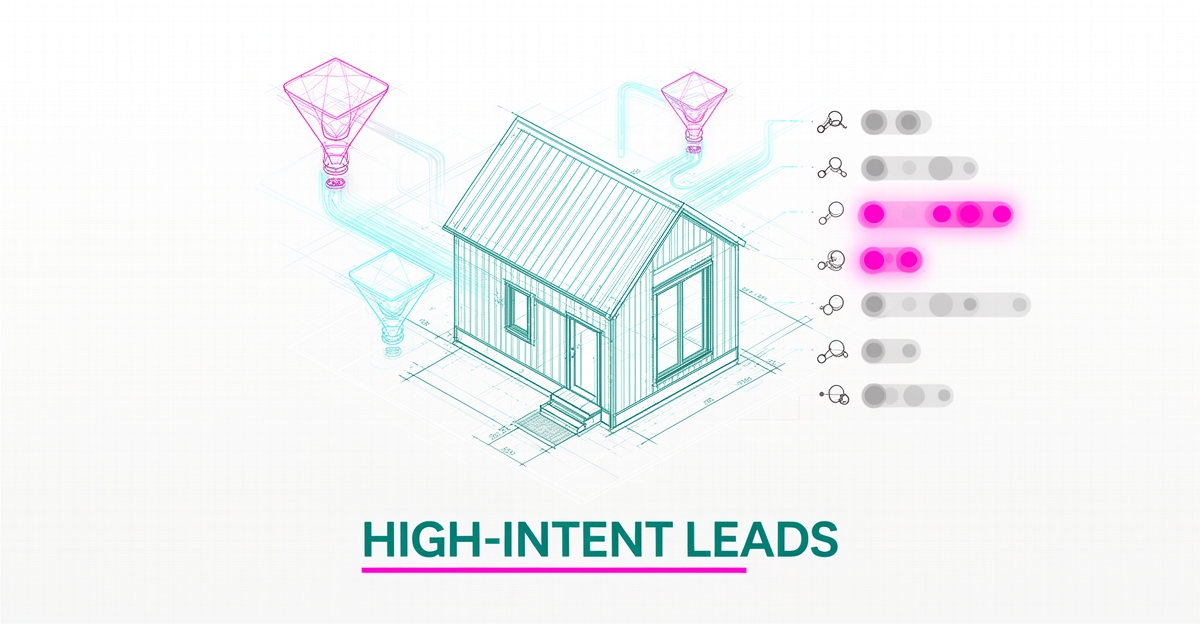
AI lead scoring works by drawing from two distinct streams of information. The first is explicit data — the details a prospect hands over directly: their budget range, property type, project timeline, and financing status, typically captured through contact forms or intake questionnaires. The second is implicit data, the behavioral trail a prospect leaves behind without ever typing a word: which pages they visited, how long they spent on your project gallery, whether they returned to your pricing page three times in one week.
On their own, neither stream tells the full story. A prospect might check every box on a form but never return to your site. Another might never fill out a form at all yet visit your ADU cost calculator five times in two days. The most effective scoring systems blend explicit and implicit data, because the combination consistently outperforms either signal alone.
Machine learning models sit at the center of this process. The model processes both data types and assigns each lead a score, identifying prospects whose behavior mirrors that of past clients who actually signed a contract. As more of your own project history feeds the model, its predictions get sharper.
For an ADU developer, the behavioral signals that matter most typically include:
- Repeated visits to pricing, financing, or cost-estimator pages
- Time spent reviewing portfolio projects similar to their property type
- Downloads of planning guides, zoning checklists, or permit resources
- Engagement with your social media content or email campaigns
- Return visits within a compressed timeframe, signaling an active decision window
The payoff for reading these signals correctly is substantial. For a high-ticket service like ADU construction, even a modest lift in conversion translates directly into signed contracts rather than stalled conversations.
This is the kind of system AIQ Labs builds: a model trained on your own sales history, connected to your website, forms, and CRM, so every lead gets scored in real time and your team reaches out while intent is still hot. Instead of guessing which inquiry deserves a call first, you start each morning with a ranked list — and the confidence that your best prospects are at the top of it.
The Payoff: Less Manual Work, More Qualified Appointments
For ADU developers, time spent qualifying is time not building. AI-powered lead scoring flips that equation by turning website visits, contact forms, and social signals into a clear priority list.
The payoff shows up immediately in the sales day. Teams stop chasing every inquiry and start calling the right homeowner first, with the right message, at the right time. Automated scoring and routing can remove the bulk of manual triage work — the repetitive sorting that bottlenecks most sales teams and lets qualified leads go cold while reps deliberate.
That reduction comes from automation replacing repetitive triage. AI scoring removes the lag by ranking intent in real time, so the hottest leads get called first instead of sitting in a queue.
Sales productivity rises because reps focus only on high-probability opportunities. When your team works a ranked pipeline instead of chasing every inquiry, more of each day goes to booked estimates and fewer hours go to dead-end calls.
The impact is measurable across the funnel:
- Manual qualification work drops sharply as scoring and routing run automatically
- Qualified appointments increase from faster, smarter follow-up
- Reps spend their day on high-probability opportunities instead of every inquiry
Conversion also improves. When predictive models replace rules-based scoring, teams typically see meaningfully higher close rates on the same lead volume — without adding headcount.
AIQ Labs applies this approach as part of its AI Operating Systems work, building systems that analyze website visits, contact forms, and social activity to predict which ADU clients are most likely to convert. The result is prioritized outreach that aligns message and timing to intent.
With continuous learning, the model gets sharper as more interactions are captured. Teams gain a repeatable advantage: fewer wasted calls, more booked estimates, and a pipeline that reflects real buying intent rather than guesswork.
Implementation Roadmap: Five Steps to Your First AI Scoring System
Implementing an AI lead scoring system for your ADU development business starts with a structured approach that turns raw data into actionable insights. The first step involves cleaning and integrating data from your CRM, contact forms, and web analytics platforms to create a unified view of each prospect. This includes standardizing formats, removing duplicates, and ensuring consistency across sources — critical because accurate scoring depends on blending explicit and implicit data. Without this foundation, even the most advanced models will produce unreliable results.
Next, define qualification criteria specific to ADU projects, such as verified lot size, local zoning readiness, budget range, and expected timeline. These factors should reflect what historically converted leads in your closed projects looked like, turning intuition into measurable signals. Once criteria are set, build and train your AI model using historical data from past builds — leveraging machine learning to recognize patterns that indicate high intent.
After training, integrate the scoring engine directly into your CRM and sales workflows so scores appear alongside lead records, enabling reps to prioritize outreach automatically. Finally, establish a continuous learning loop where the model retrains on new data from every completed project, refining its accuracy over time. This iterative approach keeps your scoring system aligned with market changes and delivers sustained value. To explore how AIQ Labs can guide you through each phase, start the Fit Check at https://aiqlabs.ai/apply and schedule your free 30-minute strategy call at https://aiqlabs.ai/book.
Your Next Step: Turning Lead Chaos into a Prioritized Pipeline
The decision to implement AI-powered lead scoring isn't just about technology — it's about ownership, scalability, and real ROI. For ADU developers drowning in unqualified inquiries, the choice between building a custom system or buying off-the-shelf software shapes long-term control and adaptability. AIQ Labs offers three clear paths: Start Monthly for immediate deployment with managed support, Build in Milestones for phased validation, or Own It Outright for full IP transfer and perpetual use — all grounded in production-grade engineering, not prototypes.
A realistic engagement begins with a free two-minute Fit Check at https://aiqlabs.ai/apply, followed by a no-obligation 30-minute strategy call at https://aiqlabs.ai/book to map your lead chaos to a prioritized pipeline. During this session, we assess whether AI lead scoring delivers measurable wins for your specific pipeline before recommending a path forward. If there's no clear ROI, we'll say so.
- Start Monthly: managed deployment with ongoing support — typically far less than the cost of a human hire
- Build in Milestones: pay per phase for a lead scoring system built around your workflow; stop anytime, keep what's built
- Own It Outright: one project price for full ownership of code, agents, and data
The goal isn't another tool — it's an owned asset that grows with your business. Real numbers, timelines, and scope are shared in writing after the strategy call, with no fake anchors or hidden costs. Your next step isn't a demo — it's a working session to see if AI lead scoring is your unfair advantage. Questions in the meantime? Reach the team at [email protected].
Still paying for 10+ subscriptions that don’t talk to each other?
We build custom AI systems you own outright. No vendor lock-in. Full control.
Not sure where to start? Ask our AI planner
Frequently Asked Questions
How does AI lead scoring actually work for ADU developers?
Is AI lead scoring really better than manually qualifying leads?
What results can I expect after implementing AI lead scoring?
What data does the model need to score leads accurately?
What steps are involved in setting up an AI lead scoring system?
How do I get started with AIQ Labs, and what does it cost?
From Guesswork to Growth: Your Next Move
For ADU developers, the shift from manual lead qualification to AI-powered scoring isn't just about efficiency — it's about not losing ready-to-buy clients while your competitors move faster. By analyzing explicit data like budget and timeline alongside implicit signals such as pricing page visits and permit guide downloads, machine learning models identify high-intent prospects before competitors even know they exist. The payoff is measurable: less manual triage, more qualified appointments, and higher close rates on the same lead volume. AIQ Labs builds these systems through a five-step roadmap that starts with clean data integration and ends with continuous learning, ensuring your sales team focuses only on prospects ready to build. If you're ready to stop guessing and start prioritizing, begin with the two-minute Fit Check at https://aiqlabs.ai/apply, then schedule your free 30-minute strategy call at https://aiqlabs.ai/book to map your lead chaos to a ranked pipeline — no obligation, just clarity on whether AI lead scoring is your unfair advantage.
Make AI your competitive advantage — not just another tool.
Strategy, implementation and ongoing optimization. One partner, end to end.
Not sure where to start? Ask our AI planner