AI-Powered Load Planning: How Moving Companies Can Optimize Truck Utilization
Key Facts
- AI load planning can dramatically cut manual planning time, freeing staff for customer-facing tasks
- Purpose-built AI systems typically improve cube utilization significantly versus manual planning, boosting revenue per trip
- Smarter route and load integration reduces empty miles, which directly lowers fuel costs
- Trucks in traditional operations often run a meaningful share of their distance empty, wasting fuel and revenue on non-productive mileage
- Modern systems generate executable 3D loading plans in seconds, not hours, enabling real-time adjustments
- AIQ Labs has deployed 200+ multi-agent systems and runs 4 live SaaS products daily—proof in production, not promises
Hire a team member that works 24/7 — for less than a part-time wage.
AI receptionists, SDRs, dispatchers and 99+ roles. Trained on your business, fully managed.
Not sure where to start? Ask our AI planner
The Hidden Cost of Underutilized Moving Trucks
Moving companies operate in a constant balancing act between customer service and operational efficiency, yet many overlook one of the most persistent profit drains: underutilized truck space. This hidden cost manifests not just in wasted fuel, but in missed revenue opportunities and eroded customer trust when delays or damages occur due to rushed, suboptimal loading.
Traditional moving operations often accept significant inefficiencies as routine. Trucks frequently run a meaningful share of their distance empty, and teams can spend hours each day on manual load coordination—phone calls, spreadsheet juggling, and last-minute route adjustments. These activities consume valuable time that could be spent on customer-facing tasks or strategic growth initiatives.
The financial impact compounds when considering load quality. Many moving companies operate with a level of cube inefficiency accepted as normal, meaning a real share of potential truck capacity goes unused on every trip. This translates directly to higher per-move costs, as fixed expenses like driver wages, vehicle maintenance, and insurance are spread across fewer revenue-generating cubic feet.
- Empty miles increase fuel consumption and vehicle wear without generating revenue
- Manual planning creates bottlenecks that delay dispatch and frustrate customers
- Low cube utilization forces companies to run more trucks than necessary for the same volume
- Inefficient loading increases risk of cargo damage during transit
- Operational waste reduces capacity to take on additional jobs during peak seasons
For moving companies already navigating tight margins and seasonal demand fluctuations, these inefficiencies aren't just operational hiccups—they represent systemic profit leakage. Solving this requires more than generic optimization; it demands purpose-built systems that account for the unique complexities of household goods, from fragile antiques to bulky furniture, while dynamically adapting to real-world constraints like customer availability windows and dock scheduling limits. The path forward begins with recognizing that every underutilized mile and manually planned load is a preventable cost—and an opportunity for smarter, AI-driven operations.
How AI Analyzes Size, Weight and Destination to Optimize Loads
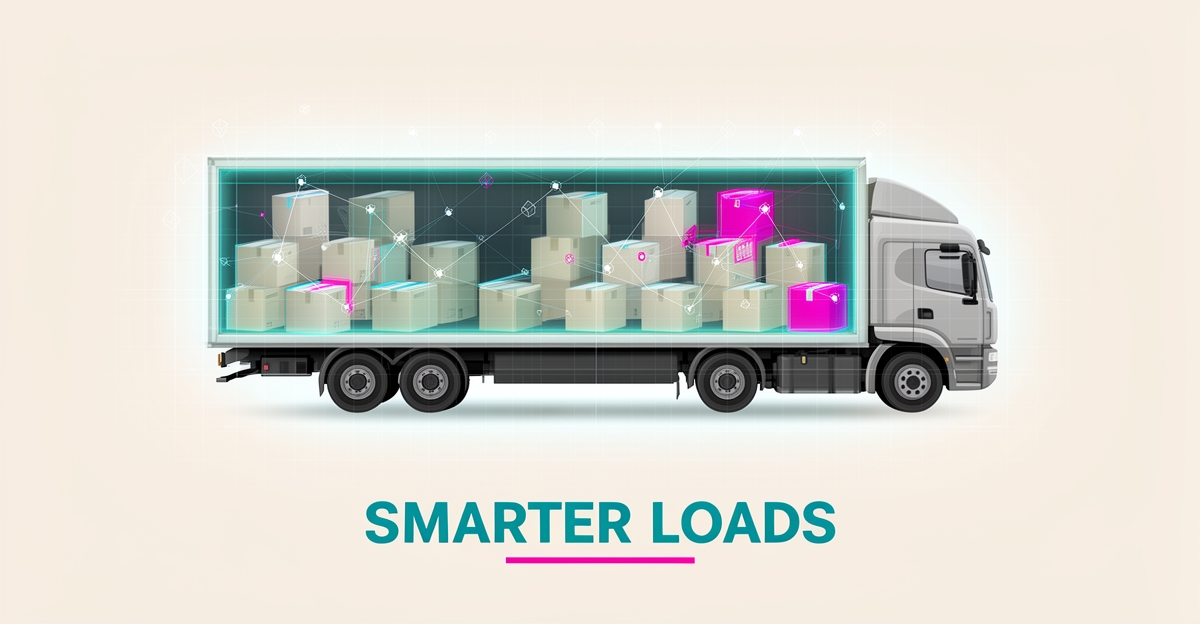
Moving companies face constant pressure to maximize truck space while managing unpredictable customer loads and tight delivery windows. AI-powered load planning transforms this challenge by analyzing shipment dimensions, weight limits, stacking rules, and destination sequences to generate optimized 3D loading configurations in seconds. This technology doesn't just pack boxes—it considers real-world constraints like fragile items, weight distribution, and loading order requirements to produce plans that are both mathematically efficient and operationally feasible. By processing these variables simultaneously, AI systems eliminate the guesswork and hours of manual coordination traditionally required for load planning.
The impact of this automation is typically measurable and immediate. Companies using AI load planning generally achieve higher truck space efficiency compared to manual methods, directly translating to more revenue per trip. Smarter route and load integration also reduces empty miles, which in turn lowers fuel costs. And because nearly every cubic foot of truck space is used effectively, this level of optimization not only cuts costs but also reduces emissions and improves on-time delivery reliability, addressing both operational and sustainability goals.
- Processes shipment dimensions, weight, and stacking constraints simultaneously
- Generates executable 3D loading plans in seconds, not hours
- Adapts to fixed loading sequences and real-world operational limits
- Integrates with WMS/TMS systems for seamless warehouse execution
- Provides export-ready PDFs, pick lists, and CSV files for implementation
For moving companies dealing with variable load types and last-minute changes, this technology offers a critical advantage. Unlike traditional tools that assume full control over loading order, AI systems work within existing constraints—such as warehouse scheduling or customer-specific item placement needs—while still maximizing space utilization. AIQ Labs builds custom load planning systems through its AI Workflow Builds that embed these capabilities directly into a moving company's workflow, enabling real-time adjustments without disrupting service. The result is a smarter, more responsive operation where every truck leaves closer to full capacity, every mile driven serves a purpose, and customer satisfaction improves through reliable, on-time deliveries.
Real-World Results and Moving Company Constraints
Moving companies face unique challenges in load planning that go beyond standard freight logistics. Fragile items like glassware, electronics, and antiques require special handling and positioning within the truck, while fixed loading orders—often dictated by customer access requirements or delivery sequences—limit flexibility. Last-minute changes, such as added items or rescheduled moves, further complicate planning, demanding systems that can adapt quickly without compromising safety or efficiency.
AI-powered load planning directly addresses these constraints by generating optimized 3D loading plans that respect item fragility, stacking rules, and predetermined sequences. Modern load optimization platforms are designed to handle real-world complexity, ensuring that even when loading orders are fixed or partially known, the resulting plans remain space-efficient, stable, and practical for execution. This capability is critical for movers who cannot rearrange items mid-load due to dock scheduling or customer-specific unloading needs.
The operational benefits are substantial. Companies implementing AI load planning typically report a major reduction in manual planning time, freeing up staff for customer-facing tasks and reducing reliance on experienced planners. Improvements in cube utilization, fuel spend, and on-time delivery tend to compound as the system learns your fleet and your constraints. These gains stem from the system's ability to analyze shipment dimensions, weight, and destination in seconds, creating loads that minimize empty space and fuel consumption while adhering to real-world constraints.
- Handles fragile item constraints with special handling flags
- Respects fixed loading sequences from customer access needs
- Adapts to last-minute changes via real-time replanning
- Optimizes weight distribution and stacking strength
- Generates operator-ready PDFs and pick lists for execution
By transforming a traditionally manual, hours-long process into an automated, seconds-long operation, AI load planning allows moving companies to maintain high service standards even amid unpredictable demands. The technology doesn't just improve efficiency—it builds resilience into daily operations, ensuring that trucks leave fuller, routes stay on schedule, and customer belongings arrive safely and on time. For moving companies seeking to reduce waste and improve reliability without overhauling their entire workflow, AI-powered load planning offers a practical, scalable path forward.
Implementing AI Load Planning with Custom Systems You Own
Moving companies face constant pressure to maximize truck space while managing unpredictable shipments and tight delivery windows. AI-powered load planning transforms this challenge by analyzing shipment dimensions, weight, and destination to generate optimal 3D loading configurations in seconds—turning what once took hours of manual coordination into an automated, real-time process.
With AIQ Labs' custom AI development approach, moving companies can build owned systems that dynamically adjust loads as new shipments arrive or schedules change. The implementation begins with uploading shipment data via CSV or Excel, including dimensions, weight, quantity, and constraints like fragile items or stacking rules. Users then select from pre-built vehicle templates—such as standard moving truck dimensions—or define custom specifications based on their fleet.
The system offers flexible optimization modes: fast heuristic processing for immediate results or AI-optimized runs for complex, mixed loads typical in residential moves. After generating a space-efficient, stable loading plan, companies export operator-ready outputs including step-by-step PDF instructions, pick lists, and CSV files compatible with warehouse or dispatch software. This end-to-end workflow ensures plans are not only mathematically optimal but executable in real-world conditions—reducing empty miles and cutting fuel spend on every route.
Unlike vendor-locked platforms, AIQ Labs delivers true ownership through three payment models: Start Monthly for incremental adoption, Build in Milestones for phased workflow automation, or Own It Outright for full control of code, agents, and data. This approach eliminates subscription dependency while enabling continuous refinement—critical for moving companies handling variable load types and last-minute changes. For companies ready to go further, an AI Operating System can connect load planning with dispatch, quoting, and customer communication in one owned layer. By owning their AI system, movers gain a scalable foundation that adapts to seasonal demand shifts, improves cube utilization, and supports sustainability goals through smarter load choices.
Still paying for 10+ subscriptions that don’t talk to each other?
We build custom AI systems you own outright. No vendor lock-in. Full control.
Not sure where to start? Ask our AI planner
Frequently Asked Questions
How much truck space are moving companies typically wasting with manual load planning?
What kind of fuel savings can AI-powered load planning actually deliver?
Can AI load planning handle the unique constraints of household moves like fragile items and fixed loading sequences?
How much time does AI load planning save compared to manual coordination?
What cube utilization improvement can moving companies expect with AI-first operations?
Do I have to commit to a subscription platform, or can I own the AI system outright?
Every Empty Mile Is a Missed Move
Underutilized trucks are more than an operational nuisance—they're profit leaking out of every route in the form of empty miles, wasted fuel, manual planning hours, and missed revenue during peak season. AI-powered load planning changes that equation by analyzing size, weight, destination and real-world constraints like fragile items and fixed loading sequences to generate executable 3D plans in seconds, not hours. For moving companies, the next step is to treat load planning as a dynamic system rather than a daily chore: audit your current cube utilization and manual coordination time, map the constraints that make your loads unique, and test how real-time replanning performs on your most variable routes. If you want an owned system built for your fleet and workflow, start with a clear fit check. Start the Fit Check at https://aiqlabs.ai/apply for a free 30-minute strategy call at https://aiqlabs.ai/book to map your biggest bottleneck and identify high-ROI automation opportunities—no pitch, just a working session with an AI engineer.
Make AI your competitive advantage — not just another tool.
Strategy, implementation and ongoing optimization. One partner, end to end.
Not sure where to start? Ask our AI planner