AI-Powered Maintenance Scheduling: How to Predict Equipment Failures Before They Happen
Key Facts
- Industry analyses suggest AI can predict a majority of equipment failures before they happen, turning emergencies into planned visits.
- A single minute of unplanned downtime has been estimated at $22,000 for large manufacturers, every second offline counts.
- AI-powered maintenance is reported to reduce unplanned downtime by up to 40%, keeping systems running when they matter most.
- A single equipment failure can cost between $10,000 and $100,000, making prevention the clear winner.
- AI-driven care is credited with extending equipment lifespan by up to 20%, delaying costly replacements and protecting your investment.
- Smart AI scheduling can cut routine checks by up to 30%, freeing technicians for work that actually matters.
- Predictive maintenance transforms HVAC from reactive firefighting into proactive care, reducing emergency calls while boosting customer retention.
Hire a team member that works 24/7 — for less than a part-time wage.
AI receptionists, SDRs, dispatchers and 99+ roles. Trained on your business, fully managed.
Not sure where to start? Ask our AI planner
Why Reactive HVAC Maintenance Is Costing You More Than You Think
When an HVAC system fails in the middle of a heat wave or a January cold snap, the true cost of that breakdown extends far beyond the repair invoice. Emergency service calls, rushed parts orders, and unhappy customers all pile onto a bill that most business owners never fully itemize. The numbers suggest it's a bill worth examining closely.
Consider what industry research reveals. Roughly 60% of equipment failures are reported as predictable before they happen with AI-powered maintenance. In other words, many of the "surprise" breakdowns that trigger emergency calls are not surprises at all, they are foreseeable events that simply went undetected.
The financial stakes scale quickly. A single minute of unplanned downtime has been estimated at $22,000 for a global automotive manufacturer. While an HVAC contractor or commercial property operator may not face that exact figure, the principle holds: every minute a critical system sits offline carries real costs in lost productivity, tenant complaints, and reputation damage.
The cost of a single equipment failure is substantial in its own right. Industry analyses put the cost of a single equipment failure between $10,000 and $100,000, depending on the asset and the consequences of the outage. Factor in the labor premium of after-hours emergency work, and reactive maintenance starts to look less like a cost-saving strategy and more like a slow leak in the P&L.
The hidden costs go beyond the repair itself:
- Unplanned downtime disrupts schedules, forcing crews to abandon planned routes for emergency calls
- Reactive repairs shorten equipment life, since a failure often damages components that routine service would have protected
- Emergency service erodes customer trust, and in a service business, trust is the retention engine
- Constant firefighting crowds out the routine checks that keep the rest of the fleet healthy
There is also an efficiency penalty hiding in the opposite direction. Traditional preventive maintenance overcorrects, scheduling service whether or not it is needed. Research suggests AI-powered maintenance can reduce the need for routine checks by up to 30%, freeing technicians for work that actually matters. And when failures are caught early, AI-driven approaches are credited with extending equipment lifespan by up to 20%, delaying capital replacement costs that every operator dreads.
The urgency, then, is not about technology for its own sake. It is about the widening gap between businesses that predict failures and those that merely respond to them. This is where AI systems that analyze service history, weather data, and equipment usage patterns come in, flagging which units are likely to fail and when, so maintenance happens on your schedule instead of the equipment's. AIQ Labs builds exactly these predictive systems for service businesses, typically as a fixed-price AI Workflow Build that rebuilds the one workflow costing you the most, in phases, with no surprise invoices. The alternative, waiting for the next 2 a.m. no-heat call, is a strategy with a compounding price tag.
How AI Predicts Equipment Failures Using Service, Weather, and Usage Data
Proactive maintenance transforms how service businesses operate by turning reactive repairs into planned, predictable interventions. By analyzing patterns in service history, weather conditions, and equipment usage, AI systems identify early warning signs of failure before they lead to breakdowns. This approach allows HVAC providers to schedule maintenance at optimal times, reducing emergency calls and improving customer satisfaction through fewer disruptions.
AI models process historical service records to detect recurring issues, such as frequent filter clogs or refrigerant leaks, which often precede major failures. When combined with weather data, like extreme temperature spikes or prolonged humidity, these models recognize environmental stressors that accelerate wear on components such as compressors and coils. Usage patterns, including runtime hours and cycling frequency, further refine predictions by highlighting equipment operating under sustained strain. Together, these data streams enable AI to forecast failures with measurable accuracy, supporting decisions that prevent costly downtime.
- AI-powered maintenance is reported to reduce unplanned downtime by up to 40%, according to industry case studies.
- The same approach is credited with extending equipment lifespan by up to 20%, delaying replacement costs and improving long-term asset value, as noted in applications of AI studies.
- A single minute of unplanned downtime has been estimated at $22,000 for large manufacturers, underscoring the financial impact of unexpected failures, as reported by predictive maintenance analysis.
For HVAC businesses, this means fewer emergency service calls, lower repair expenses, and stronger customer retention through reliable service delivery. AIQ Labs helps organizations implement these predictive systems by integrating service, weather, and usage data into custom AI models that recommend timely maintenance actions, turning equipment insights into operational advantage without requiring businesses to build or manage the technology themselves. With 200+ multi-agent systems deployed, this is work AIQ Labs does every day.
Implementing AI Maintenance Scheduling: From Data to Actionable Insights
Implementing AI maintenance scheduling begins with gathering the right data, service history, equipment usage patterns, and environmental factors like weather that impact HVAC performance. AIQ Labs helps businesses structure this data collection to feed predictive models that identify failure risks before they occur. According to industry research, roughly 60% of equipment failures are reported as predictable with AI-powered maintenance, turning reactive repairs into planned interventions.
Once data is collected, the next step is training AI models to recognize early warning signs specific to each HVAC system type and operating environment. This involves labeling historical failure events and correlating them with sensor data, maintenance logs, and external variables. The goal is to build models that not only predict when a failure might occur but also recommend the optimal maintenance action, whether it’s a filter replacement, refrigerant check, or motor inspection. As noted in predictive maintenance case studies, such systems are reported to reduce unplanned downtime by up to 40%, directly cutting emergency service costs.
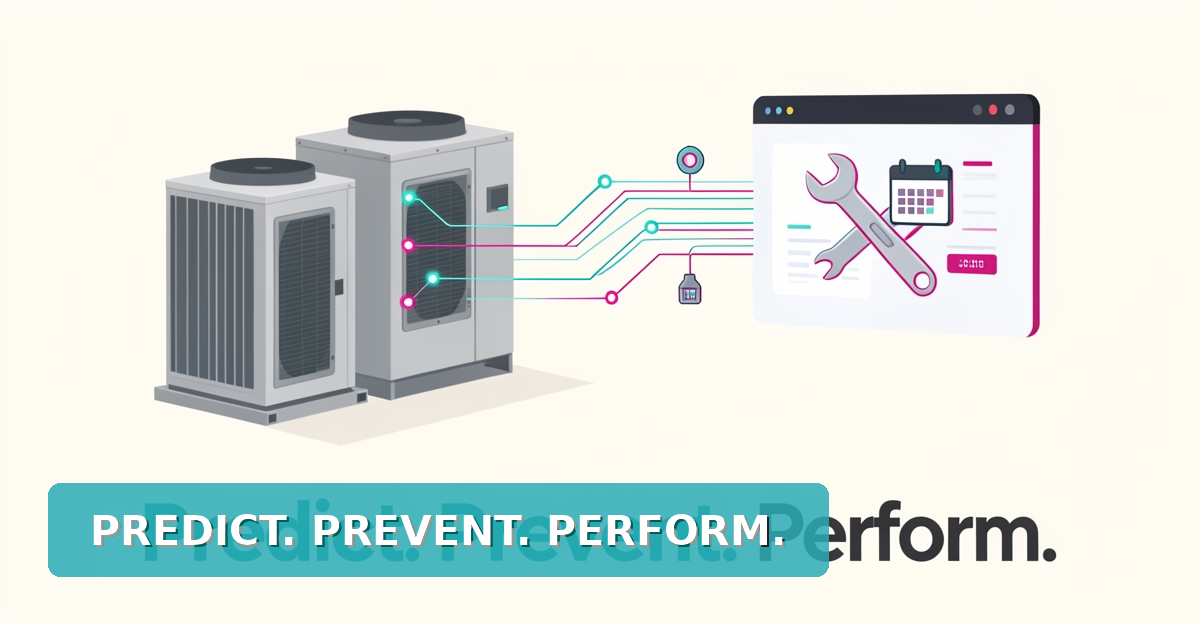
Integration with existing workflows ensures AI insights translate into action, automatically generating work orders, prioritizing technician routes, and notifying customers of upcoming service needs. AIQ Labs supports this phase by connecting AI outputs to CRM, scheduling, and dispatch systems, minimizing disruption while maximizing adoption. Teams receive role-based training to interpret AI recommendations and act confidently, addressing a key challenge: the need for skilled personnel to operate and maintain these systems. Continuous monitoring then refines model accuracy over time, adapting to seasonal shifts and equipment aging.
- Establish baseline data collection from service logs and IoT sensors
- Train and validate AI models using historical failure patterns
- Integrate predictions into dispatch and customer communication workflows
- Train technicians and support staff on interpreting AI-driven insights
- Monitor performance and retrain models regularly for ongoing accuracy
This structured approach transforms maintenance from a cost center into a retention lever, reducing emergency calls by addressing issues before they escalate. With AI handling prediction and scheduling, teams focus on high-value interactions, improving both operational efficiency and customer satisfaction. The result is a self-improving system that delivers measurable ROI while building long-term trust through reliability.
Still paying for 10+ subscriptions that don’t talk to each other?
We build custom AI systems you own outright. No vendor lock-in. Full control.
Not sure where to start? Ask our AI planner
Frequently Asked Questions
How much can AI-powered maintenance reduce unplanned downtime for HVAC systems?
What percentage of equipment failures can actually be predicted before they happen using AI?
Can AI really extend the lifespan of HVAC equipment, and by how much?
Is it true that AI can reduce the need for routine maintenance checks?
How much does a single minute of unplanned downtime really cost in industries like manufacturing?
What data does AI use to predict HVAC equipment failures before they occur?
Turning Breakdowns Into Business Advantage
AI-powered maintenance scheduling shifts HVAC businesses from reactive firefighting to proactive reliability, flagging the majority of predictable failures before they become emergencies, cutting unplanned downtime, and extending equipment life. The result isn’t just fewer emergency calls; it’s stronger customer trust, optimized technician time, and delayed capital costs. For HVAC contractors and property operators ready to move beyond guesswork, start with AIQ Labs' 2-minute Fit Check, then book a free 30-minute strategy call to see how predictive maintenance can become your retention lever, not just a cost center.
Make AI your competitive advantage — not just another tool.
Strategy, implementation and ongoing optimization. One partner, end to end.
Not sure where to start? Ask our AI planner