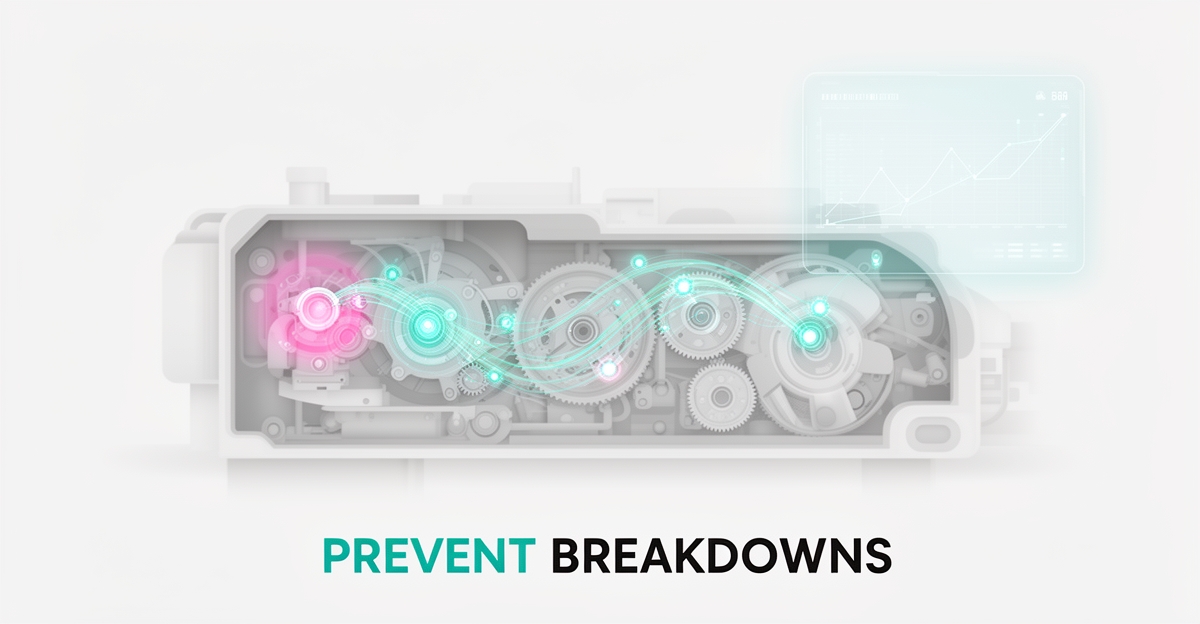
AI-Powered Maintenance Scheduling: How to Prevent Breakdowns Before They Happen
Key Facts
- AI predictive maintenance can substantially reduce unplanned downtime compared with reactive strategies, as AI capabilities mature across industries.
- A majority of manufacturers are actively moving away from purely reactive or time-based maintenance strategies, per industry analysis.
- Adopters of AI predictive systems commonly report significantly fewer breakdowns and better asset visibility after implementation.
- AI scheduling tools report meaningful gains in resource utilization and fewer scheduling conflicts.
- AI digital twins can simulate asset aging and degradation with accuracy that traditional physics-based models struggle to match, per energy-sector research.
Hire a team member that works 24/7 — for less than a part-time wage.
AI receptionists, SDRs, dispatchers and 99+ roles. Trained on your business, fully managed.
Not sure where to start? Ask our AI planner
Why Reactive Maintenance Is Costing You More Than You Think
Reactive maintenance feels cheaper until the breakdown happens. The emergency call, the overtime, the lost revenue — those costs stack up fast and quietly erode margins for field services, HVAC and trades teams who can't afford unplanned downtime.
Reactive maintenance means fixing equipment after it fails. That approach drives unexpected outages and high emergency repair costs, especially in critical operations. Preventive maintenance improved reliability by scheduling tasks on fixed intervals, but it often creates over-servicing and missed failures because it isn't tied to actual condition. The result is wasted labor, unnecessary parts, and assets that still fail between service windows.
The industry is already shifting. Industry analysis suggests a majority of manufacturers are actively moving away from reactive or time-based strategies, and adopters of AI predictive systems commonly report fewer breakdowns and improved asset visibility after implementation. In manufacturing, AI for predictive maintenance is widely credited with meaningfully reducing downtime, turning maintenance from a cost center into a reliability driver.
Hidden costs go beyond the repair invoice. Reactive and preventive models create:
- Emergency repairs and overtime premiums that spike labor costs
- Over-servicing from fixed-interval schedules that waste parts and technician time
- Scheduling conflicts and idle resources from manual planning
- Accelerated asset wear from operating past the point of safe degradation
AI-driven scheduling directly attacks those inefficiencies. AI maintenance planning tools report gains in resource utilization and reductions in scheduling conflicts, along with lower overtime costs and faster generation of maintenance plans, by automatically pairing technicians with tasks based on skills and certifications.
For SMBs in field services and HVAC, breakdowns don't just cost money, they cost customers. AIQ Labs focuses on these teams because unplanned failures disrupt operations and erode margins in real time. By analyzing vehicle history, climate patterns and usage data to predict when AC systems are likely to fail, a proactive approach reduces emergency calls and saves money on reactive repairs. Custom systems can integrate with existing CRM and service tools so predictions become work orders, not reports.
The move from reactive to predictive is a shift from scheduled work to data-driven reliability. When intervention happens only when data indicates a need, asset availability rises, service teams work smarter, and businesses stop paying for the same failure twice.
How AI Predicts Failures by Learning What 'Normal' Looks Like
Equipment rarely fails without warning. The signals are almost always there — subtle shifts in vibration, temperature drift, pressure irregularities — but traditional maintenance schedules are blind to them, operating on fixed calendars rather than actual machine condition.
AI-powered predictive maintenance changes this by establishing what "normal" looks like for each individual asset. The process begins with IoT sensors embedded in equipment, continuously tracking metrics like temperature, vibration, pressure, and acoustic signals. According to industry analysis, these inputs feed into centralized platforms where AI analyzes historical records to build a baseline model of healthy operation, accounting for variables like age, workload, and environmental conditions.
Once that baseline exists, the system becomes a vigilant observer. Anomaly detection algorithms flag deviations — an abnormal heat signature here, an unusual vibration frequency there — long before they cascade into failure. This is the critical difference from preventive maintenance, which replaces parts on schedule whether they need it or not, and reactive maintenance, which waits for breakdowns to happen.
The sophistication of modern systems is striking. Research from IBM demonstrates this vividly: AI-powered digital twins can predict asset degradation — such as battery aging in energy systems — with accuracy that traditional physics-based simulations struggle to match, simulating years of wear after only minimal real-world testing.
But prediction alone isn't enough. The real operational value emerges when AI translates forecasts into action. This is where intelligent scheduling transforms maintenance from a reactive scramble into a coordinated response. Pulsar Solutions reports that their AI-driven approach delivers:
- Improved resource utilization
- Fewer scheduling conflicts
- Lower overtime costs
- Faster generation of maintenance plans
The system doesn't just flag a failing component — it automatically assigns the right technician based on skills and certifications, resolves scheduling conflicts before they occur, and identifies optimal maintenance windows that minimize production disruption.
This integration of prediction and orchestration is where many businesses struggle. Building baseline models requires clean historical data, properly labeled failure events, and seamless connectivity between sensors, analytics platforms, and existing CMMS or ERP systems. As one industry expert notes, too many teams jump straight to AI models while ignoring the data pipelines and real-time integration required for success.
AIQ Labs addresses this gap by building custom AI workflow systems — see AI Workflow Builds — that connect predictive insights directly to operational tools, integrating with existing CRM platforms, scheduling software, and service management systems. The result is maintenance that happens because the data says it's needed, not because a calendar says it's time.
From Prediction to Action: Integrating AI with Your Existing Tools
Predictions only create value when they trigger the right action at the right time. AI maintenance systems close the gap between insight and execution by connecting directly to the tools teams already use every day.
Integration starts with enterprise systems. AI platforms connect with ERP and CMMS to automate the flow of information from sensor to work order. MaintWiz and Pulsar Solutions demonstrate capabilities to integrate with SAP and other plant systems via advanced APIs, enabling intelligent scheduling where AI automatically resolves conflicts, assigns technicians based on specific skills and certifications, and optimizes maintenance windows to minimize production disruption.
That orchestration replaces manual handoffs with auto-generated work orders and skill-based dispatch. Instead of a dispatcher searching calendars, the system pairs technicians with tasks based on competencies, experience, and current workload, resolving scheduling conflicts before they occur and balancing workloads fairly across teams.
The operational impact is measurable. AI-driven planning tools like Pulsar's report fewer scheduling conflicts and lower overtime costs through AI optimization, along with improved resource utilization and faster generation of maintenance plans, freeing planners to focus on exceptions rather than spreadsheets.
For SMBs, seamless API connections matter more than rip-and-replace. AIQ Labs builds custom systems that integrate with existing CRM and service tools such as HubSpot, QuickBooks, and Google Calendar, ensuring predictions flow into the workflows teams already trust. The approach is simple: connect first, automate second.
Typical integration points include:
- CRM systems for customer history and service records
- CMMS and ERP for work order creation and parts inventory
- Scheduling and calendar tools for technician availability
- Communication platforms for automated alerts and confirmations
When AI analyzes vehicle history, climate patterns, and usage data to predict AC failures, the signal can automatically create a prioritized work order, check parts availability, and book the best technician before a call comes in. That is prediction to action, without new software for the team to learn.
The result is proactive maintenance that reduces emergency calls and saves money on reactive repairs, while keeping the existing operational stack intact.
Start Small, Scale Fast: A Pilot-First Approach to AI Maintenance
Starting small is how maintenance teams prove AI works without betting the operation on day one. A focused pilot on high-impact assets delivers measurable results in weeks and creates the data foundation for wider rollout.
Define the business outcome first, then pick the asset. Start by clarifying goals such as reducing downtime or optimizing part replacements, not by choosing a model. Expert guidance recommends identifying critical machines with high failure risk or cost before deployment. For service fleets, AC units are a practical example because vehicle history, climate patterns, and usage data combine to create clear failure signals.
Build the data loop before the model. Install sensors for temperature, vibration, acoustic and pressure signals, then establish pipelines to stream, store and clean data at scale. Label historical logs, repairs and anomalies so models learn what failure actually looks like. Implementation guides emphasize that orchestration of data collection, cleaning and labeling is essential for success, not just model complexity.
Validate in the real world and integrate with operations. Measure precision, recall and F1-score on unseen data, then connect predictions to existing CMMS or CRM tools to auto-generate work orders and technician assignments. Industry research consistently points to meaningful downtime reductions from AI predictive maintenance, with a growing majority of manufacturers moving away from reactive strategies and adopters reporting fewer breakdowns and better asset visibility.
A pilot-first approach mirrors how AIQ Labs delivers AI Workflow Builds for SMBs: fixed price, phased delivery, and a system you own outright. The process is structured, low-risk and designed to prove value quickly:
- Define goals and select critical assets, such as fleet AC units, for initial monitoring
- Deploy sensors, label historical data and train models on real operating conditions
- Validate predictions, integrate with service tools and track ROI on emergency call reduction
- Scale to additional assets once the pilot shows clear savings and adoption
This staged method lets teams show reduced emergency calls and repair costs with clear ROI tracking before broader investment. AIQ Labs builds custom systems that integrate with existing CRM and service tools, helping SMBs move from pilot to production with milestone-based delivery and systems they own outright. Start with the 2-minute Fit Check to see if your operation is a fit.
Turning Maintenance from a Cost Center into a Competitive Edge
AI-powered maintenance scheduling isn't just about avoiding breakdowns—it's about building reliability into the core of your operations. By shifting from reactive fixes and guesswork schedules to data-driven predictions and intelligent orchestration, field service and HVAC teams can cut emergency calls, reduce overtime, and make every technician hour count. The real win comes when predictions flow seamlessly into the tools you already use, turning insights into work orders without disrupting your workflow. For SMBs ready to prove value fast, a focused pilot on high-impact assets like fleet AC units delivers measurable ROI in weeks, not months. If you're looking to move beyond theory and into a system that works for your business, start with a free strategy call to see where AI can make the biggest impact.
Make AI your competitive advantage — not just another tool.
Strategy, implementation and ongoing optimization. One partner, end to end.
Not sure where to start? Ask our AI planner