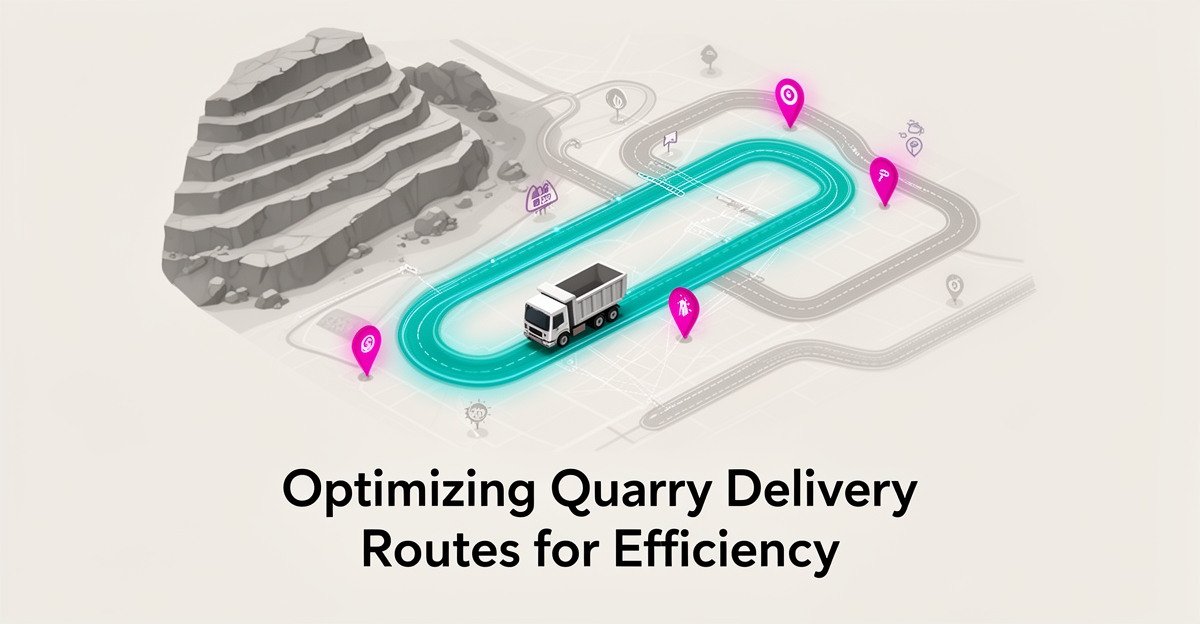
AI-Powered Route Optimization for Quarry Material Delivery
Key Facts
- A large share of field service organizations struggle to meet service level agreements due to inefficient routing, as of late 2026 industry analyses
- A meaningful percentage of truck rolls are unnecessary visits that waste fuel, driver hours, and vehicle wear
- AI route optimization typically reduces miles driven meaningfully and cuts maintenance costs as routes reduce strain on vehicles
- Real-time route adjustments improve adherence to tight construction schedules and can increase daily delivery capacity without adding vehicles
- AI route optimization reduces fuel costs per delivery cycle by minimizing excessive consumption from suboptimal routes
- Starting with route optimization on your busiest delivery corridors typically delivers the fastest ROI by tackling inefficiency where it costs the most
Hire a team member that works 24/7 — for less than a part-time wage.
AI receptionists, SDRs, dispatchers and 99+ roles. Trained on your business, fully managed.
Not sure where to start? Ask our AI planner
The Hidden Costs of Inefficient Quarry Material Delivery Routes
Every day, quarry and aggregate suppliers send heavy trucks onto the road with delivery plans built on guesswork, spreadsheets, and outdated assumptions. The result is a quiet but relentless drain on profitability that most operators underestimate until they see the numbers stacked together.
The scope of the problem is larger than many realize. Industry analyses as of late 2026 consistently find that a large share of field service organizations struggle to meet their service level agreements, with inefficient routing a leading cause. For quarry delivery operations, that translates directly to construction crews standing idle, project timelines slipping, and customers who start looking for a more reliable supplier.
The waste goes deeper than missed windows. The same analyses suggest that a meaningful percentage of all truck rolls are unnecessary visits—trips that burn fuel, consume driver hours, and put wear on expensive vehicles without delivering a single dollar of value. In an industry where margins on aggregate hauling are already tight, that kind of inefficiency compounds fast.
Consider what manual route planning actually costs your operation on a daily basis:
- Excessive fuel consumption from suboptimal routes that ignore traffic patterns, road restrictions, and load-specific constraints
- Missed delivery windows that trigger penalty clauses, damage customer relationships, and erode hard-won contracts
- Unnecessary truck rolls that waste driver hours and accelerate vehicle depreciation
- Reactive scheduling that leaves dispatchers scrambling when conditions change instead of adapting proactively
The financial impact is substantial. Operators who adopt AI route optimization typically report meaningful reductions in miles driven and maintenance costs, because optimized routes mean fewer hard stops, less idle time, and less mechanical strain. Those numbers represent real money recovered from every single delivery run.
What makes this particularly frustrating is that the problem is solvable today. Modern mapping and routing platforms provide the APIs needed to build custom route optimization, and AI systems can factor in traffic, weather, load capacity, and delivery windows simultaneously—something no human dispatcher can do at scale.
At AIQ Labs, we build custom AI systems that integrate directly with existing logistics tools to dynamically adjust routes in real time. The goal is not to replace your dispatchers but to give them intelligent automation that eliminates the guesswork and catches the inefficiencies humans simply cannot see across dozens of simultaneous deliveries. For operations that want a managed layer on top, our AI Employees can handle dispatch coordination end to end.
The question is not whether your quarry delivery operation has hidden inefficiencies. The data makes clear that it almost certainly does. The question is how much longer you are willing to absorb the cost.
How AI-Powered Route Optimization Works for Quarry Logistics
Quarry material delivery faces constant pressure to balance efficiency with unpredictable conditions on the road. AI-powered route optimization transforms this challenge by processing real-time traffic, weather, load limits, and delivery windows to calculate the most efficient paths dynamically—unlike static GPS systems that follow pre-set routes regardless of changing circumstances. This continuous adaptation ensures trucks avoid congestion, delays, and unnecessary detours throughout the delivery day.
The technology stack begins with mapping and traffic data APIs that provide the foundation for route calculation. Machine learning algorithms ingest live traffic feeds, historical congestion patterns, weather forecasts, and road closure reports to predict delays before they happen. These inputs are combined with operational constraints such as truck weight limits, material type restrictions, and time-sensitive delivery windows to generate routes that maximize load efficiency while meeting customer schedules. For example, AI can reroute a shipment mid-journey if a sudden storm makes a primary route unsafe or if traffic data shows a 30-minute backup developing ahead.
This dynamic approach delivers measurable improvements in logistics performance. Reduced miles driven directly cuts fuel consumption and vehicle wear, while fewer redundant trips improves on-time arrival rates. By continuously learning from each delivery cycle, the AI refines its predictions, becoming more accurate at anticipating regional traffic patterns and weather-related disruptions specific to quarry hauling corridors.
AIQ Labs builds custom route optimization systems that integrate these capabilities with existing logistics tools, enabling quarries to deploy AI-driven dispatch without overhauling their current workflows. The system continuously monitors conditions and adjusts routes in real time, ensuring every haul operates at peak efficiency.
The Measurable Impact: Fuel Savings, Fewer Delays, and Smarter Fleet Utilization
Quarry material delivery faces constant pressure to balance cost, timing, and fleet efficiency. AI-powered route optimization directly addresses these challenges by dynamically adjusting routes based on traffic, weather, and load capacity, turning logistics into a measurable advantage.
Reduced miles driven directly cuts fuel consumption and wear on vehicles. For quarries hauling heavy loads over variable terrain, this translates to lower fuel spend per ton delivered and fewer emissions—critical for both operational budgets and sustainability goals. Maintenance costs also typically drop as optimized routes reduce abrupt stops, idle time, and mechanical strain.
When paired with predictive maintenance, AI systems further minimize disruptions by forecasting component failures before they occur, keeping trucks on schedule for pours, foundations, and phased construction timelines. The result is higher on-time delivery rates, fewer costly delays at job sites, and improved asset utilization across the fleet—especially valuable when managing mixed loads of aggregate, sand, and stone to multiple destinations.
- Reduced miles driven lowers fuel costs per delivery cycle
- Fewer unnecessary trips decrease labor and equipment idle time
- Predictive insights extend vehicle lifespan and reduce reactive repairs
- Real-time adjustments improve adherence to tight construction schedules
- Better route planning increases daily delivery capacity without adding vehicles
For quarry operators, these efficiencies compound: less fuel burned, fewer service interruptions, and more reliable delivery performance strengthen relationships with contractors who depend on just-in-time material flow. AIQ Labs builds custom route optimization systems that integrate with existing dispatch and fleet tools, enabling quarries to capture these gains without overhauling their current operations. The technology doesn't just optimize routes—it turns delivery predictability into a competitive edge in a tight-margin industry.
Overcoming Implementation Hurdles: Data Quality, Integration, and Security
AI route optimization stalls not because the models are weak, but because quarry operations try to deploy them on fragile foundations. Without clean inputs and connected systems, even the most advanced routing logic produces missed windows and wasted fuel.
Data quality is the first gate. AI-powered route optimization relies on high-quality data to optimize routes, reduce fuel costs, and improve on-time deliveries. Historical delivery data must be complete, consistent, and time-stamped to train models that account for load capacity, site access constraints, and seasonal variability. When data is fragmented, the system cannot learn reliable patterns and recommendations degrade quickly.
Integration with existing dispatch and logistics systems is the second hurdle. Quarry fleets typically run a mix of legacy dispatch boards, telematics, and manual logs. Successful deployment requires API-compatible fleet management tools that can exchange live load status, truck availability, and customer confirmations. Modern mapping platforms provide the tools and APIs needed to build custom route optimization solutions, but value only materializes when those APIs are wired into day-to-day operations.
Security and governance form the third barrier. AI decision-making in material delivery touches commercial contracts, driver safety, and customer SLAs. Operators need governance frameworks for AI decision-making, audit trails for route changes, and controls for human-in-the-loop escalation on exceptions.
The cost of getting this wrong is visible across the industry: a large share of field service organizations struggle to meet their service level agreements, and a meaningful percentage of truck rolls are unnecessary visits—a waste pattern that repeats in quarry delivery when routing is based on incomplete data.
Before deployment, quarry operators should confirm readiness across three areas:
- Clean historical delivery data covering routes, loads, delays, and fuel use
- API-compatible dispatch and logistics systems with real-time telemetry
- Governance framework for AI decision-making, data privacy, and security
When these foundations are in place, AI can deliver measurable gains: fewer wasted miles, lower maintenance costs, and better on-time performance. AIQ Labs builds custom AI systems that integrate with existing logistics tools to dynamically adjust routes in real time, maximizing efficiency while keeping ownership with the client.
Getting Started: From Manual Dispatch to AI-Driven Delivery Operations
You don't need to overhaul your entire dispatch operation to see results. The smartest path forward starts with one workflow, one corridor, and one measurable win.
Begin with route optimization on your busiest delivery corridors. This is where inefficiency costs you the most—and where AI delivers the fastest, most visible returns. For a quarry running daily aggregate deliveries, fewer wasted miles translate directly to fuel savings and extended fleet life.
The key is choosing a partner who builds around your existing systems, not against them. AIQ Labs specializes in custom AI systems that integrate with the logistics tools you already use—whether that's your dispatch software, GPS tracking, or order management platform. This approach eliminates the disruption of ripping out infrastructure and lets you prove value before scaling. If you'd rather rebuild the one workflow that costs you the most at a fixed price, our Workflow Builds are built for exactly that.
Here's how a practical implementation typically unfolds:
- Identify your highest-volume delivery routes and current pain points
- Integrate AI-powered route optimization with your existing dispatch workflow
- Monitor performance metrics like fuel consumption, on-time delivery rates, and driver hours
- Expand to additional corridors or workflows once ROI is proven
The data supports this incremental approach. Industry analyses consistently find that a large share of field service organizations struggle to meet their service level agreements, and that a meaningful percentage of truck rolls are unnecessary visits. Starting with route optimization tackles both problems head-on—you're not just saving fuel, you're ensuring the right truck reaches the right site at the right time.
What makes this transition smoother is flexibility in how you engage. AIQ Labs offers three payment models: Start Monthly, Build in Milestones, and Own It Outright. Some quarry operators prefer to start with a single workflow fix and pay per milestone. Others want an AI dispatcher working alongside their team on a monthly plan. Larger operations moving toward a fully connected AI Operating System can build in phases and own the system outright. The right model depends on your operational complexity and growth timeline, but the principle remains the same: start small, prove value, then scale.
Integration quality matters more than most businesses expect. Poor data flow between your order system, GPS tracking, and driver communication tools creates blind spots that undermine even the best AI. Look for solutions built on robust APIs—modern route optimization platforms exemplify how current systems can dynamically adjust for traffic, weather, and load capacity in real time.
The goal isn't to replace your dispatchers but to give them superhuman capabilities. AI handles the computational heavy lifting—analyzing thousands of route permutations, factoring in real-time variables—while your team focuses on customer relationships and exception handling. This hybrid approach delivers better outcomes than either humans or AI could achieve alone.
If you're ready to explore what AI-powered route optimization could look like for your operation, the next step is straightforward. Start with a two-minute fit check to see if there's a clear win available, then book a free 30-minute strategy call to map your highest-ROI opportunity. No generic sales pitch—just a working session to identify where AI can deliver measurable results in your specific operation.
Still paying for 10+ subscriptions that don’t talk to each other?
We build custom AI systems you own outright. No vendor lock-in. Full control.
Not sure where to start? Ask our AI planner
Frequently Asked Questions
How much can AI route optimization actually save my quarry operation?
Will AI route optimization work with my existing dispatch software and GPS systems?
What if my delivery data is messy or incomplete—can AI still help?
How does AI route optimization handle unexpected delays like traffic or weather?
Do I need to replace my dispatchers with AI?
What's the best way to start implementing AI route optimization without disrupting operations?
Turn Route Inefficiency Into Competitive Advantage
The cost of inefficient quarry delivery isn't theoretical — it shows up in excess fuel, missed windows, unnecessary truck rolls, and dispatchers reacting instead of planning. AI-powered route optimization changes that by continuously processing traffic, weather, load limits and delivery windows to keep trucks on the most efficient path, cutting wasted miles and reducing strain on your fleet. The gains compound when paired with real-time adjustments and predictive insights that protect on-time performance for construction crews who depend on just-in-time material flow. You don't need a full system overhaul to capture value. Start with your highest-volume corridor, prove fuel and on-time improvements, then expand. AIQ Labs builds custom AI systems that integrate with the dispatch and fleet tools you already use, dynamically adjusting routes in real time while keeping ownership with you. If you're ready to see where the clearest win is, start the two-minute Fit Check at https://aiqlabs.ai/apply for a free 30-minute strategy call to map your highest-ROI opportunity. Most operations are leaving money on the table with manual routing — you can be the exception.
Make AI your competitive advantage — not just another tool.
Strategy, implementation and ongoing optimization. One partner, end to end.
Not sure where to start? Ask our AI planner