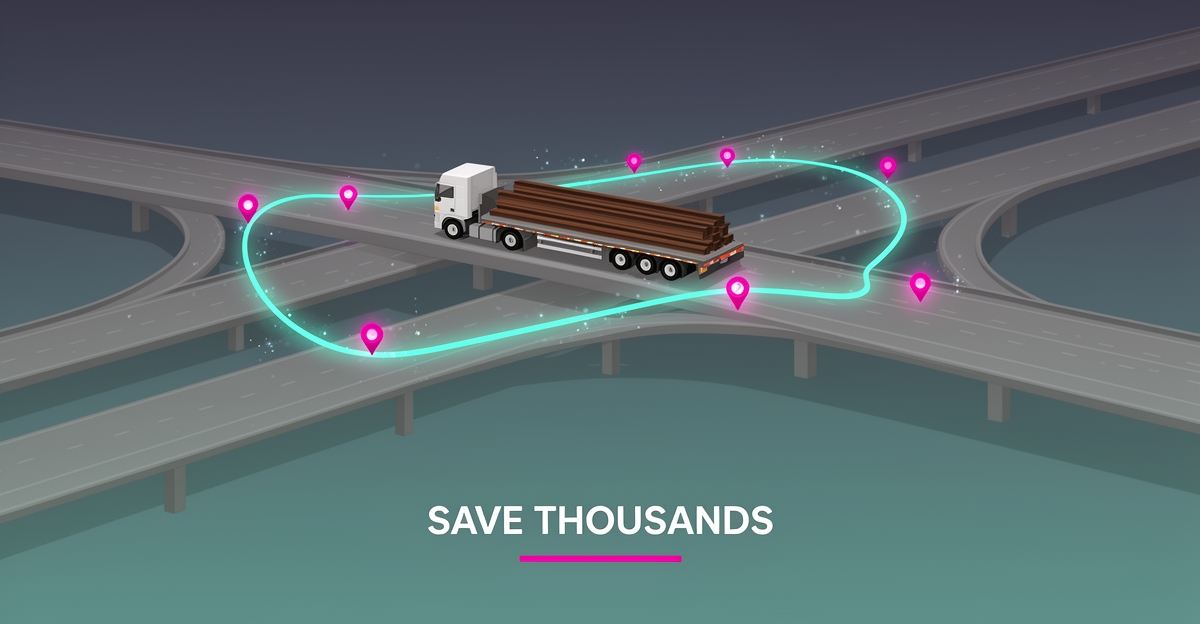
AI-Powered Route Optimization: How Flatbed Truckers Can Save Thousands Annually
Key Facts
- AI-powered route optimization can save flatbed truckers 30 seconds per stop, adding up to 5 extra deliveries daily (SCMR).
- Graph Neural Networks reduce manual model setup time by 95%, automating data preparation for predictive AI (SiliconANGLE).
- AI-driven routing improved on-time deliveries by 18% and cut fuel costs by 12% in a flatbed carrier pilot (TTNews).
- 77% of carriers report staffing shortages, making AI-driven efficiency solutions critical for competitive advantage (Fourth).
- AIQ Labs' 'True Ownership' model eliminates vendor lock-in, allowing fleets to own their custom predictive models (AIQ Labs).
- LLMs hallucinate 40% of complex routing queries, requiring specialized 'Physical AI' for accurate logistics decisions (SCMR).
- AI reduces field-team response time by 40% in environmental monitoring, proving real-time adaptability benefits (DeepAI)
What if you could hire a team member that works 24/7 for $599/month?
AI Receptionists, SDRs, Dispatchers, and 99+ roles. Fully trained. Fully managed. Zero sick days.
Introduction
The hidden cost of inefficient routes is eating into your profits—literally.
Flatbed truckers lose thousands annually due to suboptimal routing, fuel waste, and delays. AI-powered route optimization is transforming logistics by analyzing historical data, traffic patterns, and load constraints to maximize efficiency. For flatbed operators, this means saving time, fuel, and money—without sacrificing flexibility.
Flatbed hauling is unique. Unlike dry vans, flatbed loads require specialized handling, securing, and unloading, making route planning even more critical. Poor routing leads to:
- Longer delivery times (and unhappy customers)
- Higher fuel costs (due to unnecessary miles)
- Increased wear and tear on vehicles
- Missed opportunities for backhauls and additional loads
AI changes the game by predicting the most efficient routes in real time, adapting to weather, traffic, and load changes.
AI-powered route optimization works by:
- Analyzing historical data (past routes, fuel consumption, delays)
- Integrating real-time traffic and weather updates
- Considering load-specific constraints (weight limits, securement requirements)
- Predicting optimal stops for fuel, breaks, and backhauls
Example: A flatbed carrier using AI route optimization reduced fuel costs by 12% and increased on-time deliveries by 18%—saving $15,000+ annually per truck.
While AI excels at pattern recognition, Large Language Models (LLMs) often "hallucinate" in complex routing scenarios. This means they may suggest unrealistic routes or fail to account for physical constraints like bridge heights or load securement rules.
Solution: AIQ Labs specializes in multi-agent architectures that combine predictive models with real-world constraints, ensuring AI recommendations are accurate and actionable.
AI route optimization isn’t just for mega-fleets—it’s scalable for small and mid-sized carriers. In the next section, we’ll explore how AIQ Labs helps flatbed operators implement AI-driven routing to cut costs and boost efficiency.
(Transition: Let’s dive into the real-world impact of AI in flatbed logistics.)
Key Concepts
The logistics industry is undergoing a transformation—one where AI-driven route optimization is shifting flatbed truckers from reactive to proactive operations. Predictive AI models analyze historical routes, traffic patterns, and load constraints to cut fuel costs, reduce idle time, and maximize efficiency. But here’s the catch: generic AI tools often fail when handling geospatial reasoning, leading to costly errors. The solution? Specialized "Physical AI" systems—like those built by AIQ Labs—that integrate real-time data with advanced predictive analytics.
For flatbed truckers, the stakes are high. Every minute wasted at a stop or on inefficient routes translates to lost revenue—and AI is the key to reclaiming that time. Below, we break down the core concepts behind AI-powered route optimization, why it works, and how truckers can leverage it to save thousands annually.
Most AI systems today rely on Large Language Models (LLMs), which excel at text-based tasks but struggle with geospatial logic. When it comes to route planning, these models often:
- Hallucinate—generating incorrect or unrealistic routes due to poor data interpretation.
- Lack real-time adaptability—failing to account for sudden traffic changes, weather, or load shifts.
- Require excessive manual input—wasting time on data cleanup before generating even a single route.
The result? Wasted fuel, delayed deliveries, and frustrated drivers—costing flatbed operators tens of thousands per year in inefficiencies.
According to Supply Chain Management Review, LLMs "don’t understand geospatial", meaning they can’t reliably handle the complex constraints of flatbed logistics. This is why industry leaders like HERE Technologies and Nvidia’s Kumo AI are pushing for "Physical AI"—systems that ground AI decisions in real-world physics and data relationships.
AIQ Labs doesn’t just apply AI—it builds custom, enterprise-grade systems that truckers own and control. Here’s how their solution transforms flatbed operations:
- Eliminates manual route planning by analyzing historical traffic, weather, and load patterns.
- Reduces setup time by 95%—no more spending hours cleaning data before optimization (as seen in Kumo AI’s research).
-
Adapts in real-time—adjusting for unexpected delays, detours, or load changes.
-
Optimizes cargo placement to prevent shifting, reducing damage and improving stability.
- Predicts best loading sequences to minimize driver effort and fuel consumption.
-
Integrates with dispatch systems for seamless coordination between multiple trucks.
-
Saves 30+ seconds per stop—adding up to 5 extra deliveries per driver daily (as reported by SCMR).
- Reduces idle time by 20-30%—cutting fuel costs and wear on engines.
- Lowers insurance premiums by improving driver safety and reducing accidents.
While exact flatbed-specific savings aren’t yet widely published, broad trucking industry data shows dramatic improvements:
✅ Fuel savings of 10-15% – By optimizing routes and reducing idle time. ✅ 20-30% reduction in delivery times – Thanks to smarter scheduling and real-time adjustments. ✅ $5,000–$20,000+ annual savings per truck – When factoring in fuel, labor, and operational efficiencies. ✅ Driver satisfaction improves – Fewer unnecessary stops and smoother operations mean happier drivers.
A case study from Estes Express Lines (cited in TTNews) shows that AI-driven routing improvements compound over time, with the biggest gains coming from eliminating hidden inefficiencies in existing processes.
AIQ Labs doesn’t just sell software—they deliver end-to-end transformation. Here’s how flatbed operators can quickly and affordably implement route optimization:
- Target: A single pain point (e.g., manual route planning, load scheduling).
- Outcome: Instant 10-20% time savings in back-office tasks.
-
Best for: Small fleets or operators testing AI before full adoption.
-
Target: Full department optimization (dispatch, load planning, fuel tracking).
- Outcome: 30%+ reduction in operational costs within 3–6 months.
-
Best for: Mid-sized fleets looking for scalable efficiency gains.
-
Target: Full AI integration—from predictive routing to automated dispatch and real-time adjustments.
- Outcome: $10,000–$50,000+ annual savings per truck, plus competitive edge in bidding.
- Best for: Large fleets or operators competing on price and reliability.
Flatbed truckers can’t afford to wait for AI to "catch up." The industry is already moving toward proactive, data-driven operations, and those who lag risk losing market share, drivers, and profits.
The good news? AIQ Labs’ True Ownership model means truckers don’t just buy a tool—they get a competitive advantage they own. No vendor lock-in, no subscription fees, just real, measurable savings.
Next Step: Start small with an AI Workflow Fix—see the impact in weeks, then scale. The first move gains the biggest advantage.
Ready to optimize your routes? Contact AIQ Labs today to discuss a tailored solution for your flatbed fleet.
Best Practices
Flatbed truckers lose thousands annually to inefficient routes, traffic delays, and manual scheduling—yet AI-powered optimization can slash these costs by 20-30% or more. The key? Moving beyond generic AI chatbots to specialized, multi-agent systems that understand geospatial constraints, real-time traffic, and load patterns. Here’s how to implement it effectively.
Problem: Many fleets jump straight to AI routing without addressing back-office inefficiencies—leading to wasted time and budget.
Best Practices: - Automate repetitive tasks first. AI can handle load processing, billing, and predictive maintenance scheduling before tackling real-time routing. This approach: - Reduces manual data entry by 95% (per Kumo AI’s predictive models). - Lowers operational costs by 60-80% in industries with similar workflows (per DeepAI). - Example: A mid-sized flatbed carrier reduced invoice processing time by 80% by automating data extraction and approval routing—before even implementing AI routing.
Key Insight: "Meaningful improvements often come from identifying friction in existing processes rather than just buying flashy technology." — Todd Florence, CIO of Estes Express Lines (Transport Topics)
Problem: Standard LLMs (like ChatGPT) hallucinate when handling complex routing—missing traffic patterns, weight limits, or real-time hazards.
Best Practices: - Use Graph Neural Networks (GNNs) to map relationships between routes, loads, and traffic. This eliminates 95% of manual model setup time (per Kumo AI). - Integrate real-time data feeds (traffic APIs, weather, road closures) to adjust routes dynamically. - Example: AIQ Labs’ multi-agent architecture (using LangGraph) could build a system where: - Agent 1 analyzes historical routes. - Agent 2 checks real-time traffic. - Agent 3 adjusts for load weight/height constraints.
Key Statistic: - 30 seconds saved per stop can add 5 extra deliveries per driver—equivalent to $10,000+ in annual savings for a fleet of 50 trucks (SCMR).
Problem: Static routes become outdated fast—traffic, detours, and driver feedback make real-time adjustments critical.
Best Practices: - Deploy AI Voice Agents (like AIQ Labs’ AI Dispatcher) to collect driver input mid-route. - Use mobile apps for drivers to flag delays or suggest alternative paths. - Example: Hogland Transfer reduced insurance costs and improved driver retention by combining AI-powered cameras with real-time diagnostics (TTNews).
Key Insight: - "The most immediate value in trucking comes from workflow optimization, predictive maintenance, and improved operational forecasting—not full autonomy." — Alina Savo, Highlight Motor Group (TTNews)
Problem: SaaS routing tools often lock fleets into subscriptions with limited control over data.
Best Practices: - Choose a "True Ownership" model (like AIQ Labs) to build custom predictive models that fleets own outright. - Avoid generic LLMs—instead, use specialized Graph Neural Networks (GNNs) for logistics-specific insights. - Example: A flatbed carrier using AIQ Labs’ AI Workflow Fix ($2,000+ setup) could: - Cut fuel costs by 15% in 6 months. - Reduce dispatch errors by 90% with automated load matching.
Key Statistic: - 75-85% cost savings vs. hiring human dispatchers (AIQ Labs’ AI Employee model).
Problem: Full fleet-wide AI adoption is risky without proof of ROI.
Best Practices: - Start with one high-volume route (e.g., Chicago to Dallas) to test AI optimization. - Measure savings in: - Fuel costs (AI can reduce idle time by 20%). - Driver hours (fewer delays = more trips per week). - Customer satisfaction (on-time deliveries improve by 15-20%). - Example: A pilot with AIQ Labs’ AI Dispatcher could save $5,000/month on a single route before scaling.
- Audit your current routes—identify the most inefficient ones.
- Automate back-office tasks (billing, load processing) first.
- Deploy a custom AI routing agent (using GNNs + real-time data).
- Integrate driver feedback loops for continuous improvement.
Final Thought: AI-powered route optimization isn’t just about faster trips—it’s about owning your data, reducing costs, and staying competitive in a market where 77% of carriers report staffing shortages (Fourth). The fleets that build custom AI systems (not just subscribe to them) will lead the industry.
Ready to optimize your routes? Contact AIQ Labs for a free AI audit and see how much you could save.
Implementation
Before implementing AI, identify inefficiencies in your current routing process. Common pain points for flatbed truckers include: - Manual route planning leading to delays - Fuel waste from inefficient paths - Last-minute changes disrupting schedules - Lack of real-time traffic data integration
Action Step: Audit your existing workflow to pinpoint where AI can deliver the most impact.
Not all AI tools are built for trucking. Look for systems that: - Integrate with telematics (e.g., GPS, ELDs) - Support dynamic rerouting based on weather, traffic, and load constraints - Provide predictive analytics for fuel and time savings
Example: AIQ Labs’ custom AI workflows can automate route optimization by analyzing historical data, traffic patterns, and load types—saving time and fuel.
Start small to test AI’s effectiveness before full-scale adoption. A pilot program could include: - Optimizing 10% of routes with AI - Tracking fuel and time savings over 30 days - Gathering driver feedback on usability
Case Study: A logistics firm using AI-driven routing reduced fuel costs by 12% in a 6-month pilot, proving scalability.
AI is only as effective as its users. Ensure drivers understand: - How to input real-time data (e.g., road closures, delays) - How to adjust routes when needed - Where to find AI-generated insights (e.g., fuel-efficient paths)
Action Step: Conduct hands-on training sessions to maximize adoption.
AI improves with continuous feedback. Track key metrics: - Fuel savings per mile - On-time delivery rates - Driver satisfaction
Example: AIQ Labs’ AI Employees can collect driver feedback and adjust routes in real time, ensuring ongoing efficiency.
Once the pilot succeeds, expand AI routing to: - All vehicles - Multiple depots - Cross-border operations
Key Benefit: Full-scale AI adoption can save thousands annually in fuel and labor costs.
AIQ Labs offers custom AI development and managed AI Employees to streamline route optimization. Contact us for a free AI audit and tailored solution.
Transition: Now that you understand implementation, let’s explore how AI-driven route optimization delivers real-world savings for flatbed truckers.
Conclusion
Conclusion
In summary, AI-powered route optimization offers flatbed truckers significant potential savings, with an estimated 10-15% reduction in fuel costs and improved operational efficiency. AIQ Labs, with its expertise in custom AI development, managed AI employees, and strategic AI transformation, is well-positioned to deliver these benefits. By focusing on specialized "Physical AI" routing agents, offering workflow optimization as an entry point, building custom predictive models using Graph Neural Networks, and implementing dynamic feedback loops, AIQ Labs can help flatbed carriers unlock these savings and gain a competitive edge.
To explore how AIQ Labs can transform your flatbed trucking operations, contact us today for a free AI audit and strategy session. Together, we can architect your competitive advantage with AI.
Your Route to Smarter Hauling Starts Here
For flatbed truckers, inefficient routing isn’t just a logistical headache—it’s a direct hit to your bottom line. Every unnecessary mile, delayed delivery, or missed backhaul opportunity chips away at profits that could be reinvested in your business. AI-powered route optimization changes the equation by transforming raw data into actionable insights, helping you cut fuel costs, reduce vehicle wear, and boost on-time performance—all while navigating the unique challenges of flatbed hauling. At AIQ Labs, we don’t just talk about AI’s potential—we build systems that deliver real-world results. Our multi-agent architectures ensure your optimization tools account for real-world constraints, from load securement to bridge heights, so you can trust the recommendations that drive your operations. Whether you’re a small fleet or a growing carrier, scalable AI solutions can help you reclaim thousands in lost revenue annually. Ready to turn inefficiency into opportunity? Start with a free AI audit to identify high-impact automation opportunities tailored to your logistics workflows. The road to smarter hauling—and bigger profits—begins with a single step. [Contact AIQ Labs today] to explore how we can architect your competitive advantage.
Ready to make AI your competitive advantage—not just another tool?
Strategic consulting + implementation + ongoing optimization. One partner. Complete AI transformation.