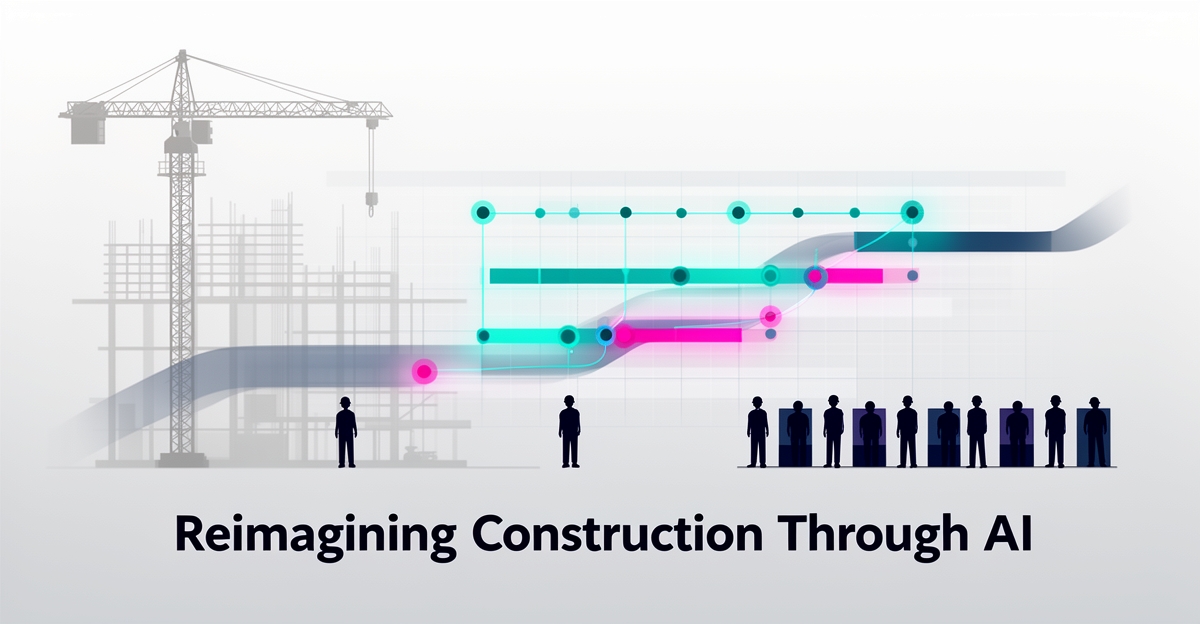
AI-Powered Scheduling: How Construction Firms Can Reduce Labor Waste by 40%
Key Facts
- Industry analyses suggest roughly 77% of construction projects finish late, with average cost overruns near 28% according to industry research
- AI-powered scheduling tools are reported to reduce delays by 15-20% based on industry analysis
- AI scheduling can deliver 17-30% fewer schedule overruns per construction AI research
- AI can improve schedule prediction accuracy by 25-40% per AI-driven construction scheduling research
- AI may reduce overall project duration by 15-25% per construction scheduling research
- AI-powered construction monitoring has been linked to reductions in safety incidents of up to 40% per comparative software analysis
- AI cost control has been credited with cutting budget overruns by 60-75% per construction management comparison
Hire a team member that works 24/7 — for less than a part-time wage.
AI receptionists, SDRs, dispatchers and 99+ roles. Trained on your business, fully managed.
Not sure where to start? Ask our AI planner
The True Cost of Idle Crews: Why 77% of Projects Run Late
Construction is one of the few industries where missing the deadline has quietly become the norm rather than the exception. According to industry research on construction project management, roughly 77% of construction projects finish late, carrying an average cost overrun near 28% — a compounding failure that drains margins on nearly every job.
The root cause rarely sits with the crews themselves. It lives in the schedule. Most firms still rely on static CPM plans built weeks before ground breaks, updated manually in spreadsheets whenever a project manager finds the time. The moment weather shifts, a subcontractor slips, or a delivery runs late, that plan becomes fiction — and the people on site pay for it in idle hours.
Idle labor is where the financial damage concentrates. When a crew of ten stands down for even half a day because materials haven't arrived or a predecessor task ran long, the firm absorbs the full cost of wages, equipment, and site overhead with zero output. Multiply that across a portfolio of projects and the waste becomes structural, not incidental.
The mechanics of this failure follow a predictable pattern:
- Static CPM schedules that can't adapt when conditions change mid-project
- Manual crew assignments made without real-time visibility into availability or skill requirements
- Weather disruptions absorbed reactively instead of planned around probabilistically
- Dependency conflicts discovered on-site rather than flagged before crews mobilize
Each of these failure points traces back to the same limitation: human schedulers, no matter how experienced, cannot continuously recalculate thousands of interdependent variables in real time. Traditional scheduling treats the plan as a fixed artifact, when every project manager knows it's a living system under constant stress.
The cost of getting this wrong extends beyond any single project. Firms that consistently run late absorb reputational damage that suppresses future bid competitiveness, while repeated overruns erode the working capital needed to take on larger contracts. Schedule failure compounds across the entire business, not just the job site.
What makes this moment different is that the problem is now solvable in practice. Research on AI-driven construction scheduling suggests AI-powered approaches can improve schedule prediction accuracy by 25-40% — not through marginal tweaks, but by replacing deterministic planning with probabilistic models that account for weather forecasts, crew availability, and historical delay patterns simultaneously.
The gap between firms that treat scheduling as an administrative chore and those that treat it as a competitive lever is widening fast. As Forbes analysis of AI in construction puts it, this is "not just an incremental improvement, but a fundamental reimagining of how construction projects are planned and managed." For firms still running on static plans and gut instinct, the 77% statistic isn't an industry average — it's a warning.
How AI Scheduling Agents Eliminate Idle Time and Overruns
Construction schedules rarely fail because of one big mistake—they fail because of thousands of small mismatches between plans, people, and real-world conditions. AI scheduling agents close that gap by continuously recalculating what should happen next, instead of waiting for a weekly update meeting.
Traditional scheduling tools depend on manual inputs, static dependencies, and deterministic CPM logic. In contrast, AI-powered construction scheduling can automate schedule creation, infer dependencies from project data, and update plans in real time as field conditions change. That shift matters because industry analyses suggest most construction projects finish late, with average cost overruns near 28%.
The biggest gains come from prediction. Instead of treating the schedule as fixed, AI evaluates project timelines, crew availability, and even weather forecasts to identify where slippage is likely before it hits the critical path. Research on AI-driven construction scheduling points to 25-40% better prediction accuracy and 15-25% shorter project durations.
That predictive layer also reduces idle time. When one trade finishes early, materials arrive late, or weather disrupts exterior work, the system can re-sequence tasks and reassign crews before labor hours are wasted. This is where probabilistic risk analysis outperforms deterministic scheduling: Monte Carlo-style simulations expose the range of possible outcomes rather than assuming one best-case timeline.
The reported operational impact is significant:
- 15-20% fewer delays from predictive schedule optimization
- 17-30% fewer schedule overruns with leading AI scheduling tools
- Real-time schedule adaptation instead of manual updates
- AI-powered crew assignment based on availability, dependencies, and site conditions
This does not remove human judgment from the process. As industry guidance notes, the best results come from experienced schedulers who understand both traditional methods and AI capabilities. That is why firms working with AIQ Labs typically deploy custom scheduling agents — through AI Employees like dispatchers and schedulers, or a targeted Workflow Build — that support project managers rather than replace them, surfacing risks, recommending adjustments, and keeping resources aligned as conditions change.
For construction firms, the practical value is simple: fewer crews standing around, fewer missed handoffs, and fewer surprises buried in the schedule. Better scheduling intelligence turns labor waste into usable capacity before it disappears.
The Human-AI Partnership: Why Schedulers Still Matter
The biggest fear about AI scheduling isn't the technology, it's the idea that it will replace the people who know a job site best. In practice, the firms seeing the largest gains treat AI as a co-pilot for their schedulers, not a replacement.
AI analyzes project timelines, crew availability, and weather forecasts to optimize scheduling, but it still relies on human judgment to interpret what those optimizations mean on the ground. Industry research notes that the best results come from experienced schedulers who understand both traditional methods and AI capabilities. That partnership is what turns data into decisions.
Construction remains difficult to predict. Project management analysis finds most construction projects finish late, with average cost overruns near 28%. AI-powered scheduling tools are reported to reduce delays by 15-20% and deliver 17-30% fewer schedule overruns, yet those gains only materialize when human managers validate assumptions and override outputs that don't fit site realities.
The research-identified challenges reinforce why schedulers stay central:
- High-quality data is required for AI algorithms to function effectively
- Bias in AI algorithms can lead to inaccurate predictions
- Human expertise is required to interpret AI outputs and make strategic decisions
- Integration with existing systems and processes can be challenging
Schedulers provide the context AI cannot infer, such as crew skill mix, subcontractor reliability, and local conditions. AI can improve schedule prediction accuracy by 25-40% and cut overall project duration by 15-25% according to AI-driven construction scheduling research, but only when historical data is clean and the model is guided by people who know which variables matter.
This is the human-AI partnership AIQ Labs builds into its scheduling agents. Whether deployed as an AI Employee working alongside your dispatch team or as part of a broader AI Operating System, the agents reduce idle time and improve resource allocation while schedulers retain control over final sequencing, risk calls, and client communication. The result is augmented expertise, not automated replacement.
When managers are trained to read AI recommendations critically, they catch data gaps early and prevent biased assumptions from propagating. That oversight protects the project and builds trust with crews who see schedules as realistic, not algorithmic.
Ultimately, AI handles speed and scale. Humans provide judgment, accountability, and site sense. Firms that protect that balance get the efficiency gains without losing the experience that keeps jobs safe and on track.
Your 5-Step Path to AI-Optimized Crew Scheduling
With most construction projects finishing late and average cost overruns near 28%, according to industry data, the need for change is clear. Moving to AI-optimized scheduling doesn't require ripping out your existing systems—it requires a structured approach that builds on what you already have.
The first step is assessing your current scheduling processes to identify where delays and inefficiencies actually occur. Document how you currently handle crew assignments, weather disruptions, and timeline adjustments. This baseline reveals the specific pain points where AI can deliver immediate value. AIQ Labs' 2-minute Fit Check is designed to surface exactly these bottlenecks.
Next, choose the right AI approach for your operation. You can adopt off-the-shelf platforms like ALICE Technologies or Buildots, or build custom AI scheduling agents that integrate directly with your existing project management and communication tools. Custom solutions — such as dispatcher and scheduler AI Employees from AIQ Labs, or a fixed-price Workflow Build targeting your scheduling workflow — work alongside your human managers to analyze project timelines, crew availability, and weather forecasts, with industry research pointing to 15-20% reductions in delays (source).
Data quality determines success. AI algorithms require high-quality historical project data to generate accurate predictions and avoid the bias that can lead to poor scheduling decisions. Clean your existing records, standardize data entry formats, and ensure your project timelines, resource logs, and weather histories are accessible and accurate.
Training your team is equally critical. As noted in construction AI analysis, "The best results come from experienced schedulers who understand both traditional methods and AI capabilities." Your project managers need to interpret AI outputs, understand confidence levels, and know when to override automated recommendations based on site-specific knowledge.
Finally, monitor performance continuously. Track metrics like schedule variance, labor idle time, and resource utilization rates. Firms implementing AI scheduling typically report 25-40% improvement in schedule prediction accuracy and 15-25% reduction in overall project duration, according to scheduling research.
Key implementation priorities include:
- Audit current scheduling workflows to identify bottlenecks
- Select AI tools that integrate with your existing software stack
- Clean and standardize historical project data
- Train schedulers to interpret probabilistic AI recommendations
- Establish KPIs for schedule accuracy and labor efficiency
Whether you choose an enterprise platform or a custom-built solution, the goal remains the same: transforming scheduling from a reactive administrative task into a predictive strategic advantage. AIQ Labs builds in milestones with clear payment stages, so you only commit to the next phase once the last one has proven itself — see pricing models for details.
From Labor Waste to Competitive Advantage
AI-powered scheduling does more than trim idle time—it transforms construction operations into lean, resilient systems that deliver measurable business impact. Firms using AI scheduling report 15-20% fewer delays, directly cutting labor waste and keeping crews productive. Industry research shows these tools can also improve schedule prediction accuracy by 25-40%, enabling proactive resource allocation that prevents costly rework and overtime.
This scheduling foundation unlocks broader advantages. Companies integrating AI scheduling with AI-powered cost control report 60-75% fewer budget overruns, as real-time data prevents scope creep and material waste. Comparative analysis suggests AI-driven cost management, when paired with optimized scheduling, creates a compounding effect on financial predictability. AI monitoring has also been linked to reductions in safety incidents of up to 40%, protecting workers while avoiding downtime from investigations or regulatory penalties (source).
- Reduced labor waste through dynamic crew allocation based on skill, availability, and weather forecasts
- Fewer budget overruns via AI cost control that adjusts for material price fluctuations and change orders
- Lower incident rates from AI monitoring that predicts risks before they materialize on-site
- Improved client satisfaction from predictable timelines and transparent progress tracking
- Stronger competitive positioning through consistent on-time, on-budget delivery
AIQ Labs positions scheduling as the entry point to a fully AI-optimized construction operation. Firms can start with a single scheduling Workflow Build, add dispatcher and scheduler AI Employees, and — when the results justify it — grow into a connected AI Operating System spanning estimating, procurement, and field execution, built in phases and owned outright. This phased approach minimizes disruption while delivering immediate return—turning a traditional pain point into a strategic advantage that scales with project complexity. For construction leaders ready to move beyond manual scheduling, the next step is assessing current workflows to identify high-impact automation opportunities. A focused evaluation reveals where AI scheduling can deliver the fastest wins. To begin, take the 2-minute Fit Check and book a free 30-minute strategy call to map your biggest bottlenecks and explore how AI scheduling can become your competitive edge.
Still paying for 10+ subscriptions that don’t talk to each other?
We build custom AI systems you own outright. No vendor lock-in. Full control.
Not sure where to start? Ask our AI planner
Frequently Asked Questions
Why do construction crews end up idle so often?
Can AI actually predict delays before they happen?
Will AI scheduling replace my project managers?
How much time and waste can AI scheduling really save?
What data do I need to get started with AI scheduling?
Is AI scheduling a complete overhaul of our current systems?
Turn Schedule Chaos into Your Competitive Edge
Construction firms lose significant money each year to idle crews and preventable delays—industry analyses suggest most projects run late, draining margins with average cost overruns near 28%. AI-powered scheduling changes that by replacing static plans with probabilistic models that predict slippage before it happens, dynamically reassign crews, and reduce delays by 15-20% while improving schedule accuracy by up to 40%. The real advantage comes not from replacing schedulers, but augmenting them: human expertise guides AI recommendations, ensuring plans stay grounded in site reality while eliminating waste from weather gaps, material delays, and dependency blind spots. Firms that treat scheduling as a strategic lever—not an admin task—gain predictable delivery, stronger client trust, and the capacity to take on more profitable work. The path forward starts with assessing your current workflow to uncover where AI can drive immediate impact. Take the 2-minute Fit Check to map your bottlenecks and see how intelligent scheduling can become your next competitive advantage.
Make AI your competitive advantage — not just another tool.
Strategy, implementation and ongoing optimization. One partner, end to end.
Not sure where to start? Ask our AI planner