AI-Powered Service Ticketing: How Repair Shops Can Reduce Errors and Speed Up Repairs
Key Facts
- Manual ticketing errors lead to wrong parts orders, misdiagnoses, and rework that inflates labor cost per job
- AI ticketing works in six stages: ingestion, language analysis, routing, automatic resolution, escalation, and continuous learning
- Integration depth predicts AI ticketing performance better than the underlying model
- Systems connected only to a knowledge base typically plateau around 28% deflection; adding CRM and order/billing data can push deflection past 50%
- Confidence-based escalation protects customer experience while the system learns your shop's patterns
- A structured rollout — audit, clean knowledge base, narrow launch, then integrate — separates successful implementations from stalled pilots
Hire a team member that works 24/7 — for less than a part-time wage.
AI receptionists, SDRs, dispatchers and 99+ roles. Trained on your business, fully managed.
Not sure where to start? Ask our AI planner
The Hidden Cost of Manual Ticketing in Repair Shops
Repair shops that rely on manual service ticketing face a cascade of hidden costs that erode efficiency and profitability. Data entry errors from handwritten or typed tickets lead to incorrect parts orders, misdiagnosed issues, and rework that frustrates both technicians and customers. These mistakes aren't just inconvenient — they directly contribute to delayed repairs and technician idle time as staff wait for clarification or correct information. Industry benchmarks on AI-assisted support consistently show that automating ticket intake removes the manual bottlenecks that stretch resolution times, often cutting them substantially.
The inefficiency extends beyond individual tickets. Technicians spend valuable time deciphering unclear notes or chasing down missing details instead of performing repairs, which reduces their productive hours and increases labor costs per job. Manual systems also struggle to scale during peak seasons, leading to backlogs and missed service commitments that damage customer trust. Automated intake and routing, by contrast, apply the same process to every request, which improves consistency and reliability under pressure.
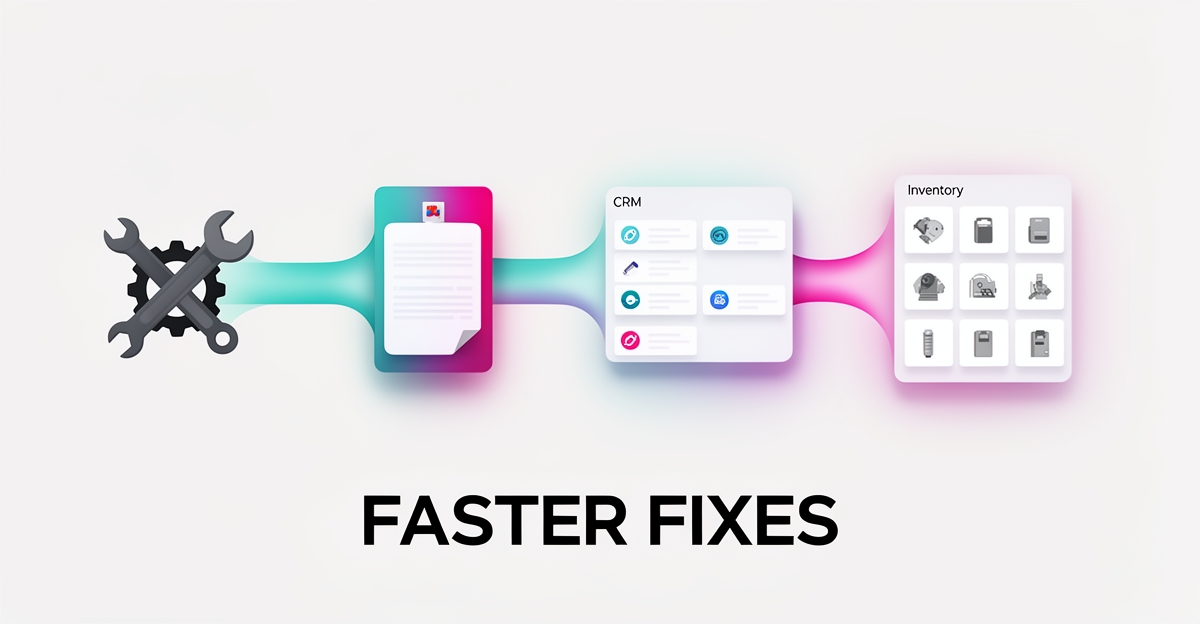
For repair shops, the solution lies in integrating AI directly into existing workflows — connecting customer calls or forms to CRM, inventory, and scheduling systems to auto-generate precise service tickets. This approach ensures technicians receive real-time, accurate data including machine specifications, service history, and parts availability, reducing errors and enabling faster first-time fixes. AIQ Labs builds exactly this kind of production-ready integration through AI Workflow Builds, rebuilding the ticketing workflow that costs a shop the most — at a fixed price, in phases, with full ownership of the finished system. By automating ticket creation and updates, repair shops transform a source of friction into a streamlined process that keeps bays busy and customers satisfied.
How AI-Powered Ticketing Actually Works in Service Environments
When a customer describes a grinding noise and a leak "somewhere under the machine," the difference between a good AI ticketing system and a bad one comes down to whether it truly understands what was said. Modern systems process every inbound contact through six distinct stages, and each stage determines whether a repair shop ends up with an accurate, actionable ticket or another manual data-entry headache.
The pipeline works like this:
- Multichannel ingestion: every call, form, email, or portal message lands in one unified queue with no manual pre-sorting.
- Language analysis: natural language processing extracts intent, urgency, and sentiment — reading actual meaning, not just keywords.
- Learned routing: models trained on historical tickets categorize the request and route it to the right technician based on past patterns.
- Automatic resolution: for well-defined requests, the system searches knowledge sources semantically and executes actions if integrations allow.
- Confidence-based escalation: when confidence drops below a set threshold, the ticket routes to a human with full history attached.
- Continuous learning: escalations and technician corrections become training data, surfacing knowledge gaps automatically.
Speed is where this pays off immediately. AI-handled intake responds in seconds rather than minutes, and because the ticket is complete and accurate from the start, technicians spend their hours turning wrenches instead of chasing clarification. Consistency improves too: an automated pipeline applies the same checks to every request, which is why automated intake typically shows far fewer missed service commitments than purely manual workflows.
But here's the finding that contradicts most vendor pitches: the number of systems the AI has live access to predicts performance better than which model it runs. Teams running a knowledge base alone typically plateau at roughly 28% deflection. Adding CRM connections pushes that to around 38%, and integrating order or billing data pushes deflection past 50%.
For repair shops, that integration depth is everything. An AI that can only read a service manual is far less capable than one that can pull live machine specifications, parts availability, and complete service history. This is why systems built to integrate directly into existing shop operations — extracting machine details from calls or forms, generating tickets, and updating job logs in real time — deliver such a meaningful reduction in manual entry errors. AIQ Labs builds exactly this kind of production-ready integration, connecting the AI to the inventory, CRM, and scheduling systems a shop already runs.
The last stage matters most over time: escalated tickets and technician corrections feed back into the model, so the system gets sharper with every job. Shops that treat the AI as a static tool plateau; shops that feed it real repair outcomes build a compounding asset they own outright.
Implementing AI Ticketing: A Repair Shop-Specific Action Plan
The difference between AI ticketing success and failure often comes down to implementation approach — not the technology itself. Teams that follow a structured rollout tend to see results in weeks, while those skipping foundational steps can stall in pilot mode for months.
Start with a comprehensive ticket audit of your last six months. Group service requests by type and identify your top ten volume drivers. In most operations, a small share of ticket types represents the bulk of total volume — targeting these first delivers visible wins quickly.
Next, clean your knowledge base before going live. Stale documentation is a leading cause of poor AI responses in new deployments. For repair shops, this means verifying that machine specifications, service procedures, and parts catalogs are current and complete.
Launch with a narrow scope: one channel and three to five high-volume, standardized intents. Set confidence thresholds conservatively so the AI escalates anything uncertain. This confidence-based escalation protects customer experience while the system learns your shop's patterns.
The most critical phase involves integration depth. Systems connected only to a knowledge base typically plateau at roughly 28% deflection, while systems integrated with CRM and operational data can achieve 50% or higher resolution rates. For automotive service operations, this means connecting:
- Inventory management for real-time parts availability
- CRM for customer service history and vehicle records
- Scheduling systems for technician workload and specialization
- Job logging platforms for automatic status updates
AIQ Labs builds these integrations directly into existing shop infrastructure, creating unified workflows where AI extracts machine details from customer calls, generates accurate service tickets, and updates job logs without manual entry. This deep systems integration — delivered through AI Workflow Builds in fixed-price phases, or as part of a full AI Operating System for shops that want one connected layer across the whole business — separates high-performing implementations from disappointing ones.
Expand to additional channels only after proving reliability in your initial scope. Well-configured AI tools routinely resolve a large share of routine tickets autonomously. The final phase brings voice, email, and text channels online, creating a unified intake system that captures every service request accurately regardless of how customers reach you. If you're not sure where to start, the two-minute Fit Check will tell you quickly whether a ticketing build makes sense for your shop.
Still paying for 10+ subscriptions that don’t talk to each other?
We build custom AI systems you own outright. No vendor lock-in. Full control.
Not sure where to start? Ask our AI planner
Frequently Asked Questions
How much can AI-powered ticketing reduce resolution times in repair shops?
Why is integration depth more important than the AI model itself for ticketing performance?
What are the six stages of how AI-powered ticketing systems work?
What should repair shops do first when implementing AI ticketing?
How does AIQ Labs ensure repair shops own their AI systems without vendor lock-in?
From Friction to Flow: The Repair Shop That Runs Itself
Manual ticketing isn't just a paperwork problem — it's a profit leak. Every handwritten note that gets misread, every parts order placed on a wrong model number, every hour a technician spends chasing clarification instead of turning wrenches adds up to real money left on the table. But the real unlock isn't the model — it's the integration. Systems connected only to a knowledge base plateau around 28% deflection; add CRM, inventory, and scheduling data, and that number pushes past 50%. For a repair shop, that means tickets that write themselves from a customer's call, complete with machine specs, service history, and live parts availability, so the bay is ready before the vehicle even arrives. AIQ Labs builds these production-grade integrations into the tools you already run — as a single workflow build or a full AI Operating System — and you own the system and the data outright. Start with a ticket audit of your top request types, clean the knowledge base, and launch on one channel with conservative confidence thresholds. The shops that treat AI as a learning asset — not a static tool — build a compounding advantage with every repair.
Make AI your competitive advantage — not just another tool.
Strategy, implementation and ongoing optimization. One partner, end to end.
Not sure where to start? Ask our AI planner