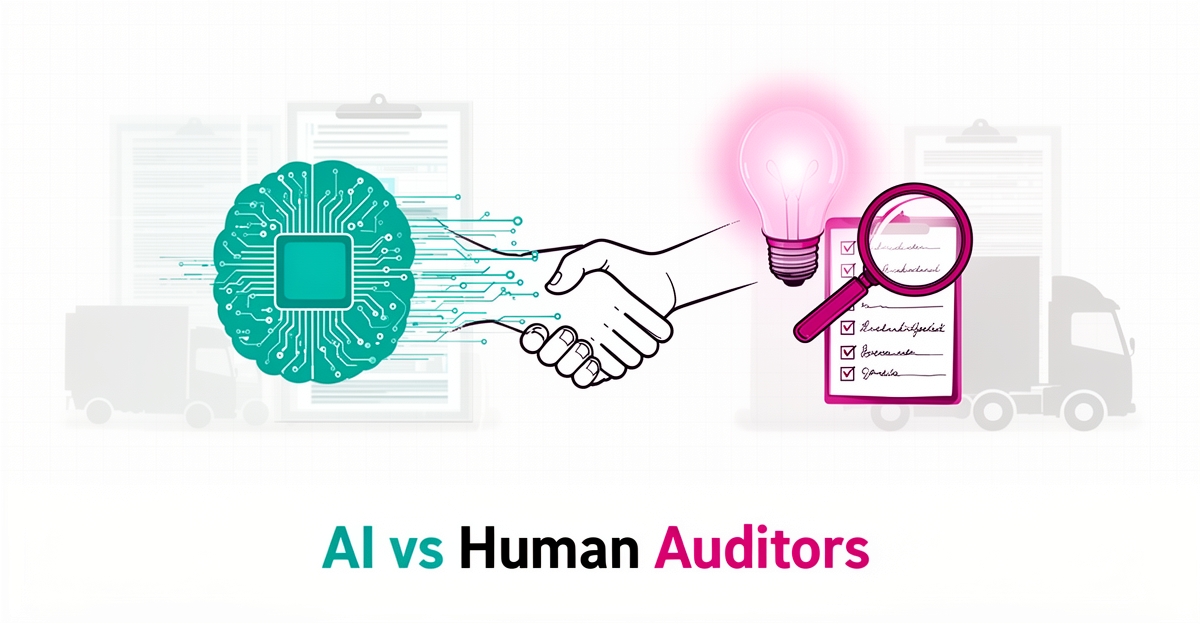
AI vs. Human Auditors: Which Is Better for DOT Compliance in High-Risk Industries?
Key Facts
- Fleet compliance research has reported that roughly 9 in 10 motor carriers fail DOT audits with at least one violation according to fleet compliance analyses
- A majority of Governance, Risk, and Compliance users still manage compliance manually per industry analysis
- AI-powered compliance systems can reduce staffing needs by roughly 25-30% and cut manual review time by as much as 65% per industry analysis
- AI auditors have been reported to reach up to 95% accuracy on data-driven tasks, versus roughly 60-70% for manual methods per industry research
- Around half of organizations report data security and privacy challenges when deploying AI systems per KPMG insights
- A growing share of legal and compliance professionals already use AI tools, with adoption projected to keep climbing per industry analysis
- AI excels at pattern recognition and flagging anomalies across vast datasets per KPMG insights
Hire a team member that works 24/7 — for less than a part-time wage.
AI receptionists, SDRs, dispatchers and 99+ roles. Trained on your business, fully managed.
Not sure where to start? Ask our AI planner
The High-Stakes Reality of DOT Compliance Audits
DOT compliance is not a paperwork exercise in high-risk industries — it is a safety and financial exposure point that can shut down operations overnight.
The scale of the problem is stark. Fleet compliance research has reported that roughly 9 in 10 motor carriers fail DOT audits with at least one violation. That failure rate reflects systemic gaps, not isolated oversights, and it puts carriers at risk of fines, out-of-service orders, and reputational damage.
Manual processes are a core driver of that non-compliance. Industry analysis of GRC practices indicates a majority of Governance, Risk, and Compliance users still manage compliance manually. Manual review is slow, inconsistent, and difficult to scale across fleets, drivers, vehicles, and changing regulations.
When audits rely on spreadsheets and spot checks, violations accumulate between reviews. Processing time stretches from days to weeks, accuracy remains limited by human error, and monitoring is confined to scheduled reviews rather than continuous visibility. The result is reactive corrections instead of prevention.
The consequences extend beyond the audit score. Organizations face:
- Regulatory fines and penalties that escalate with repeat violations
- Operational disruptions from vehicle or driver out-of-service orders
- Increased safety risk exposure for drivers and the public
- Higher insurance costs and loss of customer trust
This is where the human vs. AI auditor comparison becomes practical. Consistency and speed are critical in DOT environments where documentation volume is high and deadlines are non-negotiable. Manual audits struggle with both.
AIQ Labs works with firms designing hybrid models where AI handles pattern recognition and flagging, while humans manage nuanced decisions. That approach mirrors how AI-powered compliance systems can reduce staffing needs by roughly 25-30% and cut manual review time by as much as 65%, according to AI vs manual compliance reporting analysis.
The high-stakes reality is clear: with widespread audit failure rates and majority-manual processes still in use, organizations need a compliance posture that is continuous, auditable, and accurate enough to protect both safety and operations.
Where AI Auditors Outperform Humans — and Where They Fall Short
AI auditors deliver real advantages in speed, accuracy, and scalability compared to traditional manual reviews. According to industry research, AI-powered compliance systems can process massive amounts of data in minutes to hours versus days or weeks for human auditors, with reported accuracy of up to 95% on data-driven tasks versus roughly 60-70% for manual methods. This leap in efficiency enables real-time continuous monitoring instead of periodic scheduled reviews, giving organizations immediate visibility into compliance risks. KPMG insights confirm that AI excels at pattern recognition and flagging anomalies across vast datasets, making it ideal for high-volume DOT environments where manual reviews struggle to keep pace.
- Processing speed: Minutes to hours vs. days or weeks
- Accuracy on data-driven tasks: Reported up to 95% vs. roughly 60-70% for manual methods
- Scalability: Virtually unlimited vs. staff-limited
- Monitoring: Real-time continuous vs. scheduled reviews
Despite these strengths, AI auditors face limitations that require human oversight. Data governance concerns and bias risks remain significant challenges, as compliance gap analyses show roughly half of organizations struggle with data security and privacy issues when deploying AI systems. Additionally, AI lacks the contextual judgment needed for nuanced decisions—such as interpreting ambiguous regulations or assessing intent behind violations—which human auditors provide through experience and ethical reasoning. This is why AIQ Labs designs hybrid models where AI handles repetitive data processing and anomaly detection, while human auditors focus on complex case review, regulatory interpretation, and strategic recommendations, ensuring both efficiency and compliance integrity in high-risk industries.
Why Human Judgment Still Matters in Regulatory Auditing
Even with AI flagging the vast majority of compliance issues in minutes, the remaining gray areas demand something algorithms cannot replicate: professional judgment. KPMG research emphasizes that human intelligence is driven by analytical ability, creativity, intuition, and emotion—qualities artificial intelligence does not yet possess. In high-risk DOT environments, where most carriers fall short on audits, those nuances determine whether a finding becomes a corrective action or a conditional rating.
- Interpreting regulatory intent when guidance conflicts or evolves mid-cycle
- Assessing carrier safety culture beyond checklist completion rates
- Negotiating corrective action plans that balance compliance with operational reality
- Providing strategic advisory that connects audit findings to business risk
- Exercising discretion in edge cases where rigid rule application creates unsafe outcomes
Industry analysis shows a growing share of legal professionals already use AI tools, and adoption keeps climbing precisely because organizations recognize AI handles volume while humans handle value. Compliance leadership perspectives confirm the best approach combines AI efficiency with human expertise for nuanced decision-making. AIQ Labs designs hybrid models where AI employees manage pattern recognition and continuous monitoring, freeing human auditors to focus on the contextual interpretation and strategic advisory that protect both safety ratings and operational continuity.
Building a Hybrid Audit Model That Maximizes Compliance and Efficiency
The most effective path forward for DOT compliance in high-risk industries isn't choosing between AI and human auditors—it's combining their strengths. A hybrid audit model allows AI to handle repetitive data processing, pattern recognition, and initial flagging of compliance risks, while human auditors focus on contextual interpretation, complex judgment calls, and final validation. This division of labor ensures both speed and regulatory rigor.
Organizations implementing such models report significant operational gains. AI-powered compliance systems can reduce staffing needs by roughly 25-30% and cut manual review time by as much as 65%, according to industry analysis. These efficiencies don't come at the expense of accuracy—AI systems have been reported to reach up to 95% accuracy on data-driven tasks, well beyond the 60-70% range typical of manual reviews. By automating the heavy lifting of data aggregation and anomaly detection, teams can redirect their expertise toward higher-value activities like root-cause analysis and preventive strategy development.
The hybrid approach also addresses persistent challenges in manual compliance workflows. A majority of Governance, Risk, and Compliance (GRC) users still manage compliance through manual processes, creating bottlenecks and increasing the risk of oversight. With AI handling continuous monitoring and real-time data processing, human auditors gain the bandwidth to focus on nuanced decisions that require regulatory insight and professional skepticism—areas where algorithms still fall short. This balance is especially critical in DOT-regulated environments, where most carriers fail audits with at least one violation, underscoring the need for both precision and adaptability.
For companies pursuing this model, AIQ Labs offers the strategic guidance and technical execution needed to design and deploy compliant, auditable AI systems that augment—not replace—human expertise. Through AI Workflow Builds, organizations can rebuild the one compliance workflow that costs the most—fixed price, delivered in phases—so machines flag potential issues and humans make the final call. For carriers ready to go further, AI Operating Systems connect compliance monitoring into one operating layer, built in phases and owned outright. The result is a smarter, faster audit process that meets regulatory demands while optimizing resource allocation.
How to Transition From Manual to AI-Augmented DOT Compliance Auditing
With most motor carriers failing DOT audits with at least one violation, the cost of staying manual is measured in fines and downtime. Moving to an AI-augmented audit process doesn't happen overnight—it requires a structured roadmap that balances automation with human judgment.
Step 1: Assess your current compliance gaps. Before deploying any technology, audit how compliance is managed today. It's telling that a majority of GRC users still manage compliance manually, which means most organizations are operating with scheduled reviews, limited scalability, and accuracy rates that hover well below what automated review achieves. Map where violations cluster, which documents take the longest to review, and where human error occurs most often.
Step 2: Select AI tools that integrate with existing systems. An AI platform that can't connect to your dispatch, maintenance, and driver management systems creates more work than it eliminates. Prioritize solutions offering real-time continuous monitoring rather than scheduled reviews—AI-powered compliance systems can cut manual review time by as much as 65% while reducing staffing needs by roughly 25-30%. Data security deserves equal scrutiny: around half of organizations report challenges stemming from data security and privacy concerns, so governance requirements should be built into selection criteria, not bolted on later.
Step 3: Establish human-in-the-loop controls. AI excels at pattern recognition and flagging anomalies, but it cannot replicate human analytical ability, creativity, and intuition. Compliance leadership consistently advises combining AI's efficiency with human expertise to meet growing regulatory demands. Define clearly which decisions the AI makes autonomously and which require human sign-off—nuanced determinations about violations, edge cases, and corrective actions should always route to a qualified auditor.
Step 4: Develop your team's data interpretation skills. The auditor's role is shifting away from manual data analysis toward interpreting findings and providing strategic advice. Invest in training so your compliance staff can evaluate AI-flagged issues, validate outputs, and translate patterns into preventive action. Staying current on regulatory changes remains a human responsibility that no algorithm can own.
This hybrid model—AI handling pattern recognition and flagging while humans manage nuanced decisions—is exactly how AIQ Labs approaches custom compliance systems, with governance frameworks and human-in-the-loop controls designed in from the start rather than retrofitted. Organizations that treat the transition as a phased roadmap, rather than a software purchase, are the ones that move from reactive audit failure to continuous, defensible compliance. Start with the 2-minute Fit Check to see where your biggest compliance gaps sit.
- Assess current gaps: document where manual processes create violations and delays
- Select AI tools with deep integration and real-time monitoring capabilities
- Define human-in-the-loop controls for nuanced and high-stakes decisions
- Train auditors in data interpretation and strategic advisory skills
- Build governance, security, and audit trails into the system from day one
Still paying for 10+ subscriptions that don’t talk to each other?
We build custom AI systems you own outright. No vendor lock-in. Full control.
Not sure where to start? Ask our AI planner
Frequently Asked Questions
How many motor carriers fail DOT audits with at least one violation?
How much can AI-powered compliance systems reduce manual review time and staffing needs?
Why do organizations still need human auditors if AI is faster and more accurate on data tasks?
How many GRC users still manage compliance manually, and why is this a problem?
What are the main limitations of AI auditors in DOT compliance environments?
How does a hybrid AI-human audit model improve compliance outcomes?
From Audit Anxiety to Compliance Confidence
DOT compliance failures aren't random—they're systemic, with most carriers falling short due to manual processes that can't keep pace with volume, velocity, and regulatory complexity. AI auditors bring speed, scalability, and high accuracy to data-heavy tasks, but they still lack the contextual judgment needed for nuanced decisions. The real advantage lies not in choosing between AI and humans, but in building a hybrid model where AI handles pattern recognition and continuous monitoring, freeing human auditors to focus on interpretation, strategy, and preventive action. This approach can reduce staffing needs by roughly 25-30% and cut review time by as much as 65%, turning compliance from a cost center into a competitive advantage. For organizations ready to move from reactive fixes to continuous, defensible compliance, the next step is assessing where manual gaps create the most risk. Start with the 2-minute Fit Check and a free 30-minute strategy call to map your biggest bottlenecks and see where AI-augmented auditing can deliver measurable ROI—no obligation, just clarity on your path forward.
Make AI your competitive advantage — not just another tool.
Strategy, implementation and ongoing optimization. One partner, end to end.
Not sure where to start? Ask our AI planner