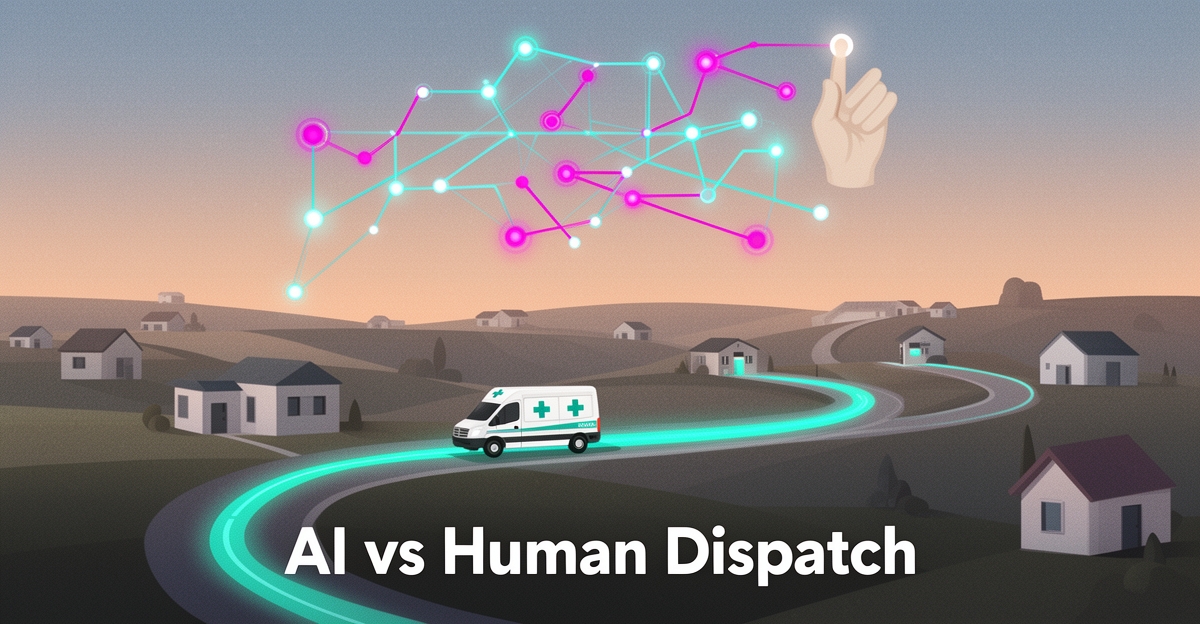
AI vs. Human Dispatchers: Which Is Better for Medical Transport in Rural Areas?
Key Facts
- AI dispatch optimization typically reduces fuel consumption and vehicle maintenance costs through smarter routing, per industry analysis.
- AI dispatch systems analyze real-time data to predict issues and prevent delays before they occur, industry reporting indicates.
- AI can detect anomalies and help providers stay compliant with federal and state regulations, NEMT Platform reports.
- AI Employees typically cost around 80% less than a comparable human hire while providing 24/7/365 availability, according to AIQ Labs.
- AIQ Labs has deployed 200+ multi-agent systems and runs 4 live SaaS products daily.
Hire a team member that works 24/7 — for less than a part-time wage.
AI receptionists, SDRs, dispatchers and 99+ roles. Trained on your business, fully managed.
Not sure where to start? Ask our AI planner
The Rural Medical Transport Dispatch Crisis: Why Current Systems Fail
Rural medical transport faces a critical dispatch crisis that directly impacts patient access to care. Limited staffing forces human dispatchers to manage excessive workloads, often juggling multiple roles while covering vast geographic areas with sparse populations. This strain leads to delayed responses, inefficient routing, and missed opportunities for timely medical transport—particularly in underserved regions where every minute counts.
AI-powered dispatch systems can dramatically reduce scheduling and routing time, freeing human staff from repetitive administrative tasks and allowing them to focus on complex cases requiring judgment and empathy. These systems analyze real-time traffic, driver availability, and patient location to generate optimal routes instantly—something human dispatchers struggle to achieve consistently under pressure. Additionally, AI can detect anomalies and help providers stay compliant with federal and state regulations, reducing errors that could delay or jeopardize patient trips.
The operational burden on human dispatchers in rural settings is compounded by long response times and inefficient resource allocation. Without intelligent routing support, vehicles often travel suboptimal paths, increasing fuel consumption and vehicle wear while delaying patient pickups. AI-powered dispatch systems counter this by optimizing routes and schedules, typically reducing fuel consumption and vehicle maintenance costs through data-driven planning. They also analyze real-time data to predict potential issues and prevent delays before they occur—proactive capabilities that exceed the reactive nature of traditional dispatch workflows.
These challenges highlight why rural medical transport providers are increasingly exploring AI augmentation—not to replace human judgment, but to alleviate systemic strain. By handling routine dispatching tasks around the clock, AI employees ensure consistent coverage while human staff focus on patient-centered care, complex coordination, and emergency escalations. This hybrid approach addresses the core failures of current systems: overburdened personnel, slow response times, and inflexible routing—ultimately improving access to care in communities that need it most. To explore how AI workflow automation can transform your medical transport dispatching, Start the Fit Check to begin a free 30-minute strategy call with an AIQ Labs engineer.
How AI Dispatchers Solve Core Rural Transport Inefficiencies
Rural medical transport faces unique challenges, from vast service areas to limited staffing resources. AI-powered dispatch systems are transforming these operations by addressing core inefficiencies that have long plagued rural providers. Industry analysis suggests AI-powered dispatch can substantially reduce scheduling and routing time, freeing up staff to focus on patient care rather than administrative tasks. These systems operate continuously, ensuring 24/7 availability without the constraints of human shift schedules or fatigue.
AI dispatchers excel at real-time optimization, dynamically adjusting routes based on traffic, weather, and vehicle availability to minimize delays and fuel consumption. Industry analysis indicates AI can optimize routes and schedules, reducing fuel consumption and vehicle maintenance costs while improving on-time performance. This capability is especially critical in rural areas where long distances amplify the impact of inefficient routing. By analyzing live data streams, AI systems prevent bottlenecks before they occur, enhancing both responsiveness and resource utilization.
Beyond scheduling, AI significantly reduces the administrative burden on human staff, allowing them to concentrate on complex cases requiring empathy and judgment. As noted in American Hospital Association research, AI-powered systems help rural hospitals reduce administrative load and improve operational efficiency. This shift enables dispatch teams to prioritize exceptional patient needs while AI handles routine trip assignments, status updates, and scheduling inquiries with consistent accuracy and speed. For organizations seeking scalable solutions, AIQ Labs offers managed AI Employees designed for medical transport workflows, integrating with existing dispatch systems to improve coverage and response reliability.
The Human-in-the-Loop Advantage: Combining AI Precision with Human Judgment
The most effective dispatch systems aren't purely human or purely AI—they're a strategic blend of both. While AI excels at processing vast amounts of data and optimizing routes, human dispatchers bring irreplaceable empathy and nuanced judgment to complex situations.
According to industry analysis, AI-powered dispatch systems can substantially reduce scheduling and routing time, freeing human dispatchers to focus on exceptional cases and customer service. This division of labor is crucial in rural medical transport, where AI is becoming essential infrastructure for sustaining care and access.
However, AI has limitations. It may struggle with complex or emergency situations that require human intuition and emotional intelligence. As the American Hospital Association notes, AI should augment human capabilities, not replace them entirely.
A hybrid approach leverages the strengths of both:
- AI handles routine tasks like scheduling, routing, and basic inquiries
- Humans manage exceptions, complex cases, and provide empathetic support
- AI augments human decision-making with real-time data and analytics
- Humans provide oversight and intervene when AI reaches its limits
This human-in-the-loop model is gaining traction across NEMT and fleet operations, with purpose-built AI dispatch software now widely available for medical transport providers.
At AIQ Labs, we've deployed 200+ multi-agent systems and run 4 live SaaS products daily. Our managed AI Dispatchers work alongside human teams, handling routine tasks while escalating complex issues to human operators. This approach helps clients reduce response times and improve patient satisfaction without adding headcount.
The future of medical transport dispatch lies in this symbiotic relationship between AI and human expertise. By leveraging AI's precision and scalability while preserving human judgment and empathy, rural medical transport providers can deliver faster, more efficient, and more compassionate care.
Ready to explore how a hybrid AI-human dispatch model could transform your medical transport operations? Start with our two-minute Fit Check to identify your biggest opportunities for AI-enhanced efficiency.
Implementing AI Dispatch in Rural Medical Transport: A Practical Roadmap
Adopting AI dispatch in rural medical transport doesn't have to be a leap into the unknown. With a structured approach, providers can overcome implementation hurdles and unlock significant efficiency gains.
The first step is assessing infrastructure readiness. According to industry analysis, AI-powered dispatch systems typically require investment in infrastructure and training. Rural providers must evaluate connectivity, hardware compatibility, and data security protocols before deployment. A phased rollout minimizes disruption while allowing teams to adapt gradually.
Next, prioritize staff training and change management. Human dispatchers may resist workflow changes, so involving them early is critical. Research from the American Hospital Association shows that AI reduces administrative burden, allowing staff to focus on complex cases and patient care. Training programs should emphasize this collaborative dynamic rather than replacement.
Integration with existing tools is another key consideration. AI dispatch systems must connect seamlessly with scheduling software, GPS tracking, and electronic health records. Industry reporting confirms that AI-powered dispatch systems can integrate with existing business tools to provide real-time data and analytics. This interoperability ensures smooth operations without costly overhauls.
For rural providers seeking a managed solution, AIQ Labs offers a practical pathway. Their AI Dispatcher role functions as a 24/7 managed AI employee, handling routing, scheduling, and real-time adjustments. The system integrates with existing tools and typically costs around 80% less than a comparable human hire, according to AIQ Labs. This model addresses infrastructure and training challenges by providing end-to-end support.
Key implementation steps include:
- Conduct a thorough infrastructure and readiness assessment
- Develop a staff training program emphasizing AI-human collaboration
- Ensure seamless integration with existing dispatch and EHR systems
- Start with a pilot program to measure performance and ROI
- Establish ongoing monitoring and optimization protocols
The results justify the effort. Industry analysis shows AI-powered dispatch can substantially reduce scheduling and routing time while optimizing fuel consumption and vehicle maintenance costs. For rural providers operating on thin margins, these efficiencies translate directly to improved patient access and sustainability.
AIQ Labs' approach—building, training, and managing AI employees—removes the technical burden from providers. Flexible payment models, including Start Monthly, Build in Milestones, and Own It Outright, include setup, integrations, and continuous optimization, making advanced dispatch capabilities accessible without massive upfront investment. See pricing for details.
Still paying for 10+ subscriptions that don’t talk to each other?
We build custom AI systems you own outright. No vendor lock-in. Full control.
Not sure where to start? Ask our AI planner
Frequently Asked Questions
Can AI really reduce scheduling and routing time in rural medical transport?
Will using AI dispatchers replace human workers in rural medical transport?
How does AI help reduce fuel consumption and vehicle maintenance costs in rural medical transport?
What kind of training or infrastructure is needed to implement AI dispatch in a rural medical transport operation?
Can AI dispatch systems work 24/7 without breaks or shift changes?
How much does a managed AI dispatcher cost compared to a human hire?
The Smarter Way to Keep Rural Patients Moving
Rural medical transport doesn't need a choice between AI and human dispatchers — it needs both working together. AI excels at the 24/7 heavy lifting: cutting scheduling and routing time through real-time optimization, preventing delays before they happen, and reducing fuel and maintenance costs across vast service areas. Humans remain essential for empathy, complex escalations, and nuanced judgment that algorithms can't replicate. The most resilient operations use a human-in-the-loop model where AI handles routine dispatch, status updates, and compliance monitoring while staff focus on exceptional cases and patient-centered care. For providers ready to test this hybrid approach, start with a clear readiness check, staff training focused on collaboration, and a pilot that measures response time and coverage. AIQ Labs offers managed AI Dispatcher roles designed for medical transport that integrate with existing tools and work alongside your team. Start the Fit Check for a free 30-minute strategy call to map your biggest bottlenecks and high-ROI automation opportunities.
Make AI your competitive advantage — not just another tool.
Strategy, implementation and ongoing optimization. One partner, end to end.
Not sure where to start? Ask our AI planner