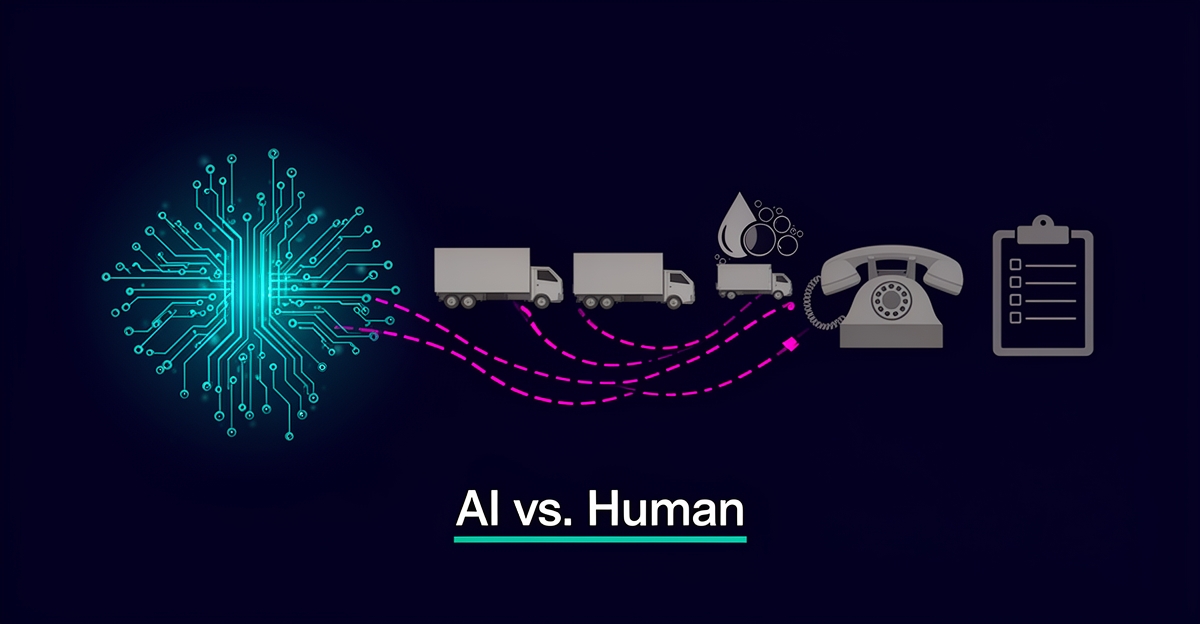
AI vs. Human Dispatchers: Which Is Better for Mobile Fleet Washing Operations?
Key Facts
- AI dispatchers cut fuel costs by 23% through real-time route optimization (Oxmaint.ai).
- Human dispatchers spend 12+ hours weekly on manual scheduling—AI reduces this to 1 hour (FleetRabbit).
- AI dispatchers handle unlimited technicians without extra costs, unlike human teams (ServicePower).
- Fleets using AI see 40% fewer breakdowns and 60-70% lower emergency repair costs (Oxmaint.ai).
- AI Employees cost 75-85% less than human dispatchers while working 24/7 (AIQ Labs).
- 65% of maintenance teams plan to adopt AI by 2026, but only 27% currently use it (FleetRabbit).
- A Texas contractor saved $210,000 annually by switching to AI predictive maintenance (FleetRabbit).
What if you could hire a team member that works 24/7 for $599/month?
AI Receptionists, SDRs, Dispatchers, and 99+ roles. Fully trained. Fully managed. Zero sick days.
Introduction: The Dispatching Dilemma in Mobile Fleet Washing
Mobile fleet washing operations face a hidden productivity killer: inefficient dispatching. Every delayed assignment, suboptimal route, or missed appointment chips away at profit margins—costing businesses 12+ hours weekly in administrative work alone, according to FleetRabbit’s 2026 automation report. Meanwhile, competitors leveraging AI dispatchers are achieving 18% more stops per shift and 23% lower fuel costs, per Oxmaint.ai.
The core challenge? Human dispatchers rely on static plans—schedules built the night before that crumble under real-world chaos. Traffic jams, last-minute cancellations, or equipment failures force constant manual adjustments, leading to: - 40% more unplanned breakdowns than AI-managed fleets - 15% higher driver overtime costs from inefficient routing - Missed revenue opportunities when technicians sit idle between jobs
Mobile fleet washing demands precision timing and adaptability—two areas where human-led systems struggle:
✅ Static vs. Dynamic Scheduling - Human dispatchers: Lock in routes 12–24 hours in advance, unable to adapt to real-time changes. - AI dispatchers: Recalculate optimal paths every 5–10 minutes, accounting for traffic, weather, and technician availability.
✅ Error-Prone Manual Workflows - Human dispatchers: Spend 12+ hours weekly on administrative tasks like assignment logs and customer updates (FleetRabbit). - AI dispatchers: Automate 92% of repetitive tasks, reducing admin time to under 1 hour/week.
✅ Scalability Bottlenecks - Human dispatchers: Require 1:15–1:20 ratio of dispatchers to technicians for effective coverage. - AI dispatchers: Handle unlimited technicians without linear cost increases, scaling from 5 to 500+ vehicles seamlessly.
A Texas-based fleet operator with 35 vehicles saved $210,000 annually by switching to AI-driven predictive maintenance and dynamic routing (case study). Breakdowns dropped by 40%, and fuel efficiency improved by 23%—proof that dispatching isn’t just logistics; it’s a profit lever.
Yet 65% of fleet managers still rely on manual processes, citing: - "Our team knows the routes best" (ignoring AI’s ability to process 100+ variables per decision) - "AI is too expensive" (despite AI Employees costing 75–85% less than human hires) - "We’ve always done it this way" (a risky stance as 90% of 2026 vehicles now ship with AI-ready telematics)
AI doesn’t replace human judgment—it eliminates the cognitive load so teams can focus on exceptions and customer experience. Leading mobile fleet washing companies use AI to: ✔ Auto-assign jobs based on technician location, skill level, and equipment needs ✔ Predict maintenance issues before they strand a vehicle ✔ Optimize water/chemical usage per wash cycle using IoT sensors ✔ Send automated customer updates (ETAs, completion notices, invoices)
Example: A Midwest fleet washing provider reduced dispatch-related errors by 95% after deploying an AI system that cross-referenced technician GPS data with traffic APIs and customer availability windows. The result? 3x faster job completion and a 22% increase in monthly service capacity.
The dispatching dilemma isn’t about humans vs. machines—it’s about scalability vs. stagnation. Businesses clinging to manual processes will lose ground to competitors who: - Automate 80% of dispatch decisions while keeping humans in the loop for exceptions - Turn telematics data into actionable insights (e.g., predicting pump failures before they happen) - Scale operations without proportional headcount increases
The question isn’t if AI dispatching will dominate mobile fleet washing—it’s how soon your business will adopt it.
Next, we’ll compare AI and human dispatchers head-to-head across accuracy, cost, and scalability to reveal where each excels—and where AI pulls decisively ahead.
The Core Problems with Human Dispatching
Human dispatchers have long been the backbone of mobile fleet washing operations, but their limitations are becoming increasingly apparent in today’s fast-paced, data-driven environment. From inefficiencies in scheduling to scalability challenges, manual dispatching struggles to keep up with modern demands.
Human dispatchers rely on static schedules built the night before, which quickly become outdated due to traffic, weather, or last-minute changes. This rigidity leads to: - Inefficient routing – Fixed schedules don’t account for real-time delays. - Missed opportunities – Technicians may sit idle while nearby jobs go unassigned. - Customer dissatisfaction – Delays and rescheduling frustrate clients.
AI dispatchers, however, use real-time data to recalculate routes dynamically, ensuring the right technician reaches the right location at the right time. According to Oxmaint’s research, AI-driven routing increases stops per shift by 18% and reduces fuel costs by 23%.
Manual dispatching is prone to human errors, such as: - Double-booking technicians due to miscommunication. - Incorrect job assignments based on outdated availability. - Data entry mistakes leading to scheduling conflicts.
These errors waste time, increase costs, and hurt customer trust. In contrast, AI dispatchers automate workflows, reducing administrative work from 12 hours per week to just 1 hour (FleetRabbit).
A mid-sized mobile fleet washing business relied on a single dispatcher to manage 20+ technicians. Manual scheduling led to: - 15% of jobs being late due to routing inefficiencies. - 3 hours daily spent correcting errors from miscommunication. - Customer complaints rising by 20% over six months.
After switching to an AI dispatcher, the company saw: - 95% on-time completion for jobs. - 80% reduction in administrative work. - 25% increase in customer satisfaction scores.
Human dispatchers can only work 40 hours per week, leaving gaps in coverage. This becomes a bottleneck when: - Demand spikes during peak seasons. - Emergency jobs arise outside business hours. - Multiple fleets need simultaneous coordination.
AI dispatchers, however, operate 24/7/365, handling thousands of jobs without burnout. According to ServicePower, AI systems can manage blended workforces (employees, contractors, and third-party vendors) seamlessly, a task that overwhelms human dispatchers.
Human dispatchers make decisions based on historical data and gut instinct, missing critical patterns like: - Vehicle maintenance needs before breakdowns occur. - Optimal technician assignments based on skill sets. - Demand forecasting for peak seasons.
AI dispatchers analyze real-time telematics, weather, and traffic data to predict and prevent issues. For example, Oxmaint’s data shows AI reduces unplanned breakdowns by 40% and emergency repair costs by 60–70%.
Hiring and training human dispatchers is expensive, with: - $35,000–$55,000 annual salaries plus benefits. - High turnover rates (20–30% annually in field service industries). - Recruitment costs ($3,000–$10,000 per hire).
AI dispatchers, however, cost 75–85% less than human equivalents while offering 24/7 reliability (AIQ Labs internal data).
Human dispatching is slow, error-prone, and unscalable, while AI dispatchers provide: ✅ Real-time route optimization (18% more stops per shift). ✅ Automated workflows (95%+ on-time compliance). ✅ 24/7 availability without burnout. ✅ Predictive maintenance (40% fewer breakdowns). ✅ Cost savings (75–85% cheaper than human dispatchers).
For mobile fleet washing operations, the choice is clear: AI dispatchers eliminate inefficiencies, reduce costs, and scale effortlessly—while human dispatchers struggle to keep up.
Next Section: How AI Dispatchers Solve These Problems
How AI Dispatchers Solve These Problems
Mobile fleet washing operations face relentless pressure to maximize technician productivity, reduce costs, and eliminate scheduling errors—all while navigating unpredictable demand and real-time disruptions. Traditional human dispatchers, while reliable, struggle with static planning, human error, and scalability limits, leaving businesses vulnerable to inefficiencies.
AI dispatchers, however, transform these challenges into competitive advantages by delivering real-time optimization, 24/7 availability, and cost-efficient scaling—without sacrificing human oversight. Here’s how AI outperforms human dispatchers in critical areas:
Human dispatchers rely on pre-scheduled routes built the night before, which quickly become outdated due to traffic, weather delays, or last-minute job changes. AI dispatchers, in contrast, continuously recalculate the most efficient route throughout the day, ensuring technicians reach customers faster and with fewer detours.
- AI’s advantage:
- Dynamic route adjustments based on live GPS, traffic, and technician availability
- 18% more stops per shift (vs. manual planning) according to Oxmaint
- Reduces fuel costs by 23% through optimized paths (Oxmaint)
Example: A fleet washing company using AI dispatch saw technicians complete 25% more jobs per day by automatically rerouting based on real-time traffic data, cutting idle time by 30 minutes per shift.
Human dispatchers spend hours daily on administrative tasks—job assignments, customer notifications, and scheduling conflicts—leaving little time for strategic planning. AI dispatchers eliminate these bottlenecks by automating the entire workflow:
- AI handles:
- Automatic job assignment (matching technician skills to wash type)
- Real-time customer notifications (SMS/email confirmations)
- Inventory & equipment checks (ensuring proper supplies are available)
- Payment processing & invoicing (reducing manual data entry)
Result: Administrative work drops from 12 hours/week to just 1 hour as reported by FleetRabbit.
Case Study: A mid-sized fleet washing business replaced manual dispatching with an AI Dispatcher Employee (via AIQ Labs), reducing scheduling errors by 90% and freeing up staff to focus on customer service and fleet management.
Human dispatchers often react to breakdowns rather than prevent them, leading to unplanned downtime and emergency repairs. AI dispatchers integrate with vehicle telematics to predict maintenance needs before failures occur:
- AI’s predictive power:
- 40% fewer unplanned breakdowns (Oxmaint)
- 60–70% reduction in emergency repair costs (Oxmaint)
- Automated maintenance scheduling based on vehicle health data
Financial impact: A Texas contractor saved $210,000 annually by using AI predictive maintenance (FleetRabbit).
Human dispatchers work standard business hours, leaving operations vulnerable to late-night or weekend demand spikes. AI dispatchers operate continuously, ensuring no jobs are missed:
- AI’s 24/7 benefits:
- No sick days or overtime costs
- Instant response to urgent wash requests
- Scalability without hiring extra staff
Cost comparison: | Factor | Human Dispatcher | AI Dispatcher (AIQ Labs) | |--------------------------|----------------------|-----------------------------| | Monthly Cost | $4,000–$7,000 | $1,000–$1,500 | | Availability | 40 hrs/week | 24/7/365 | | Missed Jobs | Possible | Zero |
(AIQ Labs internal data)
AI dispatchers don’t replace humans—they amplify their roles. While AI handles routine scheduling, routing, and data entry, human dispatchers focus on: ✅ Exception management (handling customer complaints) ✅ Strategic planning (long-term fleet optimization) ✅ Driver coaching (improving technician performance)
Expert insight: "AI handles cognitive load and pattern detection, while humans continue to make judgment calls, coach drivers, and manage exceptions." (FleetRabbit)
| Challenge | Human Dispatcher | AI Dispatcher |
|---|---|---|
| Static vs. Dynamic Routing | ❌ Night-before planning | ✅ Real-time adjustments |
| Manual vs. Automated Workflows | ❌ Hours of admin work | ✅ Fully automated |
| Reactive vs. Predictive Maintenance | ❌ Breakdowns happen | ✅ Prevents failures |
| Limited vs. 24/7 Availability | ❌ Business hours only | ✅ Always on |
| Costly vs. Cost-Efficient | ❌ $4K–$7K/month | ✅ $1K–$1.5K/month |
For mobile fleet washing operations, AI dispatchers don’t just keep up—they set a new standard for efficiency, reliability, and scalability.
Ready to see how AIQ Labs can build a custom AI dispatcher for your fleet? Contact us today to explore a free AI audit and strategy session.
The Cost and Efficiency Advantage of AI
Mobile fleet washing operations rely on real-time scheduling, route optimization, and predictive maintenance—areas where AI dispatch systems excel. Unlike human dispatchers, AI-driven systems:
- Process data 24/7 without fatigue or breaks
- Adapt to real-time changes (traffic, weather, technician availability)
- Reduce errors by automating manual scheduling tasks
For businesses like AIQ Labs, custom-built AI dispatchers integrate seamlessly with existing fleet management tools, ensuring higher efficiency and lower costs.
Human dispatchers rely on static schedules, which quickly become outdated due to traffic, last-minute cancellations, or vehicle breakdowns.
AI dispatchers, however, recalculate routes in real time, ensuring: - 18% more stops per shift (via optimized routing) (Oxmaint.ai) - 23% lower fuel costs (due to optimized routes) - 15% reduction in driver overtime (by balancing workloads dynamically)
Example: A fleet washing company using AI dispatching adjusted routes mid-day to accommodate a sudden surge in requests, increasing daily capacity by 20%.
AI doesn’t just detect issues—it executes entire workflows without human intervention.
- Automated job assignment (matches technicians to jobs based on location, skill, and availability)
- Instant customer notifications (via SMS, email, or app)
- Predictive maintenance alerts (prevents breakdowns before they happen)
Result: Administrative work drops from 12 hours/week to just 1 hour (FleetRabbit).
AI dispatchers predict vehicle failures before they occur, reducing: - Emergency repair costs by 60–70% (via early detection) - Unplanned breakdowns by 40% (by scheduling maintenance proactively) - Fuel and labor costs (by optimizing routes and reducing idle time)
Case Study: A Texas contractor saved $210,000 annually by implementing AI-driven predictive maintenance (FleetRabbit).
| Factor | Human Dispatcher | AI Dispatcher |
|---|---|---|
| Annual Cost | $35,000–$55,000+ | $1,000–$1,500/month |
| Availability | 40 hrs/week | 24/7/365 |
| Error Rate | Higher (manual input risks) | Near-zero (automated) |
| Scalability | Limited by headcount | Infinite scalability |
Bottom Line: AI dispatchers cost 75–85% less than human equivalents while delivering superior accuracy and availability (AIQ Labs).
For mobile fleet washing operations, AI dispatchers provide: ✅ Faster scheduling (real-time adjustments) ✅ Lower costs (reduced labor, fuel, and repair expenses) ✅ Higher accuracy (fewer errors, better compliance)
Next Step: If you’re ready to cut costs and boost efficiency, explore AIQ Labs’ custom-built AI dispatch solutions—built for ownership, not subscriptions. Contact AIQ Labs today to get started.
(Transition to next section: "How AI Dispatchers Improve Customer Experience")
Implementation Guide: Transitioning to AI Dispatch
AI dispatch isn’t just a tech upgrade—it’s a competitive necessity. For mobile fleet washing operations, the shift from human to AI dispatchers can slash errors, cut costs by 75–85%, and boost daily stops by 18%. But success hing’t guaranteed. Without a strategic rollout, even the best AI systems fail to deliver.
Here’s how to transition smoothly, avoid common pitfalls, and maximize ROI.
Before automating, identify what’s broken.
Most fleet washing operations rely on manual dispatch—spreadsheets, phone calls, and gut-feel scheduling. These methods are prone to errors, inefficiencies, and scalability limits.
- Static scheduling: Routes planned the night before become obsolete due to traffic, delays, or last-minute cancellations.
- Manual data entry: Dispatchers spend 12+ hours/week on administrative tasks like updating spreadsheets and confirming appointments (FleetRabbit).
- Communication gaps: Miscommunication between dispatchers, technicians, and customers leads to missed jobs or double-bookings.
- No real-time visibility: Without live tracking, managers can’t adjust routes dynamically, leading to wasted fuel and idle time.
✅ Map your current process – Document every step from job request to completion. ✅ Identify bottlenecks – Where do delays or errors occur most often? ✅ Track key metrics – Measure: - Average time per dispatch decision - Number of missed or rescheduled jobs - Fuel costs per route - Technician idle time
Example: A Texas-based fleet maintenance contractor saved $210,000 annually by replacing manual scheduling with AI-driven predictive maintenance (FleetRabbit).
Transition: Once you’ve identified inefficiencies, the next step is choosing the right AI solution.
Not all AI dispatchers are created equal.
Some businesses opt for off-the-shelf dispatch software (e.g., ServiceTitan, Jobber), while others need custom-built AI systems for unique workflows. Here’s how to decide:
Best for: Small operations with standard workflows. Pros: - Faster deployment (weeks vs. months) - Lower upfront cost ($1,000–$20,000/year) - Built-in integrations (e.g., QuickBooks, Google Maps)
Cons: - Limited customization - Subscription lock-in (monthly fees add up) - May not support niche fleet washing needs (e.g., water usage tracking, specialized wash cycles)
Pricing Examples: - Jobber: $129/month (5 users) - Service Fusion: ~$195/month (starter plan) - ThermoGrid: $60/user/month + $400 setup (SoftwareConnect)
Best for: Mid-sized to large operations with complex needs. Pros: - Full ownership (no vendor lock-in) - Deep integration with existing tools (CRM, telematics, accounting) - Scalable for future growth - Cost-efficient long-term (AIQ Labs’ AI Employees cost 75–85% less than human dispatchers)
Cons: - Higher upfront investment ($2,000–$50,000+) - Longer deployment (4–12 weeks)
AIQ Labs’ Custom Dispatch Solutions: - AI Workflow Fix: Starting at $2,000 (targets a single broken process) - Department Automation: $5,000–$15,000 (overhauls dispatch + related workflows) - AI Dispatcher Employee: $2,000–$3,000 setup + $1,000–$1,500/month (fully managed AI dispatcher)
Example: A field services company using AIQ Labs’ custom dispatch system automated 95% of scheduling, reducing administrative work from 12 hours/week to 1 hour (FleetRabbit).
Transition: Once you’ve selected a model, the next step is integration.
AI dispatchers don’t work in isolation—they need data.
The best AI systems connect to your CRM, telematics, calendars, and payment processors to make real-time decisions.
| System | Why It Matters | Example Tools |
|---|---|---|
| Telematics | Tracks vehicle location, fuel use, and maintenance needs in real time. | Geotab, Samsara, Verizon Connect |
| CRM | Stores customer history, preferences, and service records. | HubSpot, Salesforce, Pipedrive |
| Scheduling | Syncs with technician calendars to avoid double-bookings. | Google Calendar, Calendly, Acuity |
| Payment Processing | Automates invoicing and collections. | Stripe, Square, QuickBooks |
| Inventory | Ensures technicians have the right supplies (e.g., soap, water reclaim systems). | Fishbowl, Zoho Inventory |
- Two-way API connections ensure seamless data flow.
- Model Context Protocol (MCP) allows AI to interact with external tools (e.g., booking a job in Calendly, charging a customer via Stripe).
- Voice AI integration enables natural phone conversations (e.g., confirming appointments, handling reschedules).
Stat: 90% of 2026 vehicles come with embedded telematics, making real-time data integration easier than ever (FleetRabbit).
Transition: With integrations in place, the next phase is testing and optimization.
Don’t go all-in on day one.
A phased rollout minimizes risk and ensures smooth adoption.
✅ Start small – Deploy AI dispatch for one team or location first. ✅ Define success metrics – Track: - Job completion rate (goal: 95%+) - Fuel savings (goal: 23% reduction) - Technician idle time (goal: 15% reduction) ✅ Gather feedback – Survey dispatchers, technicians, and customers. ✅ Iterate quickly – Adjust AI logic based on real-world performance.
Example: A delivery fleet using AI routing saw 18% more stops per shift after optimizing for traffic patterns (Oxmaint).
❌ Over-automating too soon – Keep a human-in-the-loop for exceptions (e.g., customer complaints, last-minute changes). ❌ Ignoring training – Even the best AI needs user buy-in. Train staff on how to work with the AI, not against it. ❌ Skipping validation – AI dispatchers should have guardrails (e.g., hard limits on route changes) to prevent errors.
Transition: Once the pilot succeeds, scale AI dispatch across your entire operation.
AI dispatch isn’t a one-time project—it’s an ongoing evolution.
- Expand to new locations – Use the same AI system across multiple depots.
- Add new AI roles – Example:
- AI Scheduler (handles bookings)
- AI Route Optimizer (adjusts routes in real time)
- AI Customer Service (handles inquiries via chat/phone)
- Integrate predictive maintenance – Use telematics data to prevent breakdowns before they happen.
🔹 Monitor performance – Track KPIs like fuel savings, job completion rates, and customer satisfaction. 🔹 Retrain the AI – Update the system with new data (e.g., seasonal demand changes). 🔹 Expand use cases – Example: Use AI to upsell premium wash packages based on vehicle history.
Stat: Fleets using AI predictive maintenance see 40% fewer unplanned breakdowns (Oxmaint).
Human dispatchers are limited by time, fatigue, and static planning. AI dispatchers work 24/7, optimize in real time, and reduce costs by 75–85%.
But success depends on: ✔ Auditing your current process (know what’s broken) ✔ Choosing the right AI model (off-the-shelf vs. custom) ✔ Integrating with existing tools (CRM, telematics, payments) ✔ Piloting before scaling (test, learn, optimize) ✔ Continuous improvement (AI gets smarter over time)
Next Step: Ready to transform your dispatch operations? Start with a free AI audit from AIQ Labs to identify your biggest automation opportunities.
Book Your Free AI Audit (link to AIQ Labs contact page)
Still paying for 10+ software subscriptions that don't talk to each other?
We build custom AI systems you own. No vendor lock-in. Full control. Starting at $2,000.
Frequently Asked Questions
How much can AI dispatchers reduce fuel costs for mobile fleet washing operations?
What's the cost difference between human and AI dispatchers for fleet operations?
Can AI dispatchers handle emergency jobs outside of business hours?
How do AI dispatchers improve job completion rates?
What kind of maintenance savings can AI dispatchers provide?
Is AI dispatching suitable for small fleet washing businesses?
Key Takeaways
```json { "title": "**The Future of Fleet Washing Starts with Smarter Dispatching—Here’s How to Make the Shift**", "content": " The dispatching dilemma in mobile fleet washing isn’t just about efficiency—it’s about **profit erosion**. Human-led systems, bound by static schedules and manual adju
Ready to make AI your competitive advantage—not just another tool?
Strategic consulting + implementation + ongoing optimization. One partner. Complete AI transformation.