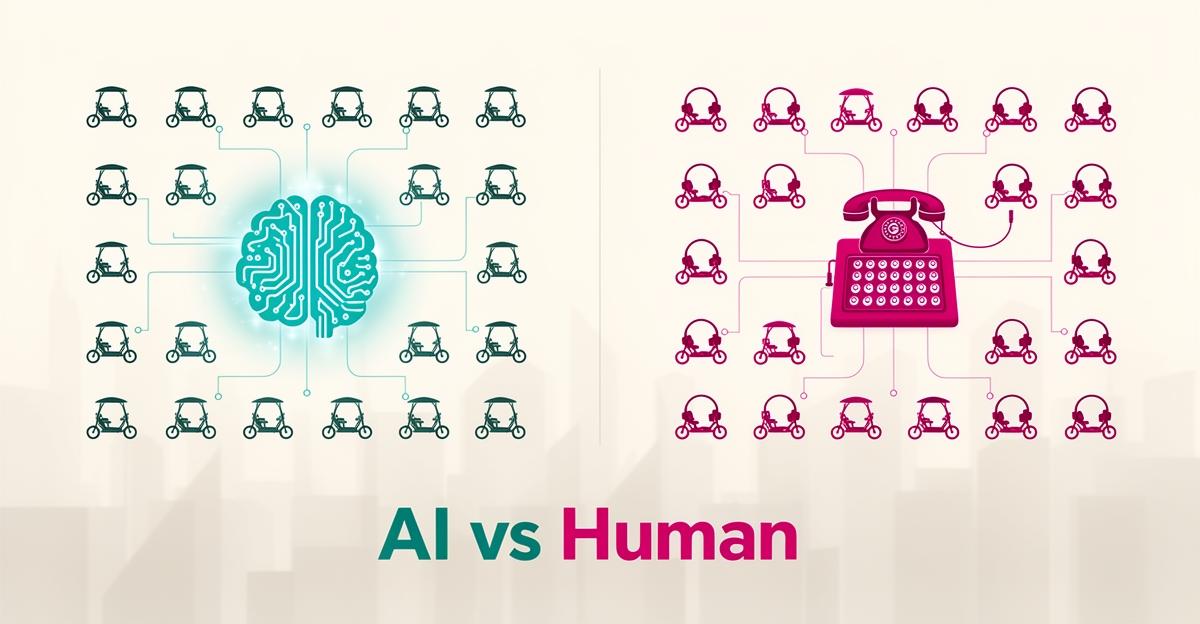
AI vs. Human Dispatchers: Which Is Better for Pedicab Operations?
Key Facts
- Human dispatchers typically cost several thousand dollars per location per month once salary, benefits, payroll taxes and overhead are included.
- Industry analyses as of late 2026 suggest AI dispatch can cut multi-location dispatch costs dramatically — often by well over half versus full human staffing.
- A large share of callers who cannot get immediate service simply call the next operator — missed calls during event surges are lost rides.
- AI-assisted route planning typically reduces daily planning time from an hour or more to a few minutes in fleet management deployments.
- AI can typically handle 70–80% of inbound calls for bookings, cancellations and modifications, freeing humans for exceptions.
- A hybrid AI-human model is generally the lowest-risk path: cost control without giving up judgment on complex calls.
Hire a team member that works 24/7 — for less than a part-time wage.
AI receptionists, SDRs, dispatchers and 99+ roles. Trained on your business, fully managed.
Not sure where to start? Ask our AI planner
The Hidden Cost of Human-Only Dispatch in Pedicab Fleets
Relying on human-only dispatch looks simple until the invoices, missed calls, and turnover start stacking up. For pedicab fleets, the hidden cost of human-only dispatch is not just salary — it is lost revenue and operational friction that compounds during peak demand.
Human dispatchers typically cost several thousand dollars per location per month when salary, benefits, payroll taxes and overhead are included. A 100-location operation can spend millions per year on single-shift, weekday-only coverage. That baseline cost makes scaling expensive and slow.
Availability creates a second cost layer. Human teams work shifts, take breaks, and cannot handle simultaneous calls. In event-driven businesses like pedicab operations, a large share of callers who cannot get immediate service simply call the next operator. Those lost calls are lost rides.
Turnover adds a recurring tax on the model. Dispatch turnover commonly runs high annually, and each departure carries real recruiting and training costs — a hidden expense that erodes service consistency and forces constant retraining.
The constraints show up daily in the form of:
- High labor cost per location with limited coverage hours and overtime during peak nights
- Scalability constraints that require new hires, desks and training for every city or vehicle added
- Missed calls and queuing during surges, leading to caller abandonment and revenue leakage
- Turnover-driven knowledge loss and inconsistent booking processes across locations
These burdens are why AIQ Labs builds [AI Employees](/ai-employees) that act as managed dispatch staff — handling the standard inbound load around the clock. AI handles bookings, cancellations and modifications 24/7 without overtime, while preserving human dispatchers for complex, high-emotion exceptions.
The result is a more resilient front door. Consistent coverage and instant scalability reduce the financial drag of human-only dispatch without removing the human touch where it matters most.
Why AI Dispatch Excels at Routine Pedicab Operations
AI dispatch systems excel at managing the high-volume, predictable interactions that form the backbone of pedicab operations. As of late 2026, well-built AI agents can typically handle roughly 70–80% of total inbound call volume — standard, predictable calls like bookings, cancellations, and modifications — freeing human staff for more nuanced tasks. This capability directly translates to operational efficiency, as AI eliminates queuing by processing multiple calls simultaneously, unlike human dispatchers who can only manage one call at a time, reducing caller abandonment during surges.
Beyond call handling, AI transforms backend operations critical to driver productivity and cost control. AI-assisted route planning typically reduces daily planning time from an hour or more to a few minutes, enabling dispatchers to optimize fleets rapidly and consistently. This efficiency gain supports a much higher dispatcher-to-vehicle ratio than manual dispatch, allowing pedicab operations to scale without proportional increases in dispatch labor. For a mid-sized fleet, the annual savings versus manual dispatch are typically substantial enough to fund the system several times over.
These advantages are amplified by AI's structural benefits: zero turnover, 24/7 availability without overtime costs, and consistent application of booking logic across all interactions. By removing the variability introduced by human fatigue, shift changes, or emotional bias, AI ensures every customer receives the same accurate, timely response — whether booking at 2 AM or during a post-event rush. For pedicab operators seeking to minimize dispatch costs while maintaining service reliability during peak demand, AI provides a scalable foundation that handles routine work with precision, allowing human teams to focus on exceptions where their judgment adds the most value. To see how this maps to your operation, start with the [Fit Check](/apply) for a free 30-minute strategy call.
The Hybrid Dispatch Model: Combining AI Efficiency with Human Judgment
The most effective strategy for pedicab operations in 2026 is not choosing between AI and human dispatchers, but integrating both to leverage their respective strengths. A hybrid dispatch model allows AI to manage routine, high-volume tasks while preserving human judgment for nuanced, high-value interactions. Operators running this model typically report dispatch cost reductions in the 50–70% range for multi-location operations, without sacrificing service quality on complex or emotional calls. By offloading predictable interactions, human dispatchers are freed to focus on situations where their expertise delivers the greatest impact.
Human dispatchers remain irreplaceable for scenarios requiring empathy, local insight, or proactive coordination. They excel at de-escalating frustrated callers, managing multi-variable scheduling requests, and applying hard-won knowledge of local traffic patterns, construction zones, or customer preferences. Humans can ask clarifying questions, adapt in real time, and build relationships that drive upsell opportunities. They also handle nuanced outbound communication — such as notifying customers of delays or rescheduling needs — where judgment matters. This division of labor ensures operational resilience while maintaining the personal touch that defines premium pedicab service.
Implementing this hybrid model begins with a targeted pilot to measure performance and refine escalation protocols. Operators should track key metrics like booking accuracy, customer satisfaction, and the percentage of calls requiring human intervention. Once validated, the system can scale across locations with minimal disruption. AIQ Labs supports this transition through managed [AI Employees](/ai-employees) that handle routine dispatch workflows, integrated with human oversight for exceptions — or, if dispatch is just one of several broken processes, a focused [Workflow Build](/workflow-builds) rebuilds the costliest workflow first at a fixed price. By pairing AI efficiency with human judgment, pedicab operations achieve both cost control and service excellence — turning dispatch from a cost center into a strategic advantage.
How to Implement AI Dispatch in Your Pedicab Operation: A Pilot-First Approach
Implementing AI dispatch in pedicab operations requires a phased approach that builds confidence and refines the system before full deployment. Starting with a pilot program allows operators to validate performance, adjust workflows, and secure team buy-in without disrupting core services. This method aligns with proven implementation strategies that emphasize measurable outcomes and iterative improvement.
Begin by selecting five high-traffic locations or vehicles for a 30-day pilot, ensuring the sample reflects typical demand patterns and route complexity. During this phase, track booking accuracy — the percentage of calls correctly processed by AI without errors — and the escalation rate, or how often calls require human intervention for complex scheduling or emotional callers. Use this data to refine handoff rules, such as triggering human review for multi-stop bookings, VIP requests, or calls where sentiment analysis detects frustration.
Next, optimize the AI-to-human workflow by defining clear escalation criteria and training dispatchers to review AI-captured details before confirming jobs. Position the system as a driver-enabling tool: AI-optimized routes typically cut daily planning time from an hour or more to under five minutes and can reduce fuel and idle costs, directly improving driver earnings and reducing fatigue. Frame these benefits in team meetings to highlight how AI removes repetitive tasks, allowing humans to focus on high-value interactions like outbound coordination or conflict resolution.
After validating the pilot — aiming for booking accuracy above 90% and escalation rates below 25% — scale the system incrementally to additional locations or vehicles. Maintain human oversight for the remaining complex calls, creating a hybrid model that balances efficiency with service quality. This approach not only cuts dispatch costs substantially at scale but also fosters long-term adoption by demonstrating tangible improvements to both operations and driver experience. For tailored implementation support, AIQ Labs offers managed AI Employee pilots, phased [AI Operating Systems](/ai-operating-systems) that connect dispatch with the rest of your operation, and flexible payment models — start monthly, build in milestones, or own it outright. Start the [Fit Check](/apply) — a 2-minute form leading to a free 30-minute strategy call at [aiqlabs.ai/book](/book).
Still paying for 10+ subscriptions that don’t talk to each other?
We build custom AI systems you own outright. No vendor lock-in. Full control.
Not sure where to start? Ask our AI planner
Frequently Asked Questions
Is AI dispatch actually cheaper than human dispatchers for pedicab fleets?
Can AI handle busy events and festivals when call volume spikes?
Will switching to AI mean firing all my dispatchers?
How quickly does AI dispatch pay for itself?
What tasks should AI do and what should humans keep?
How do we implement AI dispatch without disrupting service?
Turning Dispatch from Cost Center to Competitive Edge
The pattern is clear: relying solely on human dispatchers in pedicab operations creates avoidable costs through high labor expenses, missed calls during peak demand, and turnover-driven inefficiencies — while AI excels at handling the majority of routine bookings with 24/7 availability and zero queuing. Yet the real opportunity lies not in replacement, but in a hybrid model where AI manages standard interactions and human dispatchers focus on complex, high-emotion scenarios where their judgment adds irreplaceable value. This approach delivers major cost savings for multi-location operations while preserving service quality for the moments that build customer loyalty. For pedicab operators ready to test this balance, the path forward starts with a focused pilot to validate performance and refine workflows. Take the first step with a free, no-obligation strategy call — book yours at https://aiqlabs.ai/book.
Make AI your competitive advantage — not just another tool.
Strategy, implementation and ongoing optimization. One partner, end to end.
Not sure where to start? Ask our AI planner