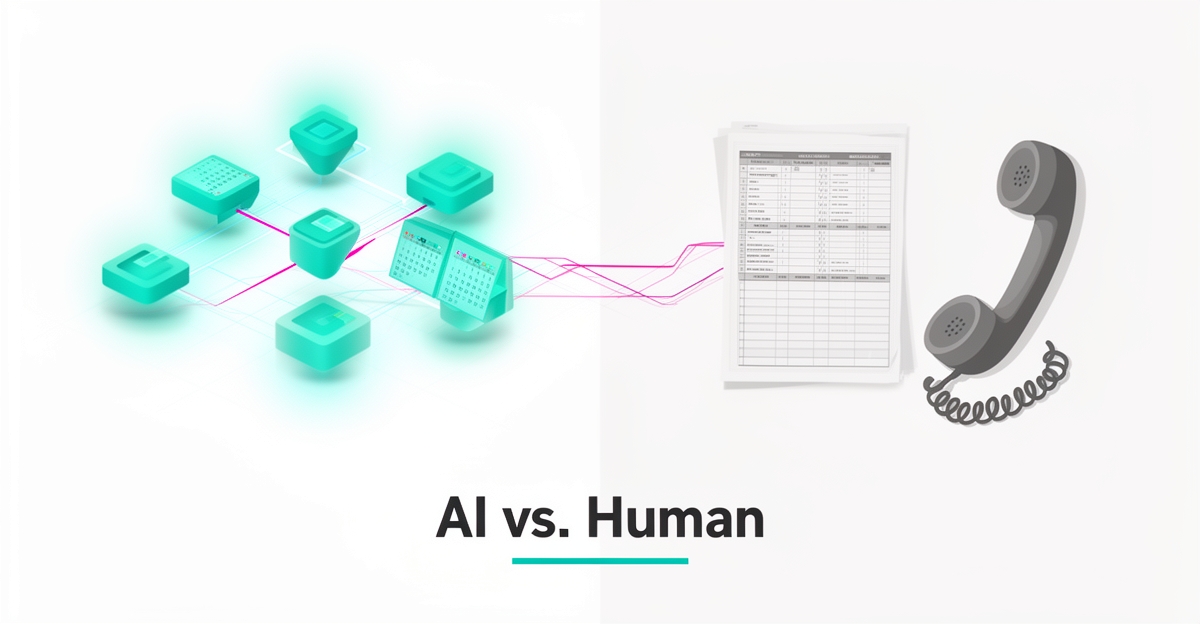
AI vs. Human Dispatchers: Which Is Better for Small Moving Teams?
Key Facts
- A full-time human dispatcher typically costs $5,000–$7,000 per month in salary and overhead; managed AI dispatchers typically run a small fraction of that
- Manual dispatching adds labor intensity, overtime, and missed optimization opportunities that erode margins month after month
- AI dispatchers work 24/7 with no shifts, no overtime, and no missed after-hours calls
- Most operations that automate dispatch see payback within the first few months, though exact timelines vary by call volume
- AI typically handles the bulk of standard inbound calls—bookings, availability checks, routine inquiries—freeing humans for judgment-heavy work
- Well-built AI dispatch systems can manage high daily job volumes with consistent, repeatable accuracy
Hire a team member that works 24/7 — for less than a part-time wage.
AI receptionists, SDRs, dispatchers and 99+ roles. Trained on your business, fully managed.
Not sure where to start? Ask our AI planner
The Costly Truth About Manual Dispatching
For small moving teams, manual dispatching isn't just outdated—it's a silent profit drain. Relying on human dispatchers alone inflates operating expenses through salary, overtime, benefits, and management overhead, turning routine scheduling into a recurring cost that erodes margins month after month. The math is stark: a full-time human dispatcher typically runs $5,000–$7,000 per month once you account for wages and overhead, while a managed AI dispatcher typically costs a small fraction of that—a disparity that quickly becomes unsustainable for growing teams. Beyond direct labor, the administrative burden of manual dispatch consumes valuable time that could be spent on customer acquisition or service quality, further amplifying the opportunity cost.
The inefficiencies extend beyond immediate expenses into systemic blind spots. Many small businesses struggle to get clear visibility into what their operational technology actually costs and what it saves. Without that transparency, it's difficult to measure ROI, optimize budgets, or confidently scale automation initiatives—even after adopting AI tools. For small moving teams with tight budgets, this uncertainty can stall progress and perpetuate reliance on expensive, error-prone manual workflows that hinder growth.
Consider the tangible disadvantages of sticking with manual methods: human dispatchers are limited by shift work, prone to fatigue-induced errors, and struggle to scale during peak seasons without costly overtime or additional hires. They also can't match the real-time routing optimization and 24/7 availability that AI provides, leading to longer response times and underutilized resources. In contrast, well-built AI dispatchers handle high daily job volumes with consistent accuracy, eliminate missed after-hours calls, and reduce administrative load by automating repetitive tasks like job booking and driver assignment. For most operations, the payback period arrives within the first few months, after which savings compound. For small teams, this isn't just about cutting costs; it's about reclaiming control over operations and building a foundation for scalable, resilient growth.
AI Dispatch: The Efficiency and Savings Powerhouse
When a customer calls at 9 p.m. on a Sunday about a last-minute move, an AI dispatcher answers on the first ring—and it never asks for overtime pay. That around-the-clock reliability is just one reason AI dispatch is becoming the efficiency engine for small moving teams.
The cost math is hard to ignore. A human dispatcher typically costs $5,000–$7,000 per month in salary and overhead, while a managed AI dispatcher typically runs a small fraction of that—a difference that compounds fast across a fleet and across a year.
The return on investment arrives quickly, too. For most operations, the break-even point for AI dispatch lands within the first few months, making it one of the fastest-paying automation investments available to a small business. Manual dispatching, by contrast, carries ongoing labor costs, overtime exposure, and the hidden expense of missed calls and suboptimal routing.
Beyond savings, AI brings structural advantages that matter for lean teams trying to do more without adding headcount:
- 24/7 availability — no shift schedules, no missed after-hours calls, no overtime costs
- Consistency — the same logic applies to every dispatch, minimizing human error across jobs
- Scalability — AI absorbs growth without additional hiring, training, or management overhead
- Real-time optimization — routes and schedules adjust instantly for faster response times and better resource use
Perhaps most importantly, AI handles the volume that buries small teams. The majority of standard inbound calls—availability checks, booking requests, routine inquiries—can typically be managed entirely by AI dispatch. That frees your human dispatcher to focus on the complex, judgment-heavy work where people genuinely excel.
This is where modern AI dispatch systems earn their keep on accuracy as well as speed. Well-built systems can manage high daily job volumes with consistent, repeatable accuracy while dramatically reducing the administrative load on a small team. AIQ Labs deploys managed AI dispatchers through its [AI Employees](/ai-employees) service—99+ roles including dispatchers, built and run for you—tailored to team size and local market demands, and built as owned assets rather than subscription dependencies, so the efficiency gains stay with the business.
For small moving teams, the case is straightforward: AI dispatch delivers enterprise-grade coverage, consistency, and cost structure at a price point built for smaller operations. The question shifts from whether AI can handle the routine work to how quickly a team can capture those savings.
Where Human Dispatchers Still Win
Even with strong automation gains, human dispatchers remain essential where judgment, empathy and local context matter most. Small moving teams that rely solely on AI often see friction in the moments customers need reassurance the most.
AI dispatch struggles with complex, multi-step situations that require human judgment and problem-solving skills. It can process routine inbound requests efficiently, yet it falters when a job involves overlapping crews, last-minute access issues, or custom loading requirements. It also typically needs human backup for outbound communication, such as rescheduling or providing sensitive updates to customers.
Emotional intelligence is another clear gap. Moving is stressful, and customers frequently call with anxiety, anger, or confusion. Human dispatchers possess empathy and emotional intelligence that AI lacks, which preserves trust during difficult interactions. In practice, the hybrid model tends to be the most effective strategy for maximizing ROI and maintaining service quality.
Local knowledge remains a differentiator. A human dispatcher who knows neighborhood parking restrictions, building loading dock rules, and traffic patterns can make scheduling decisions that improve on-time performance. AI may not possess the same level of local knowledge as a human dispatcher, which can impact scheduling quality.
Where human dispatchers still win in practice:
- Complex problem solving and multi-step exceptions that require judgment beyond scripted flows
- Emotionally charged customer interactions where empathy and de-escalation protect the brand
- Local market nuances such as access constraints, driver familiarity, and real-time coordination
- Outbound coordination like proactive rescheduling, status updates, and relationship management
Cost comparisons highlight why a blended approach makes sense. A human dispatcher typically costs $5,000–$7,000 per month, while a managed AI dispatcher runs a small fraction of that. Those savings are real, but they depend on keeping humans in the loop for the work AI cannot do.
AIQ Labs sees this pattern across small moving teams in its [AI Workflow Builds](/workflow-builds) work, where we rebuild the one workflow that costs the most—often dispatch—at a fixed price, in phases. AI handles routine booking and availability checks, while human dispatchers focus on nuanced customer interactions, problem-solving, and tasks requiring empathy and judgment. That division preserves service quality without sacrificing scalability.
The Hybrid Model: Best of Both Worlds
The most effective strategy for small moving teams isn't choosing between AI and human dispatchers—it's combining them. A hybrid model leverages AI for high-volume routine tasks while preserving human expertise for situations requiring judgment and empathy. This approach captures efficiency gains without sacrificing service quality, particularly important in customer-facing industries where trust and responsiveness drive retention.
AI can typically handle the majority of standard inbound calls, managing availability checks, booking, and basic inquiries with consistent logic and 24/7 availability. For small teams, this reduces administrative load significantly, freeing human dispatchers to focus on complex rescheduling, damaged-item claims, or emotionally charged customer interactions—areas where AI lacks emotional intelligence and local contextual knowledge. By automating routine work, teams typically see faster response times and improved resource utilization, directly contributing to operational scalability.
Implementing this model requires clear escalation protocols. AI should route cases to human dispatchers when:
- Customers express frustration or dissatisfaction
- Jobs involve special handling requirements (e.g., pianos, antiques)
- Schedule conflicts require creative problem-solving
- Outbound coordination for updates or rescheduling is needed
These criteria ensure AI operates within its strengths while preserving human oversight where it adds irreplaceable value. Continuous monitoring of AI performance—such as accuracy in booking and route optimization—allows teams to refine thresholds over time.
Financially, the hybrid approach maximizes ROI by capturing AI's cost advantages without over-automation. With a human dispatcher typically costing $5,000–$7,000 per month and a managed AI dispatcher a small fraction of that, automating routine tasks can cut the bulk of dispatch labor cost. With payback often reached within the first few months, teams can reinvest savings into training human dispatchers for higher-value interactions, enhancing both efficiency and customer experience. AIQ Labs supports this balance through managed AI staff designed to integrate seamlessly with existing teams, ensuring technology amplifies—rather than replaces—human capability.
Ultimately, the hybrid model doesn't just reduce costs; it builds a more resilient operation. By letting AI manage volume and consistency while humans handle nuance and care, small moving teams achieve sustainable scalability without compromising the personal touch that differentiates their service in a competitive market. This balanced strategy turns dispatch from a cost center into a strategic advantage.
Still paying for 10+ subscriptions that don’t talk to each other?
We build custom AI systems you own outright. No vendor lock-in. Full control.
Not sure where to start? Ask our AI planner
Frequently Asked Questions
Is AI dispatch actually cheaper than hiring a human dispatcher for a small moving team?
How quickly will we see a return on investment with AI dispatch?
Can AI really handle most of our inbound calls without a person?
Where do human dispatchers still beat AI?
Should we replace our dispatcher completely or keep a hybrid team?
How accurate and scalable is AI dispatch in practice?
Dispatch Smarter, Not Harder: Your Next Move
For small moving teams, the choice isn't AI versus humans, it's how to use each where they add the most value. Manual dispatch quietly drains margins with overtime, errors and missed optimization, while AI delivers 24/7 coverage, consistent accuracy on high job volumes, and a cost structure that's a small fraction of a $5,000–$7,000 monthly human hire. Payback often lands within the first few months. Humans still win on empathy, complex exceptions and local nuance. The winning model is hybrid: automate routine booking and availability with AI, and keep dispatchers focused on judgment-heavy, customer-facing work. If you're ready to map this to your operation, start with a clear audit of which calls can be automated, define escalation rules for frustration or special handling, and pilot AI on high-volume routine tasks first. AIQ Labs builds owned AI dispatch systems tailored to team size and local market demands, so you can test the hybrid approach without subscription lock-in. Start the 2-minute Fit Check at [aiqlabs.ai/apply](/apply) for a free 30-minute strategy call, or explore our [pricing](/pricing) to see how Start Monthly, Build in Milestones, and Own It Outright work. Questions first? Email [email protected].
Make AI your competitive advantage — not just another tool.
Strategy, implementation and ongoing optimization. One partner, end to end.
Not sure where to start? Ask our AI planner