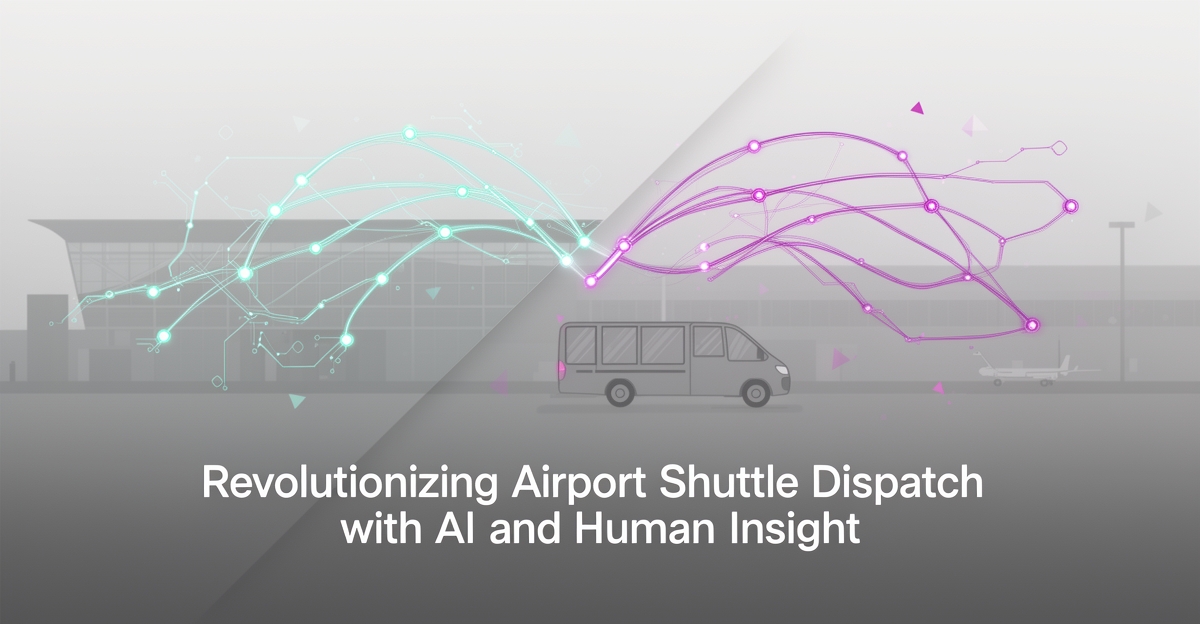
AI vs. Human Dispatchers: Which Works Better for Airport Shuttle Operations?
Key Facts
- AI dispatching can eliminate most manual scheduling errors through automated assignment based on passenger volume and driver availability
- AI systems typically recalculate optimal routes in under a second after a request change so fleets adapt instantly to traffic and demand shifts
- AI-driven load balancing has delivered roughly 25% mileage reductions in comparable automated runs through automated route optimization
- Human dispatch costs scale linearly with call volume while AI systems maintain consistent performance when demand doubles or triples without added headcount
- Human dispatchers excel at calming distressed callers and detecting inconsistencies in communication during high-stress scenarios where AI often misses emotional cues
- The hybrid model assigns AI to intake and humans to planning, coordination, and exception handling eliminating hidden costs of manual call handling
- AI eliminates hidden labor costs from interruptions, rework due to data entry errors, and follow-up calls freeing staff for strategic oversight
Hire a team member that works 24/7 — for less than a part-time wage.
AI receptionists, SDRs, dispatchers and 99+ roles. Trained on your business, fully managed.
Not sure where to start? Ask our AI planner
The Core Challenge: Why Traditional Dispatching Fails at Scale
Airport shuttle operators face mounting pressure as demand fluctuates and operational complexity grows. Traditional human-only dispatching struggles to keep pace, creating bottlenecks that ripple through scheduling, costs, and service quality.
Manual scheduling errors are a critical pain point. AI dispatching can largely eliminate them by automating assignment based on passenger volume and driver availability, per shuttle-management platform data. During peak hours, human dispatchers experience fatigue and distraction, leading to inconsistent response times that frustrate passengers and disrupt fleet coordination. These reactive limitations become especially costly when unexpected traffic or last-minute changes require instant recalculations—tasks where AI excels, recalculating optimal routes in under a second after a request change.
- Labor costs scale linearly with call volume, forcing operators to hire and train additional staff during busy periods
- Hidden inefficiencies accumulate from interruptions, rework due to data entry errors, and follow-up calls
- Manual systems lack the agility to balance loads dynamically across fluctuating demand patterns
- Human dispatchers struggle to maintain consistent performance when managing high-volume, repetitive intake tasks
- Scaling operations traditionally requires proportional increases in headcount and supervision overhead
The core challenge lies in the inherent mismatch between labor-intensive processes and the need for scalable, real-time optimization. As call volumes rise, human dispatchers face diminishing returns—each additional hour worked yields less operational value due to cognitive fatigue and increased error rates. This creates a ceiling on efficiency that AI-integrated models can bypass by handling repetitive intake and route optimization while reserving human expertise for exception handling and strategic oversight. For shuttle operators seeking to modernize without overhauling their workforce, this tension between reliability and scalability defines the operational imperative. AIQ Labs helps bridge this gap with AI Employees that work alongside staff to reduce operational costs and improve reliability.
Where AI Excels: Real-Time Optimization and Predictable Scaling
Airport shuttle operations face constant pressure to balance efficiency with reliability, especially when traffic patterns shift and demand surges. AI dispatchers excel in real-time optimization, delivering measurable gains in mileage reduction and response speed that human teams struggle to match at scale. According to iDEALER's performance data, AI systems recalculate optimal routes in under a second after a request change, ensuring fleets adapt instantly to traffic, cancellations, or new bookings. This near-instant recalculation enables dynamic rerouting that maintains on-time performance without manual intervention.
Beyond speed, AI-driven load balancing delivers consistent efficiency gains during peak hours. iDEALER reports roughly a 25% reduction in overall mileage for automated runs through route optimization—a direct result of AI assigning trips based on real-time driver availability, passenger volume, and route efficiency rather than static schedules. This optimization reduces fuel consumption and vehicle wear while increasing fleet utilization. Unlike human dispatchers, whose costs rise linearly with call volume, AI systems scale predictably: handling doubled or tripled request volumes without added headcount or performance degradation, as noted in Spedsta's analysis of AI voice assistants in dispatch roles.
The result is a dispatch operation that maintains stability and efficiency under fluctuating conditions. AI eliminates the hidden costs of manual scheduling errors and repetitive data entry, freeing human staff to focus on exception handling and strategic oversight. For shuttle operators, this means fewer delays, lower operational costs, and a more resilient service model—especially during high-demand periods like flight arrivals or weather disruptions. By automating routine intake and optimization, AI creates a foundation where human expertise can be applied where it matters most: managing complexity, ensuring safety, and maintaining customer trust when situations fall outside algorithmic parameters. This synergy allows operators to scale confidently without sacrificing service quality or incurring proportional cost increases. AIQ Labs helps shuttle providers implement this balanced approach through managed AI Employees that integrate with existing workflows, delivering the scalability of automation alongside the judgment of human teams.
The Human Advantage: Why Exception Handling Requires People
When unexpected situations arise—such as accidents, stranded passengers, or unclear locations—human dispatchers provide the emotional intelligence and adaptive judgment that AI systems cannot replicate. In high-stress scenarios, humans excel at calming distressed callers, detecting inconsistencies in communication, and making nuanced decisions that prevent operational breakdowns. AI, while efficient for routine tasks, often misses emotional cues and struggles with non-scripted situations, leading to increased customer frustration when callers feel unheard or misunderstood.
Industry experience confirms that human dispatchers are superior in complex scenario management, such as vehicles stuck in mud, low-clearance parking garages, or police-involved situations, or when passengers cannot accurately describe their location. These situations require real-time clarification, contextual awareness, and the ability to ask follow-up questions—capabilities that AI lacks when callers speak quickly due to stress, have strong accents, or are in noisy environments. AI systems that rely on rigid scripts frequently fail to adapt, forcing customers to repeat information and damaging trust in the service.
The most effective airport shuttle operations use AI to handle repetitive intake—like bookings, cancellations, and route optimization—while reserving human oversight for planning, coordination, and exception handling. This hybrid approach allows skilled staff to focus on high-value tasks rather than administrative intake, improving both reliability and customer satisfaction. AIQ Labs supports this model by deploying AI dispatchers that work alongside human teams, enhancing efficiency without removing the critical human element needed for unpredictable, real-world challenges.
The Hybrid Model: Combining AI Efficiency with Human Oversight
The most resilient shuttle operations do not view AI as a replacement for human judgment, but as a force multiplier that handles volume while people handle complexity. By deploying AI as the operational "front door" and reserving human staff for oversight, airport shuttle services can achieve a level of reliability that neither approach delivers alone.
According to industry analysis by Spedsta, the most successful transportation programs assign AI to manage the intake of bookings, cancellations, and modifications, while human dispatchers retain responsibility for planning, coordination, and exceptions. This division of labor eliminates the "hidden costs" of manual call handling—such as interruptions, rework from data entry errors, and follow-up calls—while ensuring that complex scenarios receive the nuanced attention they require.
In this hybrid framework, AI excels at the computational heavy lifting that bogs down human teams. Systems can recalculate optimal routes in under a second when requests change, dynamically balancing passenger loads and rerouting around traffic without human intervention. This capability proves particularly valuable during peak airport hours, where AI can analyze driver locations, availability, and upcoming tasks simultaneously to minimize mileage and reduce passenger wait times.
However, the human element remains irreplaceable for exception handling and emotional intelligence. As Prime Dispatching notes, when vehicles encounter mud, snow, or accidents, or when passengers are distressed and struggling to communicate their location, human dispatchers provide the empathy and adaptive problem-solving that scripted AI systems cannot match. Humans detect inconsistencies, ask clarifying follow-up questions, and calm frustrated travelers—capabilities that preserve customer trust during high-stress situations.
AIQ Labs implements this balanced approach through AI Workflow Builds that integrate with existing operations. Rather than forcing a choice between efficiency and humanity, the architecture creates a collaborative environment where:
- AI manages high-volume intake, seat reservations, and real-time route optimization
- Human dispatchers focus on strategic planning and complex coordination
- Exception handling protocols ensure immediate human takeover for non-standard situations
- Unified dashboards provide oversight without requiring manual data entry
This structure allows shuttle operators to scale predictably without linear increases in headcount. While human dispatch costs rise with call volume, AI-driven systems maintain consistent performance even when demand doubles or triples. The result is a cost-effective operation that reduces mileage and fuel consumption—iDEALER reports roughly a 25% reduction in overall mileage for automated runs—while simultaneously improving on-time performance and customer satisfaction through real-time SMS updates and live tracking.
By combining the tireless consistency of AI with the irreplaceable judgment of experienced staff, airport shuttle services build operations that are both economically sustainable and genuinely passenger-centric.
Implementation Roadmap: From Pilot to Full Integration
Moving from manual dispatch to AI requires a phased approach that proves value early and scales without disrupting service. A structured pilot limits risk while exposing the real-world exceptions where human judgment remains essential.
Start by mapping the current intake and routing workflow. Define routes and stops based on historical demand patterns, then open seat booking through a web portal or branded app for instant reservations and modifications. This front-door automation is where AI delivers the fastest relief from repetitive call handling.
Configure the AI logic to match operational priorities such as customer wait time versus driver utilization. Operators can tailor business rules for the fleet and set custom thresholds before any live dispatch occurs. Training staff on creating a request takes as little as 5 minutes in comparable shuttle systems, showing how quickly teams adapt when the interface is simple.
Pilot auto-dispatch on a single route or shift. The system assigns vehicles and drivers based on passenger volume, availability, and route efficiency, removing manual scheduling errors from routine intake. When a request changes, AI can recalculate the most optimal picture for available drivers in under a second, keeping the fleet efficient during fluctuating demand.
Enable live tracking via driver smartphones to avoid hardwired hardware costs. GPS tracking provides real-time location data and geo-fencing alerts, allowing automatic rerouting around traffic without drivers needing city knowledge. Passengers receive SMS updates with precise ETAs and tracking links, reducing status call volume.
Establish human-in-the-loop monitoring from day one. Dispatchers monitor the system for exceptions and handle complex scenarios the AI cannot resolve, while the AI continues to optimize routes in real-time. This hybrid model assigns AI to intake and humans to planning, coordination, and exception handling.
A practical phased rollout follows this sequence:
- Define routes and stops, then enable self-service booking for instant reservations and changes
- Configure AI logic and business rules, then pilot auto-dispatch on one route or peak window
- Enable live tracking via driver smartphones and automate billing and reporting
- Monitor exceptions daily and expand routes as confidence and data quality improve
As the pilot stabilizes, measure mileage, on-time performance, and wait times. Automated route planning has delivered roughly 25% mileage reductions in comparable automated runs—a useful proxy for the fuel and labor savings airport shuttles can expect. AIQ Labs aligns this rollout with its Workflow Builds model: a fixed-price rebuild of the one workflow that costs you the most, delivered in phases so you see measurable ROI before full integration.
Full integration completes when AI handles routine intake, dynamic rerouting, and peak-hour load balancing while staff focus on reliability and customer satisfaction. The result is a scalable operation where AI ensures efficiency and consistency and human dispatchers ensure reliability under real-world conditions.
Still paying for 10+ subscriptions that don’t talk to each other?
We build custom AI systems you own outright. No vendor lock-in. Full control.
Not sure where to start? Ask our AI planner
Frequently Asked Questions
Can AI dispatchers really eliminate manual scheduling errors in airport shuttle operations?
How quickly can AI recalculate routes when a shuttle request changes during peak hours?
Will using AI dispatchers force me to lay off my human dispatch team?
What cost savings can airport shuttle operators expect from AI-driven route optimization?
How do AI dispatchers handle unexpected situations like accidents or stranded passengers?
Is it difficult for shuttle operators to implement AI dispatching without disrupting current operations?
Scale Smarter, Serve Better: The Hybrid Dispatch Advantage
The choice between AI and human dispatchers for airport shuttles isn't either/or—it's where each creates the most value. AI delivers near-instant rerouting, predictable scaling without added headcount, and meaningful mileage reductions through automated load balancing, while humans remain essential for exception handling, emotional intelligence, and complex problem-solving when scripts fail. The most resilient operations use AI as the operational front door for intake, reservations, and real-time optimization, freeing skilled dispatchers to focus on planning, coordination, and high-stress situations that protect customer trust. For operators ready to modernize without overhauling their workforce, a phased pilot on a single route can prove ROI quickly while preserving human oversight. AIQ Labs helps shuttle providers implement this balanced model with managed AI Employees that integrate with existing workflows. Start the 2-minute Fit Check at https://aiqlabs.ai/apply, then book a free 30-minute strategy call at https://aiqlabs.ai/book to map your biggest bottleneck and identify high-ROI automation opportunities. Prefer email? Reach the team at [email protected].
Make AI your competitive advantage — not just another tool.
Strategy, implementation and ongoing optimization. One partner, end to end.
Not sure where to start? Ask our AI planner