AI vs. Human Sales Staff: Which Is Better for Motorcycle Showroom Engagement?
Key Facts
- Industry surveys consistently find that a large share of a sales rep's week—often a third or more—goes to non-revenue tasks like data entry and reporting.
- Teams that automate administrative work with AI typically report major time savings on data entry and reporting, freeing capacity for customer-facing work.
- Personalized, well-timed outreach generally earns meaningfully higher response rates than generic templates.
- Sales teams that pair AI with human closing commonly report faster sales cycles and improved conversion rates.
- Most B2B organizations have now adopted some form of AI for sales, yet many underuse the tools they've bought.
- AIQ Labs has deployed 200+ multi-agent systems and runs 4 live SaaS products daily—proof of production-grade AI, not demos.
Hire a team member that works 24/7 — for less than a part-time wage.
AI receptionists, SDRs, dispatchers and 99+ roles. Trained on your business, fully managed.
Not sure where to start? Ask our AI planner
The Showroom Engagement Bottleneck
Motorcycle showrooms face a persistent bottleneck that stalls lead conversion: sales representatives spend too much time on administrative tasks instead of engaging customers. Industry surveys consistently show that a large chunk of a rep's workweek—often a third or more—goes to non-revenue activities like data entry and reporting, leaving less time for meaningful interactions with potential buyers. This inefficiency creates delays in lead qualification and follow-up, directly impacting showroom throughput.
AI integration directly addresses this bottleneck by automating the most time-consuming parts of the sales process. Teams using AI for administrative work typically report substantial reductions in time spent on data entry and reporting, freeing capacity for higher-value activities like personalized outreach and vehicle recommendations. This shift lets staff focus on building relationships while AI handles the repetitive backend work.
The result is a measurable acceleration in the sales cycle—teams that pair AI with human closing commonly report faster deal velocity. For motorcycle dealerships, this means quicker turnaround from initial inquiry to test drive scheduling, reducing the chance of leads going cold. By alleviating the qualification bottleneck, AI enables showrooms to maintain consistent engagement without overburdening human reps.
Where AI Outperforms Humans on the Floor
Walk into a motorcycle showroom at 9 p.m. and an AI assistant is already qualifying leads, matching riders to bikes based on preference data, and sending personalized outreach that consistently outperforms generic templates. That around-the-clock capability stems from AI's ability to process thousands of buying signals simultaneously—filtering, ranking, and responding in real time while human reps sleep.
- Instant lead qualification using behavioral and demographic scoring
- Personalized vehicle recommendations drawn from customer preference profiles
- 24/7 initial outreach without scheduling constraints
- Data-backed timing optimization for every follow-up
The productivity gap is real. AI-augmented teams commonly report improved conversion rates and faster sales cycles when the division of labor is done right. AIQ Labs brings this hybrid model to showrooms through AI Employees—managed AI staff like SDRs and receptionists that handle the data-heavy lifting at a fraction of the cost of a human hire, so your floor staff can focus on test rides, negotiation, and the relationship work that still closes deals.
Where Human Sales Staff Still Close the Deal
AI excels at processing customer data and timing follow-ups, but when it comes to sealing the deal in a motorcycle showroom, human sales staff still hold the edge. AI can analyze and execute with precision, but humans remain essential for building relationships, managing negotiations, and earning trust—especially during high-stakes interactions like test rides and final purchase decisions. The practical consensus is that AI handles data, timing, and execution, while humans focus on the interpersonal elements that drive closing.
The test ride experience, in particular, relies on human intuition and contextual understanding that AI cannot replicate. A sales representative can read a customer's body language, answer spontaneous questions about handling or comfort, and adapt the conversation in real time based on emotional cues—skills rooted in empathy and lived experience. AI lacks the taste, context, and intuition needed for final judgment calls, a limitation that becomes especially apparent when matching a rider to a bike that feels right, not just one that fits the data.
Negotiation and relationship management further underscore the human advantage. While AI can automate lead qualification and personalized outreach, it cannot replicate the trust built through authentic conversation and long-term engagement. In motorcycle showrooms, where purchases are often emotional and lifestyle-driven, this human touch isn't just beneficial—it's what turns interest into ownership. For dealerships working with AIQ Labs, the goal isn't to eliminate human staff but to free them from administrative tasks so they can focus on what they do best: connecting with customers and closing deals with confidence.
The Hybrid Showroom Model in Practice
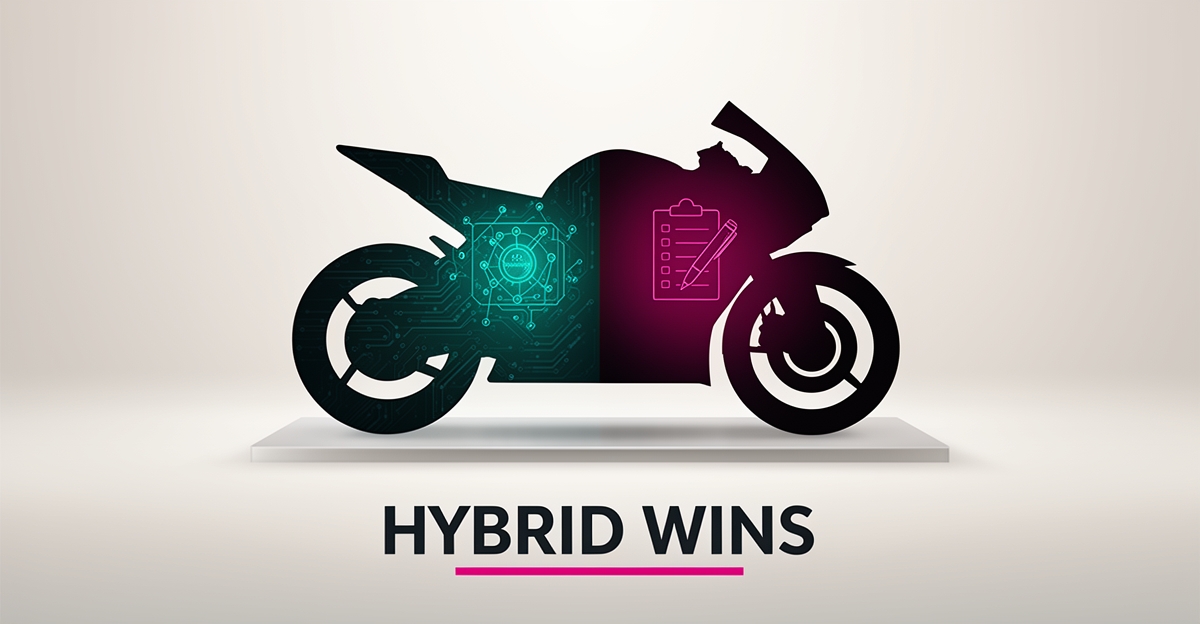
Motorcycle showrooms face increasing pressure to engage customers efficiently while maintaining the personal touch that builds loyalty. A hybrid model—AI for initial qualification, humans for relationship-driven steps—delivers measurable results.
The efficiency comes from AI handling data-intensive tasks like lead research and personalized outreach, while human staff focus on test drives, negotiation, and closing—areas where judgment and trust remain essential.
AIQ Labs supports this workflow through managed AI Employees for sales qualification and appointment setting, or a focused Workflow Build that rebuilds the one workflow costing you the most. The implementation follows a clear sequence: AI qualifies leads using CRM-integrated research, recommends vehicles based on preference data, and schedules test drives. Humans conduct the test drives, address specific concerns, and guide customers through final decisions. Post-interaction, AI logs interactions, updates lead scores, and triggers follow-up sequences for ongoing engagement.
This division of labor cuts time spent on non-revenue tasks, freeing staff to prioritize high-value interactions. The model scales without adding headcount, as AI handles thousands of signals simultaneously while humans concentrate on the nuanced aspects of motorcycle sales that drive long-term loyalty. Dealerships adopting this approach typically report faster sales cycles and higher close rates, particularly when AI handles initial outreach and humans own the experiential and closing phases. Implementing this workflow requires integrating AI with existing CRM and scheduling tools, training staff on handoff protocols, and establishing clear metrics for qualification and conversion. AIQ Labs provides end-to-end support for this integration—whether you start monthly with an AI Employee, build in milestones, or own the system outright—with payment models that fit how you want to invest. The result is a showroom where technology enhances—not replaces—the human elements that make motorcycle sales meaningful.
Still paying for 10+ subscriptions that don’t talk to each other?
We build custom AI systems you own outright. No vendor lock-in. Full control.
Not sure where to start? Ask our AI planner
Frequently Asked Questions
How much time do sales reps actually save on data entry when using AI tools in a motorcycle showroom?
Can AI really improve response rates for initial outreach in motorcycle sales, or is that just hype?
If AI handles lead qualification and outreach, what do human sales staff actually do in a modern motorcycle showroom?
Will using AI in our motorcycle showroom actually help us close more deals, or just create more work for our team?
Is it true that AI can't be trusted for final sales decisions in emotional purchases like motorcycles?
How does AIQ Labs help motorcycle showrooms implement AI without disrupting their current sales process?
Where AI and Human Strengths Meet in the Showroom
The motorcycle showroom doesn't need to choose between AI efficiency and human connection—it needs both working in harmony. AI excels at the data-heavy lifting: qualifying leads 24/7, personalizing outreach, and cutting administrative time so sales teams can focus on what truly moves the needle—test rides, negotiations, and building the trust that turns interest into ownership. This hybrid approach isn't theoretical; teams that let technology handle the repetition while humans own the relationship consistently report faster cycles and better close rates. For dealerships ready to stop losing leads to slow follow-ups and overburdened reps, the path forward is clear: start with a focused workflow fix, measure the impact, and scale what works. To explore how AI can amplify your team's strengths without replacing them, take the 2-minute Fit Check and book a free 30-minute strategy call with AIQ Labs to map your biggest bottleneck—no obligation, just clarity on where AI can actually help your showroom perform better.
Make AI your competitive advantage — not just another tool.
Strategy, implementation and ongoing optimization. One partner, end to end.
Not sure where to start? Ask our AI planner