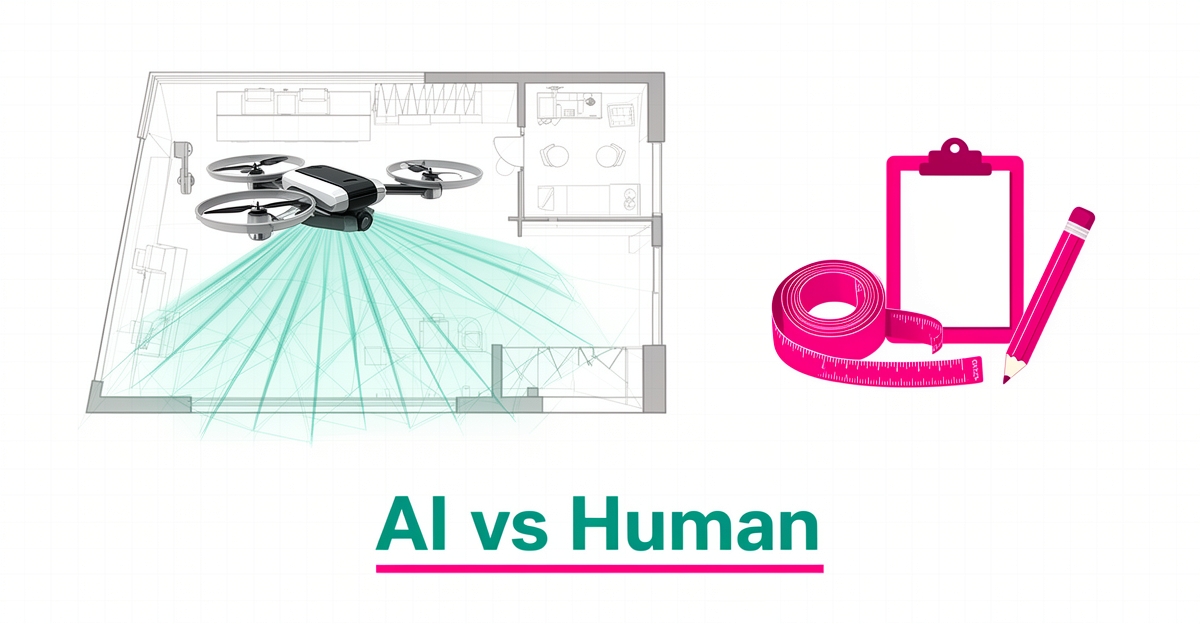
AI vs. Human Site Visits: Which Is More Effective for Space Planning?
Key Facts
- AI adoption is now mainstream across business functions, and most organizations use AI in at least one part of their operations as of late 2026
- AI-assisted site assessments are typically faster, more consistent, and lower cost than human-led methods for data collection
- Human expertise remains irreplaceable for design judgment, stakeholder navigation, and contextual creativity in space planning
- AIQ Labs advocates a hybrid model where AI handles measurement and preliminary analysis while humans focus on creative decision-making
Hire a team member that works 24/7 — for less than a part-time wage.
AI receptionists, SDRs, dispatchers and 99+ roles. Trained on your business, fully managed.
Not sure where to start? Ask our AI planner
The Space Planning Bottleneck: Why Traditional Site Visits Fall Short
Traditional site visits still dictate space planning timelines, and the friction is getting harder to ignore. Teams send architects and facilities staff on-site, wait for measurements, then reconcile handwritten notes into usable models.
The bottleneck starts with speed. Human-led assessments are slow by design. A single building walkthrough requires scheduling, travel, on-site capture, and post-visit documentation. That linear workflow creates delays for architecture, construction, and facilities teams who need timely decisions.
Inconsistent data capture compounds the problem. Manual tape measures, photos, and field notes vary by person and day. Errors propagate into BIM models and layouts, forcing rework. High labor costs follow, because senior staff spend hours collecting data that could be automated.
Scaling is the final constraint. Demand for space planning is rising as organizations reconfigure workplaces, yet teams remain fixed in size. The result is backlogs, rushed assessments, and decisions made on incomplete information.
Adoption data shows the contrast. As of late 2026, most organizations report using AI in at least one business function, while space planning remains largely manual. AI assistants like ChatGPT and Google Gemini are now embedded in everyday professional work, illustrating how quickly teams adopt tools that remove repetitive tasks once they prove reliable.
The core challenges of human-led site assessments include:
- Slow timelines from scheduling to reporting
- Inconsistent data capture across teams and sites
- High labor costs for senior staff performing routine measurement
- Scaling difficulties as project volume outpaces headcount
These constraints matter because space planning sits at the intersection of design judgment and operational data. AI excels in data collection and preliminary analysis, while humans remain irreplaceable in design judgment. That balance is why AIQ Labs supports a hybrid model that combines AI efficiency with human creativity.
A balanced comparison shows where each approach wins. AI-led capture is faster and lower cost for measurement and documentation. Human-led assessment delivers higher creativity and contextual interpretation. In practice, the bottleneck is not choosing one over the other, but removing manual data work so experts can focus on decisions.
Change management and training become critical as teams shift from field capture to AI-augmented workflows. Success requires clear policies, governance, and adoption support so AI augments rather than replaces professional expertise. When implemented well, the hybrid approach shortens timelines, improves consistency, and frees architects and facilities leaders to apply judgment where it adds the most value.
Where AI Outperforms: Data Collection, Speed, and Preliminary Analysis
AI is transforming how teams approach space planning site visits, delivering measurable advantages in data collection, speed, and preliminary analysis. Automated measurement capture eliminates manual transcription errors that often slow down human-led assessments, while AI systems process spatial data continuously without fatigue. This enables rapid generation of preliminary layouts that would take human teams hours or days to produce manually.
The reliability question that held teams back for years has largely been answered. Mainstream AI platforms now handle high-volume, repetitive work at scale across industries, and that track record is what makes AI-assisted site assessment practical rather than experimental.
- Automated laser and photogrammetry tools capture room dimensions with high precision, typically well beyond tape-measure accuracy
- AI processes floor plans, occupancy data, and workflow patterns in real time
- Preliminary layouts generate in minutes, not hours, enabling faster stakeholder feedback
- 24/7 processing capability allows assessments to run outside business hours
- Elimination of human transcription errors improves data integrity for downstream analysis
AIQ Labs integrates these capabilities into a hybrid model where AI handles data-intensive tasks while human experts focus on spatial storytelling, ergonomic judgment, and cultural fit—ensuring efficiency doesn't come at the expense of design quality. With AI adoption now widespread across business functions, the question is no longer whether to use AI in planning workflows, but how to deploy it as a force multiplier. By offloading repetitive measurement and analysis, teams reclaim time for creative problem-solving and client collaboration—where human insight remains indispensable. For firms that want this capability without hiring a full build team, AI Workflow Builds rebuild the single most expensive workflow first, at a fixed price, in phases.
Where Humans Remain Irreplaceable: Design Judgment and Stakeholder Navigation
No algorithm can sit across the table from a client who says they want "something open but not too open" and know exactly what they mean. That gap between stated requirements and real intent is where space planning projects succeed or fail—and it remains firmly human territory. AI has transformed how quickly we gather data, but the decisions that follow demand judgment no model can replicate.
Consider what happens after an AI system captures dimensions, lighting conditions, and layout constraints. The raw accuracy is impressive, and these tools are now woven into daily work across industries. Yet speed and accuracy in data collection tell us nothing about which design trade-offs a client will actually accept.
The irreplaceable human layer shows up in several places:
- Interpreting ambiguous needs — translating vague stakeholder language into concrete spatial decisions that balance competing priorities.
- Navigating building code nuances — knowing when a technically compliant layout fails in practice, and when local interpretation matters.
- Managing stakeholder politics — reading the room when facilities, finance, and leadership pull in different directions.
- Applying contextual creativity — designing for how a specific organization actually lives and works in its space.
These judgment calls are also where the comparison points in AI's favor: AI-led approaches typically win on speed, consistency, and cost, while human-led work retains a clear edge in creativity. With most companies now using AI in at least one business function, the differentiator is no longer access to the technology—it's knowing which decisions to delegate to it.
This is why framing the human role as a limitation misses the point. The most effective teams treat AI as the data-collection engine and concentrate human expertise on the high-value layer above it. That's the hybrid model AIQ Labs advocates in its consulting work: automate the measurable, and free designers to spend their hours on the ambiguous, political, and creative work where they genuinely outperform any system.
One caution deserves mention here. AI can introduce biases and errors when trained on incomplete or low-quality data, and a confident preliminary analysis can anchor a team to the wrong direction before a human ever weighs in. Governance, clear policies, and human-in-the-loop review aren't bureaucratic overhead—they're what keep the efficiency gains from becoming liabilities.
The takeaway is simple: let machines count, and let people decide.
The Hybrid Model: How Leading Firms Combine AI Efficiency with Human Creativity
The most effective space planning doesn't rely on AI or humans alone—it requires a deliberate hybrid workflow where each contributes their distinct strengths. AIQ Labs recommends a model where AI handles site scanning, data structuring, and initial option generation, while humans focus on client discovery, design refinement, and final specification. This division leverages AI's speed in processing spatial data and humans' irreplaceable role in interpreting needs and applying creative judgment.
This approach aligns with current adoption trends, as most organizations now use AI in at least one business function, recognizing its value in accelerating data-heavy tasks. However, the same pattern highlights persistent challenges: organizations often struggle with AI risk management and integration gaps when deployment lacks structured oversight. Without clear governance, even efficient AI tools can introduce errors or biases that undermine planning outcomes.
To mitigate these risks, leading firms embed human-in-the-loop controls at critical decision points, ensuring AI-generated options are validated against client goals and contextual nuances. They also establish clear policies for data quality, model validation, and ethical use—practices widely recognized as essential for responsible AI adoption. This structured oversight transforms AI from a standalone tool into a reliable collaborator within the design process.
The hybrid model thus delivers more than efficiency gains; it creates a resilient framework where technology amplifies human expertise rather than replacing it. By combining AI's capacity for rapid analysis with human creativity and judgment, firms achieve space plans that are both data-informed and deeply tailored to user needs—proving that the future of planning lies not in choosing between AI and humans, but in integrating them wisely.
Implementation Roadmap: From Pilot to Scaled Hybrid Workflow
The gap between a successful AI pilot and a scaled hybrid workflow is where most firms stall. With AI adoption now widespread across business functions as of late 2026, the differentiator is no longer adoption—it's structured implementation.
The most reliable path starts narrow. Pick a single project type—say, tenant fit-outs or a recurring retail prototype—and run a hybrid assessment there first. AI handles data collection and preliminary analysis, where it is faster, more consistent, and cheaper than manual methods, while designers retain full authority over spatial judgment and creativity.
Before the pilot begins, define your AI-human handoff points explicitly. AI captures measurements, generates preliminary layouts, and flags anomalies; humans review, refine, and make the calls that require design judgment. Clear policies and procedures for AI use are essential, since unmanaged handoffs are where errors and biases slip through.
Then establish quality gates—checkpoints where human reviewers validate AI output before it moves downstream. This is your AI-specific risk management strategy in practice, and it protects both accuracy and client trust during the transition.
Measurement turns a pilot into a case for scaling. Track two metrics from day one:
- Time-to-deliver per assessment, compared against your pre-AI baseline
- Revision cycles required before client sign-off
- Data quality issues caught at each quality gate
- Designer hours redirected from measurement to design work
If the pilot shows faster delivery and fewer revision cycles without sacrificing design quality, expand to a second project type—then a third. This mirrors the AI Maturity Curve that AIQ Labs uses with clients: most organizations move from Exploration through Pilots, Scaling, and Optimization before reaching Transformation, where AI is embedded in the operating model itself. The firms that succeed don't skip stages; they climb them deliberately, adding governance and training at each step.
The entry point matters as much as the roadmap. Low-risk engagement models—such as AIQ Labs' Start Monthly approach, where a single AI employee is built, trained, and managed on a flat monthly plan with the ability to pause or adjust anytime—let firms prove value before committing to larger transformation investments. That philosophy applies directly here: validate the hybrid workflow on one project type, with real metrics, before scaling firm-wide.
The context supports urgency. AI adoption continues to grow across industries, and clients increasingly expect AI-accelerated timelines. A phased, measured rollout ensures your firm meets that expectation without betting the practice on an unproven workflow. For firms ready to connect multiple workflows into one system they own outright, AI Operating Systems provide that connected layer, built in phases.
Still paying for 10+ subscriptions that don’t talk to each other?
We build custom AI systems you own outright. No vendor lock-in. Full control.
Not sure where to start? Ask our AI planner
Frequently Asked Questions
How much faster can AI complete space planning site assessments compared to human-led visits?
What specific advantages does AI offer in data collection for space planning that humans cannot match?
Why are humans still essential in space planning even with advanced AI tools available?
What evidence shows that AI adoption in business functions is becoming widespread and accepted?
What risks should teams be aware of when implementing AI in space planning, and how can they be mitigated?
How does a hybrid AI-human workflow improve space planning outcomes compared to using either approach alone?
The Future of Space Planning Isn't a Choice—It's a Partnership
The verdict is clear: AI wins on speed, consistency, and cost for data collection, while humans remain unmatched in design judgment, stakeholder navigation, and creative interpretation. The firms pulling ahead aren't choosing sides—they're building hybrid workflows where AI handles measurement and preliminary layouts, and designers focus on the ambiguous, high-value decisions that machines can't touch. With AI adoption now mainstream across business functions, clients increasingly expect AI-accelerated timelines. The path forward starts small: pilot a hybrid assessment on one project type, define clear AI-human handoff points, establish quality gates, and measure time-to-deliver and revision cycles against your baseline. If that feels like more than your team can take on alone, AIQ Labs helps firms build and scale exactly these hybrid workflows—from single pilots to full AI operating systems you own outright. Start with the two-minute Fit Check at aiqlabs.ai/apply, then book a free 30-minute strategy call. It's a real working session with an AI engineer to map your biggest bottleneck—and if there isn't a clear win, we'll tell you that too.
Make AI your competitive advantage — not just another tool.
Strategy, implementation and ongoing optimization. One partner, end to end.
Not sure where to start? Ask our AI planner