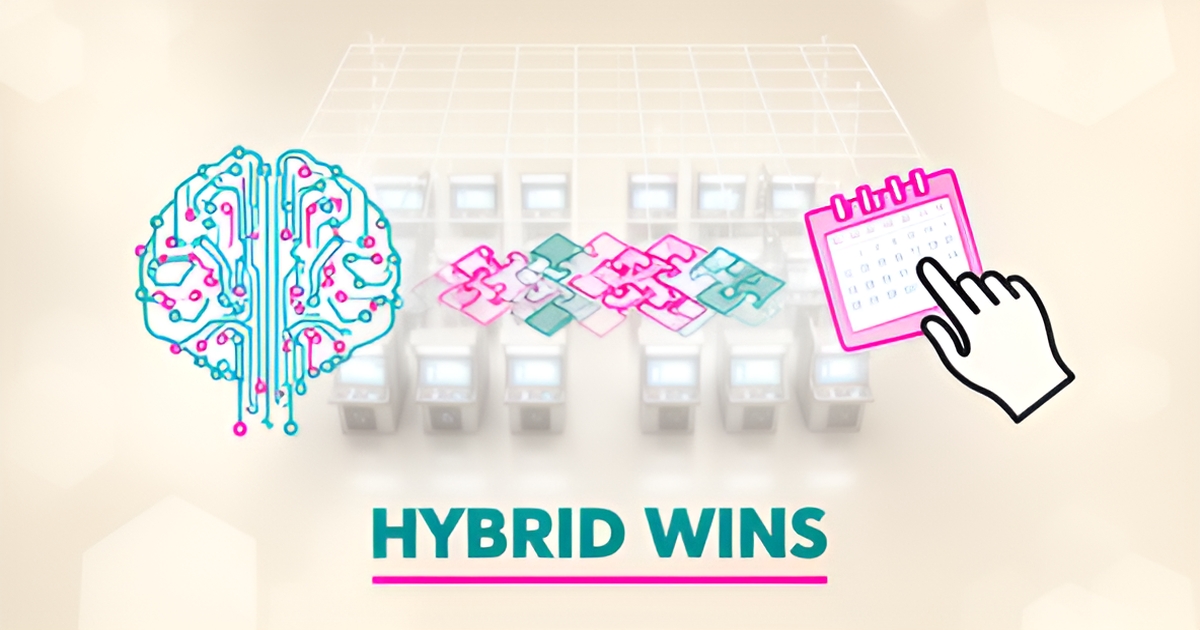
AI vs. Human Staff: Which Is Better for Managing Arcade Game Hours?
Key Facts
- AI scheduling tools typically excel at automating repetitive shifts and rescheduling around conflicts, but lack human judgment for urgency and strategic priorities
- Human staff remain essential for peak-hour decisions, equipment troubleshooting, and the on-floor presence customers expect
- Managed AI staff can run routine coordination at a fraction of the cost of an additional human hire — AIQ Labs deploys AI employees across 99+ roles at roughly 80% less than a human hire
- AIQ Labs has deployed 200+ multi-agent systems and runs 4 live SaaS products daily
- The hybrid model works best when automation rules are explicit: AI adjusts routine schedules autonomously, humans approve peak-hour and exception changes
Hire a team member that works 24/7 — for less than a part-time wage.
AI receptionists, SDRs, dispatchers and 99+ roles. Trained on your business, fully managed.
Not sure where to start? Ask our AI planner
The Scheduling Dilemma Arcade Owners Face
Arcade floors don't run on a 9-to-5 calendar. Rush hour spikes on Friday nights, school holidays create sudden surges, and a single machine outage can ripple through the entire evening shift. That volatility makes scheduling feel like a constant gamble.
Traditional spreadsheets and phone calls can't keep pace with unpredictable demand. Owners manually juggle coverage gaps, overtime, and last-minute call-outs while trying to protect margins. In practice, AI scheduling tools are good at automating repetitive scheduling and rescheduling when conflicts arise, but they lack the human judgment needed to prioritize based on urgency, energy levels, and strategic goals.
The pressure is twofold: cut labor costs without sacrificing the experience that brings families back. Human staff provide the warmth, troubleshooting, and on-floor presence customers expect, yet manual scheduling burns hours each week and leaves owners exposed to understaffing during peaks. Every week you run on manual scheduling is a week of admin hours and coverage gaps you're paying for twice.
Arcade operators face a specific set of scheduling friction points:
- Unpredictable peak hours that shift with weather, school breaks, and local events
- Equipment maintenance windows that must be staffed without disrupting play
- Coverage gaps when part-time staff cancel and replacements are hard to source quickly
- Balancing labor cost control with consistent customer service on the floor
This is where a hybrid model creates leverage. AI can handle routine shift generation, automated rescheduling, and real-time analytics while humans retain control over high-value decisions. AI excels at automating repetitive tasks and providing data-driven insights, while human oversight remains crucial for strategic planning and maintaining personal touch.
The staffing market is already moving this way. Employment and staffing operations across industries are adopting AI for routine coordination, keeping humans focused on relationships and judgment. Operators who wait pay for that admin overhead longer than they need to.
[AIQ Labs](/ai-employees) helps arcade owners design a hybrid model using AI employees to handle routine shifts while freeing up staff for high-value interactions. The goal is not to remove people from the floor, but to remove the administrative overload that keeps owners from focusing on experience and growth.
AI's Strengths and Limitations in Workforce Management
AI scheduling tools excel at the mechanical grind of workforce management — automating repetitive calendar tasks, rescheduling around conflicts in seconds, and processing bulk shift changes through simple chat interfaces. Current AI assistants paired with automated tools can schedule tasks around existing calendar events and automatically reschedule when conflicts arise. This computational speed is where AI earns its keep, particularly for arcade operators juggling dozens of part-time shifts across peak weekends and slow weekdays.
- Automates routine scheduling and rescheduling without human intervention
- Processes bulk shift changes and conflict resolution in seconds
- Provides real-time analytics on coverage gaps and labor costs
- Integrates with existing calendar systems and employee databases
- Scales effortlessly from 5 to 500 employees without added overhead
The limitation is equally clear: these systems lack the human judgment needed to prioritize based on urgency, energy levels, and strategic goals. They cannot weigh a technician's fatigue against a critical machine repair, or balance a star employee's development needs against Saturday rush coverage. That's the divide the staffing industry keeps confirming: AI transforms workforce management by automating repetitive tasks, while humans focus on relationship building and strategic planning.
Cost is where the case gets sharper. A managed AI employee handling routine coordination typically runs at roughly 80% less than the cost of an additional human hire — and it doesn't call out sick on a Saturday. The cost curve favors AI for routine coordination, but the strategic layer — deciding which shifts matter most — remains distinctly human territory.
The Hybrid Model: Best of Both Worlds
The evidence is clear: neither AI nor human staff alone delivers the optimal result for arcade operations. Across staffing and workforce management, the pattern is consistent — AI amplifies human capabilities rather than replacing them, moving teams from administrative overload to a data-driven, people-first strategy.
AI task-scheduling tools are best used as helpers — a prompt to think more carefully about how time is used, not a full replacement. For arcade owners, this means dividing responsibilities strategically:
- AI handles routine shift scheduling, automated rescheduling around conflicts, and bulk task management through chat interfaces
- Human staff focus on high-value customer interactions, equipment maintenance decisions, and peak-hour crisis management
- Managers use AI-generated analytics for strategic workforce planning while applying human judgment to urgency and energy levels
- AI employees manage 24/7 coverage for routine inquiries while human teams handle complex problem-solving
[AIQ Labs](/workflow-builds) helps arcade operators design this hybrid model — starting with the one workflow that costs you the most, rebuilt at a fixed price in phases. The result is a system where computational power handles the repetitive heavy lifting while your team delivers the personal touch that keeps customers coming back.
Implementation Roadmap for Arcade Owners
Transitioning to AI-assisted scheduling might seem daunting, but with a structured approach, arcade owners can smoothly integrate this technology while preserving the human touch that defines their brand. The key lies in viewing AI as a collaborative tool rather than a replacement, leveraging its strengths to enhance operational efficiency.
The journey begins with a thorough assessment of your current scheduling landscape. Identify repetitive tasks that consume valuable staff time, such as shift assignments and basic rescheduling. These are typically the first wins for automation, freeing your team for more strategic work.
Next, select an AI solution that aligns with your arcade's specific needs and budget. Off-the-shelf assistants can cover basic scheduling, but arcades with volatile demand usually need something built around their actual operation — which is where a phased build makes more sense than a generic subscription.
- Begin with a pilot program for a single shift or department.
- Train your team on how AI supports, not supplants, their roles.
- Establish clear protocols for human override in complex situations.
- Regularly review AI performance and gather staff feedback.
Configuring automation rules is where the hybrid model truly takes shape. Define parameters for when AI should autonomously adjust schedules and when human approval is essential, especially for peak hours or special events. AI is transforming workforce management by automating repetitive tasks, allowing humans to focus on relationship building and strategic planning.
Change management is crucial for successful adoption. Communicate transparently with your staff about the benefits, emphasizing how AI will reduce administrative burdens and create opportunities for more engaging customer interactions. AI amplifies human capabilities rather than replacing them, fostering a more strategic and people-first approach.
Finally, maintain the human touch by strategically deploying your team where their emotional intelligence and problem-solving skills shine. While AI handles the logistical heavy lifting, your staff can focus on creating memorable experiences for arcade patrons. For a tailored roadmap and expert guidance through this transformation, [AIQ Labs](/ai-operating-systems) can help design a hybrid model that fits your unique operational needs — one connected operating layer, built in phases, owned outright. Start with a free strategy call to map your biggest scheduling bottleneck.
Still paying for 10+ subscriptions that don’t talk to each other?
We build custom AI systems you own outright. No vendor lock-in. Full control.
Not sure where to start? Ask our AI planner
Frequently Asked Questions
Will AI scheduling actually work for arcade peak hours and last-minute call-outs?
Is a hybrid model really better than just using AI or just humans?
How much does AI scheduling cost for a small arcade?
What tasks should I let AI do vs keep with my staff?
Can AI replace my floor staff completely?
How do I start without disrupting operations?
Play Smarter, Not Harder: Let AI Handle the Clockwork
Arcade floors reward presence, not spreadsheets. AI wins at the mechanical grind — automating routine shift generation, instant rescheduling, and real-time coverage analytics — while human staff remain essential for the judgment calls around urgency, energy, and customer experience. The operators who win are building a hybrid model where AI handles repetitive scheduling and humans own high-value interactions, maintenance decisions, and peak-hour crisis management. That split protects margins without sacrificing the warmth that brings families back — and every month on manual scheduling is a month of admin hours and coverage gaps you keep paying for. If you're ready to test where automation earns its keep and where your team should stay in control, map your biggest scheduling bottleneck first. AIQ Labs helps arcade owners design that hybrid model, identifying which functions to automate and which to keep human-led. Start the 2-minute Fit Check at https://aiqlabs.ai/apply for a free 30-minute strategy call to map your opportunity — and if there isn't a clear win, we'll tell you that too.
Make AI your competitive advantage — not just another tool.
Strategy, implementation and ongoing optimization. One partner, end to end.
Not sure where to start? Ask our AI planner