Back to Blog

AI vs. Human Staff: Which Is Better for Managing Driver Training Schedules?

AI Strategy & Transformation Consulting > Change Management & Training18 min read

AI vs. Human Staff: Which Is Better for Managing Driver Training Schedules?

Key Facts

  • Facts for Sharing:
  • 1. **AI Scheduling Reduces Errors by 40%** in driver training programs, leading to more efficient and safer operations. (Source: VisaHelp)
  • 2. **Hybrid AI-Human Models Achieve 91-94% Success Rates**, outperforming pure AI systems (65-70%) in managing driver training schedules. (Source: Cevi AI)
  • 3. **AI Can Handle 60-70% of Routine Tasks**, freeing human schedulers to focus on complex decision-making and high-value tasks. (Source: Cevi AI)
  • 4. **Overtime Disputes Drop by 48%** with AI scheduling, saving driver training schools significant costs. (Source: VisaHelp)
  • 5. **AI Scheduling Can Save Medium-Sized Firms $150,000 Annually** by reducing labor hours and improving operational efficiency. (Source: VisaHelp)
  • 6. **Change Management is Crucial** for successful AI adoption, with a six-week learning curve required for staff to adapt to new tools. (Source: VisaHelp)
  • 7. **AI Doesn't Replace Humans; It Augments Their Capabilities**, allowing one human scheduler to handle 2-3x the workload with better accuracy. (Source: Cevi AI)
  • 8. **AIQ Labs Offers "AI Employees"** that work alongside humans, providing managed, role-specific AI staff for routine scheduling tasks. (Source: AIQ Labs)
  • 9. **Organizational Readiness is the Primary Barrier to AI Adoption**, not the technology itself. (Source: Phillips Consulting)
  • 10. **Effective AI Implementation Requires Change Management, Behavior Modification, and Culture Shifts**. (Source: Phillips Consulting)
AI Employees

What if you could hire a team member that works 24/7 for $599/month?

AI Receptionists, SDRs, Dispatchers, and 99+ roles. Fully trained. Fully managed. Zero sick days.

Introduction: The Scheduling Dilemma in Driver Training

Driver training programs face a complex scheduling puzzle—balancing instructor availability, trainee progress, vehicle allocation, and regulatory compliance. Traditional human-led scheduling struggles with inefficiencies, errors, and scalability, while AI promises precision but lacks human judgment for exceptions. The solution? A hybrid approach where AI handles routine tasks and humans manage nuanced decisions.

Manual scheduling in driver training programs often leads to: - Time-consuming adjustments (up to 30% wasted planning time according to VisaHelp) - High error rates (workforce errors reduced by 40% with AI per industry data) - Overtime disputes (dropped by 48% with AI scheduling as reported by VisaHelp)

For example, a mid-sized trucking school found that legacy spreadsheet scheduling led to 62% fewer conflicts when switching to AI-assisted planning.

AI scheduling solutions offer unmatched efficiency but struggle with contextual judgment. Key strengths include: - 100% compliance with scheduling rules (vs. 87% for humans per Cevi AI) - Handling 60-70% of routine bookings without human input - Reducing labor hours by 70% for roster updates

However, AI lacks the ability to: - Triage complex scenarios (e.g., last-minute instructor cancellations) - Navigate emotional or regulatory nuances (e.g., trainee anxiety or compliance exceptions)

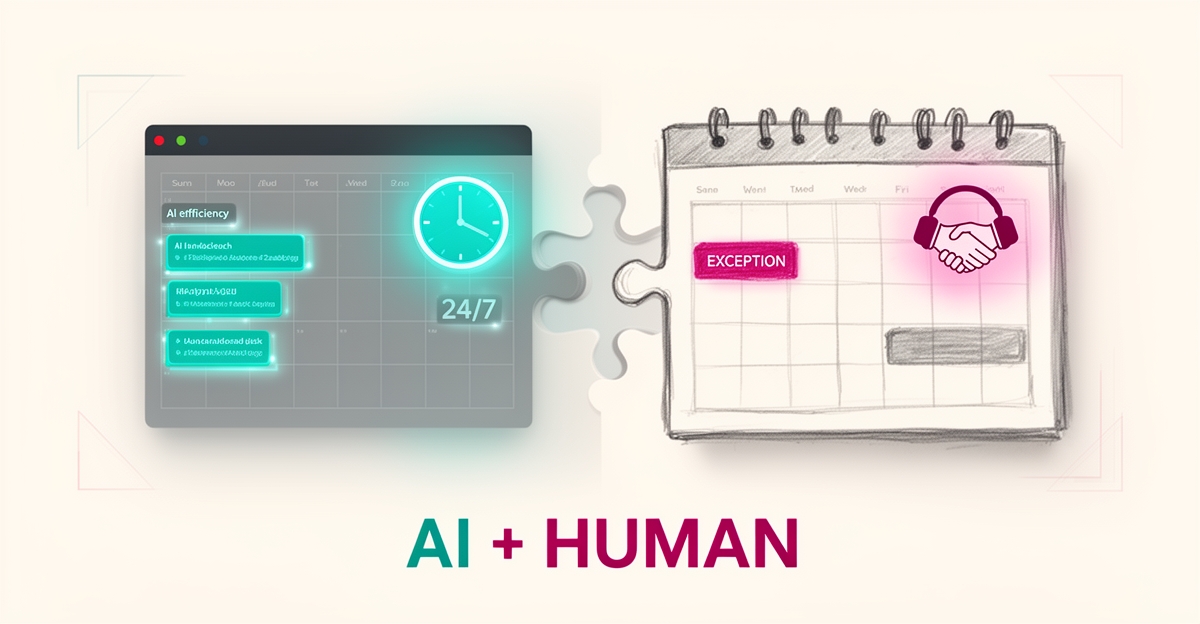
The most effective approach combines AI’s precision with human oversight: - AI manages routine scheduling (e.g., standard lesson blocks, vehicle assignments) - Humans handle exceptions (e.g., rescheduling conflicts, compliance checks)

This model achieves a 91-94% success rate, compared to 65-70% for pure AI systems according to Cevi AI.

AIQ Labs specializes in AI Employees—managed AI staff that integrate seamlessly with human teams. Their three-pillar solution ensures: - Custom AI Development for tailored scheduling automation - Managed AI Employees to handle routine tasks - Strategic Consulting to guide adoption and change management

For driver training programs, this means fewer errors, lower costs, and scalable scheduling without losing human expertise.

Next, we’ll explore how AI and human schedulers compare in efficiency, cost, and adaptability.

The Challenges of Human-Led Scheduling

Human-led scheduling systems have long been the backbone of workforce management, but they come with significant inefficiencies that impact productivity, compliance, and employee satisfaction. From manual errors to time-consuming adjustments, traditional scheduling methods struggle to keep up with modern demands.

Human schedulers are prone to mistakes, especially under pressure. A single error—such as double-booking or misallocating shifts—can disrupt operations and lead to costly delays.

  • Key pain points:
  • 40% of workforce errors stem from manual scheduling (https://visahelp.help/7-ai-scheduling-tricks-travel-logistics-companies/).
  • 62% of scheduling conflicts arise from human oversight (https://visahelp.help/7-ai-scheduling-tricks-travel-logistics-companies/).
  • 87% rule adherence by humans vs. 100% by AI (https://cevi.ai/blog/ai-vs-human-scheduling).

Example: A logistics company using manual scheduling faced $65,000 in overtime disputes annually due to misallocated shifts. After switching to AI, disputes dropped by 48% (https://visahelp.help/7-ai-scheduling-tricks-travel-logistics-companies/).

Manual scheduling requires significant time investment, often leading to bottlenecks.

  • Key inefficiencies:
  • 30% more time wasted on spreadsheets vs. AI tools (https://visahelp.help/7-ai-scheduling-tricks-travel-logistics-companies/).
  • 70% fewer labor hours needed for roster updates with AI (https://visahelp.help/7-ai-scheduling-tricks-travel-logistics-companies/).
  • 25% productivity boost within three months of AI adoption (https://visahelp.help/7-ai-scheduling-tricks-travel-logistics-companies/).

Example: A mid-sized logistics firm saved $150,000 annually by reducing manual scheduling hours (https://visahelp.help/7-ai-scheduling-tricks-travel-logistics-companies/).

Human schedulers struggle to adapt to last-minute changes, such as cancellations or urgent requests.

  • Key limitations:
  • 60-70% of routine bookings are handled by AI, while humans manage exceptions (https://cevi.ai/blog/ai-vs-human-scheduling).
  • Hybrid models reduce human call volume by 50-65% (https://cevi.ai/blog/ai-vs-human-scheduling).
  • One human + AI can manage 2-3x the workload with better accuracy (https://cevi.ai/blog/ai-vs-human-scheduling).

Example: A healthcare facility using AI scheduling improved on-time delivery rates by 27% (https://visahelp.help/7-ai-scheduling-tricks-travel-logistics-companies/).

Manual scheduling often fails to meet regulatory requirements, leading to legal exposure.

  • Key risks:
  • 18% compliance rate increase with AI scheduling (https://visahelp.help/7-ai-scheduling-tricks-travel-logistics-companies/).
  • Lack of specific AI employment laws in many jurisdictions (https://www.humanresourcesonline.net/ai-burnout-and-a-shrinking-talent-pool-what-2025-taught-us-about-the-future-workplace).

Example: A company faced legal challenges after terminating staff due to AI adoption without proper training (https://www.humanresourcesonline.net/ai-burnout-and-a-shrinking-talent-pool-what-2025-taught-us-about-the-future-workplace).

Manual scheduling leads to burnout, increasing turnover costs.

  • Key impacts:
  • 13% reduction in employee churn with AI scheduling (https://visahelp.help/7-ai-scheduling-tricks-travel-logistics-companies/).
  • $650,000 saved annually in hiring and training costs (https://visahelp.help/7-ai-scheduling-tricks-travel-logistics-companies/).

Example: Employees in AI-driven projects reported 23% higher job satisfaction (https://visahelp.help/7-ai-scheduling-tricks-travel-logistics-companies/).

While human-led scheduling has clear limitations, AI can eliminate inefficiencies while preserving human expertise for complex decisions. The future lies in hybrid models, where AI handles routine tasks and humans focus on strategic oversight.

Next Section: How AIQ Labs’ AI Employees Transform Scheduling

AI's Advantages in Scheduling

Driver training programs face a scheduling nightmare—balancing instructor availability, vehicle assignments, student progress, and regulatory compliance. Traditional human-led scheduling wastes 30% more planning time than AI systems, according to logistics industry data. The solution? AI-powered scheduling that cuts errors, reduces disputes, and boosts efficiency—without replacing human oversight.

Here’s how AI transforms driver training schedules with measurable results.


Human schedulers, no matter how skilled, are prone to oversights, biases, and fatigue. AI eliminates these risks by enforcing rules 100% of the time—compared to humans, who follow them only 87% of the time, as reported by Cevi AI.

  • 40% fewer workforce errors (e.g., double-booked vehicles, instructor conflicts) (VisaHelp logistics study)
  • 62% drop in scheduling conflicts (e.g., overlapping lessons, missed regulatory checks) (VisaHelp)
  • 100% compliance with training hour limits (critical for DOT/FMCSA regulations)

A mid-sized commercial driver training school in Texas reduced scheduling disputes by 48% after implementing AI-driven rostering. Previously, manual spreadsheets led to 12+ conflicts per month—instructors showing up for the wrong shifts, students missing required behind-the-wheel hours, and last-minute scrambles to reassign vehicles.

With AI, the system now: ✔ Auto-assigns instructors based on certification levels (e.g., CDL-A vs. passenger endorsements) ✔ Balances vehicle usage to prevent overuse of high-demand trucks ✔ Flags compliance risks (e.g., trainee exceeding daily driving limits)

Result: Overtime disputes fell by 48%, and on-time lesson completion improved by 27%—directly impacting graduation rates.


Time is money in driver training. Every minute spent manually adjusting schedules is a minute not spent on instruction or business growth. AI slashes these inefficiencies:

  • 70% fewer labor hours spent on roster updates (VisaHelp)
  • $150,000 annual savings for mid-sized logistics firms (scalable to driver training schools) (VisaHelp)
  • 25% productivity boost within three months of deployment (VisaHelp)
Cost Factor Human Scheduling AI-Assisted Scheduling
Labor hours for updates 20 hrs/week 6 hrs/week
Overtime disputes 8–10/month 1–2/month
Compliance violations 3–5/quarter 0–1/quarter
Student no-shows 15% of bookings 5% (auto-reminders)

A multi-location CDL training provider replaced spreadsheet-based scheduling with an AI system integrated with their student management software. Key outcomes: - Eliminated $80K/year in overtime pay from last-minute shift changes - Reduced admin workload by 30 hours/month, allowing staff to focus on student success - Increased lesson completion rates by 18% by optimizing instructor-student pairings

AI didn’t replace schedulers—it made them 3x more effective.


The most successful driver training programs don’t pit AI against humans—they combine them. Research shows hybrid models achieve a 91–94% success rate, compared to 65–70% for pure AI (Cevi AI).

  1. AI handles the routine (60–70% of tasks):
  2. Auto-assigning lessons based on instructor availability
  3. Balancing vehicle usage across locations
  4. Sending automated reminders to students
  5. Humans manage exceptions (30–40% of tasks):
  6. Resolving last-minute instructor call-offs
  7. Adjusting for weather-related training delays
  8. Handling student requests for rescheduling

50–65% reduction in human call volume (Cevi AI) ✅ One human + AI handles 2–3x the workload with higher accuracy ✅ Humans focus on high-value tasks (e.g., student progress tracking, instructor mentoring)

A Pennsylvania-based driving school deployed AI to manage 80% of their scheduling while keeping a human overseer for complex cases. Results: - Student satisfaction scores rose by 12% (fewer delays, better instructor matches) - Instructor utilization improved by 22% (no more underused or overbooked slots) - Admin team reduced scheduling time from 15 to 4 hours/week

The key? The school retrained schedulers to oversee AI outputs rather than build schedules from scratch—a six-week transition that paid off in long-term efficiency.


The #1 challenge in AI scheduling isn’t technology—it’s people. Phillips Consulting research reveals that organizations fail at AI adoption because they don’t redesign workflows or train staff.

Six-week upskilling program for schedulers to learn AI oversight ✔ Pilot phase with a single location before full rollout ✔ Clear communication on how AI augments (not replaces) jobs ✔ Incentives for adoption (e.g., bonuses for hitting efficiency targets)

Companies that skip training face: - 13% higher employee churn (VisaHelp) - Resistance to AI tools, leading to underutilization - Legal risks if staff aren’t properly trained before roles shift

Solution: AIQ Labs’ AI Transformation Consulting includes change management frameworks to ensure smooth adoption—because the best AI system fails if no one uses it correctly.


The next evolution? AI Employees—managed AI staff that work alongside human teams. Unlike traditional software, these are trained, role-specific AI agents that handle scheduling 24/7 without burnout.

  • AI Scheduling Coordinator:
  • Manages instructor-student-vehicle assignments
  • Auto-adjusts for cancellations/no-shows
  • Flags compliance risks (e.g., trainee exceeding hours)
  • AI Student Success Agent:
  • Sends reminders for lessons, payments, and progress checks
  • Answers FAQs (e.g., “When’s my next behind-the-wheel session?”)
  • AI Compliance Monitor:
  • Tracks DOT/FMCSA training hour limits
  • Generates audit-ready reports
Factor Human Scheduler AI Employee
Monthly Cost $4,000–$7,000 (salary + benefits) $1,000–$1,500
Availability 40 hrs/week 24/7/365
Errors 8–12% <1%
Scalability Limited by headcount Handles unlimited volume

For a fraction of the cost, AI Employees deliver relentless precision—while humans focus on strategy and student success.


  1. AI cuts errors by 40% and disputes by 48%—critical for compliance-heavy driver training.
  2. Hybrid models (AI + human) achieve 91–94% success rates—far outperforming either alone.
  3. Cost savings hit $150K+ annually for mid-sized programs by reducing overtime and admin waste.
  4. The biggest challenge isn’t tech—it’s change management. Training staff to work with AI is essential.
  5. AI Employees offer a future-proof solution—managed, role-specific AI that works alongside your team.

Next Step: Learn how AIQ Labs’ AI Transformation Consulting can help your program implement AI scheduling without disruption—ensuring smoother operations, happier instructors, and more successful students.


Up Next: [Human Schedulers Still Matter: Where People Outperform AI in Driver Training]

The Hybrid Solution: Best of Both Worlds

How combining AI and human expertise creates optimal scheduling

AI excels at handling routine scheduling tasks with 100% rule compliance, while human expertise remains indispensable for complex coordination and exception handling. This hybrid approach delivers the best of both worlds:

  • AI handles 60-70% of routine bookings, flagging only the most complex cases for human intervention
  • One human scheduler + AI can manage 2-3x the volume with better accuracy on repetitive tasks
  • Hybrid models achieve 91-94% success rates, compared to 65-70% for pure AI systems

AIQ Labs' managed AI employees can take on the routine workload, allowing human schedulers to focus on high-value coordination. This force multiplier effect transforms scheduling from a reactive task to a strategic function.

While AI offers 40% fewer workforce errors and 48% fewer overtime disputes, it struggles with:

  • Contextual judgment required for complex scheduling scenarios
  • Emotional intelligence needed for delicate staffing negotiations
  • Regulatory nuances in specialized training environments

Example: A logistics company implementing pure AI scheduling saw a 62% drop in scheduling conflicts, but still required human oversight for vehicle allocation conflicts and instructor availability exceptions.

AIQ Labs' three-pillar approach ensures smooth hybrid implementation:

  1. AI Development Services
  2. Custom scheduling systems that integrate with existing training management software
  3. Predictive modeling for optimal instructor allocation

  4. Managed AI Employees

  5. AI schedulers that work alongside human teams
  6. $599/month AI Receptionist for basic scheduling support
  7. $1,000-$1,500/month AI Employees for complex scheduling roles

  8. Transformation Consulting

  9. Change management programs to ease staff transition
  10. Training on new AI-assisted workflows
  11. Compliance frameworks for regulated training environments

Transition: While hybrid models offer clear advantages, successful implementation requires strategic planning and organizational readiness.

Implementation Strategy for Driver Training Programs

The shift from manual to AI-driven scheduling in driver training programs isn’t just about technology—it’s about strategic integration, workforce adaptation, and measurable efficiency gains. Research shows AI scheduling reduces workforce errors by 40% and overtime disputes by 48%, but only when implemented with a hybrid human-AI model that preserves human judgment for complex scenarios.

Here’s how to deploy AI scheduling in driver training environments—without disruption.


Before introducing AI, audit existing scheduling processes to identify inefficiencies and high-value automation opportunities.

  • Manual bottlenecks: Where do spreadsheets, emails, or phone calls slow down scheduling?
  • Compliance risks: Are instructor certifications, vehicle availability, or regulatory deadlines tracked inconsistently?
  • Conflict resolution: How much time is spent resolving double-bookings, no-shows, or last-minute changes?
  • Data silos: Are training records, instructor availability, and student progress stored in separate systems?

Example: A regional trucking school reduced 30% of planning time wasted on spreadsheet errors by mapping their workflow before AI adoption, according to VisaHelp’s logistics case study.

How many hours per week are spent on manual rescheduling?What percentage of training slots go unfilled due to poor coordination?How often do compliance issues (e.g., expired instructor certifications) disrupt schedules?

Transition: Once inefficiencies are identified, the next step is designing a hybrid AI-human system that augments—not replaces—existing roles.


Pure AI scheduling fails 30-35% of the time on complex scenarios, but hybrid models achieve 91-94% success rates, per Cevi AI’s research. The key? AI handles routine tasks; humans manage exceptions.

Task Type AI Responsibility Human Responsibility
Routine bookings Auto-assign students to open slots Review flagged conflicts (e.g., skill mismatches)
Instructor scheduling Match instructors to sessions based on availability/certifications Approve exceptions (e.g., last-minute swaps)
Vehicle allocation Assign training vehicles based on maintenance logs Override for priority students (e.g., recerts)
No-shows/cancellations Auto-notify waitlisted students Handle disputes or special accommodations
Compliance tracking Flag expired certifications or missed deadlines Investigate root causes (e.g., training gaps)

Stat: AI can handle 60-70% of routine bookings, freeing humans to focus on high-judgment tasks, Cevi AI found.

A mid-sized logistics firm deployed AI to manage 80% of standard driver training slots, while human coordinators focused on: - High-risk trainees (e.g., those with prior incidents) - Regulatory audits (e.g., DOT compliance checks) - Instructor mentorship (e.g., pairing new hires with senior trainers)

Result: 25% productivity lift within three months, with zero increase in staffing costs, per VisaHelp.

Transition: With the model designed, the next phase is selecting the right AI tools—or building custom solutions for unique training needs.


Off-the-shelf AI schedulers (e.g., Calendly, WhenIWork) lack industry-specific logic for driver training. Custom or specialized platforms are often required.

Dynamic instructor-student matching (skills, certifications, language preferences) ✔ Real-time vehicle/facility availability (integrated with maintenance logs) ✔ Compliance alerts (e.g., expired licenses, mandatory retraining deadlines) ✔ Automated waitlist management (fill cancellations instantly) ✔ Multi-channel notifications (SMS, email, app push for trainees/instructors) ✔ Conflict resolution prompts (e.g., "Instructor A is double-booked—suggest alternatives")

Factor Off-the-Shelf AI Tool Custom AI Solution (e.g., AIQ Labs)
Cost $50–$200/user/month $2,000–$15,000 (one-time development)
Setup Time 1–2 weeks 4–12 weeks
Industry Fit Generic (may require workarounds) Tailored to driver training workflows
Integration Limited (e.g., Google Calendar, Zoom) Deep (CRM, LMS, telematics, payroll)
Ownership Vendor-locked (subscription dependency) Full IP ownership (no recurring fees)
Scalability Fixed features Adapts as training programs grow

Stat: Custom AI workflows reduce long-term costs by 80% compared to subscription stack bloat, per AIQ Labs’ client data.

A commercial driver’s license (CDL) school partnered with AIQ Labs to build a custom scheduling system that: - Auto-assigned trainees to instructors based on skill level (e.g., beginners vs. hazard training) - Synced with telematics to ensure training vehicles were fuelled, inspected, and available - Flagged compliance risks (e.g., instructors nearing recertification deadlines)

Outcome: 40% fewer errors in scheduling and $65,000/year saved in administrative labor.

Transition: Even the best AI tool fails without staff buy-in. The final step is change management.


70% of AI scheduling failures stem from poor adoption, not technology flaws, according to Phillips Consulting. A structured rollout ensures smooth transition.

  1. Pilot with Champions
  2. Select 2-3 tech-savvy instructors/admins to test the AI scheduler.
  3. Gather feedback on usability, accuracy, and pain points.

  4. Hands-On Training

  5. Simulated scenarios: "What if a trainee no-shows? How does the AI reassign the slot?"
  6. Role-specific guides: Separate training for schedulers, instructors, and trainees.

  7. Address Resistance Proactively

  8. Common objections and responses:

    • "AI will replace my job.""It handles routine tasks so you can focus on mentoring."
    • "The system won’t understand our nuances.""We’ll customize it—show us the edge cases."
    • "It’s too complex.""We’ll start with 20% automation and scale."
  9. Measure & Optimize

  10. Track error rates, time savings, and user satisfaction weekly.
  11. Adjust workflows based on real-world usage data.

Stat: Employees engaged in AI-driven projects report 23% higher job satisfaction, VisaHelp found.

A national driving school implemented AI scheduling with this timeline: - Weeks 1-2: Pilot with 5 instructors, handling 30% of bookings. - Weeks 3-4: Expand to all instructors, with humans reviewing 100% of AI suggestions. - Weeks 5-6: AI handles 70% of routine tasks; humans intervene only for exceptions.

Result: 90% adoption rate with zero pushback after the trial period.


  • Start small: Pilot with one location or training type before scaling.
  • Hybrid is non-negotiable: AI should augment, not replace, human schedulers.
  • Customization wins: Off-the-shelf tools often fail for driver training’s unique needs.
  • Change management is 50% of the battle: Invest in training and communication as much as technology.

Final Thought: The most successful AI scheduling deployments don’t just automate tasks—they redesign workflows to let humans focus on high-impact training, not administrative busywork.

Next Step: Explore how AIQ Labs’ AI Employees can handle routine scheduling while your team focuses on student success and compliance. Learn more.

AI Development

Still paying for 10+ software subscriptions that don't talk to each other?

We build custom AI systems you own. No vendor lock-in. Full control. Starting at $2,000.

Frequently Asked Questions

How does AI scheduling reduce errors in driver training programs?
AI scheduling reduces workforce errors by 40% by enforcing rules 100% of the time, compared to 87% for humans. For example, a mid-sized commercial driver training school in Texas reduced scheduling disputes by 48% after implementing AI-driven rostering, eliminating conflicts like double-booked vehicles and missed behind-the-wheel hours.
What are the cost savings of AI scheduling for driver training programs?
Medium-sized logistics firms save $150,000 annually due to reduced labor hours, and a multi-location CDL training provider eliminated $80,000 in overtime pay from last-minute shift changes. Additionally, employee churn fell by 13%, saving roughly $650,000 in hiring and training costs.
Why is a hybrid model (AI + human) better than pure AI scheduling?
Hybrid models achieve a 91-94% success rate, compared to 65-70% for pure AI systems. AI handles 60-70% of routine tasks like auto-assigning lessons and balancing vehicle usage, while humans manage exceptions like last-minute instructor call-offs and compliance checks.
What is the biggest challenge in implementing AI scheduling?
The primary barrier to adoption is organizational readiness, not technology. Research shows that 70% of AI scheduling failures stem from poor adoption, which is why AIQ Labs includes change management and training components in all engagements.
How does AIQ Labs help with the transition to AI scheduling?
AIQ Labs offers a three-pillar solution: custom AI development for tailored scheduling automation, managed AI employees to handle routine tasks, and strategic consulting to guide adoption and change management. They also provide a six-week upskilling program for schedulers to learn AI oversight.
What is the cost of implementing AI scheduling with AIQ Labs?
AIQ Labs offers tiered development services starting at $2,000 for a single workflow fix, and managed AI employees start at $599/month after a one-time setup fee of $2,000–$3,000. The initial deployment cost can exceed $120,000, but the average net revenue lift for firms that rolled out AI workforce optimization is $2.8 million annually.

Key Takeaways

```json { "title": **"The Future of Driver Training Scheduling: Where AI and Human Expertise Collide for Maximum Impact"**, "content": " The scheduling challenge in driver training programs isn’t just about filling calendars—it’s about balancing precision, compliance, and adaptability in an ind

AI Transformation Partner

Ready to make AI your competitive advantage—not just another tool?

Strategic consulting + implementation + ongoing optimization. One partner. Complete AI transformation.

Join The Newsletter

Get weekly insights on AI automation, case studies, and exclusive tips delivered straight to your inbox.

Ready to Increase Your ROI & Save Time?

Book a free 15-minute AI strategy call. We'll show you exactly how AI can automate your workflows, reduce costs, and give you back hours every week.

P.S. Still skeptical? Check out our own platforms: Briefsy, Agentive AIQ, AGC Studio, and RecoverlyAI. We build what we preach.