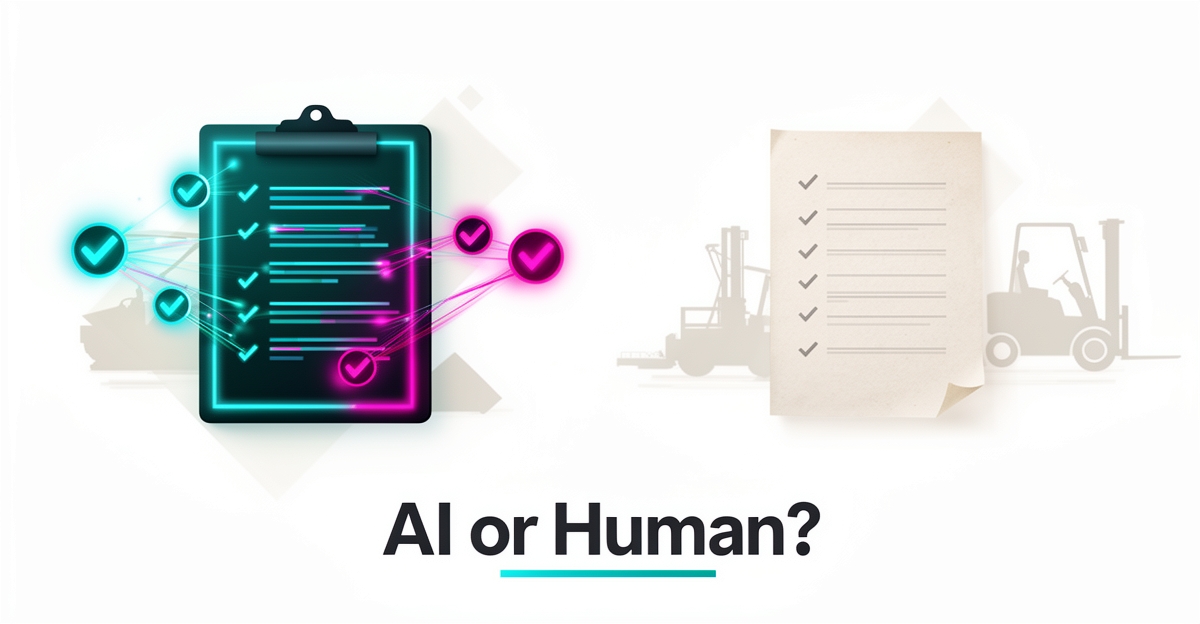
AI vs. Human Staff: Which Is Better for Managing Equipment Walk-Throughs?
Key Facts
- AI shifts the workflow from 'human finds everything' to 'human reviews what AI found'
- AI systems can generate automatic audit trails logging every finding, reviewer, and timestamp
- AI applies identical detection criteria every time, eliminating day-to-day human inconsistency
- AI-driven models can align costs with actual inspection volume, unlike fixed human staffing
- AI employees for service operations typically cost far less than an equivalent human hire
- Deployment is typically measured in days or weeks, not the months enterprise platforms often require
Hire a team member that works 24/7 — for less than a part-time wage.
AI receptionists, SDRs, dispatchers and 99+ roles. Trained on your business, fully managed.
Not sure where to start? Ask our AI planner
The Hidden Cost of Human-Only Equipment Walk-Throughs
Relying solely on human staff for equipment walk-throughs creates operational drag that intensifies as businesses grow. Manual inspections require technicians to know exactly what to look for, remember every checkpoint, and document findings consistently—tasks prone to fatigue, oversight, and subjective interpretation. Unlike AI-driven systems that automatically detect issues and flag them for review, human-led walk-throughs place the entire burden of discovery on the inspector, increasing the likelihood of missed problems, especially in complex or high-volume environments.
This approach also scales poorly and produces inconsistent documentation. Human inspectors process equipment one item at a time, limiting throughput and making it difficult to maintain uniform standards across multiple locations or large fleets. AI-driven systems, by contrast, can process many equipment records in parallel and generate structured, auditable results without manual effort. Well-built AI workflows also produce automatic audit trails that log every finding, review action, and timestamp—a capability absent in traditional manual methods, where documentation depends entirely on individual diligence and memory.
The hidden costs compound through labor inefficiency and limited adaptability. Human-only workflows incur fixed staffing expenses regardless of inspection volume, while AI-driven models can align costs with actual usage—charging per inspection or per data point processed. For businesses conducting frequent walk-throughs, this shift from fixed labor to variable cost often pays for itself quickly. And because modern AI employees handle routine check-ins on their own, your team's adjustment period is typically days, not months—shifting from exhaustive manual checking to focused review of AI-flagged anomalies, putting expert judgment where it matters most. The core inversion is simple: the workflow moves from "human finds everything" to "human reviews what AI found."
How AI Transforms the Walk-Through Workflow from 'Find Everything' to 'Review What AI Found'
Walk into any dealership service department and you'll find technicians spending most of a walk-through doing the same thing: hunting for problems they might miss. The most significant shift AI brings to this workflow isn't speed alone—it's changing who does the finding.
In a traditional human-led inspection, the technician carries the entire detection burden. They must know what to look for, remember to check every item, document findings manually, and stay consistent across dozens of visits. AI-driven systems flip that starting point: instead of finding every issue yourself, you review what the AI found.
In an AI-driven model, the system automatically detects anomalies, flags items for human review, presents findings in a structured format, and applies identical detection criteria to every inspection. The technician's job becomes judgment, not recall.
That judgment gets easier when findings arrive with context. Well-designed AI systems assign a confidence level to each detection—high-confidence items are clearly actionable, while lower-confidence items flag edge cases for closer human review. For a service manager, this means prioritizing the two ambiguous findings that genuinely need a technician's eye rather than re-verifying the twenty issues the AI already resolved.
The detection itself can be layered rather than dependent on one person's experience. A robust pipeline combines structured checks—serial numbers, maintenance schedules, service intervals—with unstructured inputs like technician observations, photos, and operator reports, plus validation steps that filter out false positives before anything reaches a human reviewer.
Consistency is where the human-led approach struggles most. A technician on their fortieth walk-through of the month checks differently than one on their first. AI applies the same criteria every time, and every action gets logged—what was found, what category it belonged to, who reviewed it, and when it was finalized. That automatic audit trail matters for compliance, insurance documentation, and demonstrating due diligence.
This is the model behind AI employees for service operations: automated, on-demand check-ins that collect data consistently, with humans reviewing flagged findings rather than conducting every routine visit themselves. Deployment is typically faster than most expect—setup is measured in days or weeks rather than the months of configuration enterprise platforms often demand, and staff adapt quickly once the review-based workflow is in place.
AI doesn't remove the human from the walk-through. It removes the parts of the walk-through humans were never good at: remembering everything, checking identically every time, and documenting it all without fail.
Scalability, Audit Trails, and Real-World Implementation for Dealerships and Field Services
For dealerships and field service teams managing equipment walk-throughs, scalability, audit trails, and rapid deployment are critical factors in choosing between AI and human-led approaches. AI-driven systems fundamentally transform workflows by shifting the human role from finding everything to reviewing what the AI has identified, enabling consistent, high-volume processing without proportional increases in labor.
AI systems excel at parallel processing, handling many equipment inspections simultaneously. Teams can submit a batch of records before day's end and have structured findings ready for review the next morning. This contrasts sharply with human-led approaches that process one item at a time, creating bottlenecks during peak inspection periods or across multiple service locations.
Automatic audit trail generation is another key advantage. AI-driven systems can log every action: what was detected, the category it belonged to, who reviewed it, and when the walk-through was finalized. This comprehensive documentation supports compliance requirements, insurance claims, and due diligence demonstrations—capabilities largely absent from manual processes, where records live in notebooks, spreadsheets, and memory.
Implementation timelines further differentiate the approaches. AIQ Labs has deployed more than 200 multi-agent systems, and its AI Employees can typically be deployed in days or weeks rather than months—avoiding the extensive configuration, dedicated integration partners, and ongoing overhead typical of enterprise platforms. Staff generally adjust to the review-based workflow quickly, minimizing disruption during transition.
By integrating AI walk-throughs into existing operations—whether as a single managed AI employee or as part of a broader AI operating system built in phases—dealerships and field services achieve consistent detection criteria across all inspections, reduce time spent on routine checks, and free technicians to focus on judgment calls for ambiguous findings—improving both efficiency and data quality without replacing human expertise.
Still paying for 10+ subscriptions that don’t talk to each other?
We build custom AI systems you own outright. No vendor lock-in. Full control.
Not sure where to start? Ask our AI planner
Frequently Asked Questions
Will AI replace my technicians who do equipment walk-throughs?
How is AI actually more consistent than a human inspector?
How long does it take to implement AI walk-throughs and train staff?
Can AI handle walk-throughs across multiple locations or a large fleet?
What happens when the AI isn't sure about a finding?
Is AI walk-through automation cost-effective for a small dealership or service team?
Turn Your Equipment Walk-Throughs Into a Competitive Advantage
AI-driven equipment walk-throughs turn a reactive, error-prone chore into a streamlined, scalable process that protects your bottom line. By shifting from 'find everything' to 'review what AI found,' technicians spend less time on repetitive checks and more time applying expertise where it matters—catching ambiguous issues AI flags for human judgment. This approach delivers consistent detection across fleets, automatic audit trails for compliance, and costs that scale with actual inspection volume rather than fixed headcount. The result isn't just faster inspections—it's higher data quality, reduced operational drag, and a workforce focused on judgment-driven work. To see how this fits your specific operation, start with the free two-minute Fit Check to identify your highest-ROI automation opportunity—then schedule a no-obligation 30-minute strategy call with an AI engineer to map your path forward. Questions first? Reach us anytime at [email protected].
Make AI your competitive advantage — not just another tool.
Strategy, implementation and ongoing optimization. One partner, end to end.
Not sure where to start? Ask our AI planner