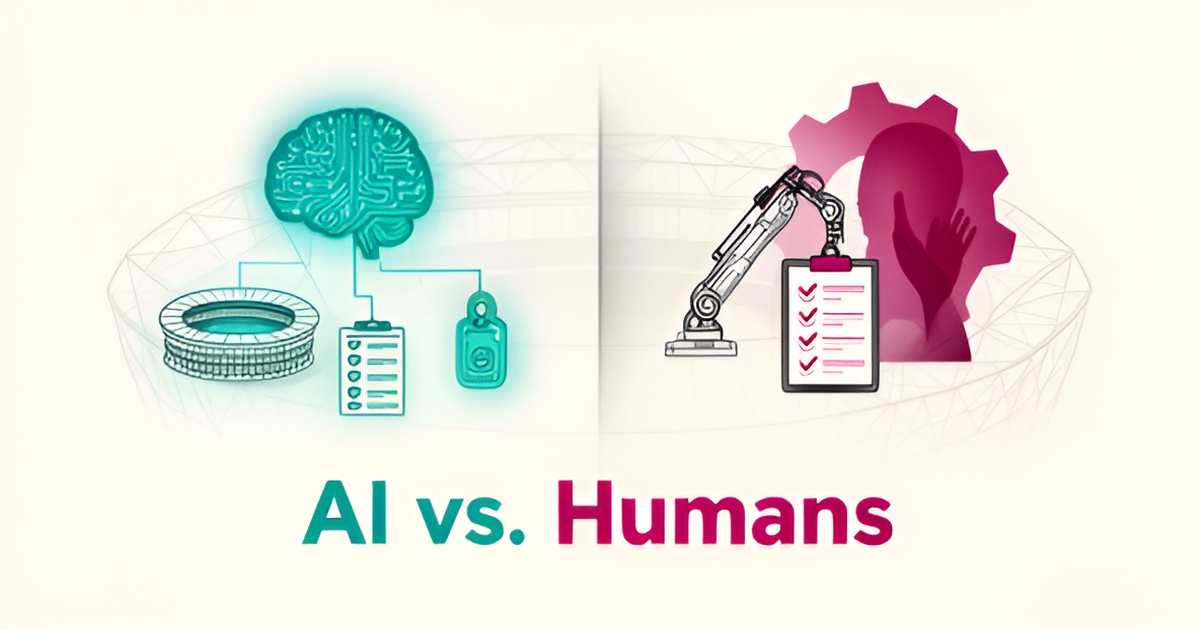
AI vs. Human Staff: Which Is Better for Managing Game Day Logistics?
Key Facts
- AI-powered automation has been reported to cut warehouse processing time significantly in fulfillment operations according to logistics workforce research
- AI-powered inspection systems can identify defects with greater consistency than manual checks per workplace productivity analysis
- AI systems run 24/7/365 with no missed shifts, making them well suited to repetitive logistics tasks per workplace productivity analysis
- AI can analyze large datasets to forecast demand, optimize inventory, and reduce costs per supply chain management research
- The U.S. has faced a projected shortfall of roughly 160,000 truck drivers by 2030 per logistics workforce research
- AI excels at data processing, automation, and precision in ways human staff cannot match at scale per workplace productivity analysis
Hire a team member that works 24/7 — for less than a part-time wage.
AI receptionists, SDRs, dispatchers and 99+ roles. Trained on your business, fully managed.
Not sure where to start? Ask our AI planner
The Hidden Cost of Game Day Chaos
Game day logistics demand precision under pressure, yet traditional human-only systems often struggle to keep pace with the complexity of modern sports operations. As fan expectations rise and operational margins tighten, even minor delays in equipment checks, team assignments, or field access control can ripple into significant disruptions, undermining the seamless experience organizers strive to deliver.
Labor shortages exacerbate these challenges, particularly in roles requiring repetitive, detail-oriented tasks. The U.S. has faced a projected shortfall of roughly 160,000 truck drivers by 2030, reflecting broader workforce strains that extend into event logistics and facility management, where consistent staffing for game day operations is increasingly difficult to maintain. When human staff are stretched thin, the risk of errors rises—missed equipment inspections, incorrect credential assignments, or delayed field access can compromise safety, delay kickoffs, and frustrate fans, coaches, and athletes alike.
These operational friction points carry tangible costs. Human error in repetitive tasks like inventory verification or access logging not only wastes time but can lead to costly rework, compliance issues, or reputational damage when preventable mistakes occur on a big stage. Meanwhile, the pressure to deliver flawless experiences intensifies as fans expect instant concessions, real-time updates, and uninterrupted access—all of which depend on flawless behind-the-scenes coordination.
- Equipment checks delayed by manual verification processes
- Team assignments mismanaged due to scheduling conflicts or communication gaps
- Field access control bottlenecks caused by credential verification delays
- Increased labor costs from overtime and last-minute staffing scrambles
- Reputational risk from visible operational failures during live broadcasts
AIQ Labs addresses these challenges by transforming reactive, error-prone workflows into proactive, automated systems where repetitive logistics tasks are handled with consistent precision—freeing human staff to focus on fan engagement, real-time problem-solving, and the high-touch elements that only people can deliver. This shift doesn’t replace human judgment; it protects it from being buried under avoidable operational noise.
Where AI Wins: Speed, Accuracy, and 24/7 Reliability
When a stadium needs 5,000 pieces of equipment counted, three field access points managed, and a dozen staff schedules coordinated before kickoff, the difference between success and chaos often comes down to raw processing speed. This is where artificial intelligence pulls decisively ahead of human logistics teams.
Consider the evidence. AI-powered automation has been reported to cut warehouse processing time significantly in fulfillment operations, according to logistics workforce research. Translated to game day operations, those gains mean equipment checks that took two hours can finish in a fraction of the time, and coordination overhead shrinks accordingly.
Accuracy is the second major advantage. AI-powered inspection systems can identify defects with greater consistency than manual checks, and workplace productivity analysis confirms that AI excels at data processing, automation, and precision in ways human staff simply cannot match at scale. For repetitive game day tasks, this reliability matters enormously:
- Equipment inventory audits, where a missed item can derail warmups or delay kickoff
- Scheduling coordination across coaches, grounds crews, and vendors working on different timelines
- Access control verification, where every credential must be checked identically, every time
- Real-time tracking of assets moving between storage, the field, and team facilities
The third advantage is availability. Human staff work 40-hour weeks, take sick days, and eventually leave, creating turnover costs and knowledge gaps. AI systems run 24/7/365 with zero missed shifts, which is precisely why AIQ Labs builds automated systems that handle repetitive logistics around the clock. On game day, when a schedule change lands at 5 a.m. or an access credential needs revalidation at midnight, there is no one to call because the system has already handled it.
Research on AI-driven operations also highlights AI's capacity to analyze large datasets to predict demand, optimize inventory, and reduce costs. Applied to game day logistics, that means forecasting equipment needs based on event type, anticipating staffing bottlenecks, and flagging access risks before they become incidents.
None of this makes human staff obsolete. Coaches, facility managers, and event coordinators bring judgment, creativity, and relationship management that no algorithm replicates. But for the repetitive, high-volume, precision-critical tasks that form the backbone of game day operations, AI delivers measurable speed, consistent accuracy, and tireless reliability that human teams cannot sustain, especially when juggling dozens of moving parts at once.
Where Humans Win: Judgment, Adaptability, and the Human Touch
While AI excels at handling routine logistics with precision, human staff remain indispensable when unexpected challenges arise during game day operations. Their ability to exercise real-time judgment, adapt to rapidly changing situations, and apply creative thinking when standard protocols fail ensures continuity in high-pressure environments where rigid systems might falter.
Research confirms that human workers bring irreplaceable strengths to logistics, particularly in areas requiring emotional intelligence and critical thinking—skills essential when dealing with frustrated fans, injured athletes, or sudden venue disruptions. These capabilities allow humans to de-escalate tense situations, make nuanced calls under ambiguity, and maintain safety and satisfaction when AI reaches its limits. According to industry research, roles centered on interpersonal interaction and adaptive problem-solving remain firmly in the human domain, even as AI handles repetitive tasks.
This isn’t a competition between humans and machines but a collaboration where each enhances the other. AI manages the predictable—equipment checks, access logs, and schedule adherence—freeing human staff to focus on what they do best: reading the room, responding with empathy, and innovating on the fly. For example, when a storm delays kickoff or a power outage affects scoring systems, humans coordinate backup plans, communicate with stakeholders, and keep operations flowing through instinct and experience.
AIQ Labs designs its AI Workflow Builds to support this balance, rebuilding the one workflow that costs you the most—automating routine logistics while preserving space for human oversight and intervention. By handling repetitive duties with consistent accuracy and 24/7 availability, AI allows human teams to conserve energy for the moments that truly require a human touch—turning potential crises into demonstrations of resilience and care. The result is not just efficient logistics, but a game day experience that feels seamless, safe, and distinctly human.
The Hybrid Playbook: Combining AI Efficiency with Human Expertise
The debate between AI and human staff misses the point. The most effective organizations don't choose one over the other; they build systems where each handles what it does best.
AI excels at repetitive, data-intensive tasks that drain human energy and introduce error. In logistics operations, AI-powered automation has been reported to cut warehouse processing time significantly. These systems operate continuously without fatigue, applying the same standards to every equipment check, schedule update, and access control decision.
Humans excel where judgment, creativity, and interpersonal skills matter. Research on workplace productivity confirms that emotional intelligence, critical thinking, and adaptability remain distinctly human strengths. The winning strategy assigns AI to handle data processing and routine coordination while freeing staff for complex problem-solving and relationship management.
For sports organizations managing game day operations, this hybrid approach transforms efficiency. Consider which tasks consume hours without requiring human judgment:
- Equipment inventory verification and maintenance scheduling
- Team assignment notifications and last-minute change distribution
- Field access control and credential verification
- Real-time schedule adjustments based on weather or delays
These workflows involve structured data, clear rules, and high volume—ideal conditions for automation. AI systems analyzing operational data can predict bottlenecks, optimize resource allocation, and flag issues before they escalate.
Implementation starts with honest workflow auditing. Map every game day task, then categorize by whether it requires human judgment or follows predictable patterns. Tasks with high repetition, clear decision rules, and data inputs become automation candidates. Tasks requiring negotiation, creative problem-solving, or stakeholder management remain human responsibilities.
AIQ Labs offers three ways to put this into practice. AI Employees give you managed AI staff—dispatchers, coordinators, and 99+ other roles—at a fraction of the cost of a human hire. AI Workflow Builds rebuild the single workflow that costs you the most, at a fixed price and in phases. And AI Operating Systems connect everything into one operating layer you own outright. You can start monthly, build in milestones, or own it outright—the goal isn't replacement, it's amplification of what your team does best.
Still paying for 10+ subscriptions that don’t talk to each other?
We build custom AI systems you own outright. No vendor lock-in. Full control.
Not sure where to start? Ask our AI planner
Frequently Asked Questions
Will AI replace human staff on game day?
Where does AI actually save time on game day operations?
Is AI more accurate than people for equipment and access checks?
What about labor shortages affecting game day staffing?
Can AI help predict problems before they happen on game day?
What tasks should stay with human staff?
Build Your Winning Game Day Strategy
The real question isn't whether AI or humans manage game day logistics better—it's how quickly you can deploy both where they excel. Automated systems deliver the speed, precision, and round-the-clock reliability that equipment checks, credential verification, and schedule coordination demand, while your staff focuses on the judgment calls and human moments that define exceptional fan experiences. Start by auditing your current workflows: identify which repetitive tasks consume hours without requiring human insight, then imagine those running flawlessly at 3 a.m. while your team handles what only humans can. AIQ Labs builds automation systems that integrate with your existing operations—whether that's managed AI staff, a single rebuilt workflow, or a full connected operating layer—handling the predictable so your people can manage the exceptional. Ready to see which workflows could transform your next game day? Take the two-minute Fit Check at https://aiqlabs.ai/apply, then book a free 30-minute strategy call to map your highest-impact opportunities—no sales pitch, just clarity on where automation wins.
Make AI your competitive advantage — not just another tool.
Strategy, implementation and ongoing optimization. One partner, end to end.
Not sure where to start? Ask our AI planner