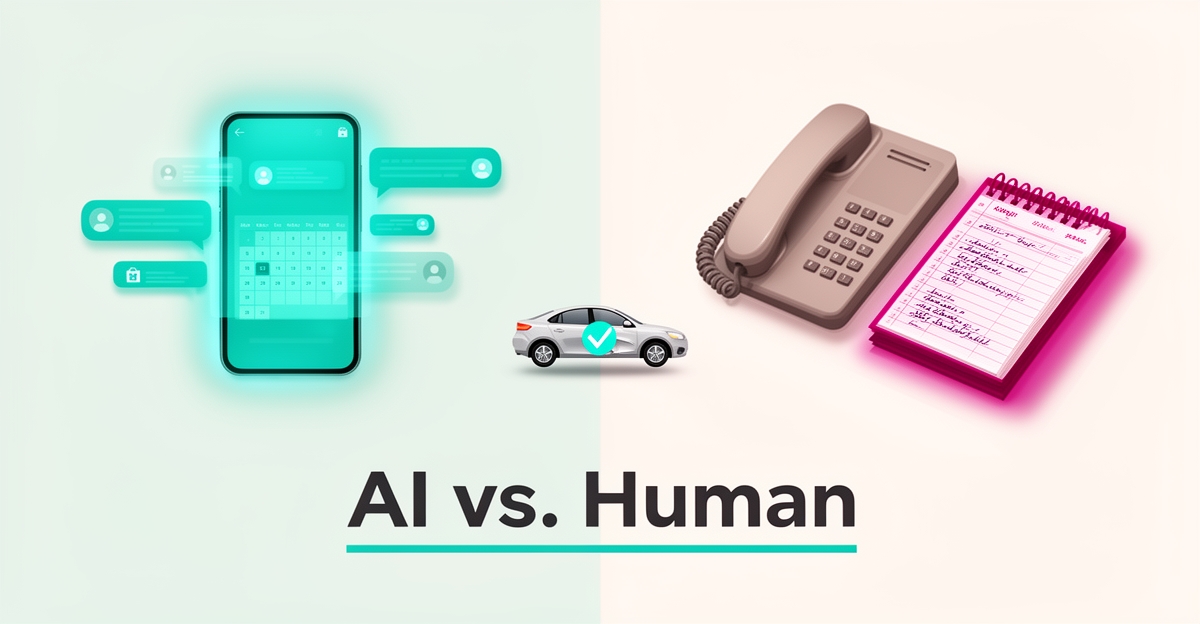
AI vs. Human Staff: Which Is Better for Managing Mobile Dent Repair Appointments?
Key Facts
- Field service sectors comparable to mobile dent repair face chronic technician shortages, pushing owners toward automated scheduling as of late 2026.
- Industry reporting suggests most field service customers expect a repair within 24 hours, with a significant share demanding same-day service, making 24/7 AI booking essential for mobile dent repair.
- Integration complexity is widely cited as the number one barrier to AI success—ahead of budget or model quality—according to industry analysis.
- A meaningful share of critical business decision logic resides as undocumented tacit knowledge, which is why humans must handle exceptions while AI manages routine bookings.
- AI Employees from AIQ Labs typically cost around 80% less than an equivalent human hire while providing 24/7/365 availability without sick days or missed calls.
- Demand for roles that bridge AI tools and real business workflows has grown sharply, showing businesses need human architects to connect AI to daily operations.
- AI-native tools provide consistent baseline performance for high-volume tasks like appointment reminders, unlike human staff whose diligence varies with workload.
Hire a team member that works 24/7 — for less than a part-time wage.
AI receptionists, SDRs, dispatchers and 99+ roles. Trained on your business, fully managed.
Not sure where to start? Ask our AI planner
The Appointment Bottleneck in Mobile Dent Repair
Mobile dent repair owners are fighting a scheduling war on two fronts: not enough technicians to cover demand and customers who expect an answer now. Manual calendars, group chats and phone tag break down the moment volume spikes, turning appointment management from admin work into a growth constraint.
Field service data shows the pressure is structural. Comparable field service markets, such as HVAC, have faced persistent technician shortfalls in recent years, with tens of thousands of unfilled roles nationwide. That gap forces owners to do more with fewer crews while protecting service quality.
Customer expectations make the bottleneck tighter. Industry reporting indicates most customers expect a repair within 24 hours when service fails, with many wanting same-day service. In dent repair that urgency translates to same-day booking requests, real-time arrival updates and instant confirmations that a human receptionist working 40 hours a week cannot consistently deliver.
Manual scheduling also creates hidden cost. Shared calendars miss double-books, reminders are sent late or not at all, and follow-ups depend on individual diligence. Dedicated software can close the gap by automating reminders and arrival windows, but the core issue remains: human staff scale linearly, demand scales exponentially.
The pressure shows up daily as:
- Technician shortages limiting how many jobs can be accepted each day
- 24-hour customer expectations driving inbound calls after hours
- Manual follow-up failing, leading to no-shows and lost revenue
- Inconsistent communication eroding trust on high-value repair jobs
This is where appointment management stops being an admin task and becomes an operational risk. The businesses that grow treat scheduling as a workflow problem, not a staffing problem. AI Employees provide 24/7 availability, consistent follow-up and lower operational costs while keeping high-quality customer communication.
AIQ Labs approaches this as a staffing model comparison, not a technology pitch. AI employees handle the what and when of booking, reminders and rescheduling, freeing human teams to focus on the why and how of customer relationships and complex service issues.
Where AI Wins and Where Humans Still Matter
Mobile dent repair lives or dies on speed, visibility, and follow-through. AI employees and human staff each bring clear advantages to appointment management, and the best operations use both in the right places.
AI wins on availability and consistency. An AI employee handles scheduling, reminders, and follow-ups 24/7/365 without sick days or shift gaps, while human teams are limited to working hours and prone to burnout. Automated communication also cuts inbound calls by providing real-time arrival windows and self-service portals where customers can view invoices or request a new appointment without calling in. Field service research shows this kind of automation helps close the gap created by staffing shortages in comparable trades.
Cost efficiency scales with volume. AI-native tools provide a consistent baseline for repetitive tasks like follow-ups and data entry, unlike human staff whose diligence varies with workload and training. Analysis of AI versus manual processes notes AI is built for bulk processing, analogous to managing a queue of appointment requests and confirmations simultaneously. For high-volume, predictable work, an AI employee typically costs around 80% less than an equivalent human hire and never misses a call.
Where humans remain irreplaceable is judgment, context, and tacit knowledge. A meaningful share of critical decision logic in a business resides as tacit knowledge rather than documented processes, such as knowing which customers need extra reassurance or how to prioritize a loyal customer's emergency request. Research on AI adoption finds AI struggles with exceptions and nuanced emotions, while humans excel at complex problem-solving, negotiation, and empathy.
Integration and workflow design determine success. Integration complexity is widely cited as the number one barrier to making AI work in practice, ahead of budget or model quality. The person who can close the gap between a tool and a team's real systems is the most valuable. Industry commentary emphasizes that making it work inside existing workflows, security requirements, approval processes, and adoption challenges requires human systems architects.
AIQ Labs sees this balance play out across AI Workflow Builds for appointment management, where AI handles the what and when and humans own the why and how.
AI is strongest for:
- 24/7 self-service booking and automated reminders that meet customers who expect a repair within 24 hours
- Consistent follow-up and arrival-window messaging that reduces “where is my tech?” calls
- High-volume repetitive tasks at lower operational cost and instant scalability
Humans stay essential for complex scheduling conflicts, upset customers, and translating undocumented business logic into workable exceptions. The optimal model is a strategic integration, not a replacement.
The Hybrid Model: AI Handles What, When, Humans Handle Why, How
The best appointment operation for mobile dent repair isn’t AI or humans alone, it’s a clear division of labor that plays to each side’s strength.
AI takes the repetitive, high-volume work that scales poorly with people. It can run 24/7 self-service portals, send automated reminders and arrival windows, and process payment follow-up without variation in diligence. That consistency matters when customers expect speed; field service industry data indicates most customers expect a repair within 24 hours, with many wanting same-day service.
Humans stay in charge of the moments that require judgment, context, and relationship. A loyal customer with a complex scheduling conflict, an upset caller about a delay, or an exception that breaks the workflow needs empathy and tacit knowledge. Research on AI adoption suggests a meaningful share of critical decision logic resides as tacit knowledge rather than documented processes, and that gap is where service recovery lives.
The hybrid model looks like this in practice:
- AI handles scheduling, dispatch, arrival windows, self-service portals and payment follow-up
- Humans handle exceptions, loyalty customers, service recovery and workflow design
- Human systems architects define where judgment remains essential and how accountability is maintained
Integration is the make-or-break factor. Analysis of AI implementation barriers finds integration complexity is the top barrier to making AI work in practice, ahead of budget or model quality. That is why a smooth rollout starts with one crew, catches workflow problems early, and ensures mobile access with offline capability for technicians.
Field service pressure makes this design urgent. Comparable field service industries continue to face significant technician shortfalls. TechRadar reporting highlights that dedicated software can close the gap by automating reminders and arrival windows, reducing calls asking where the technician is.
In this model, AI employees provide 24/7 availability and consistent follow-up, while human staff focus on the why and how of customer relationships. AIQ Labs builds these hybrid workflows as managed AI Employees that work alongside human teams, with custom integration to CRM, scheduling and payment tools so the handoff is seamless.
The result is lower operational cost for high-volume tasks and preserved quality for high-touch moments. AI does the what and when, humans own the why and how, and a human systems architect ensures the two stay aligned as the business scales.
How to Implement an AI-Enhanced Appointment System
Implementing an AI-enhanced appointment system starts with recognizing where manual workflows break down. Mobile dent repair businesses often rely on shared calendars, paper tickets, or group chats that lead to missed appointments and frustrated customers. Identifying these pain points—like repeated no-shows or delayed responses—is the critical first step toward meaningful automation. A missed appointment may have already cost you a repeat customer, making timely intervention essential for retention and revenue.
The next phase focuses on selecting tools that align with field service realities. Prioritize systems offering drag-and-drop scheduling with real-time technician location tracking and job status visibility. This allows dispatchers to reassign urgent jobs instantly and slot same-day emergencies into existing routes without disrupting the schedule. Equally important is evaluating mobile access for technicians; the app must provide offline functionality for areas with weak signal and display service history and notes from the last visit on a single screen to reduce errors and improve first-time fix rates.
Automation should extend beyond scheduling to customer communication and payment processing. Implementing automated text or email updates—including real-time arrival windows—significantly reduces inbound calls asking "Where is the technician?" Integrating on-site invoicing and immediate payment capture improves cash flow and eliminates billing delays. These features directly address customer expectations, with most field service customers expecting repairs within 24 hours and many demanding same-day service when systems fail.
Before scaling, pilot the system with a single crew to catch workflow issues early. A smooth rollout matters almost as much as the features themselves, as transitioning from manual to AI-assisted methods requires staff adjustment. Use this phase to document tacit knowledge—such as which customers need extra reassurance—and refine exception handling. Finally, budget for the true total cost: account for per-technician pricing, implementation efforts, and training expenses beyond the subscription fee, as hidden costs often emerge in the first few months. For businesses seeking a clearer path, AIQ Labs offers three entry points: AI Employees on a Start Monthly model, AI Workflow Builds at a fixed price for the one workflow that costs you most, and AI Operating Systems for a connected layer you own outright—enabling deployment without the complexity of piecemeal software vendors.
Still paying for 10+ subscriptions that don’t talk to each other?
We build custom AI systems you own outright. No vendor lock-in. Full control.
Not sure where to start? Ask our AI planner
Frequently Asked Questions
Will AI actually handle appointment booking 24/7 without missing calls?
Is AI cheaper than hiring a receptionist for dent repair scheduling?
What parts of appointment management should humans still handle?
Can AI integrate with our existing calendar, CRM and payment tools?
Will AI reduce no-shows and 'where is my tech?' calls?
Is the technician shortage a real reason to automate scheduling?
Stop Choosing Between AI and Humans — Start Designing the Handoff
The debate over AI versus human staff misses the real question facing mobile dent repair owners: where does each excel? As we've seen, AI employees deliver 24/7 availability, consistent follow-up, and lower costs for the high-volume work — booking, reminders, arrival windows — that breaks manual calendars. Humans remain essential for exceptions, upset customers, and the tacit knowledge behind a large share of critical business decisions. With field service industries short tens of thousands of technicians and most customers expecting a repair within 24 hours, the hybrid model isn't a luxury — it's how you scale without sacrificing service quality. The practical next step is small: map where your current scheduling workflow breaks down, then pilot AI on one crew's appointments before expanding. If you want a working session to identify your biggest bottleneck and whether automation offers a clear win, start the two-minute Fit Check at aiqlabs.ai/apply and book a free 30-minute strategy call with an AI engineer. No pitch — just clarity on your next move.
Make AI your competitive advantage — not just another tool.
Strategy, implementation and ongoing optimization. One partner, end to end.
Not sure where to start? Ask our AI planner