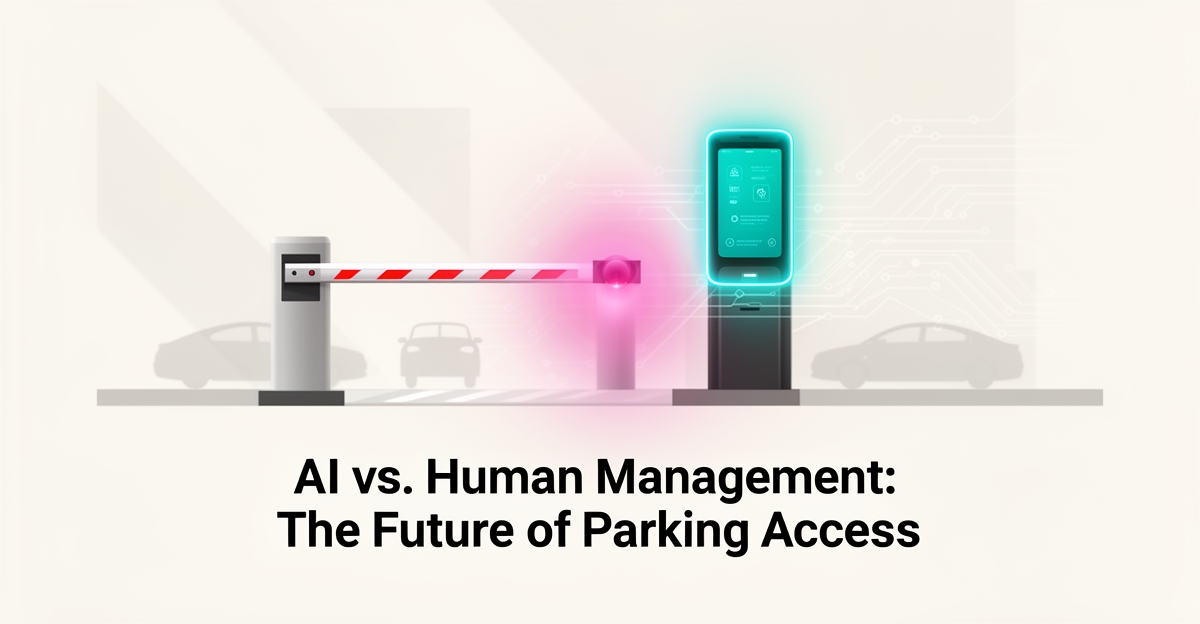
AI vs. Human Staff: Which Is Better for Managing Parking Lot Access and Entry?
Key Facts
- Staffing a single booth around the clock typically requires at least four full-time employees once breaks, sick days, and shift rotations are accounted for.
- AI systems enforce access rules uniformly, 24/7/365, without the fatigue-driven inconsistency that erodes customer trust at human-staffed gates.
- Managed AI employees typically cost around 80% less than a comparable human hire, according to AIQ Labs' deployment experience across 200+ multi-agent systems.
- A phased rollout—pilot one lane, validate ROI, then scale—minimizes disruption and de-risks the transition from manual booths.
- The most resilient parking operations pair AI for high-volume routine work with human staff for security incidents, disputes, and empathy-driven interactions.
Hire a team member that works 24/7 — for less than a part-time wage.
AI receptionists, SDRs, dispatchers and 99+ roles. Trained on your business, fully managed.
Not sure where to start? Ask our AI planner
The Parking Access Bottleneck: Cost, Wait Times, and Inconsistency
The gate arm rises, the line of cars grows, and somewhere between the fifth and sixth vehicle, your parking operation's biggest weakness shows itself. Human-staffed entry points buckle under predictable pressure, yet many operators continue to accept these bottlenecks as an unavoidable cost of doing business.
The financial strain rarely announces itself in a single line item. It accumulates quietly through overtime premiums during evening peaks, the cost of training new attendants after turnover, and the lost revenue from drivers who abandon a slow entry lane. Operators who modernize their access management typically see productivity gains that traditional staffing models cannot match, precisely because human staffing cannot scale on demand.
Staffing a single booth around the clock requires at least four full-time employees once you account for breaks, sick days, and shift rotations. Each of those employees brings variability: one may strictly enforce a two-hour limit while another waves regulars through, and fatigue during a long overnight shift leads to inconsistent decisions that erode trust. As of late 2026, organizations across industries are moving quickly to automate exactly these kinds of repetitive, rule-based roles.
The pressure intensifies during peak hours, when a single attendant faces a queue of impatient drivers while simultaneously trying to track available spaces. Without real-time data, human staff rely on guesswork and radio calls to coordinate occupancy. Modern AI systems can analyze historical patterns across thousands of data points to forecast staffing and demand needs—and the same logic applies to predicting parking demand before the morning rush hits.
These operational pain points compound each other:
- Limited 24/7 coverage leaves gates unattended during overnight hours, creating security gaps and lost revenue from unauthorized parking.
- Inconsistent rule enforcement frustrates customers who receive different answers from different attendants on different days.
- High recurring labor costs consume budget that could otherwise fund facility improvements or dynamic pricing strategies.
- No real-time occupancy visibility forces staff to manage capacity reactively instead of proactively directing drivers to open spaces.
AIQ Labs approaches this bottleneck differently, designing [AI Workflow Builds](/workflow-builds) that rebuild the one workflow costing you the most—entry validation and access enforcement—without the overhead of hiring or training. But before exploring the solution, it is worth understanding why so many organizations remain stuck: even when inefficiencies are plainly visible, changing how an operation runs is hard, and most operators delay until the cost of inaction outweighs the discomfort of change.
AI Operational Superiority for High-Volume Parking Tasks
AI systems deliver measurable operational advantages in high-volume parking environments, where consistency and speed directly impact throughput and user satisfaction. Parking access management is dominated by repetitive tasks—credential validation, payment processing, occupancy tracking—and these are exactly the tasks where AI outperforms human staff. Under peak load conditions, AI maintains precision while human performance declines due to fatigue and cognitive overload.
AI's 24/7 availability eliminates shift gaps and ensures uniform enforcement of access rules without breaks, bias, or variability—critical for facilities operating across extended hours or multiple time zones. An AI employee can handle standard entry validation or lost ticket inquiries in seconds rather than minutes, a pace unattainable by human staff managing concurrent queues. This rapid response reduces vehicle dwell time at entry points, minimizes congestion, and improves overall flow during high-demand periods.
Scalability further amplifies AI's value, enabling centralized management of dozens or hundreds of entry lanes through a single orchestrated system. Unlike human teams constrained by physical presence and shift logistics, AI agents scale horizontally without degradation in accuracy or speed, adapting dynamically to fluctuating volumes. AIQ Labs designs these capabilities into [managed AI Employees](/ai-employees) that integrate with access control hardware, payment systems, and occupancy sensors to deliver end-to-end automation—from gate actuation to real-time dashboard updates—without requiring additional headcount or supervisory overhead, typically at around 80% less cost than a comparable human hire. By handling routine tasks autonomously, AI frees human supervisors to focus on exception management, customer experience optimization, and strategic planning, creating a balanced model where technology handles volume and humans handle nuance.
The Symbiotic Model: Where Humans Still Matter
The most resilient parking operations don't pick a side between AI and people, they design for both. The economics explain why a hybrid model wins: AI delivers consistency and scale at the gate, while humans provide the judgment that machines cannot.
That tension is visible at the gate. AI excels at the repetitive, rule-based work that defines entry and exit, while humans remain essential for judgment, empathy, and exception handling. A tiered resolution framework makes the division clear and scalable.
AI handles Tier 0-1 tasks with speed and consistency. This includes validation, payments, access rule enforcement, and real-time occupancy tracking. The same AI systems can process hundreds of entries simultaneously without degradation, enforce rules 24/7/365, and resolve standard issues in seconds—capabilities that translate directly from customer support automation into parking operations.
Humans own Tier 3 exceptions where context matters. AI is not built for the novel, emotionally charged, or safety-critical moments that define trust in parking operations.
Human-led Tier 3 responsibilities include:
- Security incidents, gate malfunctions, and on-site safety escalations
- Complex disputes over billing, lost tickets, or access denials
- Special event oversight, traffic flow management, and dynamic staffing decisions
- Customer interactions requiring empathy and relationship building
This is AI augmentation over full replacement. AI frees staff from booth monotony so they can focus on high-value oversight and strategic planning rather than repetitive validation.
The symbiotic model also improves readiness for change. Because AI capability is advancing faster than most organizations can retrain, parking operators who redeploy existing staff into monitoring, exception handling, and continuous improvement roles adapt faster than those who attempt wholesale replacement—or who delay automation entirely.
AIQ Labs approaches parking access through [AI Workflow Builds](/workflow-builds), rebuilding the highest-cost workflow with tailored AI systems that handle peak hours, enforce access rules, and reduce wait times—delivered at a fixed price, in phases. The system augments the team, not erases it.
When AI manages the routine and people manage the exceptions, operations become faster, more consistent, and more resilient.
From Manual Booths to Managed AI Employees: Implementation Path
Transitioning from a manual booth to an AI-managed entry system requires more than installing a camera; it demands a structured approach to data, prediction, and people. Because most organizations find changing their operating model difficult, a deliberate implementation path is essential for parking operators.
Before deploying intelligent gates or license plate recognition, operators must audit their data infrastructure. Many companies find their data assets unprepared for AI integration, which often means consolidating fragmented entry logs and occupancy records into a unified, machine-readable format. Without clean historical data on peak traffic and violation patterns, even sophisticated AI cannot optimize barrier timing or predict congestion.
Once the foundation is set, predictive planning transforms reactive staffing into proactive management. AI systems can analyze historical entry patterns to forecast peak demand and maintenance needs, similar to how modern predictive workforce tools analyze employee data to anticipate staffing gaps. This allows operators to adjust pricing dynamically, schedule barrier maintenance during off-peak hours, and allocate human supervisors only when predicted volumes require oversight.
A phased rollout minimizes disruption while validating ROI. Consider this implementation sequence:
- Audit and digitize existing access logs and payment records to establish a training dataset
- Deploy a pilot at a single entry point to handle Tier 0 tasks like validation and payments
- Integrate predictive analytics for occupancy forecasting and maintenance scheduling
- Scale to full automation with human oversight reserved for Tier 3 exceptions and security incidents
Change management remains the critical success factor. Reskilling booth attendants to manage AI systems and handle complex exceptions is essential. AIQ Labs structures this transition through managed [AI Employees](/ai-employees) that work alongside human teams, allowing operators to start with a single automated entry point and expand as staff adapt to new supervisory roles. For operators who want a fully connected operation—access control, billing, occupancy, and reporting on one operating layer—[AI Operating Systems](/ai-operating-systems) connect everything into a single system built in phases and owned outright. This hybrid approach ensures that technology enhances rather than displaces the human judgment necessary for complex customer interactions.
Still paying for 10+ subscriptions that don’t talk to each other?
We build custom AI systems you own outright. No vendor lock-in. Full control.
Not sure where to start? Ask our AI planner
Frequently Asked Questions
How does AI compare to human staff for high-volume parking access tasks?
Can AI systems handle parking entry tasks 24/7 without breaks or inconsistencies in rule enforcement?
What kind of parking access tasks should remain with human staff instead of being fully automated by AI?
How quickly can an AI system resolve standard parking entry issues like ticket validation or payment processing?
How much does an AI employee cost compared to a human parking attendant?
Is it necessary to replace human attendants entirely when implementing AI for parking lot access control?
The Gate Is Open: Your Move
The bottleneck at your entry point isn't a staffing problem—it's a scalability problem. While human attendants bring essential judgment to complex exceptions, they cannot match the 24/7 consistency of AI-managed access. The winning strategy isn't choosing between silicon and staff, but architecting a symbiosis where AI handles Tier 0 validation and payments while your team focuses on security escalations and customer relationships. Start by auditing your data infrastructure, then pilot a single automated lane to prove the ROI before scaling. If you're ready to eliminate the booth bottleneck without the overhead of hiring and training, AIQ Labs builds managed AI employees that integrate with your existing access control systems—backed by 200+ multi-agent systems deployed and four live SaaS products we run daily. Take the two-minute Fit Check at [aiqlabs.ai/apply](/apply) to identify your highest-ROI automation opportunity, or [book a free 30-minute strategy call](/book) to map your implementation path. The technology is ready when you are.
Make AI your competitive advantage — not just another tool.
Strategy, implementation and ongoing optimization. One partner, end to end.
Not sure where to start? Ask our AI planner