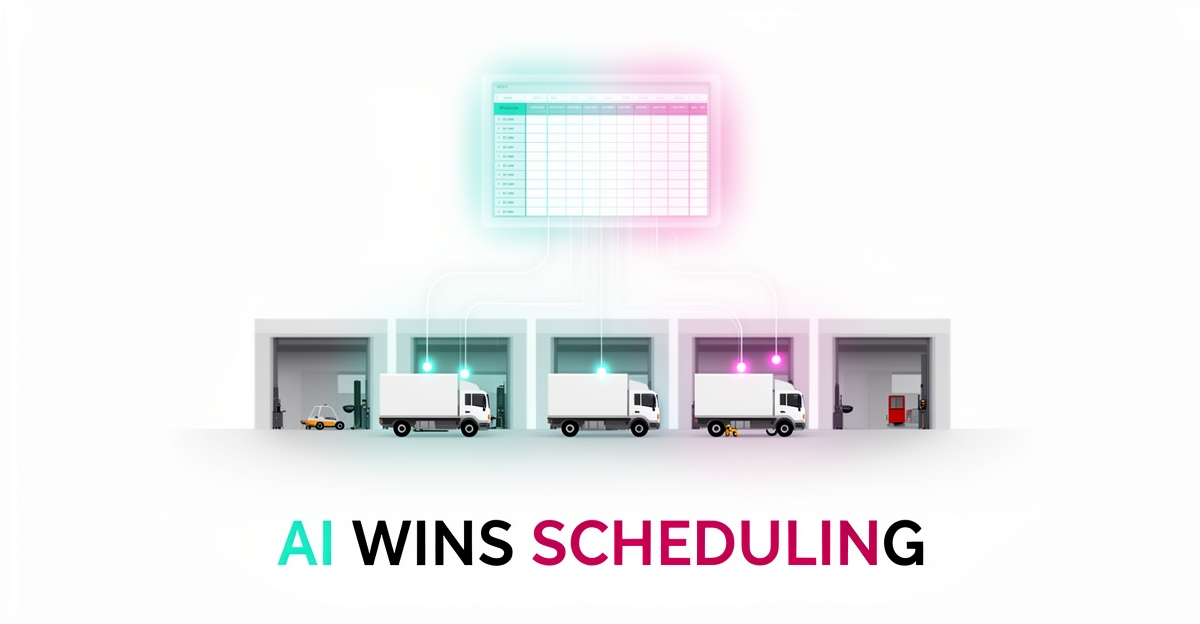
AI vs. Human Staff: Which Is Better for Managing Repair Scheduling in Fleet Shops?
Key Facts
- Manual scheduling is prone to double-bookings, missed follow-ups, and inefficient technician allocation—errors that compound into idle bays and delayed repairs
- AI-driven scheduling typically reduces error rates substantially compared to manual methods, cutting rework and scheduling conflicts
- Businesses adopting AI scheduling commonly report meaningful cost savings through reduced overhead and better resource utilization
- AI scales with business growth without requiring proportional additions to scheduling staff
- AI processes large volumes of data faster than humans, enabling real-time schedule optimization
- AI reduces idle time and optimizes technician usage, directly improving shop throughput and profitability
- Successful AI adoption depends on clean data, staff training, and security controls—plan for all three before rollout
Hire a team member that works 24/7 — for less than a part-time wage.
AI receptionists, SDRs, dispatchers and 99+ roles. Trained on your business, fully managed.
Not sure where to start? Ask our AI planner
The Scheduling Bottleneck: Why Manual Processes Are Limiting Your Fleet Shop
Fleet shops relying on manual repair scheduling face a growing bottleneck that directly impacts their bottom line. The process is labor-intensive, error-prone, and struggles to keep pace with increasing service demands. As vehicles arrive with varying repair needs, dispatchers juggle spreadsheets, whiteboards, and phone calls to assign technicians—a system that quickly becomes overwhelmed. This inefficiency leads to idle bays, delayed repairs, and frustrated customers, all while operational costs creep upward.
Manual scheduling is inherently limited by human capacity and prone to costly mistakes. Industry analysis consistently finds that manual methods produce meaningfully higher error rates than automated ones, leading to double-booked appointments, missed follow-ups, and inefficient technician allocation. These errors aren't just administrative—they translate into real-world inefficiencies like technicians waiting for parts or bays sitting empty while urgent repairs are delayed. Over time, these small missteps compound into significant productivity losses.
The scalability of manual scheduling is further constrained by workforce limits. Unlike AI systems that can handle growing volumes without proportional additional resources, human teams require more staff to manage increased workloads—a costly and slow solution. This creates a ceiling on growth; fleet shops can't simply take on more vehicles without hiring more schedulers, which increases overhead without guaranteeing better outcomes. The result is a cycle where scaling efforts are met with diminishing returns.
Perhaps most critically, manual processes lack real-time responsiveness. When a repair finishes early or a parts delay occurs, human schedulers often can't react quickly enough to reassign tasks or fill gaps. This lag leads to underutilized technicians and extended idle time—directly reducing shop throughput. AI-driven scheduling, by contrast, continuously optimizes assignments based on live data, ensuring bays stay active and skills are matched to jobs efficiently. For fleet shops aiming to maximize every hour, this gap in agility isn't just inconvenient—it's a barrier to profitability.
Unlocking Efficiency: How AI Transforms Repair Scheduling
Manual repair scheduling in fleet shops often creates bottlenecks that ripple through operations, from delayed repairs to underutilized technicians. These inefficiencies stem from the limitations of human-driven processes when managing complex, dynamic workloads. AI transforms this landscape by introducing automation that handles repetitive scheduling tasks with speed and precision, freeing human staff to focus on higher-value activities like customer service and complex problem-solving.
AI systems excel at processing vast amounts of data rapidly, enabling them to optimize repair schedules in real time based on technician availability, parts inventory, and job priority. This capability directly addresses the core challenges of manual scheduling, where human error and slow response times lead to costly delays. AI-driven scheduling typically achieves far lower error rates than manual methods, significantly improving accuracy and reducing rework. Additionally, AI can process large volumes of data faster than humans, allowing fleet shops to adapt quickly to changing conditions without bottlenecks.
The efficiency gains from AI-driven scheduling extend beyond error reduction to tangible operational improvements. By automating routine tasks such as appointment booking, resource allocation, and schedule adjustments, AI minimizes idle time and ensures technicians are consistently engaged in productive work. Businesses adopting AI scheduling commonly report meaningful cost savings through reduced overhead and optimized resource utilization. Furthermore, AI scales with business growth, handling increased scheduling volume without requiring proportional additions to staff or infrastructure—unlike manual processes, which are inherently constrained by workforce capacity.
- Automates repetitive scheduling tasks to reduce manual workload
- Processes data rapidly for real-time schedule optimization
- Substantially reduces errors compared to manual methods
- Scales with business growth without added headcount
- Cuts costs through improved efficiency and utilization
AIQ Labs helps fleet shops implement these AI scheduling solutions through AI Workflow Builds and AI Employee deployment, ensuring systems are tailored to specific operational needs while remaining owned outright by the client. The result is a more responsive, accurate, and cost-effective scheduling process that enhances overall shop performance without replacing the essential judgment and expertise of human teams. Instead, AI augments human capabilities, creating a hybrid model where technology handles routine optimization and staff focus on strategic decision-making and customer relationships. This balanced approach delivers the efficiency gains of automation while preserving the irreplaceable value of human insight in complex repair environments.
The Tangible ROI: AI's Edge in Cost, Accuracy, and Scalability
When it comes to managing repair scheduling in fleet shops, the case for AI comes down to three measurable areas: cost, accuracy, and scalability. Businesses implementing AI-driven scheduling commonly report meaningful cost savings compared to manual processes. These savings stem from reduced labor overhead, fewer errors, and optimized resource allocation. The exact figures vary by operation, but the pattern is consistent: automation pays for itself when scheduling volume is high enough.
Accuracy is another area where AI outperforms human teams. AI systems applied to structured scheduling tasks typically achieve far lower error rates than manual methods, where fatigue, distraction, and information gaps lead to double-bookings and missed follow-ups. This improvement in accuracy translates directly to fewer scheduling conflicts, reduced downtime, and better utilization of technicians and equipment.
Scalability is where AI truly shines. Unlike manual processes that are constrained by workforce capacity, AI can handle increased workloads without proportional additional resources. This means fleet shops can grow their operations without worrying about hiring and training more staff to manage scheduling. AI's ability to process large volumes of data quickly and accurately makes it a practical tool for businesses looking to scale efficiently.
The benefits of AI in repair scheduling can be summarized as follows:
- Meaningful cost savings compared to manual processes
- Substantially lower error rates than manual methods
- Scalability without proportional additional resources
- Reduced idle time and optimized technician usage
- Improved data accuracy and decision-making
At AIQ Labs, we've seen firsthand how AI can transform repair scheduling in fleet shops, with 200+ multi-agent systems deployed across client operations. Our AI-powered scheduling systems are designed to integrate with existing workflows, providing real-time updates and optimizing resource allocation. By leveraging AI, fleet shops can reduce idle time, improve technician utilization, and ultimately deliver better service to their customers.
The ROI of AI in repair scheduling is clear. With cost savings, improved accuracy, and scalability, AI offers a practical solution for fleet shops looking to streamline their operations and stay competitive. As the technology continues to evolve through 2026 and beyond, the gap between automated and manual scheduling will only widen.
Implementing AI in Your Fleet Shop: A Strategic Roadmap
Successfully integrating AI into repair scheduling requires a deliberate, step-by-step approach that aligns technology with operational goals. Fleet shops should begin by identifying repetitive, high-volume tasks—such as appointment booking, technician assignment, or parts availability checks—that consume significant staff time but follow predictable patterns. Automating these workflows allows human teams to focus on complex diagnostics, customer consultations, and exception handling where judgment is critical. This targeted approach ensures AI addresses pain points without disrupting core expertise.
Data quality forms the foundation of effective AI scheduling. AI systems perform best when trained on clean, structured data, while inconsistent or incomplete records undermine reliability. Fleet shops must audit historical scheduling data for gaps, standardize formats across systems, and establish governance protocols to maintain accuracy over time. Poor data inputs not only reduce AI reliability but can amplify errors at scale, undermining trust in the system.
Preparing human teams for collaboration is equally vital. Many workers report insufficient investment in skills development, so proactive training programs help staff understand AI as a tool that augments—not replaces—their expertise. Sessions should cover interpreting AI-generated schedules, overriding recommendations when necessary, and providing feedback to improve system performance. This fosters adoption and positions employees as partners in the automation journey.
Security and compliance cannot be overlooked. Fleet shops should implement role-based access controls, encrypt scheduling data in transit and at rest, and audit AI decision logs for accountability. Aligning with industry standards protects sensitive operational and customer information while meeting regulatory expectations.
Finally, a holistic ROI view ensures long-term success. Beyond direct labor savings, factor in reduced idle time, optimized technician utilization, and improved first-time fix rates. Continuous monitoring of key metrics—such as schedule adherence and customer wait times—allows for iterative improvements. AIQ Labs supports this journey through phased builds and payment models that fit your stage: start monthly, build in milestones, or own the system outright—ensuring AI delivers sustainable value without creating new dependencies.
Partnering for Success: AIQ Labs' Approach to Fleet Scheduling Automation
Understanding the benefits of AI is one thing; successfully implementing it is another. AIQ Labs bridges this gap with three clear entry points tailored to where your fleet shop is today.
If you want to fix one specific workflow first, AI Workflow Builds rebuild the scheduling process that costs you the most—at a fixed price, delivered in phases, with no open-ended commitments. This approach ensures AI scheduling tools reduce idle time and optimize technician usage without a risky all-at-once rollout.
For ongoing operational support, AI Employees are managed AI staff that handle appointment scheduling, dispatching, and customer communication around the clock—at roughly 80% less cost than a human hire, across 99+ roles. This level of reliability is crucial for fleet shops aiming to stay competitive in a fast-paced market.
And for shops ready to connect everything, AI Operating Systems build one connected operating layer across your business—delivered in phases and owned outright by you, so there's no vendor lock-in.
- AI Workflow Builds: fix your costliest scheduling workflow at a fixed price
- AI Employees: managed AI dispatchers and receptionists, ~80% less than a human hire
- AI Operating Systems: one connected layer, built in phases, owned outright
- Payment models that fit your stage: start monthly, build in milestones, or own it outright
By partnering with AIQ Labs, fleet shops can leverage proven expertise—200+ multi-agent systems deployed and four live SaaS products we run daily—to navigate the complexities of AI adoption. This partnership not only enhances operational efficiency but positions businesses for long-term success in an increasingly digital landscape.
Ready to transform your fleet shop's scheduling process? Start the 2-minute Fit Check today, then book a free 30-minute strategy call to map your biggest bottleneck.
Still paying for 10+ subscriptions that don’t talk to each other?
We build custom AI systems you own outright. No vendor lock-in. Full control.
Not sure where to start? Ask our AI planner
Frequently Asked Questions
How much can AI reduce scheduling errors compared to manual methods in fleet shops?
Will implementing AI scheduling require hiring more staff to manage the system?
What cost savings can fleet shops expect from switching to AI-powered repair scheduling?
How does AI handle real-time changes like early repair completions or parts delays in fleet shop scheduling?
Is my fleet shop's data ready for AI scheduling, and what if it's not?
Will AI replace my human schedulers and technicians in the fleet shop?
Schedule Smarter, Not Harder
Manual repair scheduling is hitting its limits—idle bays, double-bookings, and a workforce ceiling that makes growth expensive. AI changes the equation by automating repetitive booking and dispatch tasks and optimizing assignments in real time from technician availability, parts inventory, and job priority, all while scaling without adding headcount. The result is fewer scheduling conflicts, less idle time, and meaningful cost savings as AI takes over routine scheduling work. Human judgment remains essential for complex diagnostics and customer relationships; the strongest model is a hybrid where AI handles routine optimization and staff focus on strategic work. If you're evaluating this shift, start by mapping your highest-volume scheduling pain points, auditing data quality, and planning training for team-AI collaboration. AIQ Labs helps fleet shops implement owned AI scheduling systems through Workflow Builds, AI Employees, and AI Operating Systems. Start the 2-minute Fit Check at aiqlabs.ai/apply, then book your free 30-minute strategy call to map your biggest bottleneck and identify high-ROI automation opportunities.
Make AI your competitive advantage — not just another tool.
Strategy, implementation and ongoing optimization. One partner, end to end.
Not sure where to start? Ask our AI planner