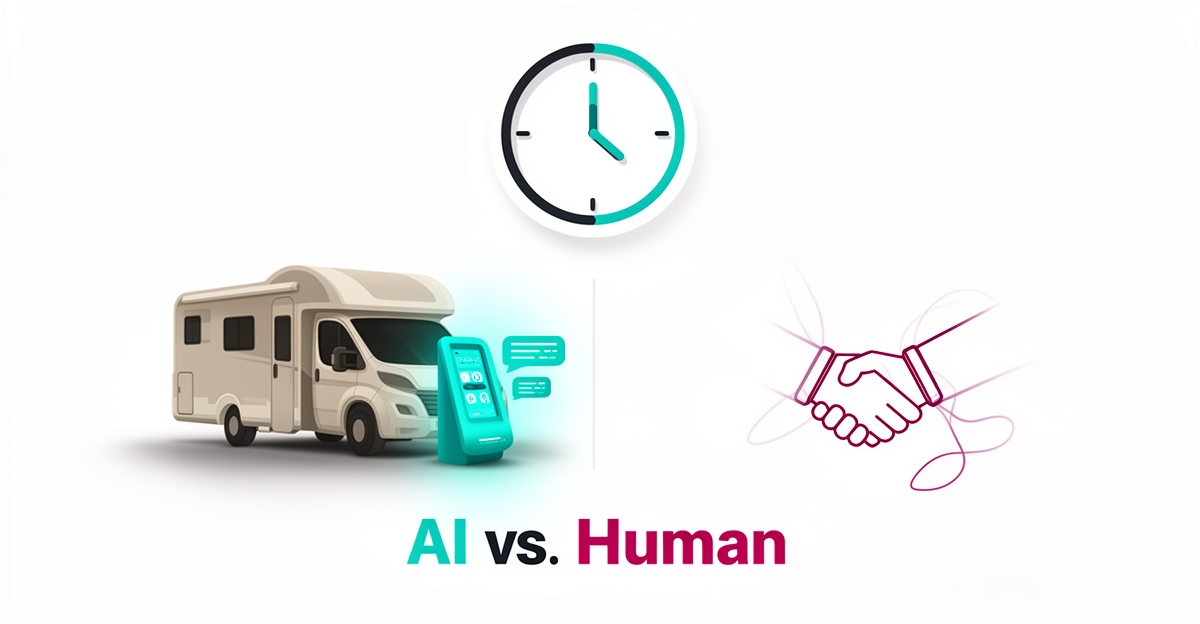
AI vs. Human Staff: Which Is Better for Managing RV Rental Check-Ins?
Key Facts
- AI can reduce labor costs by up to 75% in RV rental check-ins according to AIQ Labs
- AI agents handle 80% of inquiries automatically in some cases per HubSpot
- AI agents achieve a 67% resolution rate for customer inquiries per HubSpot
- 52% of professionals observe customers prefer human support for empathy per HiverHQ
- 43% of organizations are investing in AI for customer support per HiverHQ
- AI provides 24/7/365 availability with no sick days or breaks per AIQ Labs
- Human agents focus on complex, emotional, or high-value issues per HiverHQ
Hire a team member that works 24/7 — for less than a part-time wage.
AI receptionists, SDRs, dispatchers and 99+ roles. Trained on your business, fully managed.
Not sure where to start? Ask our AI planner
The Hidden Costs of Traditional RV Check-Ins
RV rental businesses face mounting pressure during peak seasons when manual check-in processes strain staff and frustrate guests. Traditional front desks rely on human employees who work limited hours, take breaks, and can become overwhelmed when multiple reservations arrive simultaneously. This creates bottlenecks that delay guest onboarding and increase the likelihood of errors in reservation details, payment processing, or vehicle assignments. As demand fluctuates, maintaining adequate staffing levels becomes both costly and unpredictable, especially when factoring in recruitment, training, and benefits expenses that can add 25–35% to base salaries.
These inefficiencies directly impact the guest experience, particularly when travelers arrive after hours or during holidays only to find limited support available. Research shows that 60% of customer support experts recognize AI’s advantage in automating routine tasks and providing consistent, instant responses—capabilities that are especially valuable during high-volume periods. Meanwhile, 43% of organizations are already investing in AI for customer support, signaling a broader industry shift toward solutions that reduce dependency on fluctuating human labor. For RV rental operators, this trend reflects a growing recognition that manual check-ins not only drive up operational costs but also introduce avoidable risks during critical guest interactions.
The hidden costs extend beyond wages to include missed opportunities and reputational damage from inconsistent service. Human agents, while essential for complex or emotional situations, are prone to fatigue and variability in performance, especially when handling repetitive check-in tasks across long shifts. In contrast, AI-powered systems can manage reservation confirmations, identity verification, and orientation details with perfect consistency, 24/7, without variation in tone or accuracy. By automating these repetitive elements, businesses free up human staff to focus on high-value interactions where empathy and problem-solving truly matter—aligning with findings that 52% of professionals observe customers still prefer human support for nuanced issues. This balanced approach addresses the core inefficiencies of traditional check-ins while preserving the human touch where it counts most.
The Head-to-Head Comparison: AI vs. Human Staff
RV rental check-ins sit at the intersection of speed, accuracy, and guest emotion — and the choice between AI and human staff changes the outcome on all three.
Labor cost is the most immediate differentiator. Human check-in teams operate within a 40-hour week and carry salary, benefits and recruiting overhead. AI check-in agents work 24/7/365 with no sick days and can reduce staffing costs by up to 75% in the RV rental space. That cost shift lets operators reinvest in higher-touch moments instead of routine repetition.
Availability and speed follow directly from cost structure. A human team is limited to business hours and coverage gaps, while AI delivers instant responses and ensures consistency across interactions. In some deployments, 80% of inquiries are handled automatically by AI agents, with a 67% resolution rate for AI agents. AI can handle common, repeat questions instantly, in your tone, using your knowledge base and CRM data.
Where the two models diverge is capability. AI excels at routine, high-volume tasks that define check-in: confirming reservation details, sending arrival instructions, verifying IDs, processing payments, and updating guest profiles. It also gathers insights through conversations, building a more complete, dynamic customer profile.
Human agents remain essential for the moments that require judgment and empathy. 52% of professionals observed that customers often prefer human support agents for their empathy and understanding, and 59% of support professionals believe in a human-led support strategy for complex issues. Human agents bring empathy, critical thinking, and problem-solving skills that AI cannot replicate.
A practical head-to-head looks like this:
- Cost and coverage: Human = 40 hrs/week with salary + benefits; AI = 24/7/365 with up to 75% cost reduction
- Response time: Human = queue and wait during hours; AI = instant responses and consistent handling
- Routine tasks: AI automates common questions and repetitive requests; humans focus on complex, emotional or high-value issues
- Customer experience: AI improves satisfaction through personalization and speed; humans deliver empathy and nuanced problem-solving
AIQ Labs designs scalable, 24/7 AI check-in agents for RV rentals that process reservations, confirm details, and manage guest onboarding, while keeping escalation paths to human staff for the exceptions that matter. The strongest operations use AI for the predictable workflow and humans for the unpredictable human moments.
The Hybrid Model: The Optimal Check-In Strategy
The debate over AI versus human staff in RV rental check-ins misses the point: it’s not about replacement, but collaboration. A hybrid model leverages the strengths of both to create a more efficient, responsive, and guest-centric experience. This approach recognizes that while AI excels at speed and consistency, human agents bring irreplaceable empathy and judgment to complex situations.
Research shows that 80% of inquiries are handled automatically by AI agents in some cases, particularly routine tasks like reservation confirmations, rule reminders, and payment processing. By automating these high-volume, repetitive interactions, AI reduces wait times and ensures consistent, accurate information delivery—freeing human staff to focus on the 20% of cases that require nuanced problem-solving or emotional intelligence.
This division of labor directly addresses key pain points in RV rental operations. AIQ Labs reports that AI-powered check-in systems can reduce labor costs by up to 75% while maintaining 24/7 availability—critical for guests arriving outside standard business hours. Meanwhile, 52% of professionals observe that customers often prefer human support agents for their empathy and understanding, especially when dealing with travel disruptions, vehicle issues, or special requests.
The hybrid model optimizes both operational efficiency and guest satisfaction. AI handles the predictable, scalable elements of check-in—such as verifying documentation, explaining park rules, and processing payments—while human agents step in for escalations, personalized recommendations, or conflict resolution. This ensures guests receive fast, accurate service for routine needs and compassionate, expert support when it matters most.
- Instant responses to common questions reduce guest frustration and wait times
- Human agents focus on high-value interactions that build loyalty and trust
- 24/7 AI availability accommodates early arrivals, late departures, and time-zone flexibility
- Shared workload decreases burnout and improves job satisfaction among frontline staff
- Data gathered by AI interactions informs better training and preparation for human teams
Ultimately, the goal isn’t to choose between AI and humans—it’s to design a check-in process where each does what they do best. By combining AI’s efficiency with human empathy, RV rental businesses can deliver a seamless, welcoming experience that starts the moment a guest arrives and sets the tone for a memorable trip. This balanced approach maximizes both operational performance and customer satisfaction without compromising on either.
Your 4-Step Plan for Implementing an AI Check-In System
Ready to transform your RV rental check-in process? A structured approach ensures your AI implementation delivers maximum value while complementing your human team. Start by automating routine communications such as reservation confirmations, arrival instructions, and payment reminders—tasks that AI handles instantly and consistently, reducing manual workload and improving response times. This frees up staff to focus on personalized guest interactions and complex issues that require empathy and problem-solving.
Next, leverage AI to gather insights through every guest conversation, building dynamic customer profiles that reveal preferences, pain points, and opportunities for upselling add-ons like bike rentals or guided tours. Use these insights to refine your offerings and personalize future interactions, increasing guest satisfaction and lifetime value. AI’s ability to process common questions instantly in your brand voice ensures consistency across all touchpoints, a benefit noted by 44% of customer support professionals who value AI for its precision and reliability.
Finally, train your human staff to work alongside AI in a blended workflow where technology handles repetitive tasks and humans manage emotional, high-value, or complex situations—such as last-minute changes, disputes, or special requests. This hybrid model combines AI’s efficiency with human empathy, creating a seamless check-in experience that scales with demand while controlling costs. With AIQ Labs’ managed AI employees, you gain a production-grade solution that integrates with your existing tools, learns from performance data, and operates 24/7 without fatigue—helping you reduce staffing costs by up to 75% while maintaining high service standards. To begin, start with a free strategy call to map your specific check-in workflow and identify high-impact automation opportunities.
Still paying for 10+ subscriptions that don’t talk to each other?
We build custom AI systems you own outright. No vendor lock-in. Full control.
Not sure where to start? Ask our AI planner
Frequently Asked Questions
How much can RV rental businesses save on labor costs by using AI for check-ins?
Will AI replace human staff entirely in RV rental check-ins?
How does AI improve the guest experience during RV check-ins?
What types of tasks should AI handle versus human staff in RV rental check-ins?
Is AI reliable enough to handle sensitive tasks like payment processing and ID verification during RV check-ins?
How do RV rental businesses get started with implementing an AI check-in system?
Where Efficiency Meets Experience: The Smart Path Forward for RV Check-Ins
The evidence is clear: RV rental operators no longer need to choose between operational efficiency and exceptional guest experiences. By leveraging AI for routine check-in tasks—reservation confirmations, ID verification, and payment processing—businesses can reduce staffing costs by up to 75% while ensuring 24/7 availability and consistent service. This automation frees human teams to focus on what they do best: delivering empathy, solving complex issues, and building the personal connections that turn one-time renters into loyal advocates. The hybrid model isn’t just a compromise—it’s a strategic advantage that aligns technology with human strengths to create smoother arrivals, fewer bottlenecks, and stronger brand reputation. To see how this approach works in your specific operation, start with a free strategy call to map your check-in workflow and identify high-impact automation opportunities—no obligation, just clarity on where AI can deliver real value for your business.
Make AI your competitive advantage — not just another tool.
Strategy, implementation and ongoing optimization. One partner, end to end.
Not sure where to start? Ask our AI planner