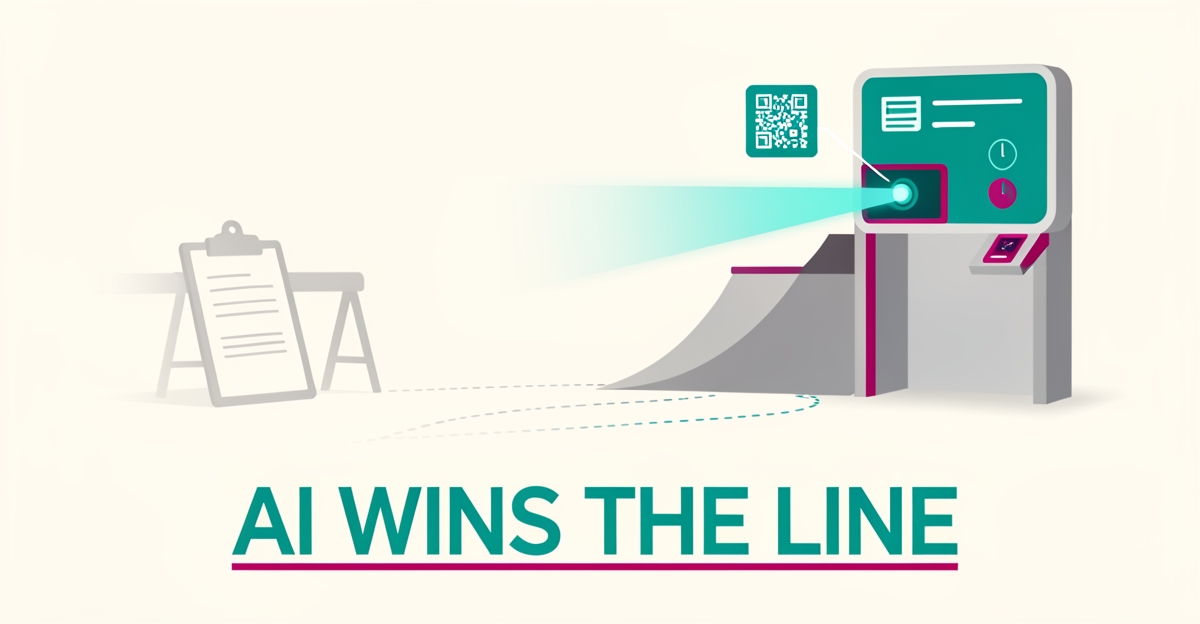
AI vs Human Staff: Which Is Better for Managing Skate Park Entry Lines?
Key Facts
- AI check-in typically processes an entry in seconds, while manual check-in often takes several minutes per guest during peak periods.
- AI data entry typically achieves higher, more consistent accuracy than manual entry, which degrades with fatigue and volume.
- Automated entry processing typically costs a fraction of manual processing once labor and error correction are counted.
- A single data entry error can take 10-15 minutes to trace and fix, turning small mistakes into big bottlenecks.
- AI scales instantly with near-zero marginal cost during weekend surges and events; human staffing costs rise linearly with demand.
- Human staff are limited to scheduled hours; AI entry systems operate 24/7/365.
- Most AI projects stall on integration and workflow design — which is why implementation approach matters more than the tool itself.
Hire a team member that works 24/7 — for less than a part-time wage.
AI receptionists, SDRs, dispatchers and 99+ roles. Trained on your business, fully managed.
Not sure where to start? Ask our AI planner
The Weekend Rush Problem at Skate Park Entry
The weekend rush at a skate park doesn't just mean more skaters—it means longer lines, frustrated guests, and staff stretched thin. As attendance spikes, manual check-in becomes a bottleneck that directly impacts both experience and revenue.
Each entry typically takes a human staff member several minutes to process, from scanning a pass to logging data into the system. During peak hours, this creates queues that grow rapidly, turning excitement into impatience before skaters even hit the ramps. Accuracy, while usually strong at the start of a shift, declines with fatigue and volume—and every error takes time to trace and fix. These mistakes—like transposed membership numbers or incorrect timestamps—cause delays, billing issues, and erode trust.
Staffing costs rise linearly with demand: more skaters mean more staff hours, with no economies of scale. Unlike AI systems that handle surges instantly, manual entry forces parks into reactive hiring, training, and scheduling during peak times. This inefficiency doesn't just slow lines—it diverts staff from engaging with guests, resolving issues, or enhancing the weekend vibe. For skate parks aiming to turn first-time visitors into regulars, every minute wasted at the gate is a missed opportunity to build loyalty and drive repeat business.
Why AI Check-In Outperforms Humans on Speed, Accuracy and Scale
The difference in processing speed between AI and human staff at skate park entry points is significant. While a human employee typically requires several minutes to manually read, interpret, and type data from a single entry record, AI systems complete the same task in seconds. This speed advantage becomes critical during peak hours, weekend surges, or tournament days when long lines directly impact guest satisfaction. By automating the repetitive grind of data entry, AI allows parks to maintain steady flow even when attendance spikes unexpectedly.
Accuracy and cost efficiency further widen the gap. Manual data entry suffers from fatigue-related degradation, and the true cost per entry includes wages plus the time spent correcting errors. AI delivers consistent accuracy across every transaction, and the marginal cost of processing an additional entry is close to zero—meaning processing 1,000 entries costs nearly the same as processing 100, eliminating the need to hire and train temporary staff for busy periods.
- AI processes entries in seconds vs. several minutes for humans
- AI maintains consistent accuracy vs. human accuracy that degrades with fatigue
- Cost per entry drops to a small fraction of manual processing with AI
- AI scales instantly with near-zero marginal cost during peak events
- Human staff limited to business hours; AI operates 24/7/365
For skate parks seeking to modernize entry management without overhauling existing infrastructure, AI workflow solutions offer a practical path forward. These systems integrate directly with current access control or point-of-sale tools, automatically validating tickets, updating attendance logs, and flagging exceptions for human review. By handling routine data entry at machine speed, AI frees staff to focus on guest engagement, safety monitoring, and resolving complex issues—transforming entry points from bottlenecks into seamless experiences. [AIQ Labs' AI Workflow Builds](/workflow-builds) rebuild the one workflow that costs you the most—like entry processing—at a fixed price, in phases, so you see results before committing to more.
From Grind to Guest Experience: Reallocating Staff with AI
The grind at the gate is what turns a fun day into a frustrated line. Entry work is repetitive by design — scan, validate, log, repeat — and it scales poorly when the crowd surges on weekends or tournament days.
AI agents remove the repetitive typing from the workflow while keeping humans in the loop for what matters. Ticket validation, membership checks and attendance logging can be extracted and structured in seconds with AI tools, compared with several minutes of manual reading and typing per transaction. That speed differential eliminates the bottleneck without adding staff.
Consistency is the second gain. Manual entry accuracy typically degrades with fatigue, while AI data entry tools maintain consistent accuracy across every transaction. For a skate park, that means fewer transposed ticket numbers, fewer unauthorized entries and far less time spent tracing and fixing errors that can take 10-15 minutes each to resolve.
Cost and scalability reinforce the shift. Manual processing costs accumulate in labor alone, whereas AI solutions reduce the per-entry cost to a small fraction. The near-zero marginal cost of AI means peak volumes can be handled without hiring and training temporary staff, and entry points stay open 24/7 with the same performance.
Integration is what makes the model work in practice. Modern AI workflow solutions connect directly with existing entry hardware, POS and attendance databases so data flows automatically without copy-pasting. This is the operational model where AI agents handle paperwork and routine validation, and humans step in for exceptions.
With the grind automated, staff can be redeployed to high-value guest interaction:
- Exception handling for damaged tickets, mismatched IDs or system flags
- High-touch welcome and safety briefings for first-time visitors
- Real-time problem solving for membership issues and refunds
- Crowd flow management and guest experience during surges
AIQ Labs designs tailored AI workflow solutions that integrate with existing entry points, reducing congestion and improving guest satisfaction through this reallocation. For parks that want a full front-of-house layer—check-in, phone answering, membership questions—[AI Employees](/ai-employees) act as managed AI staff across 99+ roles, typically at a fraction of the cost of a human hire.
The result is a leaner front of house: automate away the grind for routine validation and logging, and let people do what people do best — read the room, de-escalate, and create a welcoming experience.
Implementing AI Entry Lines with AIQ Labs
For skate parks facing weekend crowds or special events, entry line congestion often stems from repetitive, time-consuming manual tasks that frustrate guests and strain staff. AIQ Labs addresses this by implementing tailored AI workflow solutions that automate these bottlenecks while integrating seamlessly with existing entry systems.
The implementation begins by identifying repetitive entry tasks such as ticket scanning, membership validation, and attendance logging—activities that take humans minutes per entry but can be completed by AI in seconds with consistent accuracy. Auditing current pain points like long wait times or error-prone data logging helps define clear goals for reducing processing delays and improving guest flow.
Next, selecting a layout-agnostic AI approach ensures the system handles various ticket formats—digital passes, paper tickets, or membership cards—without requiring pre-defined templates or retraining. This flexibility is critical for skate parks dealing with diverse entry methods during peak times. Evaluating integration capabilities confirms the AI connects directly with existing CRM, point-of-sale, or access control systems, enabling real-time data flow without manual copy-pasting or workflow disruption.
Once configured and deployed, human staff are redeployed from routine data entry to higher-value roles like exception handling, guest assistance, and safety monitoring. This shift not only leverages AI's near-zero marginal cost for scaling during surges but also reduces labor costs per entry to a small fraction of manual processing, directly addressing congestion while improving consistency and satisfaction.
- Identify repetitive entry tasks like ticket validation and data logging
- Audit pain points such as wait times and error rates during peak hours
- Select layout-agnostic AI for handling diverse ticket formats without retraining
- Ensure seamless integration with existing entry and management systems
- Redeploy staff from manual entry to guest experience and exception handling
Still paying for 10+ subscriptions that don’t talk to each other?
We build custom AI systems you own outright. No vendor lock-in. Full control.
Not sure where to start? Ask our AI planner
Frequently Asked Questions
How much faster is AI check-in compared to human staff at a skate park entry?
Will using AI for skate park entry reduce costs, and by how much?
Is AI more accurate than humans for validating skate park passes and memberships?
Can AI handle weekend rushes and special events without needing extra staff?
What happens to staff when AI takes over routine entry tasks at a skate park?
Does AI integration require replacing our current skate park entry systems?
Where Speed Meets Service: Transforming Your Skate Park Entry
The weekend rush doesn't have to mean long lines and frustrated skaters. As we've seen, AI-powered check-in transforms entry from a bottleneck into a seamless experience—processing tickets in seconds with consistent accuracy, cutting per-entry costs to a fraction of manual processing, and freeing your staff to focus on what truly matters: welcoming guests, managing exceptions, and keeping the vibe alive. By automating the repetitive grind, you're not just reducing wait times; you're creating a scalable, consistent operation that turns first-time visitors into loyal regulars. Ready to see how this works for your specific entry points? [Start with a 2-minute Fit Check](/apply) and book a free 30-minute strategy call to map your bottlenecks and discover where AI can deliver the biggest impact—no obligation, just clarity on your opportunity to modernize entry management and elevate the guest experience.
Make AI your competitive advantage — not just another tool.
Strategy, implementation and ongoing optimization. One partner, end to end.
Not sure where to start? Ask our AI planner