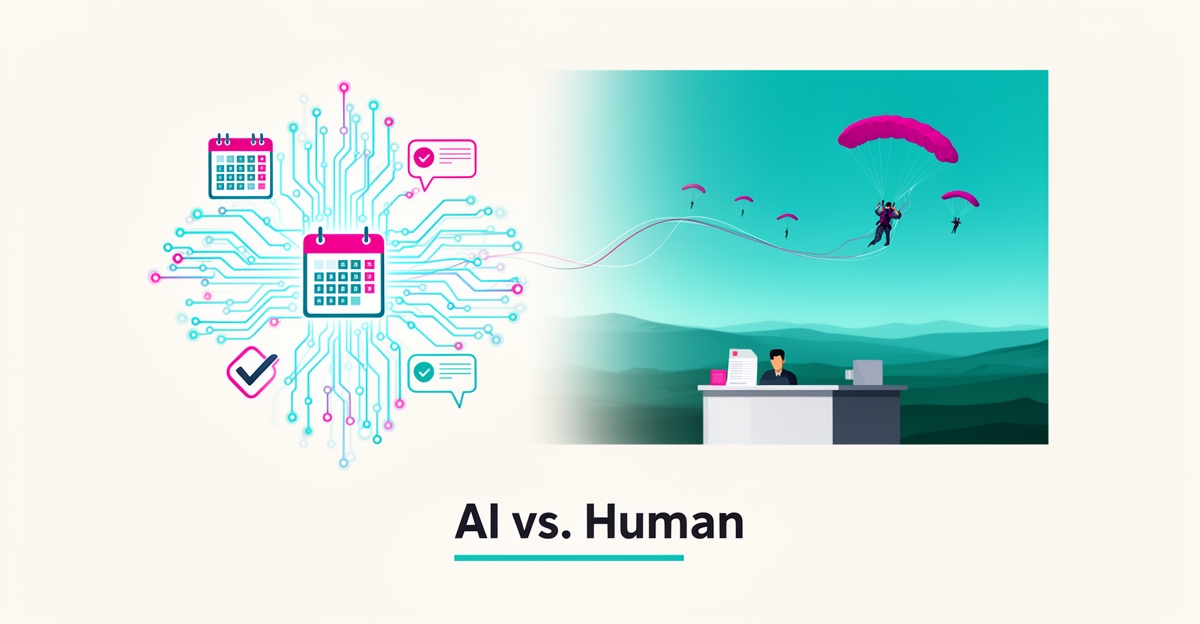
AI vs. Human Staff: Which Is Better for Managing Skydiving Group Bookings?
Key Facts
- AI systems deploy quickly and operate at full capacity from day one, avoiding the multi-month ramp-up typical of human hires.
- AI employees typically cost a small fraction of a fully-loaded human hire—AIQ Labs' managed AI staff run at roughly 80% less than the cost of a human employee.
- In structured, repetitive tasks like data entry and validation, AI systems produce consistent, correctable outputs with far fewer random errors than manual work.
- Automated workflows can substantially reduce manual data entry in repetitive booking tasks.
- AI handles 24/7 inquiries and processes bookings while your staff are offline—no overtime, no missed leads.
- The strongest operators use a hybrid model: AI for execution, humans for judgment, negotiation, and safety.
Hire a team member that works 24/7 — for less than a part-time wage.
AI receptionists, SDRs, dispatchers and 99+ roles. Trained on your business, fully managed.
Not sure where to start? Ask our AI planner
The Hidden Cost of Manual Booking Management in Adventure Tourism
For skydiving centers, the peak-season surge in group bookings exposes a critical flaw in relying solely on human staff: the system simply cannot scale. While demand may spike dramatically during summer months or holiday weekends, human capacity remains fixed, creating a bottleneck that turns inquiries into lost revenue. This limitation isn't merely an inconvenience—it's a structural growth constraint that caps how many groups a center can safely and efficiently accommodate, regardless of market interest.
The true cost of this manual approach becomes evident in the time and resources required to maintain even baseline operations. Human hires typically take months to reach full productivity, and during that ramp-up period new staff are still prone to errors in high-stakes tasks like waiver processing and payment scheduling—mistakes that can lead to compliance issues, customer dissatisfaction, or even safety concerns. The financial burden is compounded by recurring expenses: recruiting, training, benefits, and taxes can add 25–35% on top of a base salary, making each seasonal employee a significant ongoing cost.
These challenges are amplified by the repetitive, data-intensive nature of group booking management. Tasks such as entering participant details, synchronizing waivers with liability systems, and coordinating multiple time slots are highly susceptible to human error, especially under peak-season pressure. Fatigue and distraction increase the likelihood of typos in names, incorrect weight entries, or mismatched emergency contacts—errors that may seem minor individually but accumulate into systemic risks. Unlike humans, whose mistakes are random and variable, AI systems produce consistent, predictable outputs that can be monitored and corrected at scale, ensuring every booking meets the same standard.
Perhaps most critically, hiring and training seasonal staff for booking management creates a self-defeating cycle. Each year, centers must reinvest in recruitment and onboarding just to return to the same operational baseline, with no cumulative improvement in efficiency or capacity. This approach treats a scalable demand surge as a temporary staffing problem rather than an opportunity to build durable, automated infrastructure. As a result, the very process designed to serve customers becomes a limiting factor on growth—one that AI-driven transformation can resolve by shifting repetitive execution to intelligent systems while freeing human staff to focus on experience quality, safety oversight, and relationship-driven sales.
- AI systems deploy quickly and operate at full capacity from day one, avoiding the multi-month ramp-up typical of human hires.
- For structured tasks like data entry and validation, AI reduces random errors through systematic, correctable processes.
- AIQ Labs' managed AI employees run at roughly 80% less than the cost of a fully-loaded human hire—typically a small fraction of the annual spend.
By partnering with a provider like AIQ Labs, skydiving centers can navigate this shift smoothly—ensuring staff feel empowered, not displaced, while building a booking system that scales with demand rather than against the business.
Why AI Outperforms Humans in Repetitive Booking Workflows
AI excels at handling the repetitive, high-volume workflows that dominate skydiving group bookings, such as processing multiple reservation requests simultaneously, validating waiver forms, scheduling time slots, and sending automated confirmation emails. Unlike human staff, who are limited by working hours and cognitive fatigue, AI systems operate continuously and maintain consistent performance regardless of workload spikes. This allows skydiving centers to manage peak-season demand without delays or dropped inquiries.
In structured tasks like data entry, validation, and payment processing, AI systems consistently outperform manual work on both speed and error rates. AI employees also cost a small fraction of a fully-loaded human hire—AIQ Labs' managed AI staff run at roughly 80% less than a human employee. These savings are amplified by AI's ability to deploy quickly and scale on demand, eliminating the long ramp-up period human employees need to reach full productivity.
- AI handles 24/7 inquiries and processes bookings while staff are offline
- Scaling with AI requires no hiring or training—only configuration adjustments
- Systematic AI errors are easier to identify and correct than random human mistakes
- AI ensures consistent application of pricing rules, waiver requirements, and group size limits
- Automated workflows substantially reduce manual data entry in repetitive tasks
By offloading routine booking workflows to AI, human staff can shift from transactional processors to experience directors—focusing on safety briefings, special accommodations, and corporate client relationships where judgment and empathy add irreplaceable value. In this model, AI manages execution and humans provide oversight. AIQ Labs supports this transition through phased builds and change management strategies that align automation with workforce development, ensuring teams feel empowered rather than displaced during implementation.
The Hybrid Model: AI for Execution, Humans for Experience
Full replacement sounds efficient on paper, but skydiving group bookings live in the messy middle of rules and exceptions. The smartest operators keep humans in the loop where judgment matters and let automation handle the repetitive execution.
A hybrid model puts AI on execution and people on experience. AI processes inquiries, enters waiver data, confirms time slots, and sends reminders 24/7. Humans stay focused on corporate client negotiations, special accommodations, weather-related rescheduling, and safety briefings. This split protects revenue and reputation while cutting manual workload.
That balance matters because manual processes remain more adaptable in ambiguous or low-data environments. Humans bring contextual adaptability that automation can't match for strategic decision-making and complex, relationship-driven negotiations—and over-automation can reduce flexibility when rigid systems meet non-standard requests.
Cost and capacity still push toward automation for the routine layer. AI employees typically cost a small fraction of a fully-loaded human hire—as of late 2026, AIQ Labs' managed AI staff run at roughly 80% less than the cost of a human employee, with no recruiting, benefits, or payroll overhead. And most workers who use AI on the job report it saves them time on repetitive tasks.
That efficiency is valuable, but change management is the risk point. Many workers worry about AI replacing their jobs, and even more worry that using AI makes them look replaceable to employers. The most effective organizations address this head-on: they design workflows that combine AI automation with human oversight, and they communicate clearly that AI absorbs tasks, not roles.
In practice, the hybrid workflow looks like this:
- AI handles execution: intake forms, data entry, payment collection, confirmation emails, and 24/7 chat responses
- Humans own experience: corporate negotiations, custom packages, weather rescheduling calls, and pre-jump safety briefings
- Humans provide oversight: exception handling, quality checks, and final approval on non-standard requests
This is where AI acts as a force multiplier for staff, not a replacement. AIQ Labs supports this transition with training and integration plans, ensuring staff feel supported as execution shifts to automation. The result is faster turnaround, fewer errors, and a team freed to protect the human moments that sell skydiving.
How to Implement AI Booking Staff Without Disrupting Your Team
The biggest mistake skydiving operators make when bringing in AI isn't technical—it's treating the rollout as a software install instead of a people transition. With many workers worried about AI replacing them, how you introduce the technology matters as much as what it does.
The safest path starts with a limited pilot. Rather than overhauling your entire booking operation overnight, deploy a single AI Employee for one defined task—booking intake. This lets your front desk staff see the system handle repetitive confirmations and scheduling while they retain control over exceptions, corporate negotiations, and nervous first-time jumpers. Because AI primarily replaces tasks, not roles, most organizations reassign human effort to oversight and decision-making rather than eliminate positions.
Risk mitigation should also shape how you pay for the rollout. AIQ Labs offers a Start Monthly model—a flat monthly plan that costs far less than a human hire, with the build, training, integrations, monitoring, and improvements included, and the ability to pause or adjust anytime. For operators wary of long commitments, this turns a major operational decision into a low-stakes experiment with measurable results. If your booking workflow needs a deeper rebuild instead, AI Workflow Builds tackle the one workflow that costs you the most at a fixed price, in phases.
Training is the piece operators most often skip. Your staff need to understand not just what the AI does, but why it exists: to absorb the 2 a.m. inquiry emails and the peak-season phone surges, not to take their jobs. The goal is reframing roles from "doers" to "AI directors"—people who supervise a small team of AI employees handling execution. Addressing the fear that using AI makes staff "look replaceable" is essential for genuine buy-in.
AIQ Labs' implementation process follows four phases that map cleanly to a change-management-first approach:
- Discovery: analyze your current booking workflow, assess your tech stack, and project the return before anything is built.
- Integration: connect the AI to your existing scheduling, CRM, and payment tools so staff aren't forced to change systems.
- Deployment: go live with role-specific training and documentation so every team member knows their new responsibilities.
- Optimization: continuously monitor performance, retrain the AI, and expand scope only once your team is confident.
This phased structure also guards against over-automation, a real risk when rigid systems meet non-standard requests—like a corporate group asking to reschedule around a weather window. Human judgment stays in the loop for exactly those moments.
If you're ready to map where AI fits in your booking operation, start with the two-minute Fit Check at aiqlabs.ai/apply, then book a free 30-minute strategy call. It's a working session with an AI engineer—not a sales pitch—and if there isn't a clear win for your drop zone, you'll hear that too.
Still paying for 10+ subscriptions that don’t talk to each other?
We build custom AI systems you own outright. No vendor lock-in. Full control.
Not sure where to start? Ask our AI planner
Frequently Asked Questions
Can AI really handle skydiving group bookings without messing up waivers and payments?
How much cheaper is an AI booking agent compared to hiring someone?
Will my staff be replaced if we automate bookings?
How fast can AI get up and running versus training a new hire?
What parts of group bookings should still be done by humans?
Is a hybrid model actually used in adventure tourism?
The Winning Team: AI Handles the Paperwork, Your Team Owns the Sky
The verdict is clear: neither AI nor humans alone wins the group booking game. AI delivers 24/7 availability, consistent error-free execution on structured tasks, and a cost far below a human hire, while your people remain irreplaceable for weather calls, corporate negotiations, and calming nervous first-timers. The operators pulling ahead aren't choosing sides—they're building hybrid teams where AI executes and humans direct, all while keeping staff buy-in front and center. That's why AIQ Labs pairs every implementation with change management and role-specific training, so your team feels empowered as AI directors rather than displaced. The best part? You can test this with minimal risk through the Start Monthly model—far less than a human hire, with the ability to pause or adjust anytime. Ready to see where AI fits in your drop zone? Take the two-minute Fit Check at aiqlabs.ai/apply and book your free 30-minute strategy call—a working session with an AI engineer, not a sales pitch. And if there's no clear win for your operation, we'll tell you that too.
Make AI your competitive advantage — not just another tool.
Strategy, implementation and ongoing optimization. One partner, end to end.
Not sure where to start? Ask our AI planner