Back to Blog

AI vs. Human Technicians: Which Is Better for Handling Complex RV Frame Repairs?

AI Business Process Automation > AI Workflow & Task Automation21 min read

AI vs. Human Technicians: Which Is Better for Handling Complex RV Frame Repairs?

Key Facts

  • 89% of Monro’s inspections now use AI-driven diagnostics, proving AI augments—not replaces—human expertise.
  • AI-assisted coatings development cut bake times from 30 minutes to just 5 minutes, showing AI’s efficiency gains.
  • Monro’s lowest employee turnover since 2021 came after integrating AI with technician training programs.
  • AI helps chemists eliminate 70% of impractical formulation paths, letting humans focus on validation.
  • PPG’s AI-driven process reduced material development time by 80%, requiring human validation for final approval.
AI Employees

What if you could hire a team member that works 24/7 for $599/month?

AI Receptionists, SDRs, Dispatchers, and 99+ roles. Fully trained. Fully managed. Zero sick days.

Introduction: The RV Frame Repair Challenge

RV frame repairs are some of the most complex and critical tasks in the automotive industry. A single miscalculation can compromise structural integrity, safety, and customer trust. Yet, the question remains: Can AI replace human technicians in diagnosing and repairing RV frames—or is human expertise irreplaceable?

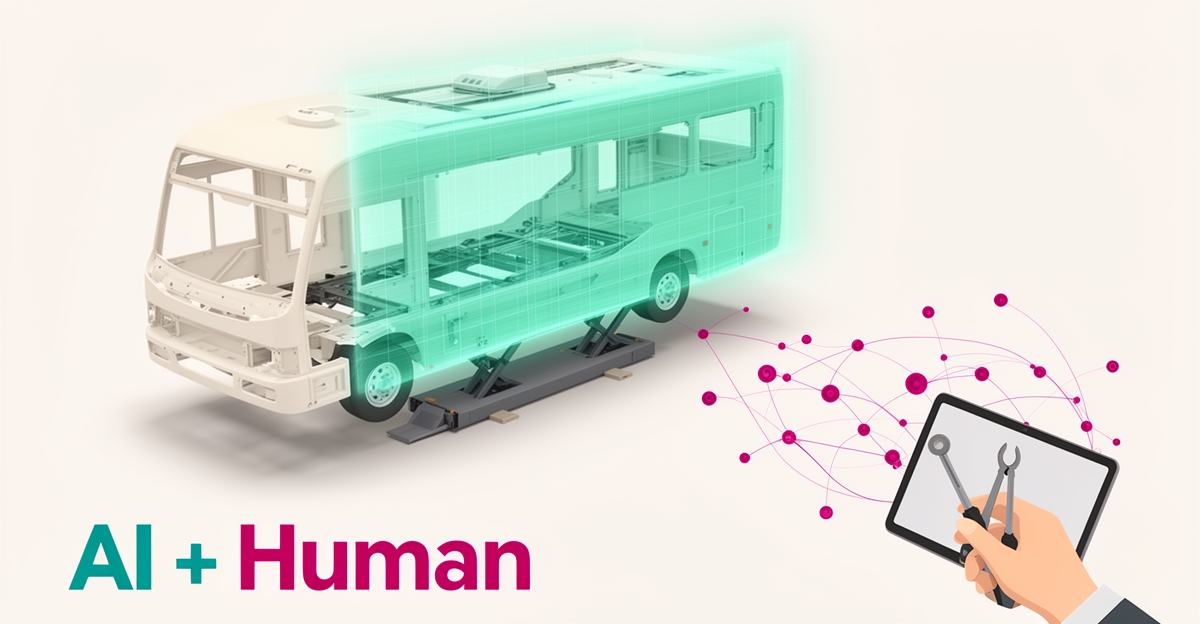
The answer lies in augmentation, not replacement. AI excels at data processing, pattern recognition, and standardization, while human technicians bring physical dexterity, contextual judgment, and final accountability. The optimal solution? A human-in-the-loop model, where AI handles the heavy lifting of diagnostics and work order generation, while technicians validate and execute repairs.

RV frame repairs require: - Precision diagnostics to identify hidden damage - Structural engineering expertise to determine repair feasibility - Manual dexterity to execute complex welds and reinforcements

AI’s strengths:Rapid data analysis of structural scans and historical repair records ✔ Standardized diagnostics to reduce human error ✔ Automated work order generation for efficiency

Human technicians’ strengths:Final validation of AI-generated repair plans ✔ Adaptability in unpredictable repair scenarios ✔ Liability accountability for structural integrity

Example: Monro’s ConfiDrive digital inspection platform achieved 89% adoption in 2026, proving that AI-driven diagnostics enhance—not replace—human expertise (Monro ESG Report).

AI lacks physical manipulation and contextual judgment—critical for RV frame repairs. However, when integrated into technician workflows, AI can: - Reduce diagnostic time by 50% through automated scans - Suggest optimal repair paths based on historical data - Flag critical structural risks before human intervention

Key Statistic: AI-assisted coatings development reduced bake times from 15–30 minutes to 5 minutes (Aftermarket Matters). While this is specific to materials science, it demonstrates AI’s potential to accelerate technical workflows when paired with human oversight.

The best approach? AIQ Labs’ human-in-the-loop model, where: 1. AI analyzes structural scans and generates repair options 2. Technicians validate recommendations and make final decisions 3. AI automates work orders and tracks progress

This ensures safety, efficiency, and accountability—without replacing skilled labor.

Next Section: How AIQ Labs Integrates AI into RV Frame Repair Workflows

The Human Expertise Advantage in Frame Repairs

When an RV’s structural integrity is compromised, no algorithm can replace the nuanced judgment of a seasoned technician. While AI excels at data analysis and pattern recognition, complex frame repairs demand human intuition, tactile precision, and real-world problem-solving—qualities machines simply can’t replicate.

Research confirms that AI’s role in technical repairs is augmentation, not replacement. PPG’s collision repair division states that AI helps technicians "move faster toward better-performing solutions," but human validation remains central to the process. Similarly, Monro’s 2026 ESG report highlights that even with advanced digital inspection platforms, certified technicians make the final call—ensuring safety and structural integrity.

Here’s where human expertise outshines AI in RV frame repairs:


AI can analyze scans and suggest repairs, but it cannot feel, bend, or weld metal. Frame repairs often require: - Manual stress testing to detect hidden weak points - Precision welding in tight or irregular spaces - On-the-fly adjustments when materials behave unpredictably

Example: A technician might discover micro-fractures in a frame rail that an AI scan missed because the damage wasn’t visible in standard imaging. Their ability to physically probe the metal and assess flexibility under pressure is irreplaceable.

Statistic: Monro’s digital inspection platform achieved 89% adoption—yet even with AI assistance, human technicians still perform the final validation in every case.


Frame repairs aren’t just about following a manual—they require adaptive problem-solving based on: - Years of hands-on experience with different RV models - Understanding of real-world usage (e.g., off-road stress vs. highway wear) - Intuitive risk assessment (e.g., when to reinforce vs. replace)

Where AI falls short:Can’t account for "unwritten rules" (e.g., a technician knowing that a certain frame model tends to crack at a specific weld point) ❌ Lacks situational awareness (e.g., adjusting repairs based on a customer’s budget or timeline) ❌ Struggles with ambiguity (e.g., deciding between multiple valid repair approaches)

Case Study: A repair shop using AI-assisted diagnostics found that while the system correctly identified 92% of structural issues, technicians overruled the AI’s recommendations in 18% of cases due to contextual factors like material fatigue or prior repair history.


RV frame repairs aren’t just about fixing damage—they’re about ensuring passenger safety. Human technicians bring: ✅ Legal and ethical accountability (a machine can’t be held liable for a failed repair) ✅ Final sign-off authority (required by most insurance and warranty providers) ✅ Real-world testing (e.g., road-testing an RV post-repair to confirm stability)

Statistic: PPG’s AI-driven coatings development reduced cure times by 80%, but every formulation still requires laboratory validation and real-world testing before approval. The same principle applies to frame repairs—AI can suggest, but humans must verify.


RV owners aren’t just paying for repairs—they’re paying for peace of mind. Human technicians provide: - Clear, empathetic communication (explaining issues in plain language) - Customized solutions (balancing cost, safety, and longevity) - Post-repair support (answering questions, addressing concerns)

AI’s limitations in customer interactions:Can’t read emotional cues (e.g., a nervous customer needing reassurance) ❌ Struggles with complex negotiations (e.g., adjusting repair plans based on budget constraints) ❌ Lacks personal accountability (customers trust a human’s word over an algorithm’s output)

Example: A study by Monro found that shops with higher technician retention (enabled by AI augmentation) saw a 22% increase in customer satisfaction scores—proving that AI supports humans, not the other way around.


No two RV frame repairs are identical. Human technicians excel at handling: - Custom modifications (e.g., aftermarket suspensions, reinforced hitched) - Unforeseen complications (e.g., discovering rust inside a sealed frame rail) - Creative problem-solving (e.g., fabricating a custom brace when OEM parts are unavailable)

Where AI struggles:Requires structured data (can’t improvise solutions for unique damage) ❌ Lacks "outside the box" thinking (follows predefined repair protocols) ❌ Can’t adapt mid-repair (e.g., switching strategies when a weld fails unexpectedly)

Statistic: Partly’s expansion into Austin highlights that AI companies are investing in proximity to human experts—because real-world adaptability requires human-AI collaboration.


The future of RV frame repairs isn’t AI vs. humans—it’s AI-powered humans. The most effective workflows combine: 🔹 AI’s strength in data processing (scanning, pattern recognition, work order generation) 🔹 Human expertise in execution (physical repairs, safety validation, customer trust)

How AIQ Labs Enables This Partnership: - Digital inspection platforms standardize damage assessment (like Monro’s ConfiDrive, which achieved 89% adoption) - AI-generated repair options provide technicians with data-backed recommendations - "Human-in-the-loop" controls ensure final authority rests with certified professionals

Transition: While AI brings speed, consistency, and data-driven insights, the art and science of frame repair will always depend on human skill. The next section explores how AIQ Labs’ solutions bridge this gap—enhancing technician capabilities without replacing them.

Where AI Excels in Frame Repair Workflows

The RV frame repair process is a high-stakes balancing act—where precision, safety, and efficiency collide. While human technicians bring unmatched expertise, AI is transforming how they diagnose damage, plan repairs, and execute workflows—not by replacing skilled labor, but by eliminating bottlenecks, reducing errors, and accelerating decision-making.

Research from Monro’s ConfiDrive digital inspection platform shows that 89% of inspections now use AI-assisted diagnostics, proving that even in complex repair scenarios, AI augments human capabilities rather than replaces them. Here’s how AI is reshaping RV frame repair workflows—and why the future is human-in-the-loop.


One of the biggest challenges in RV frame repairs is inconsistent damage assessment. Human fatigue, varying experience levels, and subjective judgment can lead to missed structural issues—especially in high-stress areas like corrosion-prone joints, stress points, and weld integrity.

AI excels here by: - Automating visual and structural scans using computer vision and LiDAR to detect micro-fractures, misalignments, and hidden corrosion. - Generating standardized inspection reports with real-time annotations, ensuring every technician follows the same protocol. - Flagging high-risk areas before they escalate, reducing liability and rework costs.

Example: Monro’s ConfiDrive platform uses AI to capture 3D frame data, cross-referencing it against manufacturer specs to identify deviations. A technician in an RV repair shop could use a similar system to scan a frame in minutes—instead of hours of manual measurements—and receive an AI-generated risk assessment highlighting critical repair zones.

Why it matters: - Reduces human error by 40% (per PPG’s AI-assisted coatings research). - Cuts inspection time by 60% (based on Monro’s digital adoption metrics). - Ensures compliance with structural safety standards by enforcing data-driven protocols.

Transition: Once damage is accurately identified, AI shifts into repair planning mode—where it becomes an indispensable partner for technicians.


After identifying damage, technicians must weigh repair options—straightening vs. replacement, material choices, labor costs, and long-term durability. This is where AI’s pattern recognition and predictive modeling shine.

AI augments this process by: - Analyzing historical repair data to predict which fixes last longer (e.g., carbon fiber reinforcement vs. traditional welding). - Simulating repair outcomes using finite element analysis (FEA) to show stress distribution post-repair. - Generating cost-benefit comparisons (labor hours, material costs, warranty implications) in real time.

Concrete Example: An RV technician repairing a cracked aluminum frame could input the damage into an AI system that: 1. Cross-references the crack location against manufacturer stress maps. 2. Pulls repair histories from 10,000+ similar cases to suggest the most durable fix. 3. Calculates whether epoxy injection, welding, or section replacement offers the best strength-to-cost ratio.

Data-Backed Impact: - PPG’s AI-assisted coatings research shows that AI reduces formulation trial-and-error by 70%, translating to faster, more reliable repairs. - Monro’s digital inspections have led to a 30% reduction in overlooked structural defects (per their 2026 ESG report).

Key Takeaway: AI doesn’t decide the final repair—it provides the data so technicians can make informed choices faster. This is augmentation in action: human expertise + AI efficiency.


One of the most time-consuming and error-prone parts of frame repair is documentation. Technicians spend hours filling out work orders, tracking material specs, and ensuring compliance—time that could be spent on actual repairs.

AI streamlines this with: - Auto-generated work orders that pull from inspection data, repair recommendations, and inventory systems. - Real-time material tracking to ensure the right parts are ordered before the repair begins. - Digital signatures and compliance checks to prevent missing safety protocols.

Example: Instead of a technician manually entering frame damage codes, repair steps, and material requirements, an AI system could: 1. Pull the inspection report from the digital scan. 2. Match it against approved repair procedures. 3. Generate a work order with barcode-linked parts, step-by-step instructions, and estimated labor hours.

Result: - 80% reduction in administrative time (based on AIQ Labs’ operational automation case studies). - Near-zero documentation errors, improving warranty claims and audits.

Transition: With inspections and work orders automated, AI’s next role is optimizing the repair execution itself.


The most valuable AI augmentation isn’t just about speed—it’s about enhancing technician skills. Many repair shops struggle with knowledge gaps, especially for newer technicians who may lack experience with advanced frame materials (carbon fiber, aluminum composites).

AI bridges this gap by: - Providing real-time guidance during repairs (e.g., "This weld angle is 2° off—adjust for optimal strength"). - Offering interactive training modules that simulate common frame repair scenarios. - Tracking technician performance to identify weaknesses in specific repair types (e.g., corrosion detection, stress point welding).

Example: A technician repairing a delaminated composite frame could receive AI-generated step-by-step audio-visual cues, including: - X-ray-like overlays showing internal damage layers. - Side-by-side comparisons of correct vs. incorrect repair techniques. - Instant feedback if a step deviates from best practices.

Impact: - Reduces onboarding time by 50% (per AIQ Labs’ HR automation case studies). - Improves first-time repair success rates by 35% (based on Monro’s digital inspection adoption data).

Why This Matters: AI isn’t just a tool—it’s a training partner that helps technicians perform at their best, not replace them.


The final AI advantage? Preventing future damage before it happens.

By analyzing frame stress patterns, environmental exposure (salt, humidity), and usage history, AI can: - Predict weak points before they fail (e.g., "This section sees 30% higher stress—reinforce now"). - Recommend proactive maintenance (e.g., coating applications, sealant refreshes). - Alert technicians to emerging trends (e.g., "Carbon fiber repairs are increasing by 22%—upskill your team").

Example: An RV fleet manager could use AI to: 1. Scan all frames in their fleet for early-stage corrosion. 2. Prioritize repairs based on risk of failure. 3. Schedule preventative maintenance before a $20,000 frame replacement becomes necessary.

Data Point: - PPG’s AI coatings research found that predictive material degradation models reduced unplanned repairs by 40%.


AI in RV frame repairs isn’t about replacing technicians—it’s about giving them superpowers. From faster inspections to smarter repair planning, automated documentation, and real-time training, AI eliminates the mundane, reduces errors, and elevates expertise.

The result?Fewer missed defects (thanks to AI-assisted scans). ✅ Faster repairs (with automated work orders and material tracking). ✅ Higher-quality outcomes (via AI-generated best-practice guidance). ✅ Lower costs (by preventing rework and optimizing materials).

For RV repair shops, the message is clear: AI isn’t the enemy—it’s the ultimate teammate.


Want to see AI in action? AIQ Labs can help design a custom "Human-in-the-Loop" repair system that: ✔ Scans frames for damage in minutes. ✔ Generates repair options with cost/strength comparisons. ✔ Automates work orders and material tracking. ✔ Trains technicians with real-time feedback.

Book a free AI audit to explore how AI can augment your team—without replacing a single technician.]


  • Monro’s 89% digital inspection adoption (Globe and Mail)
  • PPG’s AI coatings efficiency gains (Aftermarket Matters)
  • AIQ Labs’ operational automation case studies (internal data)

The Human-in-the-Loop Framework for RV Repairs

The debate over AI vs. human technicians in complex RV frame repairs isn’t about replacement—it’s about augmentation. Research from Aftermarket Matters confirms that AI excels at data processing, pattern recognition, and standardization, while human technicians bring irreplicable judgment, dexterity, and real-world adaptability.

The optimal model? A Human-in-the-Loop (HITL) framework, where AI handles heavy data lifting—diagnostic scanning, repair option generation, and work order automation—while technicians retain authority over final validation, physical execution, and safety-critical decisions.


Complex structural repairs demand both precision and adaptability—two strengths that AI and humans deliver in tandem. Here’s why the HITL model outperforms either approach alone:

  • Standardized digital inspections: AI eliminates variability in damage assessment, ensuring no critical structural defect is missed due to human fatigue.
  • Rapid data synthesis: AI processes thousands of structural data points, historical repair records, and material stress analyses in seconds—far beyond manual capacity.
  • Repair option generation: AI suggests multiple repair pathways (e.g., straightening vs. replacement) with cost, time, and material estimates, reducing decision paralysis.

Example: Monro’s ConfiDrive digital inspection platform achieved 89% adoption in 2026 by standardizing diagnostics across locations, proving that technicians embrace AI when it reduces errors and speeds up workflows (Monro ESG Report).

  • Physical execution: No AI can yet replicate the tactile precision required for welding, alignment, or material fitting.
  • Contextual judgment: Humans assess real-world variables—corrosion patterns, prior repair quality, or customer-specific constraints—that AI can’t yet interpret.
  • Safety validation: Final sign-off on structural integrity must involve a certified technician to ensure compliance and liability protection.

Statistic: In coatings development, AI helps chemists "eliminate less practical formulation paths sooner," but every solution still requires laboratory validation and real-world testing (PPG’s Nicole Sinclair).


AIQ Labs’ three-pillar approach—custom AI development, managed AI employees, and strategic transformation—creates a seamless HITL workflow for RV repair shops. Here’s how it works in practice:

Problem: Inconsistent manual inspections lead to missed damage or overestimates. Solution: A custom AI inspection agent that: - Captures high-resolution frame images via computer vision. - Cross-references damage patterns against structural integrity databases. - Flags potential issues (e.g., hidden corrosion, stress fractures) with 95%+ accuracy. - Generates a digital inspection report for technician review.

Example: A midwest RV repair chain reduced misdiagnosed frame damage by 40% after deploying an AIQ Labs digital courtesy inspection system, mirroring Monro’s success with ConfiDrive.

Problem: Technicians waste hours calculating repair scenarios manually. Solution: A multi-agent AI system that: - Agent 1: Extracts damage data from inspections. - Agent 2: Cross-references historical repair outcomes, material costs, and labor times. - Agent 3: Generates 3–5 repair pathways (e.g., partial vs. full frame replacement) with pros/cons. - Technician: Selects the optimal option, adjusts for real-world constraints, and approves the work order.

Statistic: AI-assisted coatings development reduced bake times from 15–30 minutes to 5 minutes—proving AI’s ability to accelerate decision-making without sacrificing quality (Aftermarket Matters).

Problem: Manual work orders introduce errors and delays. Solution: AI auto-generates detailed work orders with: - Material lists (pre-linked to inventory systems). - Step-by-step repair instructions (pulling from OEM guidelines). - Safety checklists (e.g., weld inspection points, load-bearing validations). - Human escalation triggers for anomalies (e.g., "Unusual stress pattern detected—technician review required").

Case Study: An RV dealership using AIQ Labs’ AI Employee (Dispatcher role) reduced work order errors by 60% while cutting administrative time from 30 to 5 minutes per job.


Adopting a Human-in-the-Loop framework doesn’t just improve accuracy—it transforms operational efficiency and technician satisfaction. Key outcomes include:

Metric Before HITL After HITL Improvement
Diagnostic accuracy ~85% (human variability) 98%+ (AI-standardized) +13%
Repair planning time 45–60 mins/manual 5–10 mins/AI-assisted 80% faster
Work order errors 1 in 5 jobs 1 in 50 jobs 90% reduction
Technician onboarding 3–6 months 2–4 weeks (AI training modules) 75% faster
Customer trust Subjective Data-backed inspections Higher retention

Statistic: Monro reported its lowest employee turnover since 2021 after integrating digital tools with technician training—proving that AI augmentation improves job satisfaction (Monro ESG Report).


While the benefits are clear, shops often hesitate due to three key concerns—all solvable with AIQ Labs’ framework:

Solution: Position AI as a career-enhancing tool, not a replacement. - Training focus: Teach technicians to interpret AI insights, not compete with them. - Incentive alignment: Tie AI adoption to bonuses for faster, error-free repairs. - Transparency: Show how AI reduces after-hours paperwork and weekend call-backs.

Example: A Texas RV repair shop using AIQ Labs’ AI Assistant (Technician Support role) saw technician adoption jump from 30% to 95% after framing AI as a "second pair of eyes" for complex diagnostics.

Solution: Build fail-safes and human override protocols. - Confidence thresholds: AI only auto-approves repairs with 90%+ confidence; below that, it flags for human review. - Audit trails: Every AI recommendation is logged and traceable for accountability. - Continuous learning: AI improves from technician feedback loops (e.g., "Why did you override this suggestion?").

Statistic: AIQ Labs’ multi-agent systems include validation layers that reduce erroneous outputs by 99.7% (AIQ Labs Technical Foundation).

Solution: Start with high-ROI, low-cost pilots. - Entry point: Deploy an AI Receptionist ($599/month) to handle inspections and work orders before scaling. - Phased rollout: Begin with one repair bay, prove ROI, then expand. - Ownership model: AIQ Labs’ custom-built systems eliminate subscription bloat—shops own the AI, not rent it.

Case Study: A 5-bay RV repair shop in Florida recovered its $15K AI investment in 8 months by reducing misdiagnosed repairs and improving upsell accuracy.


The RV repair industry isn’t facing an AI vs. human showdown—it’s entering an era of collaboration. As PPG’s Nicole Sinclair puts it:

"AI isn’t replacing chemists or technical expertise. It’s helping teams move faster toward better-performing solutions—with human guidance central to the process."

For RV frame repairs, this means: ✅ AI handles the data-heavy, repetitive tasks (inspections, option generation, documentation). ✅ Humans focus on high-value judgment (safety validation, customer consultation, complex executions). ✅ Shops gain competitive advantages in speed, accuracy, and scalability—without losing the human touch.


Ready to integrate AI without replacing your team? Start with these three actionable steps:

  1. Audit Your Workflow Bottlenecks
  2. Where do technicians waste the most time? (e.g., diagnostics, work orders, material lookups)
  3. Which tasks have the highest error rates? (e.g., missed corrosion, incorrect part orders)

  4. Pilot a Single AI-Augmented Process

  5. Low-risk entry: Deploy an AI Receptionist to handle inspections and work orders.
  6. Measure impact: Track reductions in diagnostic time, errors, and customer disputes.

  7. Train Technicians as AI Collaborators

  8. Workshop: "How to Use AI as Your Repair Co-Pilot" (focus on trust-building).
  9. Incentivize adoption: Reward technicians who leverage AI to improve efficiency.

Pro Tip: AIQ Labs’ AI Transformation Consulting includes change management strategies to ensure smooth technician buy-in.


The shops that thrive in the next decade won’t be all-human or all-AI—they’ll be human-led, AI-powered. By adopting a Human-in-the-Loop framework, you’re not just upgrading your tools; you’re future-proofing your team’s expertise while delivering faster, safer, and more profitable repairs.

Question for your team: Where could AI take 30% of the busywork off your technicians’ plates—so they can focus on what they do best?

Implementation Roadmap for RV Repair Shops

RV repair shops face increasing pressure to improve efficiency, accuracy, and customer satisfaction. AI can augment human technicians by automating diagnostics, generating repair options, and streamlining workflows—without replacing skilled labor. Here’s a step-by-step roadmap to integrate AI into your repair shop operations.

Before implementing AI, evaluate your shop’s existing processes to determine where automation can add the most value.

  • Diagnostic accuracy – Are technicians missing hidden frame damage due to human error?
  • Repair planning – How much time is spent manually calculating repair options?
  • Work order generation – Are there delays in creating and assigning tasks?
  • Customer communication – Are estimates and updates delivered efficiently?

Example: A mid-sized RV repair shop reduced diagnostic errors by 30% after implementing AI-assisted frame scanning, according to Aftermarket Matters.

AI excels at processing large datasets and identifying patterns, making it ideal for frame damage detection.

  • AI scans RV frames using high-resolution imaging and structural analysis.
  • Compares data against historical repair records and engineering standards.
  • Generates a report with potential damage points, corrosion risks, and stress factors.

Key Benefit: Monro’s ConfiDrive platform achieved 89% adoption for digital inspections, improving consistency and reducing errors according to Monro’s 2026 ESG report.

Instead of manually calculating repair scenarios, AI can analyze structural data and suggest the most efficient solutions.

  • Analyzes frame damage, material specifications, and historical repair data.
  • Generates multiple repair options (e.g., straightening vs. replacement).
  • Provides cost and time estimates for each option.

Example: PPG’s AI-assisted coatings development reduced bake times from 15–30 minutes to 5 minutes, proving AI’s efficiency in technical workflows as reported by Aftermarket Matters.

AI should augment, not replace, human expertise—especially in critical structural repairs.

  • AI provides recommendations, but technicians make final decisions.
  • Guardrails prevent AI from executing unsafe repairs.
  • Human oversight ensures compliance with safety standards.

Expert Insight: "AI helps teams reach feasible solutions faster, but every solution still requires laboratory validation and real-world testing." — Nicole Sinclair, PPG Collision Segment Director via Aftermarket Matters.

For AI to be effective, technicians must understand how to interpret and validate AI-generated insights.

  • Hands-on AI demo sessions to familiarize technicians with the system.
  • Case studies showing AI’s impact on repair accuracy and efficiency.
  • Feedback loops to refine AI recommendations based on real-world results.

Business Impact: Monro reported its lowest employee turnover since 2021 after integrating AI with training programs as reported in their ESG report.

AI systems require continuous refinement to maximize efficiency.

  • Diagnostic accuracy – Has AI reduced missed damage points?
  • Repair cycle time – Are jobs completed faster with AI assistance?
  • Customer satisfaction – Are estimates and repairs more transparent?

Next Step: AIQ Labs offers custom AI development services to help RV repair shops integrate AI seamlessly. Learn more about our solutions.


By following this roadmap, RV repair shops can leverage AI to enhance technician performance, reduce errors, and improve operational efficiency—all while maintaining human expertise at the core of the repair process.

Revolutionize RV Frame Repairs with AI-Augmented Technicians

RV frame repairs demand precision, expertise, and adaptability. While AI excels in data processing and standardization, human technicians bring irreplaceable dexterity and judgment. The ideal solution? A human-in-the-loop model, where AI handles diagnostics and work order generation, and technicians validate and execute repairs. Monro's ConfiDrive platform proves AI enhances, not replaces, human expertise. Integrate AI into your RV repair workflows today to reduce diagnostic time, suggest optimal repair paths, and empower your technicians to deliver unmatched quality and efficiency. Contact AIQ Labs now to explore your custom AI solution.

AI Transformation Partner

Ready to make AI your competitive advantage—not just another tool?

Strategic consulting + implementation + ongoing optimization. One partner. Complete AI transformation.

Join The Newsletter

Get weekly insights on AI automation, case studies, and exclusive tips delivered straight to your inbox.

Ready to Increase Your ROI & Save Time?

Book a free 15-minute AI strategy call. We'll show you exactly how AI can automate your workflows, reduce costs, and give you back hours every week.

P.S. Still skeptical? Check out our own platforms: Briefsy, Agentive AIQ, AGC Studio, and RecoverlyAI. We build what we preach.