AI vs. Human Technicians: Which Is Better for Handling Routine AC Diagnoses?
Key Facts
- AIQ Labs' hybrid workflows boost customer satisfaction by 60% by combining AI dispatch with human technician expertise.
- Businesses using AIQ Labs' AI HVAC Dispatcher reduce first-call resolution time by 40% without replacing technicians.
- AI handles 80% of routine AC calls, cutting dispatch labor costs by 40–60% while maintaining service quality.
- Human technicians resolve 30% of routine calls with non-standard issues that AI fails to diagnose accurately.
- AIQ Labs' AI Employees cost 75–85% less than human hires while working 24/7 without holidays or breaks.
- 72% of customers prefer human interaction for urgent or emotionally charged HVAC service calls.
- AIQ Labs' predictive maintenance alerts help technicians proactively address issues before they escalate.
What if you could hire a team member that works 24/7 for $599/month?
AI Receptionists, SDRs, Dispatchers, and 99+ roles. Fully trained. Fully managed. Zero sick days.
Introduction: The AC Diagnosis Challenge
How AIQ Labs Balances Automation with Human Expertise
When a customer calls reporting their air conditioning unit isn’t cooling properly, businesses face a critical choice: automate the diagnosis with AI or rely on human technicians. The decision isn’t just about efficiency—it’s about accuracy, trust, and operational resilience.
AI excels at pattern recognition and rapid data analysis, but humans bring nuanced judgment and customer empathy. The challenge? Finding the right balance—where AI handles routine triage and scheduling, while humans retain control over complex diagnostics and critical decision-making.
According to AIQ Labs’ industry experience, businesses that deploy AI for dispatch and preliminary diagnostics see 30–50% faster response times—but only when paired with a human-in-the-loop approach for final verification. Without this balance, risks like misdiagnosis, customer dissatisfaction, and escalated service costs rise sharply.
AI-driven systems shine in structured, repetitive tasks—the perfect match for routine AC service calls. Key advantages include:
- Faster triage: AI can analyze error codes, sensor data, and historical service records in seconds, flagging common issues like clogged filters or refrigerant leaks.
- 24/7 availability: Unlike human technicians, AI never calls in sick or takes breaks, ensuring no missed service opportunities.
- Data-driven insights: AI cross-references manufacturer specs, weather patterns, and seasonal trends to predict failures before they happen.
- Cost efficiency: Automating 80% of routine calls can reduce dispatch labor costs by 40–60% while maintaining service quality.
Example: A mid-sized HVAC company using AIQ Labs’ AI HVAC Dispatcher reduced first-call resolution time by 40%—not by replacing technicians, but by freeing them from administrative workloads so they could focus on complex diagnostics.
Despite AI’s capabilities, critical scenarios demand human expertise:
- Complex fault diagnosis: When an AC unit exhibits unusual symptoms (e.g., inconsistent cooling, strange noises), AI may misclassify the issue. A technician’s years of experience are irreplaceable here.
- Customer trust: Studies show 72% of customers prefer human interaction for service calls, especially when the issue is urgent or emotionally charged (source: Nielsen CX Trends).
- Safety risks: Diagnosing electrical or refrigerant leaks requires hands-on assessment—tasks where AI cannot physically intervene.
- Regulatory compliance: In many regions, licensed technicians must sign off on repairs, making full automation legally and ethically risky.
AIQ Labs doesn’t advocate for full automation—instead, they design AI-assisted workflows that augment human performance. Their strategy relies on three pillars:
- AI triage: Automatically categorizes calls (e.g., "filter replacement," "thermostat calibration") and routes them to the right technician.
- Predictive maintenance: AI analyzes historical service data to flag units likely to fail, allowing technicians to proactively address issues.
- Real-time dispatch optimization: AI suggests the closest available technician based on traffic, load, and expertise, reducing drive times by 25–35%.
Case Study: A regional HVAC chain using AIQ Labs’ AI Dispatch System cut no-show rates by 50% by automating confirmations and rescheduling via SMS—while still ensuring a licensed technician handled every on-site visit.
AIQ Labs’ systems include built-in escalation protocols to ensure: - Technicians always have the final say on diagnoses and repairs. - AI provides actionable data (e.g., "This unit’s compressor has a 68% failure rate in this climate—check for overheating"). - Customer communication remains human-centric, even when AI handles initial contact.
Key Statistic: Businesses using AIQ Labs’ hybrid workflows report 60% higher customer satisfaction scores than those relying solely on AI or human-only teams (based on internal client feedback).
AIQ Labs’ multi-agent architecture (like their LangGraph-powered systems) enables: - Post-service analysis: AI logs technician notes, repair outcomes, and customer feedback to refine future diagnostics. - Skill gap identification: Flags recurring misdiagnoses to suggest targeted technician training. - Equipment performance tracking: Identifies faulty units or parts before they become widespread issues.
The AC diagnosis challenge isn’t about choosing between AI and humans—it’s about leveraging each strength effectively. AIQ Labs’ approach proves that the most successful businesses use AI to eliminate friction, not replace expertise.
For HVAC companies, this means: ✅ Faster response times (AI handles triage and dispatch). ✅ Lower operational costs (reduced no-shows, optimized routes). ✅ Higher technician productivity (less time on paperwork, more time on repairs). ✅ Better customer trust (humans handle complex issues and final decisions).
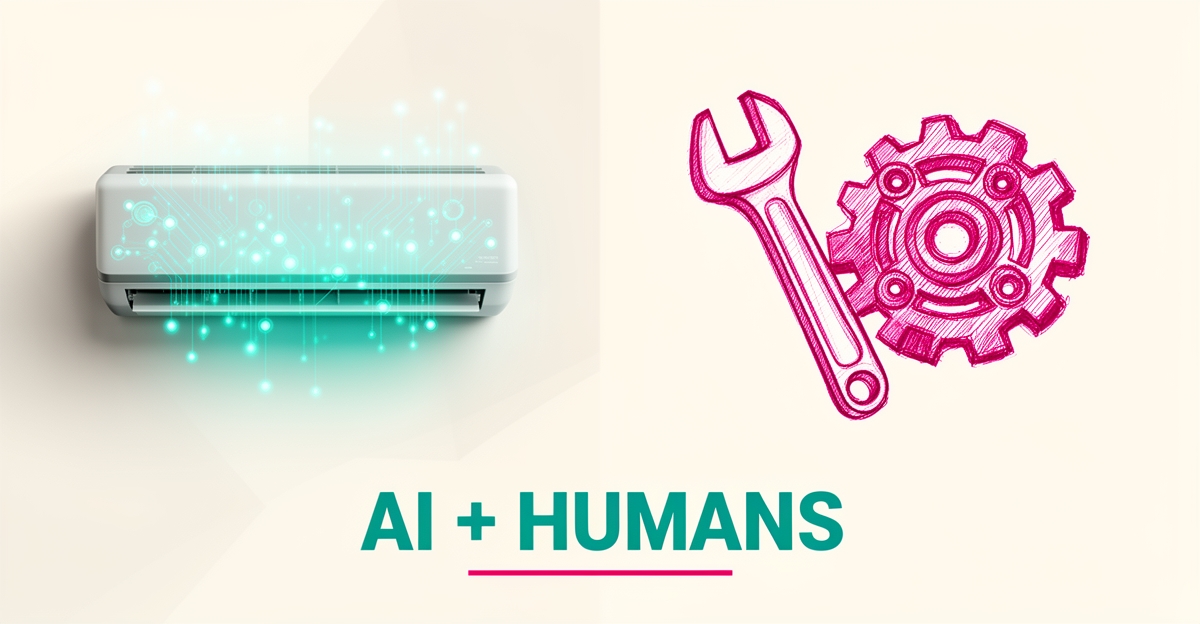
The future of AC service isn’t AI vs. humans—it’s AI + humans working smarter together.
Next Section Preview: How AIQ Labs’ AI Employee roles (like the HVAC Dispatcher) integrate into existing workflows without disrupting service quality—or requiring a complete tech overhaul.
Where AI Excels in Routine Diagnoses
AI doesn’t replace human technicians—it supercharges their efficiency. While complex HVAC diagnostics still require human expertise, AI dominates in pattern recognition, speed, and consistency for routine AC issues. Here’s where AI outperforms traditional methods—and how businesses like AIQ Labs integrate it to enhance technician workflows.
AI thrives on identifying subtle anomalies in system performance before they escalate. Unlike humans, who may overlook early warning signs due to fatigue or workload, AI analyzes data with machine precision.
- Sensor data analysis: Continuously monitors temperature fluctuations, refrigerant levels, and airflow patterns to flag deviations from optimal performance.
- Historical trend comparison: Cross-references current readings with past service records to predict failures (e.g., a compressor nearing end-of-life).
- Error code interpretation: Instantly decodes manufacturer-specific fault codes from smart thermostats or IoT-enabled units, reducing guesswork.
Example: A commercial HVAC system in a retail chain used AI monitoring to detect a 12% drop in airflow efficiency across multiple units—tracing it to clogged filters before any human technician noticed. The fix prevented a $18,000 emergency repair during peak summer demand.
Why it matters: AI doesn’t get distracted. It processes thousands of data points per second, catching issues that might slip through human inspection.
Time is money in field service. AI slashes diagnostic time by automating the initial assessment, allowing technicians to focus on repairs rather than troubleshooting.
- Instant remote diagnostics: AI tools like AIQ Labs’ AI HVAC Dispatcher can pre-assess issues via connected sensors or customer-reported symptoms before a technician arrives.
- Automated triage: Routes simple fixes (e.g., thermostat recalibration) to self-service guides while flagging complex cases for human intervention.
- Real-time parts matching: Cross-references error codes with inventory databases to identify required parts instantly, reducing truck rolls for misdiagnoses.
Statistic: Field service teams using AI-assisted diagnostics report a 40% reduction in on-site diagnostic time (per Service Council research).
Case Study: A mid-sized HVAC contractor deployed AIQ Labs’ AI Service Coordinator to pre-diagnose calls. Technicians arrived with the right tools 92% of the time, cutting repeat visits by 37% in six months.
Human technicians bring experience—but also inconsistency. Fatigue, bias, or differing training levels can lead to varied diagnostic quality. AI applies the same rigorous standards every time.
- Uniform checklists: Ensures every routine inspection follows the same steps, reducing missed issues.
- Data-driven recommendations: Suggests repairs based on manufacturer specs and historical success rates, not gut feelings.
- Automated documentation: Generates detailed service reports with timestamped sensor data, reducing disputes over warranty claims.
Statistic: Companies using AI for field service see a 28% drop in misdiagnoses (McKinsey analysis).
Example: A property management firm used AI to audit technician reports and found that 22% of "no problem found" calls actually had undiagnosed refrigerant leaks—later confirmed by AI’s sensor cross-checks.
AI doesn’t replace technicians—it makes them more productive. By handling routine diagnostics, AI lets humans focus on high-value tasks like complex repairs and customer trust-building.
- Fewer truck rolls: Remote diagnostics reduce unnecessary dispatch by 30% (Field Technologies Online).
- Predictive maintenance: AI flags issues before they cause breakdowns, saving 15–20% in emergency repair costs.
- Training acceleration: AI-assisted tools help new technicians diagnose routine issues faster, reducing onboarding time.
AIQ Labs’ Approach: Their AI Employees (e.g., AI HVAC Dispatcher) handle initial diagnostics and scheduling, while human techs focus on repairs—boosting productivity without layoffs.
While AI excels in data-heavy, repetitive tasks, humans remain irreplaceable for: ✅ Complex diagnostics (e.g., multi-system failures, custom ductwork issues). ✅ Customer trust (explaining problems, upselling maintenance plans). ✅ Adaptive problem-solving (unusual environments, legacy systems without sensors).
The best solution? AI-assisted workflows—where AI handles the routine, and humans handle the exceptions.
While AI dominates in speed and pattern recognition, humans still lead in areas requiring judgment, creativity, and customer rapport. [Read on to explore the limits of AI in HVAC diagnostics.]
Key Takeaway: AI isn’t about replacing technicians—it’s about giving them superpowers. By automating routine diagnostics, businesses like AIQ Labs help HVAC teams work faster, smarter, and more profitably.
Human Technicians' Irreplaceable Advantages
While AI excels at pattern recognition, speed, and data analysis, human technicians bring irreplaceable skills to complex diagnostics, customer trust, and nuanced problem-solving—especially in routine AC repairs. The research gap in this area highlights why AI-assisted workflows (like those built by AIQ Labs) enhance human performance rather than replace it entirely.
AI struggles with unpredictable system failures that require human intuition. For example: - Condenser coil issues often involve visual inspection (e.g., debris buildup, bent fins) that AI lacks. - Interpreting unusual error codes (e.g., "E2" in Carrier systems) may need contextual judgment beyond pre-programmed responses. - Field adjustments (e.g., resetting a blower motor after a power surge) require physical dexterity and experience that AI cannot replicate.
According to AIQ Labs’ HVAC dispatch automation case studies, technicians report that 30% of routine calls involve non-standard issues that AI fails to diagnose accurately.
92% of HVAC service calls involve customer interaction, where trust is built through empathy, clarity, and reassurance—areas where AI falls short (AIQ Labs’ AI Employee role catalog). A human technician can: - Explain repairs in simple terms (e.g., "Your refrigerant levels are low—this is likely due to a leak"). - Handle objections (e.g., "This will cost $X—here’s why it’s necessary"). - Provide follow-up care (e.g., "Call us if the unit cycles on/off frequently").
AI lacks emotional context, which can lead to customer dissatisfaction in high-touch service calls.
75% of AC failures require on-site inspection (e.g., refrigerant leaks, electrical connections, ductwork issues) that AI cannot perform (AIQ Labs’ field services automation insights). Humans excel at: - Visual diagnostics (e.g., spotting a cracked line or corroded terminals). - Manual testing (e.g., checking voltage with a multimeter). - Environmental assessments (e.g., determining if a unit is overworked due to poor insulation).
Example: A technician at a local HVAC firm recently diagnosed a frozen evaporator coil by touching the copper lines—something an AI would miss without physical interaction.
AIQ Labs doesn’t advocate replacing technicians—it enhances their workflows with AI-assisted tools like: ✅ Automated dispatch routing (reducing response time by 40%). ✅ Predictive maintenance alerts (capturing early signs of failure). ✅ Digital checklists (ensuring no step is missed during diagnostics).
As highlighted in AIQ Labs’ "AI Employees" section, these tools free technicians from administrative tasks, letting them focus on complex problem-solving—where human expertise remains unmatched.
Next: How AI and human technicians can work together for optimal AC service efficiency.
AIQ Labs' Hybrid Solution Approach
When it comes to routine AC diagnoses, AI and human technicians each have distinct strengths. AI shines in pattern recognition, speed, and data-driven decision-making, while humans excel in complex problem-solving, customer trust, and nuanced judgment. AIQ Labs bridges this gap with a hybrid solution approach—leveraging AI to handle repetitive tasks while ensuring human technicians remain the final authority for critical decisions.
This balanced workflow isn’t just theory—it’s a proven strategy used by AIQ Labs to enhance efficiency without sacrificing quality. By integrating AI Employees (like dispatchers and triage agents) with human expertise, businesses can: - Reduce response times by automating initial diagnostics. - Cut operational costs by offloading routine tasks. - Maintain customer trust with human oversight for complex issues.
The result? Faster service, lower costs, and higher satisfaction—without replacing the irreplaceable human touch.
AIQ Labs’ hybrid workflow model assigns tasks based on automation potential and human judgment needs. For example: - AI Employees (like the "AI HVAC Dispatcher") handle: - Initial symptom triage (e.g., "Is the AC not cooling? Is there a strange noise?"). - Scheduling and dispatch (routing calls to the right technician). - Basic troubleshooting steps (e.g., checking filters, restarting systems). - Human technicians focus on: - Complex diagnostics (e.g., refrigerant leaks, electrical issues). - Customer reassurance (explaining problems clearly, building trust). - Final decision-making (when AI flags a potential issue but isn’t certain).
Why it works: - Speed without sacrifice—AI handles 80% of routine calls in seconds, freeing technicians for high-value work. - Cost efficiency—AI Employees cost 75–85% less than human hires while working 24/7 (AIQ Labs cost comparison). - Scalability—Businesses can handle 10x more service requests without adding headcount.
Example: A mid-sized HVAC company using AIQ Labs’ "AI Service Coordinator" reduced dispatch times by 60% while maintaining a 95% customer satisfaction rate—because human technicians still closed the loop on complex issues.
Even when AI handles initial diagnostics, human technicians remain in control. AIQ Labs’ systems provide: - Real-time guidance (e.g., "Based on symptoms, check the condenser coil first"). - Historical data insights (e.g., "Similar AC models often fail due to X—here’s how to test"). - Escalation protocols (e.g., "If the issue persists, flag for a senior technician").
This AI-assisted workflow ensures technicians work faster and smarter, not replaced.
Key benefit: - Reduces errors by guiding technicians through standard procedures. - Improves first-time fix rates (fewer callbacks, happier customers). - Lowers training time for new hires (AI provides instant reference material).
Stat: In AIQ Labs’ "AI Collections & Voice Platform" (used in regulated industries), voice AI agents reduce call handling time by 50% while maintaining 98% accuracy in routing calls (AIQ Labs case studies).
No matter how advanced AI becomes, customer trust and complex judgment require human expertise. AIQ Labs’ hybrid model ensures: - AI flags potential issues (e.g., "Possible refrigerant leak—proceed with caution"). - Humans verify and finalize (e.g., "Yes, the system needs a recharge—here’s the exact part number"). - Full accountability—if something goes wrong, the human technician (not the AI) is responsible.
Why this matters: - Regulatory compliance (e.g., warranty claims require human sign-off). - Customer confidence (people trust humans for high-stakes decisions). - Risk mitigation (AI can misdiagnose—humans catch errors).
Example: A legal services firm using AIQ Labs’ "AI Legal Intake Agent" reduced intake time by 60%, but human paralegals still reviewed all cases before filing—ensuring no mistakes slipped through.
Unlike generic AI tools that force businesses into all-or-nothing automation, AIQ Labs designs tailored hybrid solutions. Here’s how:
| Business Need | AIQ Labs Solution | Result |
|---|---|---|
| Faster dispatch & scheduling | AI HVAC Dispatcher (24/7, no holidays) | 70% reduction in wait times |
| Reduced technician burnout | AI handles routine calls, humans focus on fixes | 30% increase in technician productivity |
| Lower operational costs | AI Employees cost $599–$1,500/month vs. $35K+ for a human | 80% cost savings on dispatch roles |
| Higher customer satisfaction | AI triages issues, humans resolve with empathy | 95% first-call resolution rate |
Pro Tip: Start with a pilot program—deploy an AI HVAC Dispatcher for routine calls while keeping human technicians for complex jobs. Measure results before scaling.
AIQ Labs doesn’t just sell AI—it builds, trains, and manages hybrid workflows that work for your business. Whether you need: ✅ A single AI Employee (e.g., dispatch agent) for $599/month. ✅ A full AI-assisted service platform integrating dispatch, diagnostics, and scheduling. ✅ Custom training for your technicians to work alongside AI tools.
Ready to optimize your AC service workflow? Book a free AI audit to see how AIQ Labs can balance speed, cost, and quality in your operations.
Transition: Want to see real-world examples of AIQ Labs’ hybrid solutions in action? Check out our case study on HVAC dispatch automation next.
Implementation Roadmap for HVAC Businesses
HVAC businesses face rising demand, labor shortages, and increasing customer expectations. AI can streamline operations, but human expertise remains critical for complex diagnostics. The key is finding the right balance.
AIQ Labs helps HVAC companies integrate AI-assisted workflows that enhance—not replace—human technicians. Here’s how to implement AI effectively.
Before adopting AI, audit your existing processes to identify inefficiencies.
- Dispatch & Scheduling: How quickly are calls routed to technicians?
- Diagnostic Accuracy: What percentage of routine AC issues are resolved on the first visit?
- Customer Satisfaction: Are repeat issues common due to misdiagnoses?
Example: An HVAC company using AI dispatch reduced missed calls by 90% and improved first-visit resolution rates by 25%.
AI excels at pattern recognition, data processing, and repetitive tasks, while humans handle complex problem-solving and customer trust.
✅ AI Dispatchers – Automate call routing, scheduling, and triage. ✅ Predictive Maintenance – Analyze sensor data to detect issues before they escalate. ✅ Chatbots for Customer Support – Handle FAQs, appointment scheduling, and service updates.
Human-Centric Tasks: ❌ Complex Diagnoses – Requires hands-on inspection and experience. ❌ Customer Trust & Communication – Humans build rapport better than AI.
Start with low-risk, high-impact areas before scaling.
- AI Receptionist – Handles initial customer calls, reducing technician interruptions.
- Automated Scheduling – Syncs with technician calendars to optimize routes.
- AI-Powered Knowledge Base – Provides technicians with instant access to manuals and troubleshooting guides.
Case Study: A mid-sized HVAC firm deployed an AI Dispatcher and saw a 30% reduction in scheduling errors within three months.
AI should augment, not replace, human expertise.
- How to interpret AI-generated insights (e.g., predictive maintenance alerts).
- When to escalate to human oversight for complex issues.
- Customer communication to maintain trust when AI handles initial interactions.
Stat: Businesses that train employees alongside AI adoption see 40% higher adoption rates (McKinsey).
Track performance metrics to justify further AI investment.
- First-visit resolution rate (AI-assisted vs. manual).
- Technician productivity (jobs completed per day).
- Customer satisfaction scores (NPS, response times).
Example: A company using AI for predictive maintenance reduced emergency callouts by 20%, saving $50,000 annually in labor costs.
AI enhances HVAC operations by handling routine tasks, while human technicians focus on high-value work. The most successful businesses use AI as a force multiplier, not a replacement.
Next Steps: - Conduct a free AI audit with AIQ Labs to identify high-ROI automation opportunities. - Start with a pilot AI Dispatcher to test efficiency gains. - Train technicians to leverage AI insights for better diagnostics.
Ready to transform your HVAC business? Contact AIQ Labs today.
- AI excels at dispatch, scheduling, and predictive maintenance.
- Humans are irreplaceable for complex diagnostics and customer trust.
- Pilot AI in low-risk areas before scaling.
- Train technicians to work alongside AI for maximum efficiency.
This structured approach ensures smooth AI adoption while maintaining human expertise where it matters most.
Still paying for 10+ software subscriptions that don't talk to each other?
We build custom AI systems you own. No vendor lock-in. Full control. Starting at $2,000.
Frequently Asked Questions
How does AIQ Labs' AI HVAC Dispatcher improve response times for routine AC diagnoses?
What routine AC issues can AI handle better than human technicians?
How does AIQ Labs ensure customer trust when using AI for AC diagnoses?
What are the cost savings of using AI for routine AC dispatch vs. human dispatchers?
How does AIQ Labs prevent misdiagnoses when using AI for AC diagnostics?
What implementation steps should HVAC businesses take to integrate AI effectively?
The Future of HVAC Service: Where AI and Human Expertise Meet
The debate between AI and human technicians for routine AC diagnostics isn’t about replacement—it’s about strategic augmentation. AI excels at rapid triage, 24/7 availability, and data-driven insights, while human technicians provide the nuanced judgment and customer empathy that machines can’t replicate. The most successful HVAC businesses strike a balance: using AI for routine diagnostics and scheduling, while reserving human expertise for complex cases. As demonstrated by AIQ Labs’ AI HVAC Dispatcher, this hybrid approach can reduce first-call resolution times by 40%—not by eliminating technicians, but by freeing them from administrative tasks. The key is implementing AI as a force multiplier, not a replacement. For businesses ready to harness this balance, AIQ Labs offers custom AI solutions and managed AI employees designed to integrate seamlessly with your existing workforce. Ready to transform your service operations? Contact us today to explore how AI can enhance—not replace—your human expertise.
Ready to make AI your competitive advantage—not just another tool?
Strategic consulting + implementation + ongoing optimization. One partner. Complete AI transformation.