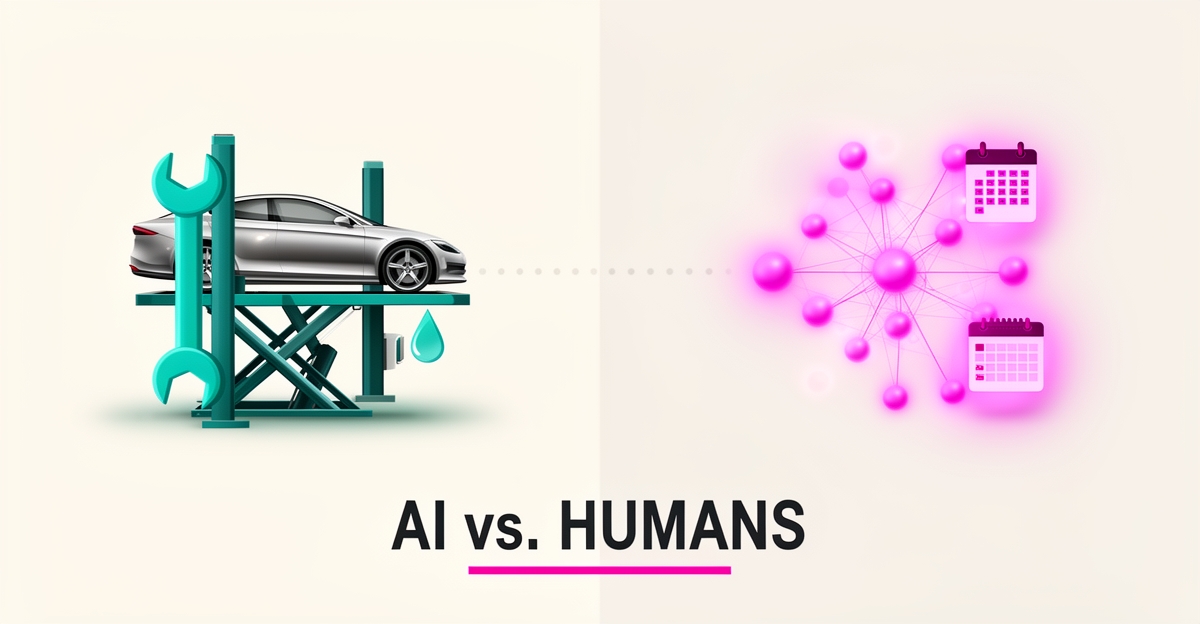
AI vs. Human Technicians: Which Is Better for Routine Oil Change Tasks?
Key Facts
- A meaningful share of critical decision logic in small shops lives as tacit knowledge in employees' heads rather than documented processes
- Automated scheduling typically reduces no-shows and double-bookings through real-time calendar sync
- Integration complexity is commonly the biggest barrier to effective AI implementation—often more than budget or model quality
- Consistent data entry eliminates discrepancies in service history and mileage tracking
- Proactive reminders support customer retention by ensuring timely maintenance
- Audit-ready logs simplify compliance and warranty validation
- AI Employees typically cost around 80% less than an equivalent human hire—and work 24/7/365
Hire a team member that works 24/7 — for less than a part-time wage.
AI receptionists, SDRs, dispatchers and 99+ roles. Trained on your business, fully managed.
Not sure where to start? Ask our AI planner
The Hidden Cost of Routine Maintenance: Why Oil Changes Are a Prime Target for AI Automation
Routine oil changes might seem simple, but the hidden costs of manual scheduling and logging add up quickly. Scheduling errors, missed appointments, and inconsistent data entry create operational friction that impacts both customer satisfaction and shop efficiency. These pain points are especially pronounced in rule-based tasks where variability stems not from complexity, but from human oversight in repetitive processes.
In many shops, a meaningful share of critical decision logic lives as tacit knowledge in employees' heads rather than documented processes, making routine maintenance ideal for AI-driven standardization. When critical know-how isn't captured in systems, even simple tasks like oil changes become prone to delays, duplicate entries, or forgotten follow-ups—each representing a tangible cost in labor and lost trust.
AI automation targets these gaps by handling repetitive, rule-based workflows such as appointment scheduling, service reminders, and completion logging. By embedding standardized logic into AI systems, shops reduce reliance on individual memory and minimize variability in service delivery. This approach doesn't replace skilled technicians—it frees them from administrative burdens so they can focus on higher-value work.
- Automated scheduling reduces no-shows and double-bookings through real-time calendar sync
- Consistent data entry eliminates discrepancies in service history and mileage tracking
- Proactive reminders improve customer retention by ensuring timely maintenance
- Audit-ready logs simplify compliance and warranty validation
- Integration with existing tools creates a single source of truth across departments
For businesses in automotive services, AI workflow automation delivers measurable gains in efficiency without requiring a complete overhaul. AIQ Labs' Workflow Builds rebuild the one workflow that costs you the most—on a fixed price, in phases—so shops get end-to-end oil change workflows that connect scheduling tools, CRM platforms, and inventory systems, and that the client owns outright. This is where practical AI transformation begins: not with replacing humans, but with removing the friction that keeps them from doing their best work.
AI as a Force Multiplier: How Automation Complements, Not Replaces, Skilled Technicians
AI is proving to be a powerful force multiplier in routine service operations, particularly when it comes to handling repetitive, rule-based tasks like scheduling oil changes, logging service completion, and sending automated reminders. By taking over these predictable workflows, AI allows human technicians to redirect their focus toward higher-value activities such as complex diagnostics, troubleshooting unexpected issues, and delivering personalized customer service. The division of labor is straightforward: AI handles execution of routine work while humans apply judgment and expertise—augmenting rather than replacing skilled labor.
Because a meaningful share of decision logic in technical workflows lives as tacit knowledge rather than documented processes, human insight remains irreplaceable for nuanced problem-solving. At the same time, integration complexity is frequently the biggest barrier to effective AI implementation—often ahead of budget or model quality—highlighting the need for partners who can bridge technical systems with real-world operations. AIQ Labs addresses this with AI Employees—managed AI staff covering 99+ roles, from receptionists to dispatchers—that integrate into existing shop management tools, reducing manual data entry and minimizing errors without displacing the technician's role.
- Automating scheduling and reminder systems reduces no-shows and improves shop throughput
- AI-powered logging ensures accurate, real-time service records for compliance and tracking
- Handling routine inquiries via AI frees staff for face-to-face customer engagement and upsell opportunities
- Continuous monitoring by AI flags maintenance trends that inform preventive service recommendations
The most effective approach positions AI not as a replacement for technicians, but as a collaborator that amplifies their impact. When routine tasks are automated, technicians gain bandwidth to develop deeper expertise, engage more meaningfully with customers, and contribute to long-term shop profitability. This synergy ensures that AI enhances human capabilities rather than diminishing them, creating a more resilient and efficient service operation.
From Pilot to Performance: Implementing AI for Oil Change Workflows with Measurable ROI
Successfully adopting AI for routine oil change scheduling requires more than just technology—it demands a structured, phased approach that respects existing shop workflows. Because integration complexity is often the biggest barrier to AI success, a deliberate rollout is essential for real-world adoption. AIQ Labs addresses this through its Start Monthly and Build in Milestones payment models, which allow shops to begin small, validate results, and scale confidently without disrupting daily operations. The process begins with automating high-volume, rule-based tasks like appointment booking and service reminders—functions that AI Employees can handle 24/7 while integrating directly with the tools shops already use, such as calendar systems for scheduling, CRM platforms for customer history, and payment processors for invoicing. This seamless connection ensures AI doesn't create new silos but instead strengthens existing operational flow.
Human-in-the-loop controls are built into every phase, allowing technicians to review and override AI decisions when exceptions arise—such as a customer requesting a non-standard service or a vehicle with unique maintenance needs. This design acknowledges that a meaningful share of critical decision logic lives as tacit knowledge rather than documented processes, preserving the value of human expertise while offloading repetitive administrative work. Shops using this model typically see fewer no-shows through automated SMS reminders and less administrative time spent on manual data entry and follow-up calls. By tracking these metrics from pilot to full deployment, businesses can quantify ROI early and adjust course based on real performance data. The result is not a replacement of skilled technicians, but a force multiplier that lets them focus on complex diagnostics and customer service—turning AI from a pilot experiment into a sustained performance advantage. Start the two-minute Fit Check at https://aiqlabs.ai/apply to explore how your shop can begin this transformation with a free 30-minute strategy call.
Still paying for 10+ subscriptions that don’t talk to each other?
We build custom AI systems you own outright. No vendor lock-in. Full control.
Not sure where to start? Ask our AI planner
Frequently Asked Questions
Will AI replace human technicians in oil change services?
How does AI reduce no-shows for oil change appointments?
How much of a shop's decision logic lives in people's heads rather than documented processes?
What is the biggest barrier to successful AI implementation in service shops?
Can AI Employees work outside regular business hours?
How do AI systems handle exceptions like non-standard service requests?
The Verdict: AI Handles the Routine, Your Technicians Own the Rest
The answer to the AI vs. human question isn't either/or—it's a division of labor that plays to each side's strengths. AI excels at the rule-based work that bogs shops down: scheduling, reminders, service logging, and data entry. Human technicians remain irreplaceable where judgment matters—complex diagnostics, unexpected issues, and the face-to-face trust that keeps customers coming back. The catch is that integration complexity, not budget or model quality, is usually what makes or breaks AI in practice, so a phased rollout with human-in-the-loop controls matters more than the technology itself. That's exactly how AIQ Labs approaches it: AI systems that plug into the scheduling, CRM, and payment tools your shop already uses, with flexible payment models—Start Monthly, Build in Milestones, or Own It Outright—so you can validate results before scaling. If routine admin work is quietly eating your team's time, start small and measure. Take the two-minute Fit Check at https://aiqlabs.ai/apply, then book a free 30-minute strategy call to map your biggest bottleneck. If there isn't a clear win, we'll tell you that too.
Make AI your competitive advantage — not just another tool.
Strategy, implementation and ongoing optimization. One partner, end to end.
Not sure where to start? Ask our AI planner