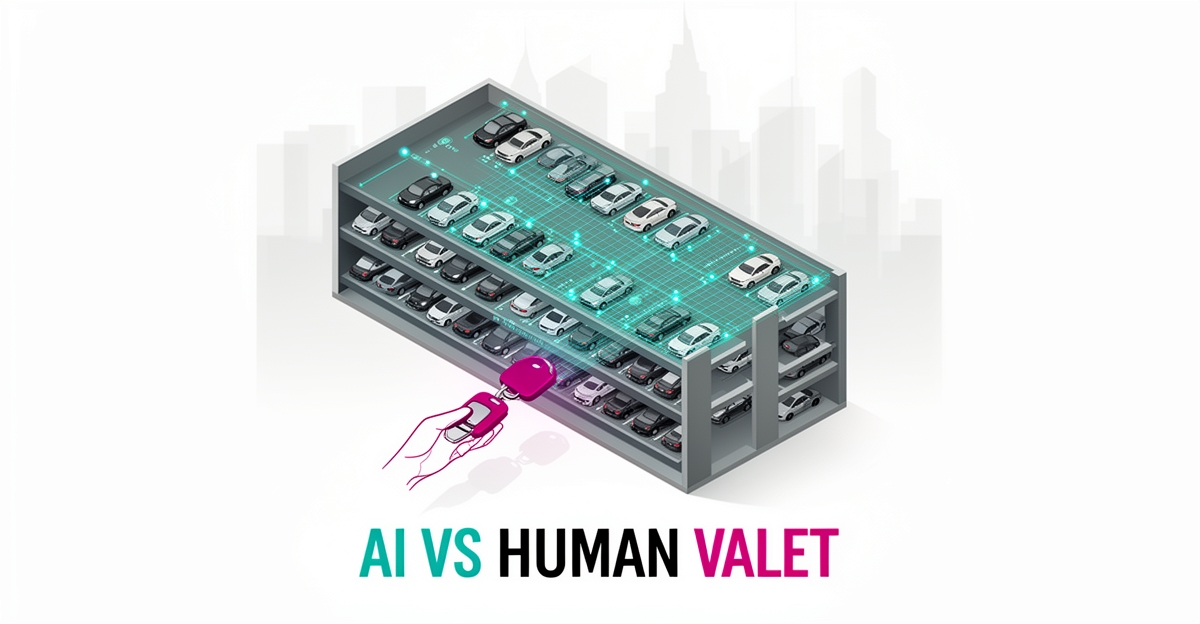
AI vs. Human Valet Staff: Which Is Better for High-Volume Urban Parking?
Key Facts
- AI valet systems reduce parking search times by up to 30% compared to traditional operations according to industry analysis
- Space utilization typically jumps from 60-70% to 85-95% with AI-powered valet management per cost-benefit research
- Automated revenue collection achieves 99.9% accuracy, eliminating manual errors in cash handling as shown in industry benchmarks
- Drivers waste 3.5-14 minutes searching for spots in traditional valet systems based on operational data
- Digital tipping can lift monthly tip revenue from $3,688 to $5,618 with better service and 55% participation per cloud valet analysis
- License plate recognition systems like FALCON VISION® detect available spaces with 99% accuracy according to ECO Parking Technologies
- ValetConnect scores 9.6/10 overall for automated ticketless workflows and real-time vehicle visibility per software comparison research
Hire a team member that works 24/7 — for less than a part-time wage.
AI receptionists, SDRs, dispatchers and 99+ roles. Trained on your business, fully managed.
Not sure where to start? Ask our AI planner
Introduction
In high-volume urban parking, the choice between human and AI valet staff isn't just about replacing people—it's about reimagining efficiency at scale. As cities grow denser and parking demand intensifies, traditional valet operations face mounting pressure to deliver faster, more reliable service without ballooning costs. The right approach blends automation with human teams rather than eliminating them, ensuring seamless handoffs where empathy and judgment matter most.
AI-driven valet systems transform core operational metrics in measurable ways. According to industry analysis, these systems reduce parking search times by up to 30% and improve space utilization from 60-70% to 85-95%, directly increasing revenue potential in constrained urban environments. Automated revenue collection achieves 99.9% accuracy, eliminating the errors and disputes common in manual processes, while cloud-based platforms enable real-time vehicle tracking and predictive maintenance that reduce downtime. These capabilities allow valet operations to scale during peak hours without proportional increases in staffing or overhead.
- AI systems leverage license plate recognition and computer vision for 99% accuracy in detecting available spaces
- Cloud valet platforms connect check-in, vehicle records, pickup requests, dispatch, and digital tipping in one system
- Structured 90-day implementation roadmaps prevent common pitfalls by prioritizing workflows and vendor evaluation
The most successful implementations follow a phased approach, starting with high-impact automations like ticketless entry and real-time notifications before expanding to full integration. This method ensures staff adapt smoothly while preserving the human touch that defines premium valet service. For urban operators balancing efficiency with experience, AI isn't a replacement for hospitality—it's a force multiplier that lets teams focus on what they do best: delivering personalized, stress-free parking in the heart of the city.
Key Concepts
High-volume urban parking is a race against time, congestion, and labor costs. The core debate is no longer whether technology helps, but how far automation can replace the human valet without losing service quality.
AI-powered valet operations automate detection and coordination at scale. Systems leverage license plate recognition, computer vision, and real-time data processing to monitor space availability and track vehicles. According to industry analysis, AI systems can reduce parking search times by up to 30% while improving space utilization from 60-70% to 85-95%. That efficiency gain directly translates to higher throughput during peak hours in dense city environments.
Human valet teams remain valuable for judgment, guest interaction, and exception handling. Traditional operations rely on paper tickets, physical key cabinets, and manual plate notation, which creates documentation gaps and disputes. Cloud valet models address this by logging every plate photographically and automating reconciliation, but they still depend on staff availability and consistent execution.
The operational model shifts from headcount to system uptime. AI systems provide 24/7 operational capability with minimal downtime and automated revenue collection achieving 99.9% accuracy compared to manual, error-prone processes. Predictive maintenance capabilities further reduce operational costs over time, while drivers waste 3.5-14 minutes searching for spots in traditional systems.
Key concepts that define the comparison:
- Automation vs. Augmentation: AI automates slot detection, LPR tracking, and dispatch; humans handle complex guest requests and vehicle handling.
- Scalability: Cloud-based valet connects check-in, vehicle records, pickup requests, dispatch, and notifications in one system, enabling multi-site visibility.
- Cost Structure: High upfront investment in cameras and platforms versus ongoing labor, benefits, and training costs for human teams.
- Service Continuity: AI offers zero missed calls and round-the-clock coverage, while human teams are limited to shifts and availability.
Implementation success hinges on workflow prioritization and vendor selection. Industry blueprints recommend structured 90-day roadmaps with specific owner roles and success metrics, rather than broad technology rollouts. As noted in cloud valet analysis, digital tipping and SMS ready notifications can lift service revenue while improving transparency.
For service businesses in urban centers, the emerging pattern is hybrid. AI manages routine intake, tracking, and notifications 24/7, with seamless handoffs to human staff for exceptions. This mirrors how AIQ Labs deploys managed AI employees—receptionists, dispatchers, and 99+ other roles at roughly 80% less cost than a human hire—alongside human teams, maintaining a human touch where it matters most while extending coverage and consistency across high-demand periods.
Best Practices
Transitioning to AI-powered valet operations requires more than just purchasing software; it demands a strategic approach that balances automation with human oversight. The most successful implementations follow structured roadmaps rather than ad-hoc deployments.
Start by conducting a thorough readiness assessment before investing in hardware. According to the Valet Parking Services AI Implementation Blueprint, operators should complete a Pre-Flight Audit covering five readiness categories with yes/no checklists. If your foundation has gaps, fix those before spending on AI infrastructure.
When evaluating technology partners, prioritize vendors offering ticketless workflows with license plate recognition and real-time vehicle visibility. Research from industry analysis shows top-rated platforms like ValetConnect score 9.6/10 for their automated LPR capabilities, while Passport Parking achieves 9.3/10 for multi-site dispatch operations. Avoid the common trap of selecting tools based on price alone; the blueprint identifies four vendor red flags that disqualify contracts and four implementation traps that sink projects.
Structure your rollout using a phased 90-day approach rather than attempting full automation overnight. Break implementation into distinct phases with specific owner roles and success metrics:
- Days 1-30: Deploy foundation infrastructure including LPR cameras and cloud management systems
- Days 31-60: Train staff on mobile apps and establish automated revenue collection protocols
- Days 61-90: Integrate predictive maintenance alerts and optimize space utilization algorithms
Maintain the human element through intelligent escalation protocols. While AI handles routine tasks like plate logging and payment processing with 99.9% accuracy, ensure your system includes seamless handoffs to human staff for complex customer service issues or dispute resolution. This hybrid approach preserves the service quality that drives digital tipping revenue—potential increases from $3,688 to $5,618 monthly according to cloud valet operational data—while capturing AI's efficiency gains.
Finally, establish clear ROI measurement from day one. Track metrics including search time reduction (targeting up to 30% improvement), space utilization gains (moving from 60-70% to 85-95% capacity), and reconciliation accuracy. Build these measurement frameworks into the initial strategy phase rather than retrofitting them later, ensuring your high-volume urban operation captures both immediate efficiency wins and long-term scalability benefits.
Implementation
AIQ Labs helps urban parking operators implement AI valet systems through a phased approach that starts with workflow mapping and vendor evaluation. The process begins by identifying specific automation opportunities—such as license plate recognition for real-time space detection or SMS-based retrieval requests—based on their ease of implementation and operational impact. This prioritization ensures resources are focused on high-leverage changes first, avoiding the common pitfall of attempting full-scale deployment without foundational readiness.
A structured 90-day roadmap guides implementation, with clear milestones for foundation building, expansion, and full integration. During Days 1-30, operators focus on installing core infrastructure like LPR cameras and cloud-based management platforms, followed by staff training on digital check-in and dispatch workflows. Days 31-60 expand capabilities to include predictive maintenance alerts and dynamic pricing during peak hours, while Days 61-90 emphasize performance measurement against benchmarks like reduced search times and improved space utilization. AI systems consistently achieve 85-95% space utilization compared to 60-70% in traditional setups, directly boosting revenue potential in high-volume environments.
Before investing, operators should complete a Pre-Flight Audit assessing five readiness categories—including technology infrastructure, staff adaptability, and data security compliance—to avoid costly missteps. Successful implementations also establish clear ROI tracking using metrics such as reduced labor expenses, automated revenue collection with 99.9% accuracy, and tip revenue increases from digital tipping features. One model shows possible monthly tip lifts of $1,928 with better service and digital options, scaling to $5,618/month at 55% participation and $10 average tips. By following this disciplined approach, urban parking operators can transition smoothly to AI-enhanced operations that maintain human oversight where needed while maximizing efficiency and scalability. Industry blueprints confirm that vendors offering integrated cloud valet platforms—connecting check-in, vehicle records, and dispatch in one system—deliver the most reliable results for high-traffic urban locations. Cloud valet solutions further enhance transparency through photographic evidence for disputes and automated end-of-shift reconciliation, reducing operational friction. Software comparisons show platforms like ValetConnect scoring 9.6/10 for features, particularly excelling in automated ticketless workflows and real-time vehicle visibility—key advantages for operators managing fluctuating demand across multiple city sites.
Depending on where you're starting from, AIQ Labs offers three entry points: AI Employees for managed AI staff like dispatchers and receptionists, AI Workflow Builds to rebuild the single workflow that costs you the most at a fixed price, and AI Operating Systems for a fully connected operating layer built in phases and owned outright. Payment models are straightforward—start monthly, build in milestones, or own it outright—with no invented case-study numbers or hidden pricing games. See /pricing for how each model works.
Conclusion
The data clearly shows AI valet systems transform urban parking efficiency, reducing search times by up to 30% and boosting space utilization from 60-70% to 85-95% compared to traditional methods. Automated revenue collection achieves 99.9% accuracy, eliminating manual errors that plague paper-based systems. These gains stem from technologies like license plate recognition and cloud-based platforms that enable real-time vehicle tracking and predictive maintenance—capabilities human-only teams simply cannot match at scale in high-volume environments.
For businesses evaluating this shift, the implementation path matters as much as the technology itself. A structured 90-day roadmap prevents costly missteps by prioritizing foundational workflows first, while a pre-flight audit assesses readiness across five critical categories before investment. Vendors must be evaluated against specific red flags—such as vague pricing or lack of compliance documentation—to avoid traps that derail projects. Cloud-based systems further enhance reliability by storing all operational data remotely, ensuring continuity even if local devices fail.
AIQ Labs supports this transition with 200+ multi-agent systems deployed and four live SaaS products the company runs daily—proof in operations, not promises. The journey begins with a clear understanding of your operation's unique bottlenecks and ROI potential—no guesswork, no vendor lock-in. To explore how AI valet systems can deliver measurable efficiency gains for your specific high-volume context, start with the two-minute Fit Check, then book a free 30-minute strategy call to map your biggest opportunity. This working session identifies where automation creates the highest impact, ensuring your investment aligns with sustainable, long-term advantages.
Still paying for 10+ subscriptions that don’t talk to each other?
We build custom AI systems you own outright. No vendor lock-in. Full control.
Not sure where to start? Ask our AI planner
Frequently Asked Questions
Will AI valet staff replace human valets completely in urban parking?
How much faster and more efficient is AI valet compared to traditional valet?
Is automated revenue collection with AI actually accurate?
What's the realistic implementation timeline for AI valet?
Can AI valet increase tip revenue for my staff?
Which valet software platforms are best for high-volume operations?
From Bottleneck to Breakthrough: Your Next Move
AI valet systems deliver measurable gains in high-volume urban parking—cutting search times by up to 30%, lifting space utilization to 85-95%, and automating revenue collection with 99.9% accuracy. But technology alone doesn't create ROI; the operators seeing real results follow a disciplined path: a Pre-Flight Audit to fix foundation gaps, a vendor matrix that filters out red flags, and a phased 90-day roadmap that prioritizes ticketless entry and real-time notifications before expanding to predictive maintenance and dynamic pricing. The hybrid model—AI handling routine intake, tracking, and dispatch 24/7, with seamless handoffs to human staff for exceptions—preserves the hospitality that drives digital tipping revenue while capturing efficiency at scale. AIQ Labs helps urban parking operators navigate this transition through three entry points: AI Employees for managed AI staff, AI Workflow Builds to rebuild your costliest workflow at a fixed price, and AI Operating Systems for a connected operating layer you own outright—with 200+ multi-agent systems deployed as proof. If you're evaluating whether AI valet makes sense for your operation, start with the two-minute Fit Check to map your biggest bottleneck and identify the highest-impact automation opportunity—no obligation, just clarity on your next step.
Make AI your competitive advantage — not just another tool.
Strategy, implementation and ongoing optimization. One partner, end to end.
Not sure where to start? Ask our AI planner