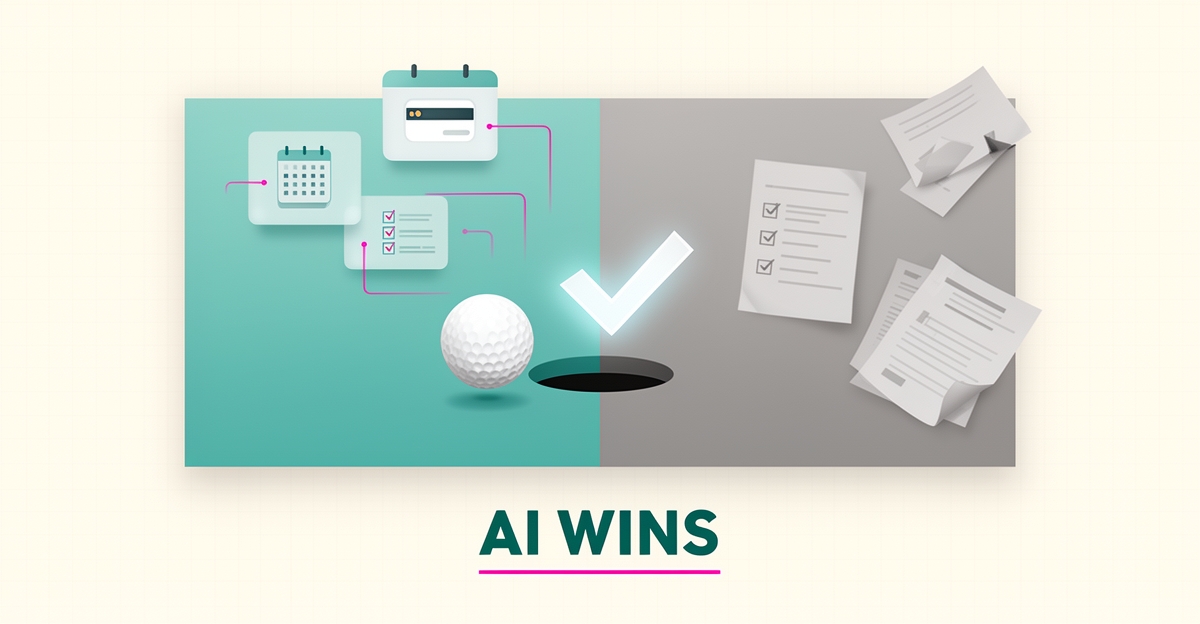
AI vs Human: Which Is Better for Handling Golf Tournament Registrations?
Key Facts
- Manual registration typically consumes 15-20 hours per event in corrections and follow-up according to Fastbreak AI analysis.
- Registration abandonment rates can reach 40% with multi-step manual processes per Fastbreak AI research.
- Industry analyses suggest roughly 80% of golf facility operational data is trapped in unstructured formats per Energent.ai.
- Operators using top-tier AI-powered golf management software report saving around 15 hours per week on back-office tasks per industry comparison data.
- Modern AI document-processing systems report accuracy above 94% on unstructured data benchmarks per Energent.ai.
- Automated systems can cut schedule publication from days to hours according to Fastbreak AI.
Hire a team member that works 24/7 — for less than a part-time wage.
AI receptionists, SDRs, dispatchers and 99+ roles. Trained on your business, fully managed.
Not sure where to start? Ask our AI planner
The Hidden Cost of Manual Golf Tournament Registrations
Every golf tournament director knows the drill: registration opens, the inbox floods, and the real work begins. But what most don't realize is just how much that "real work" is actually costing them.
According to Fastbreak AI's analysis of tournament operations, manual registration processes typically consume 15-20 hours per event in corrections and follow-up alone. That's nearly half a work week spent fixing typos, chasing missing payments, and reconciling mismatched rosters—before a single ball is teed up.
The problem compounds at the sign-up stage. The same research found that registration abandonment rates can hit 40% when teams face multi-step manual processes. One director's spreadsheet chaos is another player's abandoned cart, and as Fastbreak AI puts it, "Every dropped registration is revenue that never materializes."
The deeper issue is structural. Most golf facilities are sitting on a mountain of unusable information—industry analysis suggests that as much as 80% of a golf facility's operational data is trapped in unstructured formats like PDFs, spreadsheets, and scanned invoices. Player profiles, tee time preferences, group bookings, handicap histories: it all exists, but none of it talks to each other.
This creates three distinct failure points for tournament operations:
- Speed collapses under volume — manual verification steps that feel manageable in week one become bottlenecks when registration spikes before deadlines
- Errors multiply silently — duplicate entries, mismatched names, and incorrect division placements surface only after brackets are published
- Scalability hits a wall — adding 50 more players means adding proportionally more administrative hours, a linear model that breaks as events grow
The window between sign-up and schedule publication has compressed dramatically in recent years, and participant expectations around digital experience have risen sharply. The manual verification steps that used to feel manageable now block everything downstream—from bracket seeding to payment reconciliation to waitlist management.
For facilities still running registrations through email threads and Excel files, the question isn't whether the system is broken. It's how much revenue and how many hours they're willing to lose before admitting it.
How AI Registration Outperforms Humans on Speed, Accuracy and Scale
When tournament organizers switch from spreadsheets to AI-driven registration, the performance gap becomes immediately measurable. Manual processes typically consume 15-20 hours per event in corrections and follow-up, while automated systems compress schedule publication from days to hours by connecting sign-up, payment, and bracket creation into one continuous flow.
The accuracy differential proves even more stark. Modern AI systems report over 94% data accuracy when processing unstructured operational documents—the PDFs, scanned forms, and spreadsheets that typically trap most of a golf facility's operational data. This eliminates the transcription errors that plague manual entry, where staff must decipher handwriting, reconcile mismatched names, and correct duplicate entries across multiple systems.
Speed advantages compound across the entire registration lifecycle. Operators using top-tier AI-powered management software report saving around 15 hours per week on back-office tasks, redirecting that time toward member experience rather than administrative firefighting. Real-time synchronization means bracket assignments pull directly from the same dataset that captured player details and payment status at intake, eliminating the traditional bottleneck of reformatting spreadsheets and manually seeding divisions.
The operational transformation extends across several critical workflows:
- Payment processing occurs at the point of registration via credit card, debit, or ACH, removing invoice-chasing and enabling real-time revenue tracking
- Roster verification happens automatically, with document collection embedded directly into the sign-up flow so teams cannot complete registration without submitting compliance items
- Bracket creation updates dynamically as registration data changes, with division balancing and waitlist movement reflected instantly in scheduling
- Data synchronization maintains a single source of truth from initial sign-up through final scheduling, eliminating end-of-cycle reconciliation
Scalability represents perhaps the most decisive advantage. Manual registration creates linear workload growth—every additional team requires proportional administrative effort. AI systems handle hundreds of teams across multiple divisions without corresponding staff increases, crucial during peak registration periods when volumes spike before deadlines.
For organizations evaluating this transition, AIQ Labs' AI Workflow Builds rebuild the one workflow that costs you the most—registration included—handling complex inputs like tee times, player profiles, and group bookings with zero human intervention. These systems maintain the real-time data flow essential for modern tournament operations, ensuring that registration, payment, and scheduling function as unified processes rather than disconnected tasks.
The result transforms tournament management from reactive data entry to proactive event strategy, where directors make decisions based on live registration dashboards rather than outdated spreadsheets.
From Registration to Brackets: Integrated Workflows That Save Revenue
Registration is where revenue leaks first appear, and integration is how you close them. AI systems connect sign-up, payment, compliance and scheduling into one continuous flow, cutting schedule publication time from days to hours while manual processes still cost tournament directors an estimated 15-20 hours per event in corrections and follow-up according to Fastbreak AI research.
Payment collection moves from invoice chasing to point-of-registration capture. Teams pay by card or ACH at sign-up, confirmations send automatically, and revenue logs without spreadsheet manipulation. Real-time dashboards replace end-of-cycle reconciliation, giving directors live visibility into outstanding balances and division fill rates as they happen.
Compliance stops being a post-sign-up chase. Document and waiver requirements embed directly in the workflow so teams cannot complete registration without submitting necessary items. With the bulk of golf facility operational data trapped in unstructured formats like PDFs and spreadsheets per Energent.ai analysis, AI parsing is essential to validate eligibility, insurance certificates and medical forms at intake.
The integration advantage shows up in scheduling. Registration data syncs directly into the scheduling engine, so bracket assignments pull from the same dataset that captured team details, division placement and payment status. Division balancing happens automatically based on actual enrollment, travel considerations apply to tee time assignments, and waitlist movement updates bracket sizes in real time.
AIQ Labs builds this type of connected workflow for tournament operations through its AI Workflow Builds service—fixed price, delivered in phases—handling complex inputs like tee times, player profiles and group bookings with zero human intervention. The result is measurable operational gain.
Top-tier AI-powered golf management software can save operators around 15 hours per week on back-office tasks per industry comparison data, and accuracy improves dramatically. Modern AI document-processing systems report accuracy above 94% on industry-standard benchmarks, eliminating transcription errors that plague manual workflows.
Revenue optimization compounds from fewer drop-offs and faster decisions. Multi-step manual processes can drive abandonment rates as high as 40% when teams face friction at sign-up. Streamlined flows reduce abandonment, while live registration data enables timely waitlist management, division closures and promotional pushes that capture revenue otherwise lost.
Integrated workflows deliver three core outcomes:
- Automated payment collection at sign-up with real-time revenue dashboards
- Embedded compliance document collection that blocks incomplete registrations
- Direct sync to scheduling engines for instant bracket and tee time generation
Speed, accuracy and scalability replace the linear workload of manual registration.
Implementing AI Registration Without Disrupting Your Tournament
The good news: moving from clipboards and spreadsheets to AI-driven registration doesn't require a rip-and-replace overhaul. It requires a structured sequence, and tournament directors who follow it typically see results within a single event cycle.
The first step is centralizing registration data. Industry analyses suggest that most of a golf facility's operational data sits trapped in unstructured formats like PDFs, spreadsheets, and scanned invoices. Consolidating that information into one accessible system is the foundation everything else builds on—without it, AI tools have nothing reliable to work from.
From there, implementation follows a clear progression:
- Automate the communication layer — registration confirmations, payment reminders, and feedback collection run on autopilot, ensuring no participant falls through the cracks.
- Integrate payments at sign-up — collecting fees at the point of registration eliminates invoice-chasing and enables real-time revenue tracking instead of end-of-cycle reconciliation.
- Embed compliance into the workflow — build waiver and document requirements directly into registration so teams cannot complete sign-up without submitting them, reducing liability exposure and the manual chase for missing paperwork.
- Connect registration to scheduling — sync registration data directly into your scheduling engine so bracket assignments pull from the same dataset captured at intake.
- Enable real-time monitoring — use live dashboards to track registration trends, payment status, and waitlist movement as they happen.
That last connection matters most. When registration flows directly into scheduling, the hours directors once spent reformatting spreadsheets, sorting late entries, and manually seeding brackets disappear. Division balancing happens automatically based on actual enrollment, and schedule publication time drops from days to hours, according to Fastbreak AI's analysis of tournament operations.
This is where purpose-built automation earns its keep. AIQ Labs, for example, rebuilds the one workflow that costs you the most through its AI Workflow Builds service—fixed price, delivered in phases—handling complex registration inputs like tee times, player profiles, and group bookings with zero human intervention, so the intake data feeds scheduling without a single manual re-entry step.
Expect a brief learning curve. Industry research on AI-powered golf management platforms notes that feature complexity can overwhelm new users at first, but operators using top-tier systems report saving around 15 hours per week on back-office tasks once adopted. The trade is a few days of training for a permanent reduction in administrative load.
The phased approach also manages risk. Rather than automating everything at once, directors can start with a single workflow—say, payment collection—and expand once the team is comfortable. Data accuracy provides the safety net: modern AI systems report accuracy above 94% on industry-standard benchmarks, which means the errors that plagued manual data entry largely vanish from day one.
Implementation done this way feels less like disruption and more like relief—the registration chaos quietly stops, and nobody misses it.
Still paying for 10+ subscriptions that don’t talk to each other?
We build custom AI systems you own outright. No vendor lock-in. Full control.
Not sure where to start? Ask our AI planner
Frequently Asked Questions
How much time does manual golf tournament registration actually waste?
Why do teams abandon golf tournament sign-ups?
Is AI really more accurate than staff entering data by hand?
What happens to all the data golf facilities already have?
Can automated registration handle a big spike before a deadline?
Will switching to AI disrupt our current tournament workflow?
Stop Losing Revenue at the Tee Box
Manual golf tournament registration is quietly draining hours and revenue before the first tee shot. Directors spend an estimated 15-20 hours per event in corrections and follow-up, while multi-step sign-ups can drive abandonment rates as high as 40% and leave registration data trapped in spreadsheets and PDFs that never talk to each other. AI-driven workflows change that equation by connecting sign-up, payment, compliance and scheduling into one continuous flow, cutting publication time from days to hours and lifting data accuracy above 94% on unstructured documents. The shift isn't about replacing people, it's about removing the linear workload that breaks as events grow. Centralize your registration data first, then automate communications, embed payments and compliance at intake, and sync directly to your scheduling engine so brackets update in real time. AIQ Labs rebuilds the one workflow that costs you the most—registration included—through AI Workflow Builds, turning reactive data entry into proactive event strategy. Take the two-minute Fit Check at https://aiqlabs.ai/apply, then book a free 30-minute strategy call at https://aiqlabs.ai/book to map your biggest bottleneck and identify a high-ROI automation opportunity, with no obligation.
Make AI your competitive advantage — not just another tool.
Strategy, implementation and ongoing optimization. One partner, end to end.
Not sure where to start? Ask our AI planner