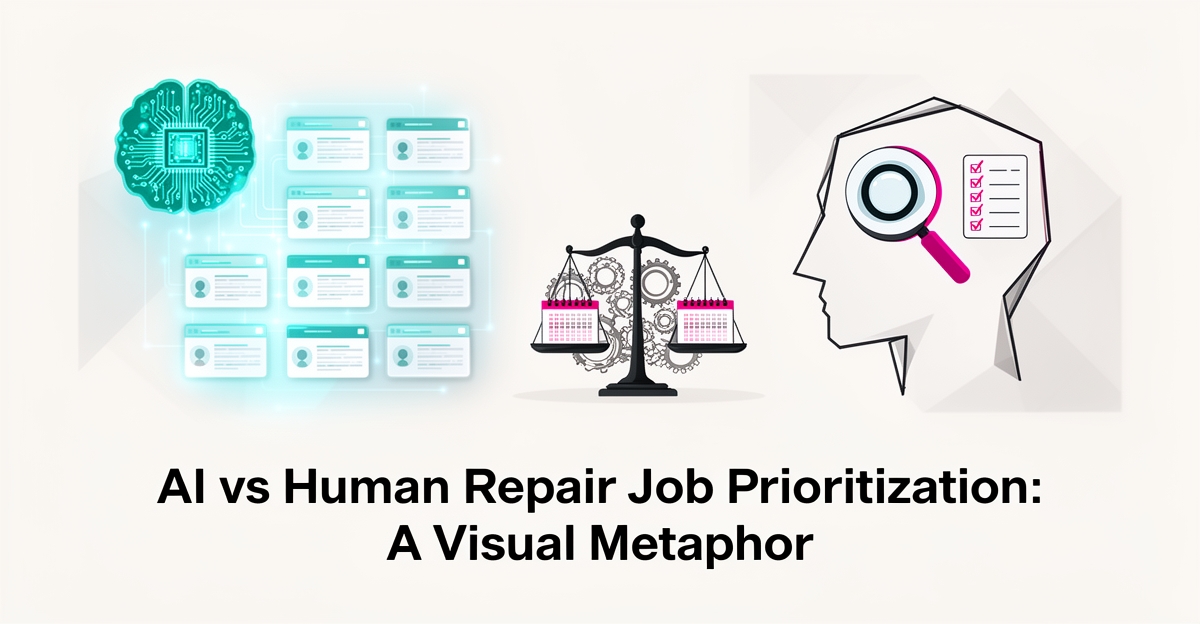
AI vs. Human: Which Is Better for Managing Repair Job Prioritization?
Key Facts
- Manual prioritization creates bottlenecks that ripple through the whole workflow — urgent repairs wait while simpler jobs jump the queue
- AI can analyze vehicle type, part availability, technician skill and customer urgency simultaneously to rank jobs continuously, without manual triage
- Human judgment remains essential for exceptions: relationship history, safety concerns, and fairness in high-stakes allocation decisions
- The strongest results come from redesigning the workflow around AI's strengths — not just automating a broken process
- AIQ Labs has deployed 200+ multi-agent systems and runs 4 live SaaS products daily, so these patterns are proven in production, not theory
Hire a team member that works 24/7 — for less than a part-time wage.
AI receptionists, SDRs, dispatchers and 99+ roles. Trained on your business, fully managed.
Not sure where to start? Ask our AI planner
The Hidden Cost of Manual Repair Job Prioritization
Many repair shops still rely on manual methods to prioritize repair jobs, often based on technician experience or ad-hoc decisions. This approach creates bottlenecks that ripple through the entire workflow, leading to delays in urgent repairs and inefficient use of technician time. Human-led prioritization struggles to scale as job volume increases, resulting in missed revenue opportunities when high-value repairs are deprioritized in favor of simpler, quicker jobs. The lack of a systematic, data-driven process means shops frequently fail to optimize for factors like part availability or customer urgency, causing avoidable downtime and customer dissatisfaction.
The deeper problem is usually workflow design, not technology. A shop can buy the best tools available and still see no gain if the prioritization process itself isn't rebuilt around what AI does well — continuous, data-driven ranking. The cost of manual prioritization extends beyond lost time: it directly impacts profitability by preventing shops from capturing the full value of their repair capacity. When every bay hour is accounted for and every queue decision is deliberate, shops stop leaking revenue to poor sequencing.
- Technicians spend excessive time deliberating over job order instead of performing repairs
- Urgent repairs wait unnecessarily while lower-priority jobs are completed first
- Inconsistent prioritization leads to uneven workload distribution and technician burnout
- Shops cannot adapt quickly to sudden changes in part availability or emergency requests
- Revenue is lost when high-margin repairs are delayed due to poor sequencing
AIQ Labs helps repair shops uncover these hidden inefficiencies through a structured workflow rebuild that examines current prioritization practices and identifies where intelligent automation can deliver measurable improvements without disrupting established workflows. By revealing the true cost of manual decision-making, this work lays the foundation for a prioritization system that leverages AI's strengths in data analysis and predictive scheduling while preserving the essential role of human expertise in complex judgment calls. The goal is not to replace technicians but to eliminate the cognitive burden of constant prioritization so they can focus on what they do best — fixing vehicles efficiently and accurately.
Where AI Excels: Data-Driven Prioritization and Predictive Scheduling
AI excels at analyzing complex variables like vehicle type, part availability, and customer urgency to generate optimal repair queues. By processing historical patterns and real-time data, AI systems can predict repair timelines and prioritize jobs based on impact and resource constraints. This data-driven approach reduces reliance on manual triage and enables faster, more consistent decision-making across shifting workloads. When AI handles the scheduling logic, technicians are freed to focus on high-value repairs rather than administrative sorting — and the ranking continues around the clock without anyone babysitting it.
AI's predictive capabilities also extend to anticipating delays before they disrupt operations. By modeling part lead times, technician skill matches, and historical failure rates, AI can flag jobs at risk of bottlenecks and re-prioritize accordingly. This proactive scheduling minimizes idle time and prevents urgent repairs from being buried in the queue. In a repair context, hours saved on sorting and reshuffling translate directly into additional jobs completed or improved customer response rates. Such efficiency gains are especially valuable when managing fluctuating demand and limited bay availability.
- Analyzes vehicle type, part availability, and urgency signals simultaneously
- Predicts delays using historical and real-time operational data
- Re-prioritizes queues dynamically as conditions change
- Runs the ranking continuously — no manual triage required
- Improves on-time completion rates through predictive balancing
AIQ Labs helps shops assess where these AI-driven prioritization strengths align with their current workflows, starting with a 2-minute Fit Check. By identifying high-impact automation opportunities — such as intelligent job sequencing or predictive parts planning — businesses can determine where AI adds measurable value without overhauling existing processes. The goal isn't to replace human expertise but to augment it with systems that handle repetitive, data-intensive triage, freeing advisors and managers to focus on customer communication and complex exception handling. When AI manages the mechanics of prioritization, human judgment can be applied where it matters most: interpreting nuanced customer needs, weighing strategic trade-offs, and ensuring fairness in urgent cases. This collaborative model turns scheduling from a reactive chore into a strategic lever for shop performance.
Why Human Judgment Remains Irreplaceable in Complex Decisions
Imagine a customer whose vehicle breakdown threatens a critical business deadline, or a repair involving a rare part with complex sourcing implications. These are the moments when the true value of human judgment in repair job prioritization becomes undeniably clear, moving beyond mere data points.
While AI excels at rapid data analysis and pattern recognition, its capabilities have inherent limits when confronted with nuance and unpredictability. AI systems are trained on historical data, which means they perform best when the situation resembles something they've seen before. Genuinely novel situations — an unprecedented repair, an unusual customer constraint, a one-off commercial arrangement — fall outside what a model can rank confidently.
AI's reliance on historical data also means it can miss the subtle, non-quantifiable factors that often dictate true urgency or impact. It cannot fully grasp the emotional weight of a customer's situation, the long-term strategic value of a particular client relationship, or the ethical implications of prioritizing one job over another based purely on metrics. These complex scenarios demand a level of contextual understanding that remains uniquely human.
Human experts bring indispensable qualities to complex repair prioritization:
- Ethical considerations: Ensuring fairness and preventing bias in critical allocation decisions.
- Strategic thinking: Aligning immediate repairs with broader business goals and client relationships.
- Handling exceptions: Devising creative solutions for unique or unprecedented repair challenges.
- Empathy and negotiation: Understanding unspoken customer needs and managing delicate situations.
The practical takeaway: AI is a multiplier, not a replacement. It augments human capabilities rather than superseding them. This perspective is crucial for repair shops aiming to optimize their workflows without sacrificing quality or customer trust. Human oversight ensures that AI-driven recommendations are always vetted through a lens of real-world complexities and ethical responsibility.
Determining the precise balance between AI automation and human intervention requires a deep understanding of a shop's unique operational landscape. This is where a structured discovery process, like the one AIQ Labs runs before any build, becomes invaluable — it helps businesses strategically identify where AI can genuinely add measurable value without disrupting the critical human elements of their service. Embracing this collaborative model ensures that while AI drives efficiency, human judgment remains the ultimate arbiter in complex, high-stakes decisions.
The Collaborative Model: Combining AI Efficiency with Human Expertise
The best repair shops don't choose between AI and people — they design workflows where each does what it does best.
AI handles the high-volume, data-heavy sorting of repair jobs while humans own the judgment calls that protect customer trust and long-term strategy. That division creates a system that is both faster and more reliable than either approach alone.
In prioritization, AI excels at pattern recognition and data analysis. It can analyze vehicle type, part availability, customer urgency and historical data to generate optimal prioritization lists, automate scheduling around technician availability and part lead times, and flag predictive maintenance opportunities before they escalate. The result is routine prioritization that runs continuously without manual triage.
Humans remain essential for the exceptions and strategy that AI cannot safely own. Contextual understanding of nuanced situations, ethical considerations around fairness, and strategic decision-making with long-term implications still require human oversight. The pattern holds across industries: AI handles what's repeatable and data-rich; humans step in wherever the situation is novel, sensitive or strategically loaded.
A collaborative model looks like this in practice:
- AI ingests daily job intake and ranks the queue by vehicle type, parts in stock, promised completion time and customer urgency
- Human service advisors review the AI-ranked list, adjust for relationship history, safety concerns and commercial priorities
- AI updates the queue in real time as parts arrive or technicians finish early, freeing staff from manual reshuffling
- Humans log exception reasons back into the system so the model learns shop-specific priorities over time
The broader lesson from workflow work is consistent: the gain comes from redesigning the process, not just automating a step. A shop that bolts AI onto a broken prioritization process gets a faster broken process. A shop that rebuilds the workflow around what AI and humans each do well gets compounding returns — faster throughput, fairer allocation, and a queue that adapts to reality instead of fighting it.
For repair shops, that integration starts with clarity on where AI adds measurable value without disrupting workflow. AIQ Labs maps current prioritization processes, data quality and team capabilities, then designs a human-AI handoff that preserves service quality while reducing manual triage.
When AI handles the repeatable ranking and humans focus on exceptions, strategy and continuous improvement, prioritization becomes faster, fairer and more consistent — and the shop can scale without adding headcount.
How AIQ Labs Helps Repair Shops Implement Human-AI Workflows
Repair shops hit a wall when prioritization depends on memory, sticky notes, and whoever shouts loudest. Human-AI workflows remove the bottleneck without removing the human.
The first move is an honest readiness check. Shops need to map how jobs currently get ranked across vehicle type, part availability, and customer urgency, then identify where data is missing or siloed. AIQ Labs starts with a 2-minute Fit Check followed by a free 30-minute strategy call to pinpoint where AI can add measurable value without disrupting existing workflows — focusing on data quality and integration points before any build begins.
Piloting is where theory turns into proof. A small, contained workflow lets the team see gains and build trust. The upside comes from redesigning the process rather than automating a broken one — which is why AIQ Labs builds in phases, with a fixed price and a clear scope for each milestone, so shops always know what they're getting and what it costs before the next phase starts.
A practical pilot for repair prioritization includes:
- Data audit of current job intake, parts inventory, and technician schedules
- AI-assisted scoring of incoming jobs using vehicle type, part lead time, and customer urgency
- Human review loop for exceptions, nuanced customer situations, and ethical fairness checks
- Metrics tracking for cycle time, backlog reduction, and customer satisfaction
Human oversight remains essential throughout. The most successful implementations involve a collaborative partnership where AI handles pattern recognition and data analysis while technicians and service advisors retain control over final prioritization. The gap between AI investment and measurable gains is typically a workflow design problem, not a technology problem — and it's solved by rebuilding the process, not by buying more tools.
Shops can start with the Start Monthly model for a managed AI employee that triages and scores jobs around the clock at a fraction of the cost of a human hire, Build in Milestones for a custom prioritization workflow at a fixed price, or — for shops that want the full connected layer — an AI Operating System built in phases and owned outright. Either starting path keeps the existing tools in place and adds a transparent layer of AI support. With the right discovery and phased rollout, prioritization becomes faster, fairer, and more predictable while keeping human expertise at the center of every decision.
Still paying for 10+ subscriptions that don’t talk to each other?
We build custom AI systems you own outright. No vendor lock-in. Full control.
Not sure where to start? Ask our AI planner
Frequently Asked Questions
Is AI actually better than a human for deciding which repair jobs to do first?
What does manual repair prioritization cost a shop?
Can AI handle nuanced customer situations like a breakdown before a critical business deadline?
Will AI replace service advisors and technicians?
How do I start using AI for repair job prioritization without disrupting my shop?
What should the human-AI handoff look like day-to-day?
Where Smarter Prioritization Meets Real-World Repair
The most effective repair shops aren't choosing between AI and human expertise — they're combining both to create workflows that are faster, fairer, and more responsive to real-world demands. AI excels at processing complex variables like part availability and urgency to optimize job sequencing, while human judgment remains essential for nuanced decisions involving customer relationships, ethics, and strategy. When AI handles the repetitive sorting and humans focus on exceptions and long-term priorities, shops reduce delays, improve technician utilization, and capture more value from their existing capacity. The key to unlocking these gains lies not in the technology alone, but in thoughtful workflow redesign — something AIQ Labs helps shops achieve through a structured discovery process that identifies where automation adds value without disrupting what already works. If you're ready to see how your repair prioritization could become more efficient and predictable, start with the 2-minute Fit Check and a free strategy call to explore where AI can support your team — not replace it.
Make AI your competitive advantage — not just another tool.
Strategy, implementation and ongoing optimization. One partner, end to end.
Not sure where to start? Ask our AI planner