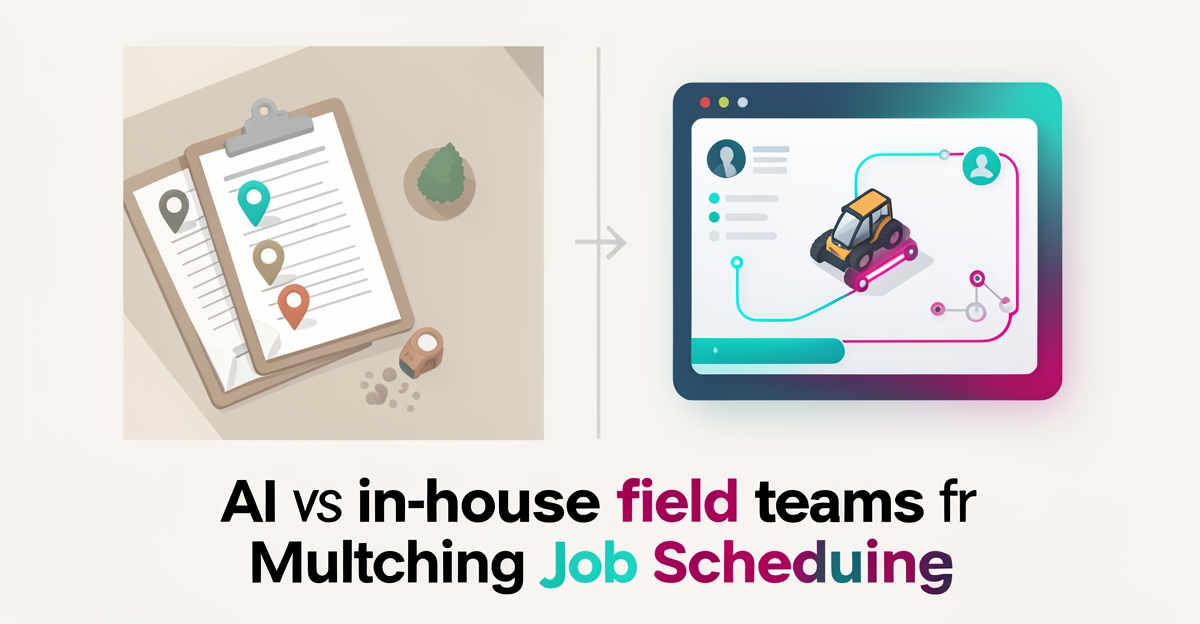
AI vs. In-House Field Teams: Which Is Better for Mulching Job Scheduling?
Key Facts
- AI scheduling automates dispatch and optimizes routes in real time using crew skills, live traffic and customer preferences — something manual boards rarely achieve
- Field service operations are shifting from reactive responses to predictive, data-driven orchestration as AI adoption grows
- AI analytics tools can track SLA compliance and monitor KPIs such as first-time fix rate, job completion rates and personnel utilization
- Field service work moves fast, and dispatch is constantly adjusting the board as crews update notes on the go
- An AI dispatcher from AIQ Labs costs roughly 80% less than a human hire and works around the clock, every day of the year
Hire a team member that works 24/7 — for less than a part-time wage.
AI receptionists, SDRs, dispatchers and 99+ roles. Trained on your business, fully managed.
Not sure where to start? Ask our AI planner
The Scheduling Bottleneck Mulching Teams Face
Mulching crews move fast, but the schedule rarely does. When dispatch is manual, every call, traffic jam, and no-show ripples through the day and leaves revenue on the table.
In-house teams rely on memory, spreadsheets, and phone calls to match jobs with crews. That reactive approach creates constant rework. Field service work moves fast and jobs change while crews update notes on the go, forcing dispatch to constantly adjust the board.
Reactive assignments drive travel waste. Without real-time optimization, crews drive farther between sites and spend more time on the road than on the job. AI scheduling automates job assignments and optimizes routes in real time using crew skills, traffic, and customer preferences — a level of coordination manual dispatch rarely achieves, and one that typically cuts travel time and fits more jobs into each day.
The human cost compounds the operational cost. Unbalanced workloads and last-minute changes wear crews down, and burnout in field service is a well-documented problem. It shows up as missed jobs, slower service, and higher turnover — and better scheduling is one of the most direct ways to relieve it.
Missed jobs and poor visibility also erode customer trust. Manual dispatch struggles to track SLA compliance, first-time fix rates, and personnel utilization in real time. AI analytics tools can provide a comprehensive view of performance data, tracking service-level agreement compliance and monitoring KPIs such as first-time fix rate, job completion rates, and personnel utilization.
The scheduling bottleneck shows up as:
- Reactive assignments that wait for calls instead of planning proactively
- Travel waste from non-optimized routing and last-minute reassignments
- Crew burnout from unbalanced loads and constant changes
- Missed jobs and delayed updates because dispatch cannot see the whole board
These pain points are why field service is shifting from reactive responses to predictive, data-driven orchestration, using machine learning and predictive analytics to plan ahead instead of firefighting.
For mulching operations, that shift matters. AIQ Labs deploys managed AI Employees — dispatchers, planners and other roles — that handle real-time job assignments, reducing idle time and missed opportunities. The comparison between AI-driven scheduling and traditional human field teams centers on efficiency, accuracy, and scalability under pressure.
How AI Scheduling Transforms Field Service Dispatch
Traditional dispatch boards can't keep pace when job volumes spike, traffic shifts, or a crew calls out sick. AI-driven scheduling replaces that static whiteboard with a living system that reads real-time data — crew location, certified skills, current traffic, and customer history — and matches every job to the right person in seconds.
The impact is measurable. AI scheduling platforms typically cut travel time and fit more jobs into each day while continuously learning from each assignment to refine the next one. By analyzing service histories, asset records, and live conditions, these platforms move operations from reactive firefighting to predictive orchestration.
- Real-time matching of skills, location, and availability across the entire crew
- Predictive demand adjustment that anticipates seasonal spikes or weather-driven surges
- Continuous feedback loops that turn every completed job into training data for the next schedule
- Route optimization that factors live traffic, realistic drive times, and required breaks
Field service leaders using this approach report higher first-time fix rates because the right crew — with the right equipment and expertise — arrives on site the first time. Burnout is a recurring problem for field technicians, and balanced, intelligent scheduling directly relieves that pressure by preventing overload and minimizing wasted windshield time.
AIQ Labs applies these principles through managed AI Employees like dispatchers and planners that handle real-time job assignments for mulching and landscaping operations. The system integrates with your existing CRM, scheduling, and communication tools so crews receive optimized routes on mobile devices while the office maintains full visibility. No separate software subscription to manage — just an AI team member that works 24/7, learns your business rules, and improves with every dispatch decision.
AI Dispatcher vs Human Dispatcher: Efficiency, Accuracy and Scale
AI-powered dispatchers deliver consistent, data-driven scheduling that human teams struggle to match at scale. Unlike human dispatchers who manage limited working hours and cognitive load, AI employees operate 24/7 without fatigue, continuously analyzing crew availability, job urgency, and real-time traffic to optimize assignments. That relentless availability reduces idle time and ensures no service opportunity is missed — the core of the efficiency gains seen in AI-driven field service platforms, where dynamic route optimization routinely outperforms manual scheduling.
Accuracy improves when AI handles dispatch decisions, because it removes subjective judgment and fatigue-related errors. Human dispatchers may overlook skill mismatches or underestimate travel buffers, leading to delays or repeat visits. AI systems, by contrast, evaluate hundreds of variables — including crew certifications, equipment readiness, and historical job duration — to assign the right person to the right job every time. This precision also combats technician burnout, a recurring issue in field service. By balancing workloads and minimizing unnecessary travel, AI dispatchers create sustainable schedules that protect team well-being while maintaining service quality.
Scalability becomes a defining advantage as mulching businesses grow. Human dispatch teams require proportional hiring to manage increased job volume, often creating bottlenecks during peak seasons. AI employees handle surges in demand without additional cost or delay, automatically reprioritizing schedules when new jobs arrive or conditions change. Unlike fixed human teams, AI dispatchers scale instantly — processing hundreds of job assignments in the time it takes a human to process a few — without sacrificing speed or accuracy. And with AIQ Labs' Start Monthly model, an AI dispatcher costs roughly 80% less than a human hire. For field service operations aiming to grow without proportional overhead, this level of responsiveness turns scheduling from a constraint into a competitive lever.
Implementing AI Scheduling for Mulching Operations
Mulching crews lose money every time a truck sits idle between jobs or a dispatcher spends the morning re-routing. AI scheduling changes that by turning live field data into instant assignments instead of manual guesswork.
AI scheduling automates dispatch and optimizes routes in real time to match crews with jobs, cutting travel and balancing workloads. These systems analyze location, availability, skills, traffic and customer preferences to create efficient schedules. The result is faster assignments and fewer last-minute changes.
Implementation starts with a focused pilot, not a full rebuild. AIQ Labs uses the Start Monthly model for a Dispatcher AI Employee — a flat monthly plan that costs far less than a part-time hire, with build, training, integrations, monitoring and improvements included. The employee works 24/7/365 and can be paused or adjusted anytime.
A practical rollout path looks like this:
- Map your current dispatch workflow and data sources, including job tickets, crew skills, equipment and customer windows.
- Deploy an AI Dispatcher that ingests real-time availability and routes, then assigns mulching jobs with automatic confirmations.
- Integrate with existing CRM, scheduling and mobile tools so field updates flow back to the office without manual entry.
- Track idle time reduction, jobs completed per day and on-time arrival as the feedback loop refines decisions.
AI in field service management is primarily used for predictive maintenance, optimizing scheduling and routing, automating data-driven processes, and empowering the workforce. AI-powered platforms continually analyze data from IoT sensors, service histories and enterprise systems to optimize operations. That continuous analysis supports real-time dispatch coordination and time tracking tied to scheduling accuracy.
Field service work moves fast and jobs change constantly — dispatch is always adjusting the board as crews update notes on the go. An AI employee captures those updates automatically, reduces gaps between field work and office needs, and improves job data accuracy.
Measurement should focus on operational KPIs. AI analytics tools can provide a comprehensive view of performance data, tracking service-level agreement compliance and monitoring KPIs such as first-time fix rate, job completion rates, and personnel utilization. With those metrics visible, mulching businesses can prove idle time reduction and job completion gains within weeks.
Still paying for 10+ subscriptions that don’t talk to each other?
We build custom AI systems you own outright. No vendor lock-in. Full control.
Not sure where to start? Ask our AI planner
Frequently Asked Questions
How much more efficient is AI scheduling actually compared to a human dispatcher?
Will AI scheduling help reduce technician burnout and turnover?
Can AI dispatchers handle seasonal surges and sudden schedule changes in mulching operations?
Do I need to replace my current CRM or scheduling software to use AI?
How does the cost of an AI dispatcher compare to hiring an in-house coordinator?
How do I track whether AI scheduling is actually improving my mulching business?
From Reactive Dispatch to Revenue-Ready Scheduling
Mulching operations win or lose on how fast crews get to the right job with the right skills. Manual dispatch creates the familiar bottleneck: reactive assignments, wasted drive time, unbalanced workloads, and missed updates that erode trust and margins. AI-driven scheduling replaces that static board with real-time orchestration that matches location, skills, traffic and customer windows, learns from every completed job, and scales without adding headcount. The result is fewer idle trucks, more jobs completed per day, and healthier teams. For mulching businesses ready to test this shift, a focused pilot is the practical path — map your current workflow and data, deploy an AI Dispatcher that ingests live availability and routes, integrate with your existing CRM and mobile tools, then track idle time reduction, jobs per day and on-time arrival. AIQ Labs supports this with managed AI Employees like dispatchers and planners delivered via Start Monthly, so you can prove impact before committing long term. Start with the two-minute Fit Check at https://aiqlabs.ai/apply, then book a free 30-minute strategy call to map your biggest scheduling bottleneck and identify high-ROI automation opportunities.
Make AI your competitive advantage — not just another tool.
Strategy, implementation and ongoing optimization. One partner, end to end.
Not sure where to start? Ask our AI planner