AI vs. In-House Staff: Which Is Better for Managing Equipment Returns and Reservations?
Key Facts
- AI systems can process reservations, confirmations, and inventory updates 24/7 without shift gaps, while human teams typically cover standard business hours.
- Labor market research through 2025 suggests AI-related job losses have been offset by new AI-related roles — work is redistributing, not simply disappearing.
- Most organizations that adopt AI tools without governance policies face oversight challenges; validation and review, not creation, tend to become the bottleneck.
- A hybrid model — AI for volume, humans for exceptions — is the pattern AIQ Labs sees work across 200+ deployed multi-agent systems.
Hire a team member that works 24/7 — for less than a part-time wage.
AI receptionists, SDRs, dispatchers and 99+ roles. Trained on your business, fully managed.
Not sure where to start? Ask our AI planner
The Hidden Cost of Manual Returns and Reservations
Manual returns and reservations quietly drain AV rental businesses every day. Limited staff cover limited hours, demand runs 24/7, and small tracking errors compound into lost gear, angry clients, and overtime.
The labor market is already shifting under that pressure. Industry research through 2025 suggests AI-related job cuts have been substantial, but new AI-related roles have largely kept pace — work is redistributing, not simply disappearing. Roles are moving away from repetitive processing and toward oversight, judgment, and customer relationships.
For equipment returns and bookings, that redistribution shows up as scalability pain. Human teams can only process so many check-ins during business hours. After-hours calls go to voicemail, weekend returns wait until Monday, and reservation requests pile up. The result is bottlenecks that throttle revenue when demand peaks.
Error-prone tracking is the second hidden cost. Manual entry into spreadsheets or disconnected tools creates duplicate bookings, missed returns, and inventory mismatches. Staff spend time reconciling instead of serving customers. The pattern is familiar across industries: faster intake often means more work reviewing and fixing mistakes downstream, because problems shift rather than disappear.
Routine tasks are prime for automation while exceptions need humans. The hidden cost is not just salary, it is the opportunity cost of staff doing repetitive work that scales poorly.
AV rental teams typically absorb this cost in three ways:
- 24/7 demand with 40-hour coverage, forcing missed calls and delayed confirmations
- High-volume repetitive tracking of returns, inventory updates, and reminder emails
- Manual exception handling that pulls staff away from high-value client service
This is where a hybrid staffing model changes the math. AI can own the high-volume, rule-based work — automated confirmations, return status updates, inventory syncs — while people focus on damage assessment, scheduling conflicts, and sensitive negotiations. AIQ Labs' AI Employees cover roles like receptionists, dispatchers, and booking coordinators at roughly 80% less cost than a comparable human hire, keeping human judgment where it matters most.
The goal is not to replace staff, it is to stop paying premium labor costs for routine work. When automation handles the predictable, teams gain capacity for the exceptions that actually require experience and empathy.
The Speed-Without-Control Paradox in AI Automation
The promise of AI-driven speed in equipment returns and reservations often collides with a hidden bottleneck: validation. AI can process returns and generate booking confirmations at high velocity, but time saved in creation is frequently consumed by downstream review, validation, and governance — problems aren't eliminated, they're shifted. This pattern shows up consistently in software research, where delivery speed gains are often offset by review and validation work.
For equipment management, this means faster AI processing of returns or reservations can create new pressures on human teams tasked with verifying accuracy. In practice, staff can end up auditing AI-generated outputs — checking for mis-scanned equipment, incorrect fee calculations, or conflicting reservations — rather than managing the process manually. Without robust oversight, errors cascade: a single misclassified return can trigger incorrect inventory updates, billing disputes, and customer dissatisfaction.
This speed-without-control dynamic exposes governance gaps. Many organizations adopt AI tools faster than they implement corresponding governance policies. For AV equipment teams, this creates risks where automated systems operate without clear error thresholds, audit trails, or escalation paths for exceptions like damaged gear or last-minute cancellations. Trust erodes when staff can't distinguish AI-driven decisions from human ones, making accountability difficult when issues arise.
AIQ Labs addresses this paradox by embedding governance into AI workflows from the start, ensuring human oversight scales with automation speed rather than becoming its bottleneck. By designing systems where AI handles routine tasks while escalating exceptions to trained staff, businesses retain the speed benefits without sacrificing control or trust. The goal isn't just faster processing — it's reliable, auditable operations that hold up under scrutiny.
Hybrid Model: AI Handles Volume, Staff Govern Exceptions
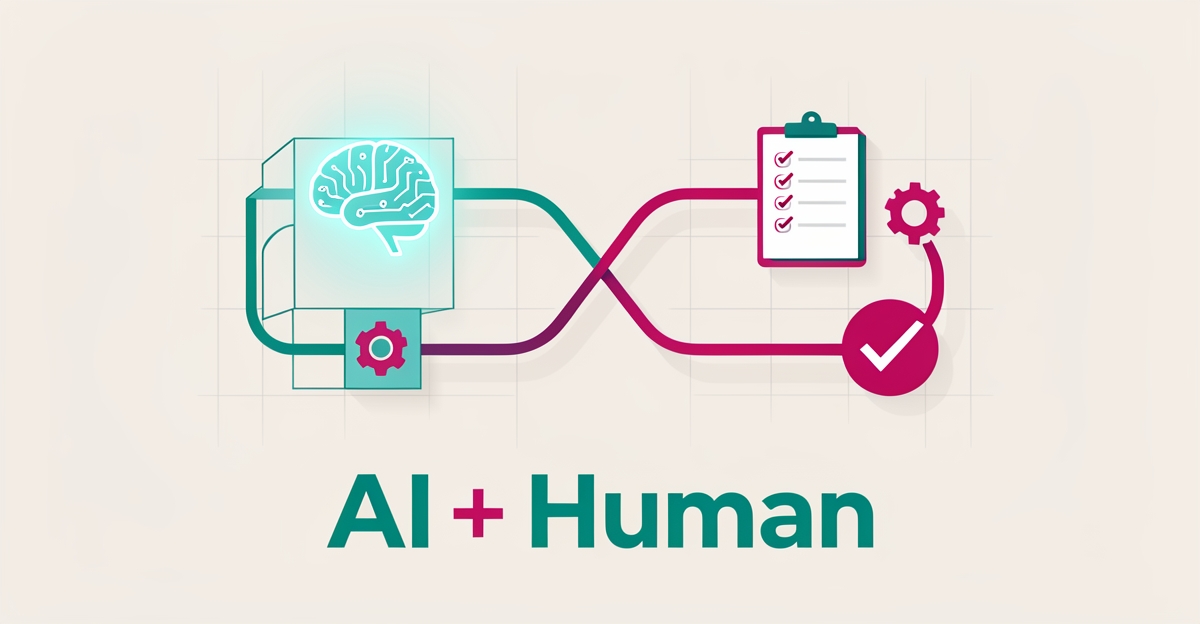
The real risk isn't choosing AI or staff — it's choosing one over the other. Equipment returns and reservations sit on a knife edge between high-volume repetition and high-stakes judgment, and a hybrid model lets each side do what it does best.
AI delivers 24/7 scalability and consistency for routine returns and bookings. It processes confirmations, tracks inventory updates, sends reminders, and logs timestamps without fatigue or shift gaps. In-house staff, by contrast, bring contextual judgment for damage assessment, dispute resolution, and strategic inventory decisions that rules alone can't cover.
Labor data shows why this balance matters. Research through 2025 indicates AI-related job cuts have been matched by new AI-related roles being created. The market is redistributing work, not simply eliminating it — and the roles growing fastest are the oversight and exception-handling ones.
The productivity paradox is the same in operations as it is in software. Speed without control becomes a liability: if every AI decision needs manual review, you've added a step, not removed one.
In equipment management, that translates to AI handling volume while humans govern exceptions. The hybrid model keeps routine workflows automated and consistent, and reserves human expertise for moments where cost, trust, and brand are on the line.
A practical split looks like this:
- AI handles routine returns/reservations: automated confirmations, status updates, inventory sync, and 24/7 booking intake
- Staff own exceptions: damage assessment, fee disputes, scheduling conflicts, and customer escalations
- Humans set strategy: pricing rules, inventory thresholds, and service standards that AI then enforces
- Joint governance: audit trails, error-rate thresholds, and escalation paths reviewed regularly
This approach mirrors how AIQ Labs designs implementation roadmaps for SMBs evaluating staffing models for AV equipment return and booking management. Some businesses start with a single AI Workflow Build — rebuilding the one workflow that costs the most, at a fixed price — before expanding. The goal is not replacement, but scalable consistency with human oversight.
Governance is the differentiator. For equipment operations, that means clear rules for when AI can auto-approve a return, when it must flag for review, and how decisions are logged. Most organizations now budget specifically for AI governance — the question is whether it's designed in from day one or bolted on after a problem.
Customer experience improves when expectations are met consistently at scale and rescued expertly when things go wrong. AI ensures no reservation is missed at 2 a.m.; staff ensure a damaged mixer isn't charged unfairly at 2 p.m.
Hybrid isn't compromise. It's the model that captures AI's 24/7 scalability and staff's judgment, and it aligns cost, accuracy, and experience for equipment returns and reservations.
Implementation Roadmap for AV Equipment Operations
Implementing AI for AV equipment operations requires a structured approach that balances automation with human oversight. A practical roadmap begins with auditing current workflows to identify routine tasks suitable for AI, such as reservation confirmations and return tracking, while reserving exception handling for staff. Organizations that adopt AI without corresponding governance face significant oversight challenges, so define your rules before you automate.
Next, configure systems for AI integration by ensuring data is clean, well-organized, and accessible. Keep instructions concise and focused on context the AI cannot infer — business rules, pricing logic, and escalation criteria. Define clear governance policies upfront, including acceptable error rates, escalation procedures, and audit trail requirements, since review and validation — not creation — tend to become the biggest constraint in AI-driven operations.
Automate routine tasks first, such as inventory updates and customer notifications, while maintaining human oversight for exceptions like damaged equipment assessments or scheduling conflicts. Provide the AI with relevant context — current inventory, customer history, pricing rules — and review output regularly to catch errors before they impact operations. Train staff to oversee AI operations and handle escalations effectively. Finally, monitor key metrics and budget for ongoing governance. AIQ Labs supports this journey through its AI Operating Systems model — one connected operating layer, built in phases, owned outright — guiding businesses from assessment to optimization.
Still paying for 10+ subscriptions that don’t talk to each other?
We build custom AI systems you own outright. No vendor lock-in. Full control.
Not sure where to start? Ask our AI planner
Frequently Asked Questions
Will AI replace my staff for equipment returns and reservations?
How does AI handle after-hours equipment returns and weekend reservations?
Won't faster AI processing just create more work for my team reviewing errors?
What kind of governance is needed when using AI for equipment management?
Can my team still override AI decisions when something seems wrong?
How do I know if AI is right for my AV rental business right now?
Why the Hybrid Approach Wins for Equipment Operations
The evidence is clear: AI excels at the high-volume, rule-based work of equipment returns and reservations — processing confirmations, tracking inventory, and handling 24/7 intake without fatigue — while human staff remain essential for damage assessments, dispute resolution, and strategic decisions that require judgment and empathy. Speed without governance creates new bottlenecks, which is why a hybrid model — where AI manages routine tasks and staff govern exceptions — delivers scalable consistency without sacrificing control or trust. For AV rental businesses ready to stop paying premium labor for repetitive work and start focusing on what truly moves the needle, the next step is a clear-eyed assessment of where automation fits. Start with a free 30-minute strategy call to map your biggest bottlenecks and see where AI can create real operational value — no obligation, just clarity. Reach the team at [email protected] or apply at aiqlabs.ai/apply.
Make AI your competitive advantage — not just another tool.
Strategy, implementation and ongoing optimization. One partner, end to end.
Not sure where to start? Ask our AI planner