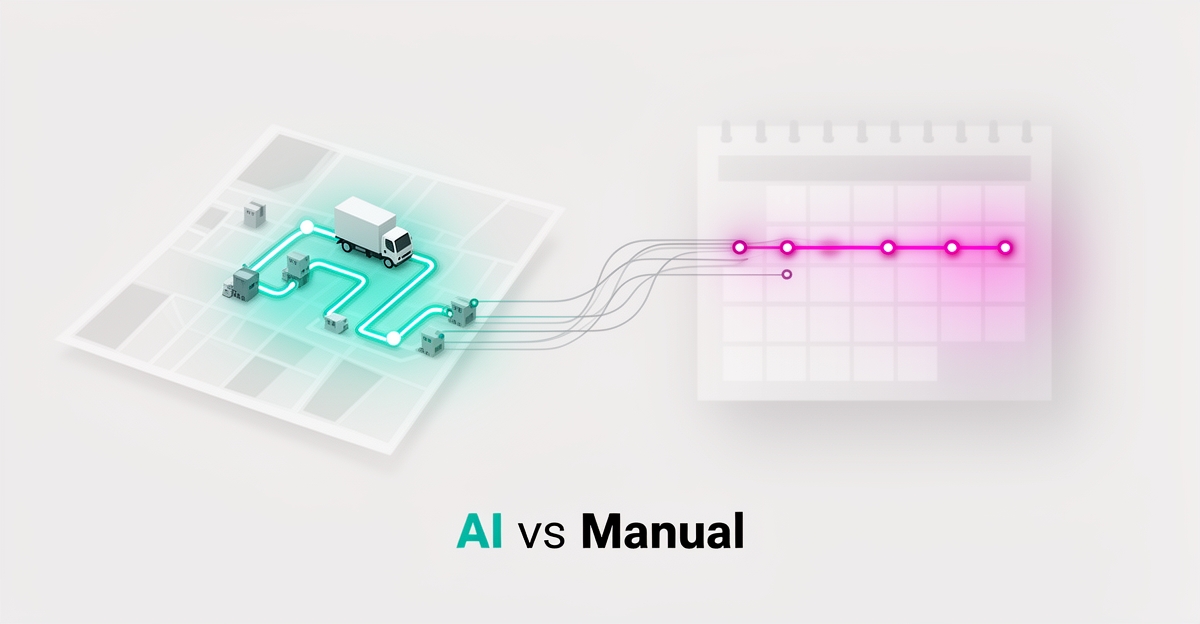
AI vs. In-House Staff: Which Is Better for Managing Material Delivery Schedules?
Key Facts
- AI-driven workforce scheduling typically delivers sustained labor-cost reductions in the range of 20–30% in comparable operational studies according to industry research.
- AI scheduling has improved operational readiness times by as much as 90% in comparable workforce studies.
- AI scheduling has reduced overtime hours by up to 70% per hospitality scheduling research.
- AI delivery scheduling improves route accuracy and reduces congestion by dynamically adjusting to changing site conditions industry research confirms.
- Manual scheduling fails at real-time recalculation, so one supplier delay can unravel an entire delivery schedule.
- AI systems instantly re-route vehicles when weather or supplier delays strike, without hours of manual rework.
Hire a team member that works 24/7 — for less than a part-time wage.
AI receptionists, SDRs, dispatchers and 99+ roles. Trained on your business, fully managed.
Not sure where to start? Ask our AI planner
The Delivery Scheduling Bottleneck on Construction Sites
Construction sites lose hours every week to a scheduling process that hasn't changed in decades. Project managers still juggle spreadsheets, phone calls, and whiteboards while trucks idle at gates and crews wait for materials that arrive late—or not at all. This manual approach creates a cascade of downtime, congestion, and cost overruns that compound across every phase of a build.
The core problem is threefold. First, planning deliveries by hand consumes disproportionate time; coordinators spend hours each week mapping gate windows, crane zones, and laydown areas instead of managing the actual work. Second, accuracy suffers when humans track dozens of moving variables—traffic, weather, subcontractor readiness—without computational support. Conflicts go undetected until a concrete truck blocks a steel delivery. Third, real-time adaptability is virtually nonexistent. When a supplier calls with a delay or a crane goes down, the entire schedule unravels because there's no system to recalculate optimal sequences instantly.
- Time-intensive planning that pulls supervisors off high-value tasks
- Conflict-prone accuracy with no proactive detection
- Zero real-time recalculation when conditions change
- Inability to optimize routes across multiple constraints simultaneously
- No historical pattern analysis to prevent recurring bottlenecks
Research from adjacent industries points to what's possible when AI handles this complexity. In hospitality, AI-driven workforce scheduling has delivered sustained labor-cost reductions in the 20–30% range, with large properties reporting six-figure annual savings through optimized shift planning and assignment algorithms. The same principles—analyzing historical patterns, real-time constraints, and predictive demand—apply directly to material logistics on construction sites.
AIQ Labs helps suppliers deploy AI systems that analyze historical delivery patterns, road conditions, and demand forecasts to optimize delivery routes and reduce downtime. By mapping site constraints once and letting AI continuously recalculate optimal sequences, teams eliminate the manual bottleneck that stalls projects and inflates budgets.
How AI Optimizes Delivery Planning with Data
AI-powered delivery planning transforms how suppliers manage material logistics by turning historical patterns into proactive optimization. Instead of reacting to delays after they occur, AI systems analyze past delivery data, real-time road conditions, and forecasted demand to anticipate bottlenecks before they disrupt operations. This approach reduces idle time at construction sites and minimizes unnecessary truck movements, directly addressing inefficiencies that manual scheduling often overlooks. Industry research confirms that AI-driven scheduling improves route accuracy and reduces congestion by dynamically adjusting to changing site conditions.
Compared to manual methods, AI delivers measurable gains in efficiency, cost control, and adaptability. Manual scheduling relies on static spreadsheets and supervisor intuition, which struggle to scale when delivery volumes fluctuate or unexpected road closures occur. In contrast, AI continuously recalculates optimal routes using live traffic data and predictive demand models, cutting downtime and preventing double-handling of materials. Studies in workforce scheduling show comparable AI applications reducing labor costs by roughly 20–30%—principles that directly translate to delivery logistics where timing and resource allocation are critical.
AI also enhances flexibility in ways manual planning cannot match. When weather delays a shipment or a supplier faces a sudden surge in orders, AI systems instantly re-route vehicles and reschedule drop-offs without requiring hours of manual rework. This responsiveness prevents costly delays and keeps projects on track, especially in time-sensitive industries like construction.
- Analyzes historical delivery patterns to identify recurring bottlenecks
- Integrates live road condition data for dynamic route adjustments
- Uses demand forecasts to align supply with site readiness
- Reduces idle time through proactive conflict detection
- Scales efficiently without proportional increases in planning effort
By grounding decisions in data rather than guesswork, AI delivery planning creates a more predictable and cost-effective supply chain. Suppliers using these systems report fewer missed deliveries, better truck utilization, and stronger alignment between material arrivals and construction milestones. For businesses seeking to move beyond reactive scheduling, AI offers a practical path to greater reliability and lower operational waste—without requiring a complete overhaul of existing workflows. AIQ Labs supports this transition through AI Workflow Builds that rebuild the one scheduling workflow costing you the most, at a fixed price and in clear phases, giving suppliers full ownership of the technology that drives their logistics.
Accuracy, Cost and Scalability Trade-Offs
AI-powered delivery planning transforms how suppliers manage material schedules by replacing error-prone manual methods with intelligent automation. Unlike traditional approaches that depend on static spreadsheets and reactive adjustments, AI systems continuously analyze historical delivery patterns, real-time road conditions, and demand forecasts to optimize routes and timing. This shift eliminates guesswork and reduces the likelihood of bottlenecks that cause costly downtime on job sites. According to industry research, AI-driven scheduling typically delivers sustained labor-cost reductions in the 20–30% range by minimizing unnecessary overtime and improving shift efficiency.
The financial impact extends beyond direct labor savings to include measurable improvements in operational throughput. Comparable workforce scheduling applications have cut overtime hours by up to 70%—a benefit that translates directly to delivery operations, where unexpected delays often trigger premium pay. For suppliers managing high-volume material flows, this means fewer rush-hour surcharges and better utilization of existing fleet and staff resources. Faster turnaround at the point of need is the analogous win in delivery logistics: materials arrive when crews are ready, not hours before or after.
Scalability is another critical advantage where AI outperforms manual methods. As delivery volumes grow or site constraints become more complex, human planners face diminishing returns due to cognitive overload and coordination challenges. AI systems, however, scale by processing vast datasets in real time and adapting to disruptions like weather events or last-minute order changes. This adaptability ensures consistent performance without proportional increases in planning overhead. Suppliers working with AIQ Labs can handle peak demand periods without adding schedulers or sacrificing accuracy—turning logistics into a predictable, cost-controlled function rather than a recurring operational headache.
Implementing AI Without Losing Human Oversight
For suppliers navigating the shift toward smarter logistics, implementing AI for material delivery scheduling doesn't mean removing human expertise—it means enhancing it with precision and foresight. The most effective approach begins with a clear understanding of site-specific limitations, such as gate access windows, road weight restrictions, and designated laydown zones, which AI systems can then use to generate feasible, conflict-free delivery plans. By grounding the technology in real-world operational boundaries, suppliers ensure that automated recommendations remain practical and actionable.
Next, configuring the AI model with labor rules, crew availability, equipment priorities, and delivery hierarchies allows the system to align with existing workflows rather than override them. This step transforms raw data into schedules that respect shift patterns, skill requirements, and urgent material needs—such as prioritizing structural steel before facade work. When AI is tuned to reflect human judgment, it becomes a force multiplier, not a replacement.
Integrating live data feeds from GPS trackers, weather services, and inventory systems enables the AI to adapt dynamically to delays, road closures, or last-minute changes in demand. Suppliers can then run AI-generated schedules alongside manual baselines to compare accuracy, identify inefficiencies, and validate improvements before full deployment. This side-by-side analysis builds confidence in the technology while highlighting where human oversight adds irreplaceable value—such as interpreting nuanced site conditions or managing vendor relationships.
Continuous refinement is essential: as delivery patterns evolve and new constraints emerge, the AI model should be retrained and adjusted based on performance feedback. AIQ Labs supports this iterative process by helping suppliers treat AI not as a static tool but as a learning system that evolves with their operations—always under human guidance. This balanced approach ensures that automation enhances decision-making without eroding the accountability and adaptability that experienced teams bring to complex delivery environments. For suppliers ready to explore this path, starting with a focused workflow build offers a low-risk, fixed-price way to test AI's impact while maintaining full control over outcomes. To begin, complete the 2-minute Fit Check to assess readiness and identify high-ROI opportunities in your delivery scheduling processes.
Still paying for 10+ subscriptions that don’t talk to each other?
We build custom AI systems you own outright. No vendor lock-in. Full control.
Not sure where to start? Ask our AI planner
Frequently Asked Questions
How much time do construction site coordinators typically lose each week to manual delivery scheduling?
What cost savings can AI-driven scheduling deliver for material delivery operations?
Can AI really adapt to real-time changes like weather delays or road closures on construction sites?
Will implementing AI for delivery scheduling replace my human planners and supervisors?
How does AI improve accuracy in delivery scheduling compared to manual methods?
Is AI delivery scheduling scalable for growing construction projects with increasing delivery volumes?
From Bottlenecks to Breakthroughs: Smarter Delivery Scheduling Starts Here
Construction sites lose valuable time and money when delivery scheduling relies on spreadsheets, phone calls, and reactive fixes—creating a cycle of delays, congestion, and cost overruns. AI-powered delivery planning breaks this pattern by analyzing historical patterns, real-time road conditions, and demand forecasts to optimize routes, reduce idle time, and proactively prevent conflicts. As comparable workforce studies suggest, the same principles apply directly to material logistics: fewer missed deliveries, better truck utilization, and stronger alignment with project milestones. The key is augmentation, not replacement—AI enhances human expertise by handling complex calculations while teams focus on high-value decisions. For suppliers ready to test this approach without overhauling existing workflows, starting with a focused workflow build offers a low-risk, fixed-price path to measurable gains. To explore where AI can unlock the highest ROI in your delivery scheduling, complete the 2-minute Fit Check—then book a free 30-minute strategy call to map your next steps.
Make AI your competitive advantage — not just another tool.
Strategy, implementation and ongoing optimization. One partner, end to end.
Not sure where to start? Ask our AI planner