AI vs. In-House Staff: Which Is Better for Managing Member Reservations?
Key Facts
- Hospitality operators that automate back-of-house logistics have reported meaningful reductions in labor dependency, with large resorts citing double-digit percentage gains according to hospitality operations analysis
- Reported hospitality automation programs have repurposed hundreds of thousands of staff hours annually for higher-value guest interactions as reported in hotel automation coverage
- Some hotel groups have eliminated physical front desks entirely and centralized 24/7 operations across multiple properties as reported in hotel automation coverage
- AI handles the repetitive logistics while humans keep judgment where it matters: recovery, upselling, and emotional intelligence according to hospitality experts
- AI systems are only as reliable as the data they receive, and even business users have to check AI outputs because it makes mistakes as noted by Margaret Atwood
- AIQ Labs builds managed AI staff and workflow automation that fits the augmentation model — owned systems that integrate scheduling, reminders and alerts without subscription chaos
Hire a team member that works 24/7 — for less than a part-time wage.
AI receptionists, SDRs, dispatchers and 99+ roles. Trained on your business, fully managed.
Not sure where to start? Ask our AI planner
The Reservation Bottleneck Costing Parks Time and Revenue
Manual scheduling, reminders and alerts turn a fast-moving trampoline park into a front-desk bottleneck every time demand spikes. Staff who should be monitoring jump floors and coaching guests get pulled into phones, spreadsheets and back-and-forth messages about time slots, waivers and payments.
Peak demand magnifies the problem. Hospitality operations that automate repetitive logistics show how volume overwhelms human capacity. Industry research documents how large resorts have faced double-digit surges in service volumes in recent years, forcing a shift to automation to keep service consistent.
The cost is labor dependency and missed experience moments. The same hospitality automation analysis reports operators achieving significant reductions in labor dependency after deploying AI and robotics for back-of-house work, with hundreds of thousands of staff hours annually repurposed for higher-value tasks.
For member reservations, the pattern repeats at the front desk:
- Manual booking entry creates delays and double-bookings during after-school and weekend rushes
- Reminder calls and texts consume staff time that could support safety and guest engagement
- Waiver renewals and payment follow-ups pile up, pulling staff away from the floor
- Inconsistent alerts lead to no-shows and underutilized court capacity
The International Adventure & Trampoline Park Association emphasizes the industry’s focus on safety at scale and rising costs, noting new hires need fast onboarding to deliver a better customer experience. Industry guidance points to the need for vetted partners and standards-driven operations as parks scale.
AI handles the repetitive logistics while humans keep judgment where it matters. Hospitality experts argue the smart operators are not replacing hospitality, they are protecting it by using AI for the repetitive and keeping humans for judgment, recovery, upselling, and emotional intelligence.
This is why augmentation beats replacement in member-facing operations. Systems can manage scheduling, instant confirmations and proactive reminders 24/7, freeing in-house teams to focus on safety monitoring, member engagement and conflict resolution.
AIQ Labs designs workflow automation that fits this model. Instead of stacking another subscription on top of your booking, waiver and POS tools, we rebuild the one workflow that costs you the most — fixed price, phased delivery — or deploy managed AI employees that handle scheduling, reminders and alerts around the clock. The result is faster bookings, fewer errors, and staff who spend time on the floor instead of the inbox.
What Research Shows About AI Handling Repetitive Reservations
The evidence is clear: AI thrives where repetition drowns human capacity. Booking confirmations, 24-hour reminders, and waiver renewals follow predictable rules that machines execute reliably at scale. Hospitality coverage describes major resorts deploying automation for back-of-house logistics and reporting meaningful reductions in labor dependency while repurposing large volumes of staff hours annually for higher-value guest interactions. The pattern isn't cutting roles; it's elevating them, retraining staff to manage inventory systems and automation dispatching instead of manual hauling.
- Instant confirmation and reminder delivery across thousands of simultaneous bookings
- Zero fatigue during holiday surges that would overwhelm a front desk
- Consistent waiver processing without manual data-entry errors
- 24/7 coverage without shift scheduling or overtime costs
Some hotel groups have gone further, eliminating physical front desks at most of their properties and centralizing 24/7 operations across their room inventory as reported in hotel automation coverage. Their consolidation of separate property management systems into one mirrors what trampoline parks face: fragmented booking, waiver, and POS tools that create friction. The lesson is consistent — AI handles the logistics layer so humans can own the experience layer. As hospitality advisors put it, smart operators "use AI for the repetitive" and "keep humans for judgment, recovery, upselling, and emotional intelligence." This is exactly the hybrid model AIQ Labs architects for recreation venues, where AI employees manage the scheduling engine while your team focuses on safety and member relationships.
AI and Staff Are Not Mutually Exclusive
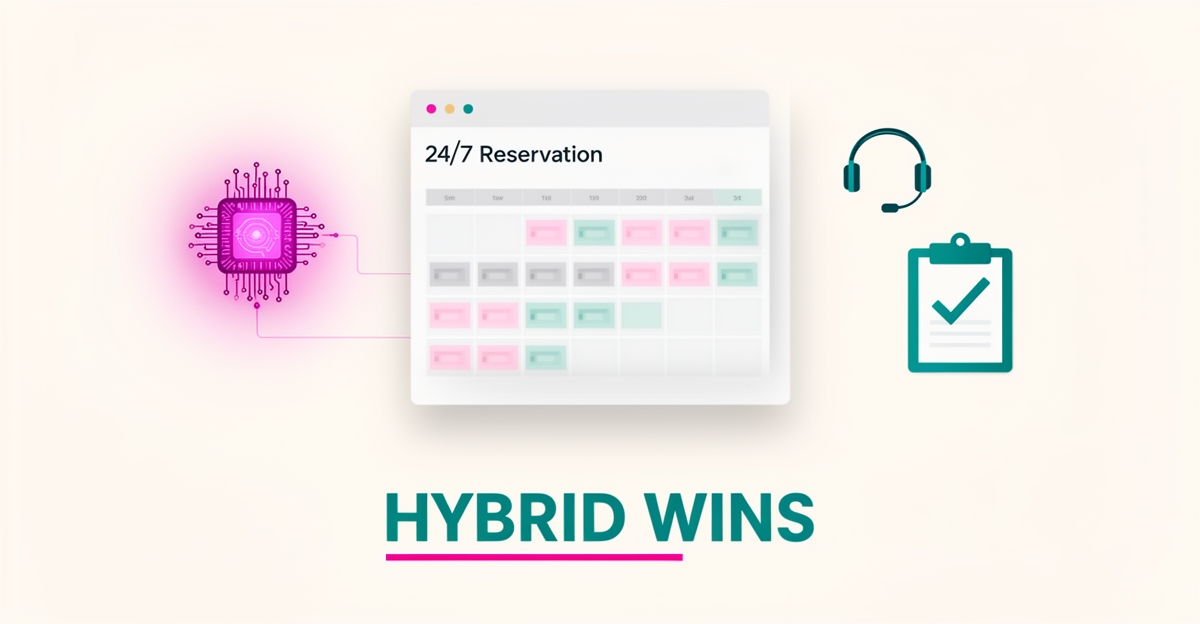
The choice between AI and in-house staff for member reservations is a false one. The most resilient operations use both, letting automation handle the logistics while people own the moments that matter.
AI excels at high-volume, repetitive work. It confirms bookings instantly, sends proactive reminders, and answers routine FAQs about hours and pricing without waiting for a phone queue. Human teams remain essential for judgment, recovery, upselling, and emotional intelligence when a member is upset or a safety question arises.
Hospitality case studies show the pattern clearly. Operators that deployed AI and robotics for back-of-house operations report significant reductions in labor dependency, freeing substantial staff hours annually for higher-value tasks according to hospitality operations analysis. Staff were retrained from manual deliveries to inventory management and automation dispatching, not replaced.
That augmentation model is also about risk control. AI systems are only as reliable as the data they receive. As author Margaret Atwood warns, “garbage in, garbage out” means an AI will repeat bad data, and even business users have to check it because it makes mistakes in her discussion of AI limitations. For reservations, outdated capacity or pricing rules will create double-bookings unless humans provide oversight.
Scalability reinforces the hybrid approach. Hospitality operators have managed multi-year surges in service volumes by scaling automation rather than proportional headcount as reported in hotel automation coverage. Trampoline parks face similar peaks on holidays and summer breaks where a fixed staff team would be overwhelmed.
A practical hybrid division of labor looks like this:
- AI manages scheduling, instant confirmations, waiver renewals, and 24-hour reminder alerts
- Staff focus on safety monitoring, on-site member engagement, conflict resolution, and personalized upsells
- Human-in-the-loop protocols verify AI outputs for complex inquiries, pricing exceptions, and safety-critical data
This is augmentation over replacement. The secret lies in treating AI as a partner for your people, not a replacement according to industry leadership on AI adoption. When AI handles the repetitive, staff can protect the hospitality experience.
AIQ Labs designs reservation workflows with that balance in mind, building systems that automate logistics while keeping staff in control of judgment calls. The result is faster service, lower error risk, and a team that spends time where humans add the most value.
How to Deploy AI for Reservations Without Disruption
Deploying AI for reservations requires a structured, low-disruption approach grounded in hospitality automation best practices. The process begins with auditing and consolidating data systems to ensure clean, unified pipelines—fragmented data across booking, POS, and guest messaging remains a primary bottleneck that undermines AI effectiveness. Next, identify repetitive workflows such as booking confirmations, reminder alerts, and standard waiver renewals, which are high-volume, rule-based tasks ideal for automation. Deploying AI for these routine functions allows immediate handling of scheduling, FAQs about hours and pricing, and proactive alerts without increasing labor overhead.
Once AI manages these tasks, repurpose human staff to higher-value roles rather than reducing headcount. As hospitality automation programs have demonstrated, automation frees substantial staff hours annually, enabling teams to shift from manual logistics to inventory management, automation dispatching, and direct guest recovery. Establish human-in-the-loop oversight to verify AI outputs, particularly for complex inquiries or safety-critical data, mitigating risks of incorrect information due to flawed inputs. Measure outcomes through cost savings, labor hours redirected, and guest satisfaction scores to refine performance and confirm real business value. Finally, embed security and compliance guardrails to prevent unauthorized data access or protocol overrides, ensuring the system remains trustworthy and audit-ready.
AIQ Labs supports this end-to-end. Start with a Workflow Build to rebuild the one reservation workflow that costs you the most, or move toward a full AI Operating System — one connected operating layer for scheduling, reminders, waivers and member communication, built in phases and owned outright. You choose the payment model: start monthly, build in milestones, or own it outright.
Still paying for 10+ subscriptions that don’t talk to each other?
We build custom AI systems you own outright. No vendor lock-in. Full control.
Not sure where to start? Ask our AI planner
Frequently Asked Questions
Will using AI for reservations mean I have to lay off my front desk staff?
Can AI actually handle the busy spikes we get after school and on weekends?
What’s the real risk if we let AI handle bookings and reminders?
Is AI for reservations just for big hotels, or does it work for trampoline parks too?
How do we split work between AI and in-house staff for member reservations?
What should we fix first before deploying AI for reservations?
Protect the Experience, Automate the Logistics
The choice between AI and in-house staff for member reservations isn’t either/or — it’s about putting each where they add the most value. AI handles the high-volume, repetitive logistics — instant confirmations, 24-hour reminders, waiver renewals and routine FAQs — 24/7 without fatigue or overtime. Humans stay on the floor for safety monitoring, member engagement, conflict resolution and personalized upsells where judgment and emotional intelligence matter. Hospitality case studies show the model works: operators that automated back-of-house operations report meaningful reductions in labor dependency, repurposing substantial staff hours annually for higher-value guest work according to hospitality operations analysis. For trampoline parks, that means fewer double-bookings, less front-desk bottlenecking, and staff freed to protect the experience. AIQ Labs builds reservation workflows that fit this augmentation model with owned systems that integrate scheduling, reminders and alerts without subscription chaos. Start the 2-minute Fit Check at https://aiqlabs.ai/apply to book a free 30-minute strategy call and map your biggest reservation bottleneck.
Make AI your competitive advantage — not just another tool.
Strategy, implementation and ongoing optimization. One partner, end to end.
Not sure where to start? Ask our AI planner