AI vs In-House Team: Which Is Better for Dispatching Dumpster Deliveries?
Key Facts
- AI dispatch systems typically reduce empty miles by 10-30% through intelligent route optimization according to industry studies
- Manual dispatching typically results in 20-35% more miles driven than necessary due to suboptimal routing decisions per industry analysis
- AI dispatch systems respond to booking requests in seconds rather than hours, capturing work that would otherwise go to competitors based on home services case studies
- Businesses using AI dispatch report meaningfully more booked jobs and faster response times compared to manual scheduling per home services case studies
- AI routing typically reduces drive time by 15-25%, translating directly into fuel savings and more deliveries per day per contractor dispatch analysis
- Manual dispatchers typically manage 10-15 drivers at a time, according to industry benchmarks per industry analysis
Hire a team member that works 24/7 — for less than a part-time wage.
AI receptionists, SDRs, dispatchers and 99+ roles. Trained on your business, fully managed.
Not sure where to start? Ask our AI planner
The Hidden Cost of Manual Dispatching in Dumpster Rentals
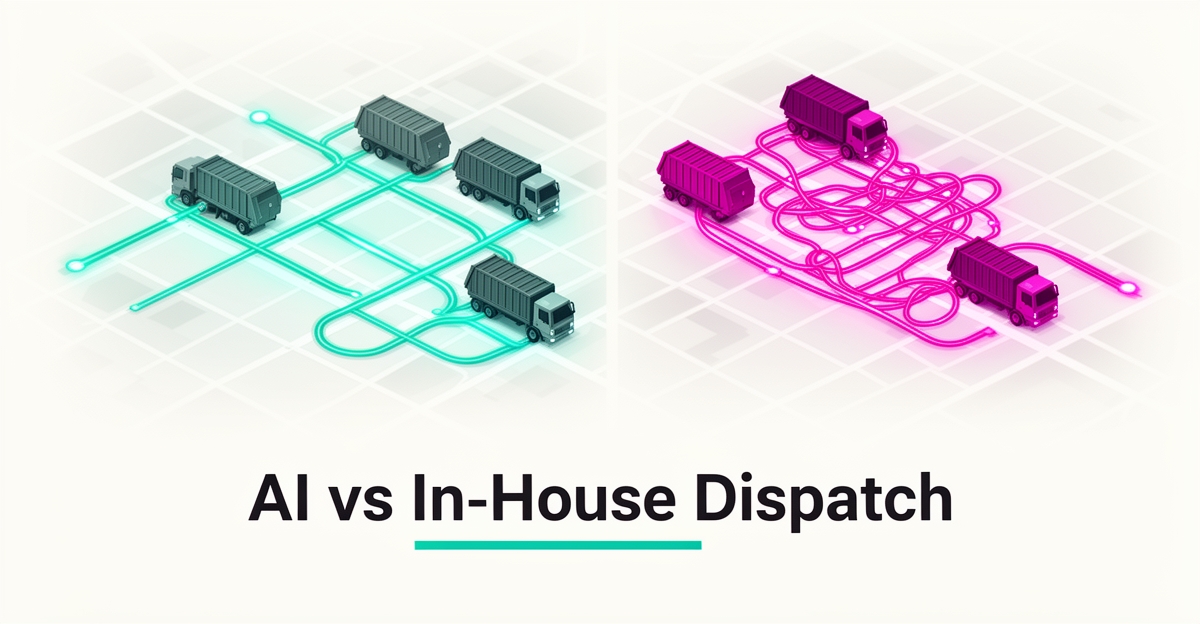
Traditional human-led dispatching in dumpster rentals creates operational inefficiencies that directly impact profitability and service quality. Manual systems struggle with route optimization, often leading to unnecessary mileage and delayed responses as dispatchers juggle multiple variables in real time. These limitations become especially pronounced during peak seasons or unexpected demand surges, where human capacity to process information quickly reaches its breaking point. Industry analysis suggests manual dispatching typically results in 20-35% more miles driven than necessary due to suboptimal routing decisions.
The hidden costs of manual dispatching extend beyond fuel waste to include labor inefficiencies and missed service opportunities. Human dispatchers can only effectively manage a limited number of drivers—typically 10-15 per dispatcher—creating scalability barriers as fleets grow. This constraint forces businesses to either hire additional dispatch personnel at significant cost or accept declining service quality as driver-to-dispatcher ratios increase. These scalability limits directly contribute to delayed response times and reduced job booking rates, particularly when handling fleets ranging from 5 to 500+ drivers across varying service areas.
Manual systems also generate avoidable expenses through inefficient job allocation and poor demand forecasting. Without predictive analytics, dispatchers frequently assign jobs based on immediate availability rather than optimal sequencing, leading to what the industry terms "empty miles"—distance traveled without generating revenue. Studies indicate that AI-powered systems can reduce these empty miles by 10-30% through intelligent route optimization and dynamic job sequencing, while also eliminating redundant hauls that drain both time and resources.
- Increased fuel consumption from non-optimized routes
- Higher labor costs due to limited dispatcher scalability
- Lost revenue from delayed responses and missed bookings
- Greater vehicle wear and tear from excess mileage
- Reduced customer satisfaction from inconsistent service timing
These inefficiencies compound over time, creating a drag on profitability that many dumpster rental businesses accept as an unavoidable cost of operation. However, much of this waste is preventable through better dispatch intelligence. AIQ Labs builds custom AI Employees for dispatching that continuously analyze route efficiency, job priorities, and resource availability—working 24/7 to eliminate the hidden costs inherent in manual systems while maintaining the human judgment needed for complex operational decisions. The result is a dispatching approach that reduces unnecessary mileage, improves response times, and scales efficiently with business growth—without the recurring costs of expanding human dispatch teams.
How AI Dispatch Systems Outperform Human Teams on Speed and Accuracy
When a customer calls to schedule a dumpster delivery, every minute of delay costs you the job. AI dispatch systems respond to booking requests in seconds rather than hours, capturing work that would otherwise go to competitors.
According to home services case studies, businesses using AI dispatch report meaningfully more booked jobs and dramatically faster response times compared to manual scheduling. The speed advantage comes from instant job assignment and automated customer communication.
AI systems also excel at route optimization, calculating the most efficient paths between job sites in real time. Research from contractor dispatch analysis suggests AI routing typically reduces drive time by 15-25%, which translates directly into fuel savings and more deliveries per day.
The accuracy improvements extend beyond speed. AI dispatch systems eliminate double-bookings, optimize container placement schedules, and predict job durations based on historical data. According to fleet management research, AI dispatching can reduce unnecessary miles by 20-35% compared to manual route planning.
Here's what AI dispatch handles automatically:
- Assigning jobs to the nearest available driver based on real-time location and capacity
- Recalculating routes when urgent jobs arrive or traffic conditions change
- Sending automated customer notifications with accurate delivery windows
- Balancing workload across your fleet to prevent driver burnout and overtime costs
Manual dispatchers typically manage 10-15 drivers at a time, according to industry benchmarks. AI systems scale from 5 to 500+ drivers without adding headcount, making them essential for growing operations.
The predictive routing capabilities analyze patterns across thousands of jobs to anticipate delays before they happen. If a construction site consistently takes longer to access or certain neighborhoods have recurring traffic issues, the AI adjusts future schedules automatically.
AIQ Labs builds AI dispatchers that integrate directly with your existing scheduling and customer management systems. These aren't generic software tools—they're custom-trained on your operation's specific constraints, delivery zones, and service standards.
The result is fewer missed deliveries, faster customer response, and more jobs completed per truck per day. While human dispatchers bring valuable judgment for complex situations, AI handles the computational work of optimization faster and more consistently than any manual process can match.
Why a Hybrid Model Delivers the Best ROI for SMB Dumpster Operators
For dumpster operators balancing growth with operational stability, the most effective dispatch strategy isn't choosing between AI and human teams—it's combining them strategically. Industry analysis shows that top-performing home service companies achieve superior results by using AI for mathematical optimization while relying on human judgment for exceptions and customer interactions, a model particularly effective for businesses managing 10 to 500+ drivers according to contractor industry insights.
This hybrid approach delivers measurable efficiency gains without sacrificing service quality. AI-powered systems typically reduce empty miles by 10-30% while lowering overflow calls through smarter scheduling and real-time route adjustments based on dumpster rental management data. These improvements translate directly to fuel savings, reduced vehicle wear, and higher utilization—critical advantages for SMBs operating tight margins.
- Route optimization driven by AI typically yields 20-35% fewer miles traveled per job, significantly cutting operational costs
- Dispatchers managing AI-assisted workflows can effectively oversee more drivers each, scaling human capacity without proportional headcount increases
- Businesses implementing hybrid models report 15-25% reductions in overall drive time, improving on-time performance and customer satisfaction
- Cost savings from AI-enhanced dispatching typically range from 10-30%, primarily through reduced labor overtime and minimized deadheading
AIQ Labs supports this balanced model by providing AI Employees for dispatching that handle repetitive scheduling and route calculations 24/7, while enabling human supervisors to focus on complex customer needs, urgent exceptions, and relationship management—ensuring technology enhances rather than replaces the human element essential to service businesses. This approach maximizes ROI by leveraging AI's consistency for predictable tasks and human adaptability for unpredictable scenarios, creating a resilient dispatch operation that grows with the business.
Implementing AI Dispatch: From Pilot to Full Ownership with AIQ Labs
Dispatching dumpster deliveries sits at the intersection of margin and customer satisfaction, and the path to automation does not have to be all-or-nothing. A staged rollout lets operators test impact before committing to full ownership.
Starting with an AI Employee pilot for dispatching creates a low-risk way to measure real gains. The agent works 24/7 alongside the human team, handling inbound requests, confirming windows, and routing assignments while integrating with existing CRM and scheduling software. This mirrors the hybrid model where the most profitable home service companies use AI for the math and humans for the judgment.
Pilots typically focus on one workflow first, such as same-day delivery requests or overflow call handling. Integration points are mapped to the tools already in use, so data flows between dispatch, routing, and customer records without manual re-entry. Performance is tracked against baseline metrics for speed, accuracy, and on-time pickups.
Early results from AI-powered dispatch in home services show predictable improvements. Industry research documents 10-30% reductions in empty miles, along with meaningful reductions in unnecessary hauls and overflow calls. Route efficiency also improves, with reports of 20-35% fewer miles driven when algorithms assign jobs to the right drivers.
When the pilot proves value, scaling moves from managed service to owned capability. AIQ Labs supports this progression through three practical payment models:
- Start Monthly for a managed AI Employee with build, training, integrations, monitoring and improvements included, and the ability to pause or adjust anytime
- Build in Milestones for a workflow or department system split into phases, with approval and payment per phase and the option to stop anytime while keeping everything built so far
- Own It Outright for a full AI operating system with full ownership of code, agents and data when complete
The milestone approach avoids upfront complexity while preserving long-term control and ROI. Each phase ships a working capability, such as real-time route optimization or automated customer confirmations, and integrates tightly with CRM and scheduling systems. For operators ready to connect dispatch with scheduling, billing, and customer communication in one layer, a phased AI Operating System build is the natural next step.
Ownership also means the system adapts to dumpster rental specifics rather than forcing process change. True ownership eliminates vendor lock-in and subscription sprawl, aligning with the mission to reduce software dependencies and create sustainable advantage. As adoption grows, governance, monitoring and human-in-the-loop controls ensure safety and compliance.
From pilot to full ownership, the transition is incremental, measurable, and reversible. Businesses gain the efficiency and 24/7 coverage of AI dispatch without sacrificing the judgment that manual dispatchers provide for complex or dynamic operations.
Still paying for 10+ subscriptions that don’t talk to each other?
We build custom AI systems you own outright. No vendor lock-in. Full control.
Not sure where to start? Ask our AI planner
Frequently Asked Questions
Is AI dispatch really faster than a human dispatcher for dumpster rentals?
How many drivers can one dispatcher actually handle before things break down?
Will switching to AI actually reduce miles and fuel costs?
Do I have to fire my dispatch team to use AI?
What kind of cost savings is realistic for a small dumpster operation?
Is AI dispatch only worth it if I have a huge fleet?
Why the Future of Dumpster Dispatch Is Smarter, Not Just Faster
Manual dispatching in dumpster rentals creates avoidable costs—excess mileage, missed bookings, and scalability limits—that quietly erode profitability. AI-powered dispatch systems address these pain points by optimizing routes, typically reducing empty miles by 10-30%, while scaling seamlessly from 5 to 500+ drivers without adding headcount. Yet the highest ROI comes not from replacing human judgment but combining it with AI's consistency: letting algorithms handle real-time routing and job assignment while supervisors focus on exceptions, customer relationships, and complex decisions. This hybrid model delivers fuel savings, improved on-time performance, and higher utilization—critical advantages for SMBs operating on tight margins. If you're ready to test how AI dispatch could work in your operation without overhauling your team or tech stack, start with a no-obligation Fit Check to map your biggest bottleneck and explore high-impact automation opportunities. Start the Fit Check to see where AI can make a measurable difference in your dispatching workflow.
Make AI your competitive advantage — not just another tool.
Strategy, implementation and ongoing optimization. One partner, end to end.
Not sure where to start? Ask our AI planner