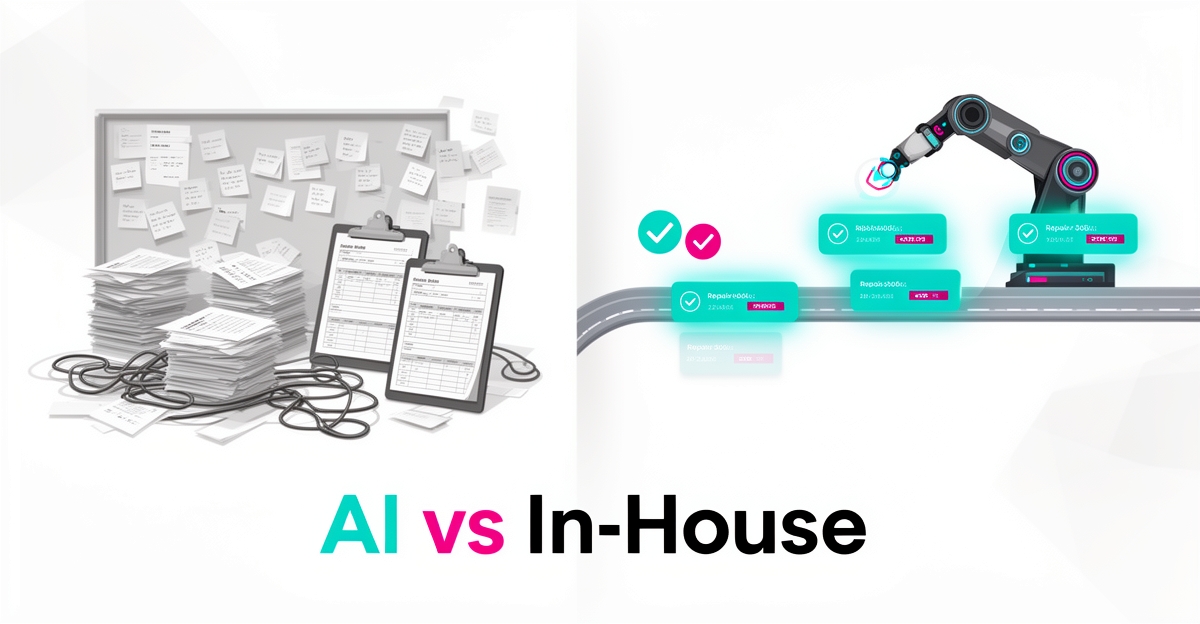
AI vs In-House: Which Is Better for Managing Repair Job Tracking?
Key Facts
- A large share of manufacturers and repair operations still rely on manual data collection, creating bottlenecks as volume grows according to industry research.
- Many operations have seen their data volume more than double in just a few years, overwhelming manual tracking systems Repair Labs found.
- A substantial portion of repetitive data, analytics, and decision workflows can be automated with AI, freeing staff for complex repairs according to automation analysis.
- Predictive maintenance is widely expected to become a primary objective for manufacturers by 2030 industry data suggests.
- Manual tracking breaks down as volume increases—whiteboards fill up, paper piles grow, and handoffs fail Repair Labs reports.
- AI-powered tracking provides branded status pages and 24/7 automated notifications, eliminating customer status calls according to industry research.
- AI systems enable real-time data tracking and performance analytics that are difficult or impossible to obtain manually Repair Labs notes.
Hire a team member that works 24/7 — for less than a part-time wage.
AI receptionists, SDRs, dispatchers and 99+ roles. Trained on your business, fully managed.
Not sure where to start? Ask our AI planner
Introduction
Repair shops today face a critical decision in managing job tracking: stick with traditional in-house methods or adopt an AI-powered system. Manual tracking, still common across many manufacturers and service businesses as of late 2026, becomes increasingly inefficient as data volumes grow. That surge exposes the limitations of paper tickets, whiteboards, and reliance on human memory, where tickets get lost, updates are forgotten, and handoffs break down under pressure.
AI-powered tracking offers a practical alternative by automating routine tasks like scheduling, dispatching, and data entry—freeing staff to focus on complex repairs and customer service. These systems deliver high accuracy through automated data capture and validation, eliminating the inconsistencies of manual methods. With real-time tracking and analytics, shops gain immediate visibility into job status, technician performance, and workflow bottlenecks—insights that are difficult or impossible to achieve manually.
Beyond efficiency, AI enables predictive maintenance by analyzing historical and real-time data to anticipate equipment issues before they occur, reducing costly downtime. Customers benefit from automated notifications and branded status pages, keeping them informed 24/7 without needing to call for updates. This transparency builds trust and reduces staff interruptions, directly improving satisfaction. For shops evaluating their options, AIQ Labs helps assess whether automation aligns with their operational goals, scalability needs, and long-term cost efficiency—guiding the decision between in-house effort and intelligent system deployment. According to industry research, a large share of repetitive data, analytics, and decision workflows can be automated by AI, making it a powerful lever for operational change.
- Manual tracking is limited by human capacity and struggles to scale as job volume increases
- AI systems provide real-time data tracking and analytics for performance insights
- Automated customer updates reduce inquiry volume and improve satisfaction
- Predictive capabilities enable proactive maintenance and reduce downtime
- AI handles higher job volumes without physical limitations like whiteboards or paper tickets
Key Concepts
Repair job tracking sits at the intersection of operational efficiency and customer trust, and the method you choose defines both. Manual systems still dominate many shops, while AI-powered tracking is reshaping how work moves from intake to completion.
Manual tracking relies on paper tickets, whiteboards, and human memory. As volume increases, "whiteboards fill up, paper piles grow, handoffs break down as volume increases." The approach is limited by human capacity and creates friction at every handoff. Industry research finds many manufacturers still collect data manually, even as data volumes surge.
AI-powered tracking replaces those constraints with continuous, automated workflows. Systems automate scheduling, dispatching, and data entry, freeing staff for higher-value work. Analysis of automation potential suggests a substantial share of repetitive data, analytics, and decision workflows can be automated by AI, reducing manual touchpoints across the job lifecycle.
Accuracy and visibility diverge sharply between the two models. Manual methods are prone to lost tickets, erasures, and forgotten verbal updates. AI systems ensure consistent capture, validation, and real-time record keeping. Repair Labs reporting notes AI enables real-time data tracking and analysis, providing valuable insights into performance metrics that are difficult or impossible to obtain manually.
Customer experience becomes a differentiator with AI. Automated notifications and branded status pages keep customers informed 24/7 without staff intervention. That transparency reduces inbound status calls and builds trust. The shift matters as expectations rise: survey data suggests predictive maintenance will be a primary objective for many manufacturers by 2030.
Scalability is where the gap widens. Manual tracking requires more personnel as job volume grows. AI tracking handles higher throughput with minimal physical limits and supports proactive management.
Key concepts that define the comparison:
- Efficiency and throughput under rising volume
- Accuracy of data capture and real-time visibility
- Customer communication automation and transparency
- Predictive maintenance and proactive intervention
In practice, the choice is not just about software versus staff, it is about cost, accuracy, and scalability. AIQ Labs helps shops evaluate those trade-offs in the context of repair job tracking—mapping where internal staff still add value and where an AI Workflow Build can take over the one workflow that costs the most, at a fixed price and in clear phases.
Best Practices
Manual job tracking breaks down the moment volume rises. Whiteboards fill up, paper piles grow, and handoffs break down as volume increases, which is why shops need a deliberate approach before choosing a path.
Start by auditing your current data reality. Repair Labs research indicates many manufacturers still collect data manually, and a significant share have seen the amount of data they collect more than double in recent years. Map where tickets get lost, where verbal updates are forgotten, and where staff spend time re-entering information.
Design for accuracy from day one. Manual tracking is prone to human oversight and inconsistent record-keeping, while AI systems ensure data accuracy through automated capture and validation. Prioritize a single source of truth for jobs, parts, and customer history so real-time visibility is possible without chasing staff for updates.
Automate the repetitive work that scales poorly. Analysis of AI versus manual work finds a large share of repetitive data, analytics, and decision workflows can be automated by AI. Use automation for scheduling, dispatching, status notifications, and data entry so human teams focus on diagnosis, repair quality, and customer relationships.
Build customer transparency into the workflow. AI-powered platforms offer branded status pages and automated notifications, keeping customers informed 24/7 and reducing inbound calls for updates. This improves satisfaction and frees staff time for billable work.
Adopt best practices that work for both paths:
- Assess current needs and pain points before selecting a tool or staffing model
- Integrate job tracking with existing CRM, accounting, and dispatch systems for seamless data flow
- Establish clear data governance, security, and human-in-the-loop escalation for critical decisions
- Monitor performance metrics and optimize workflows after implementation
Plan for scalability and predictivity. Industry data suggests predictive maintenance will be a primary objective for many manufacturers by 2030. Even basic AI tracking enables real-time data tracking and analysis, providing insights into performance metrics that are difficult to obtain manually.
Evaluate cost and ownership honestly. Manual tracking has lower upfront cost but higher long-term operational cost due to headcount and error. AI requires higher upfront investment but delivers lower long-term operational cost and continuous operation without physical limits. With AIQ Labs, you can start monthly, build in milestones, or own your system outright—no subscription treadmill. See the payment models for how each path works.
AIQ Labs helps shops evaluate costs, accuracy, and scalability to decide the most efficient path forward—whether that's an AI dispatcher or receptionist handling intake and updates at a fraction of a human hire, or a full AI Operating System that connects your whole operation in phases, owned outright. A structured assessment now prevents the breakdowns that happen when volume increases.
Implementation
Moving from theory to practice requires a structured approach that balances technological capability with operational reality. Repair shops that rush implementation without assessing their data infrastructure often struggle to realize the efficiency gains that AI promises.
The first step involves auditing your current tracking workflow to identify specific bottlenecks. According to industry analysis, many manufacturers still collect data manually, creating inefficiencies that compound as volume grows. Document where tickets get lost, where handoffs break down, and which repetitive tasks consume staff time.
Data preparation follows assessment. Research indicates that a substantial share of repetitive data, analytics, and decision workflows can be automated by AI, but only when historical records are digitized and standardized. Clean your existing job histories, customer information, and equipment logs before migration.
When selecting an AI platform, prioritize integration capabilities over feature lists. The system must connect with your existing CRM, accounting software, and communication tools to eliminate data silos. AIQ Labs specializes in building these unified systems—its Workflow Builds rebuild the one workflow that costs you the most at a fixed price, phased so you see value at each step, and its AI Operating Systems connect everything into one operating layer you own outright. With 200+ multi-agent systems deployed and four live SaaS products run daily, the integration work is proven, not theoretical.
- Run a pilot program with one service category or technician team before full deployment
- Establish data governance protocols for ongoing accuracy and security
- Configure automated customer notifications to replace manual status calls
- Set up dashboards that track the metrics identified during your initial assessment
Training determines long-term adoption success. Staff need to understand not just how to use the system, but how AI augments their decision-making rather than replacing their expertise. Address concerns about job displacement directly by redefining roles around complex problem-solving and customer relationship management.
Finally, implement continuous monitoring. Repair Labs notes that many operations have seen their data volume more than double in recent years, making scalable tracking essential. Regular optimization ensures your AI system evolves alongside your business growth, transforming job tracking from an administrative burden into a strategic asset.
Conclusion
The decision between managing repair job tracking in-house or leveraging AI isn't just about technology—it's about operational resilience. Manual systems, while familiar, quickly become bottlenecks as data volumes grow, and many manufacturers still rely on manual collection methods that struggle to scale. AI-powered tracking transforms this dynamic by automating routine tasks like scheduling and data entry, enabling continuous operation without human limitations and freeing staff for higher-value work.
Beyond efficiency, AI delivers measurable improvements in accuracy and customer experience. Manual tracking is prone to lost tickets, forgotten updates, and inconsistent records—issues AI eliminates through automated data capture and validation. Platforms offering branded status pages and real-time notifications keep customers informed 24/7, reducing inquiry volume and building trust, while predictive capabilities allow shops to anticipate maintenance needs before failures occur. These advantages compound over time, turning what might seem like a higher upfront investment into lower long-term operational costs through reduced errors, faster throughput, and proactive issue resolution.
For repair shops evaluating this shift, the path forward begins with clarity. Assess current pain points in your tracking process, research platforms that align with your workflow needs, and prioritize solutions offering real-time visibility and scalability. AIQ Labs supports this journey with three clear entry points: AI Employees for managed dispatchers and receptionists at roughly 80% less than a human hire, Workflow Builds to rebuild your costliest workflow at a fixed price, and AI Operating Systems for a connected layer you own outright. Start with the 2-minute Fit Check, then schedule your free 30-minute strategy call—no obligation, just clarity on whether AI-driven tracking is the right next step for your shop.
- Identify tracking inefficiencies and data pain points
- Research AI platforms with real-time analytics and predictive features
- Choose a solution offering scalability and seamless integration
- Implement with staff training and ongoing optimization
- Monitor performance and refine based on metrics
Still paying for 10+ subscriptions that don’t talk to each other?
We build custom AI systems you own outright. No vendor lock-in. Full control.
Not sure where to start? Ask our AI planner
Frequently Asked Questions
Is manual job tracking really still common in repair shops?
Will AI actually reduce the errors we get with paper tickets and whiteboards?
Can AI handle more jobs without hiring more staff?
How much repetitive work can AI really automate in repair tracking?
Does AI help with customer updates and reduce phone calls?
Is predictive maintenance worth it for a small shop?
Build Tracking That Grows With Your Shop
The choice between in-house tracking and AI is really a choice about resilience under pressure. Manual systems work until volume spikes—then whiteboards fill up, tickets get lost, and handoffs break down, a reality still common across manufacturers who collect data manually according to industry research. AI-powered job tracking removes those physical and human bottlenecks by automating scheduling, data capture and customer updates while delivering real-time visibility, predictive maintenance signals, and scalable throughput without adding headcount. The payoff is fewer errors, faster jobs, and customers who stay informed without calling for status. If you're evaluating the shift, start by mapping where tickets disappear and time is lost to re-entry, then test automation on one service line before scaling. AIQ Labs helps shops assess costs, accuracy and scalability to design an owned system that fits their workflow—start monthly, build in milestones, or own it outright. Start the Fit Check at https://aiqlabs.ai/apply, then book your free 30-minute strategy call at https://aiqlabs.ai/book to map your biggest bottleneck and identify high-ROI automation opportunities.
Make AI your competitive advantage — not just another tool.
Strategy, implementation and ongoing optimization. One partner, end to end.
Not sure where to start? Ask our AI planner