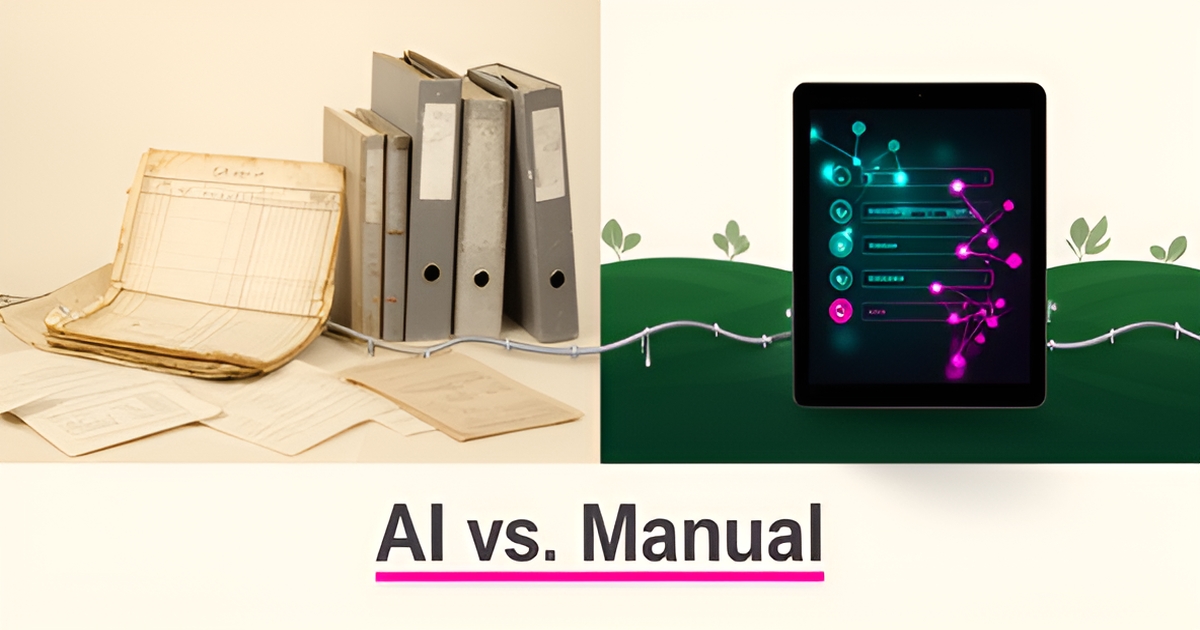
AI vs. Manual Record-Keeping: Which Is Better for Organic Farm Compliance?
Key Facts
- Sensor-controlled drip irrigation in an organic tomato pilot in Maharashtra reportedly reduced water usage by 28% while increasing yield by 17% according to an ICAR-cited case study
- AI models using convolutional neural networks achieved 94% accuracy in detecting early and late blight in organic tomatoes per a 2021 study in Computers and Electronics in Agriculture
- Blockchain-integrated smart farms reported certification overhead reductions of roughly 40% based on an AgriDigital pilot in Australia
- Sensor-based interventions can improve resource use efficiency by up to 40% per McKinsey's Digital Agriculture reporting
- Poor data quality costs organizations an average of $12.9 million annually according to Gartner
- Manual recording methods introduce potential for error, data gaps, and inconsistencies per a systematic review of on-farm recordkeeping
- Most farm management software packages do not support data interoperability per ARMA's roadmap for AI-driven records management
Hire a team member that works 24/7 — for less than a part-time wage.
AI receptionists, SDRs, dispatchers and 99+ roles. Trained on your business, fully managed.
Not sure where to start? Ask our AI planner
The High Stakes of Organic Certification: Why Manual Records Fall Short
The stakes of organic certification extend far beyond paperwork — they determine whether a farm can legally sell its harvest under the organic label. Certification bodies require complete traceability from seed to sale, documenting every input, field operation, and harvest decision across multiple growing seasons. This level of scrutiny leaves no room for the gaps that manual systems inevitably create.
Research confirms that traditional recordkeeping "relies on manual recording methods that introduce the potential for error and data gaps, and inconsistencies" across the entire production cycle. A systematic review of on-farm recordkeeping systems found that paper-based methods remain widespread despite their documented shortcomings, with data collected from planning through post-harvest activities suffering from human observation errors that compound over time. Poor data quality costs organizations an average of $12.9 million annually according to Gartner, and organic farms face the additional risk of certification suspension when auditors uncover incomplete trails.
Manual systems create three critical vulnerabilities during audits:
- Inability to produce real-time field histories when inspectors request specific plot records
- Missing input documentation that breaks the chain of custody for organic materials
- Version control failures where corrected entries overwrite original observations without audit trails
These aren't theoretical risks. The same review noted that "accuracy in on-farm data is necessary for precision in operational planning and farm management," yet most farm management software lacks interoperability, forcing farmers to maintain parallel paper and digital systems that diverge over time. When certification auditors arrive, they find conflicting records rather than the seamless documentation that organic standards demand.
AI-powered systems address these structural weaknesses by capturing data at the source — whether from IoT sensors monitoring soil conditions, automated equipment logs, or voice-enabled field entries that sync immediately to centralized platforms. This approach transforms recordkeeping from a retrospective chore into a continuous, verified stream that meets the transparency requirements modern certification demands.
AI-Powered Record-Keeping: Enhancing Accuracy and Audit Readiness
Manual record-keeping in organic farming often means chasing paper trails and fragmented digital files, turning audit preparation into a high-stakes scavenger hunt. AI-powered systems eliminate this chaos by automatically capturing, classifying, and verifying farm data as it is generated, transforming compliance from a reactive burden into a proactive operational asset.
Modern AI leverages Large Language Models (LLMs) and machine learning to process unstructured content—handwritten field notes, sensor logs, and input receipts—that traditional systems cannot interpret. According to records management research, these tools understand context and language to automate classification, ensuring every document is filed correctly without human intervention. This capability directly addresses the systematic errors and data gaps inherent in manual entry, where descriptive observations often introduce inconsistencies that jeopardize certification.
The shift from manual to intelligent document management creates complete visibility across the operation. Instead of searching through file cabinets or outdated folders, farm managers retrieve specific compliance records instantly using keywords, metadata, or contextual queries. Industry analysis confirms that AI-driven searchability eliminates the version control issues and approval delays that plague manual collaboration, allowing staff to focus on analysis rather than paperwork.
For organic certification, this accuracy translates directly into audit readiness. AI systems create immutable audit trails by logging every input application and irrigation cycle automatically. Research on smart farming reports that blockchain-integrated IoT devices reduced certification overheads by roughly 40% in pilot deployments while making audits more transparent. By maintaining a single source of truth, these systems flag missing documentation before it becomes a compliance failure.
Key capabilities that ensure continuous compliance include:
- Automated classification of compliance documents and input records
- Intelligent search for instant retrieval during inspections
- Continuous monitoring that flags missing or expiring certifications
- Automated audit trails that log every data point without human input
Implementing these capabilities requires more than off-the-shelf software; it demands a tailored approach that aligns with specific organic standards and workflows. AIQ Labs builds these systems through AI Workflow Builds — a fixed-price engagement that rebuilds the one workflow costing you the most, in phases, with no surprise invoices. By treating compliance as an automated byproduct of daily operations rather than a separate administrative task, organic farms secure their certification status while reclaiming valuable time for actual farming.
Beyond Compliance: AI as a Tool for Operational Intelligence
Compliance is the entry point, but the farms that stay competitive use the same data stream for operational intelligence. When AI moves beyond filing logs, it starts connecting field signals to decisions about water, inputs, and timing.
Smart farming in the organic context refers to the integration of Internet of Things, Artificial Intelligence, and climate data analytics to optimise cultivation without compromising soil health, biodiversity, or chemical-free standards. According to farming-with-intelligence research, IoT sensors act as a digital extension of a farmer's intuition, ensuring every litre of water and every handful of organic manure is optimally utilised.
That extension becomes actionable when AI processes the stream. Earth5R analysis notes sensor-based interventions can improve resource use efficiency by up to 40%. In one reported case, sensor-controlled drip irrigation in organic tomato cultivation in Maharashtra reduced water usage by 28% while increasing yield by 17%.
Pest and disease forecasting is another clear lever. AI models using convolutional neural networks achieved 94% accuracy in detecting early blight and late blight in organic tomatoes, enabling farmers to prevent spread through targeted pruning and biocontrol sprays. The most successful application of AI in organic farming involves combining AI-generated recommendations with traditional farming practices, where farmers use AI for confirmation and data but rely on their own experience for final decisions.
Case work shows the hybrid model in action. An organic orchard implemented an AI-based disease-detection app in 2021 that provides chemical, biological and mechanical management options. The farm focuses on organic methods, applying only the organic recommendations. As the owner described, "we already know, and we get confirmation through the app, and we feel that we are going in the right direction."
Water scarcity decisions benefit similarly. A crop farm facing shifting rainfall used AI-based weather-prediction apps to manage water levels, protect harvested wheat from rain damage, and schedule fertilisation. The farmer noted, "Harvesting and threshing are mostly done after consulting the weather predictions."
Operational intelligence also strengthens compliance economics. Pilot data shows blockchain-integrated smart farms reported certification overhead reductions of around 40%, while automated classification and intelligent search reduce audit risks and free staff for higher-value work.
AI supports strategic insight without replacing judgment:
- Resource optimisation via sensor data for water and organic inputs
- Pest and climate risk forecasting that complements field experience
- Traceability automation that makes certification transparent and audit-ready
This is where AI as decision-support aligns with organic principles. Farmers view AI tools as aids to improve decision-making, not as replacements for their expertise. AIQ Labs builds these systems so the farm owns them outright — data stays with the operation, and workflows integrate with existing tools. The result is operational intelligence that respects the hybrid approach favored in organic agriculture.
Implementing AI Systems: A Practical Roadmap for Organic Farms
The gap between knowing you need better records and actually building that system stops most organic farms before they start. A systematic review of on-farm recordkeeping found that while digital platforms are replacing paper-based methods, most software packages do not support data interoperability and few are free — creating real barriers for operations already running lean.
- Phase 1: Pick one high-pain workflow. Start with input logging — every seed, amendment, and spray application. This single workflow touches certification, traceability, and inventory. Farms using sensor-based interventions have reported resource use efficiency gains of up to 40%, but only when the underlying data is clean and consistent.
- Phase 2: Build data quality before automation. Manual recording methods introduce "potential for error and data gaps, and inconsistencies" that compound when fed into AI models. Clean historical records, standardized naming conventions, and defined validation rules must exist before any intelligent layer adds value.
- Phase 3: Deploy with human-in-the-loop oversight. Research on sustainable agriculture shows farmers treat AI as decision-support, not replacement — using apps for confirmation while relying on experience for final calls. The same principle applies to compliance: automated classification and continuous monitoring reduce audit risk, but a qualified person reviews flagged items.
- Phase 4: Choose systems you own, not rent. Interoperability failures lock farms into proprietary formats. Custom-built systems that transfer full code and data ownership eliminate vendor lock-in and let you connect to certification bodies, buyers, and future tools on your terms.
The ARMA roadmap for AI-driven records management emphasizes that successful adoption depends on high-quality data, clear business rules, and proper human oversight — not just technology deployment. Organic farms face an additional constraint: certification auditors require complete, traceable documentation. AI systems that embed compliance logic directly into workflow automation — auto-tagging harvest dates, linking input lots to field records, flagging missing buffer zone logs — turn recordkeeping from a retrospective scramble into a continuous, audit-ready process.
AIQ Labs helps farms navigate this transition with AI Workflow Builds for the first high-pain workflow, scaling over time toward an AI Operating System the farm owns outright — each milestone delivering measurable compliance value before the next investment. If you're unsure where to start, the two-minute Fit Check will tell you which entry point fits your operation.
Still paying for 10+ subscriptions that don’t talk to each other?
We build custom AI systems you own outright. No vendor lock-in. Full control.
Not sure where to start? Ask our AI planner
Frequently Asked Questions
How does AI-powered record-keeping improve audit readiness for organic farms?
Can AI replace a farmer's experience in organic farming decision-making?
What specific benefits do IoT sensors provide in organic farming according to research?
What are the main risks of relying on manual record-keeping for organic certification?
How much can blockchain-integrated smart farms reduce certification overheads based on pilot data?
What is the recommended first step for organic farms implementing AI record-keeping systems?
Key Takeaways
From Audit Anxiety to Operational Intelligence. The evidence is clear: manual record-keeping creates structural vulnerabilities that no amount of diligence can fully eliminate. AI-powered systems don't just digitize paperwork — they capture data at the source, enforce verification at every step, and turn audit preparation from a scramble into a status check. Start with the workflow that hurts most, build data quality before automation, keep a human in the loop, and own the system outright. The farms that treat compliance data as an operational asset — not an administrative tax — are the ones that pass audits without losing a season to paperwork.
Make AI your competitive advantage — not just another tool.
Strategy, implementation and ongoing optimization. One partner, end to end.
Not sure where to start? Ask our AI planner