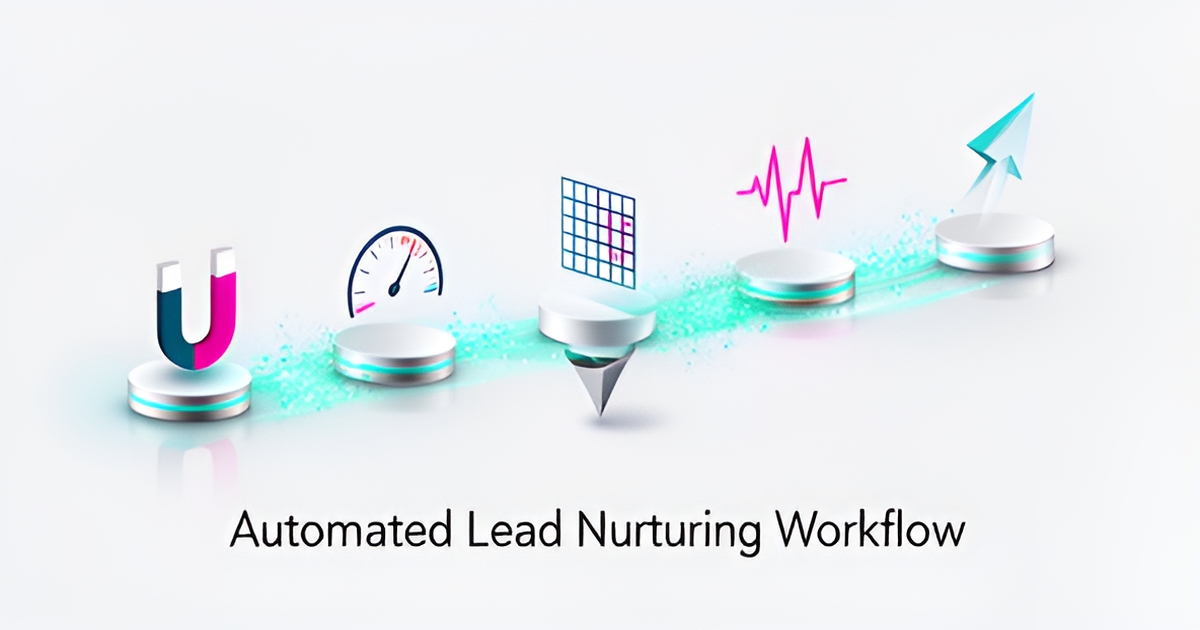
Automated Lead Nurturing AI Workflow Overview
Key Facts
- 79% of marketing leads never convert into sales, with lack of nurturing cited as a common cause, according to lead nurturing research.
- AI-powered nurture delivers 45% higher engagement and 30% faster pipeline velocity than traditional drip campaigns, industry benchmarks show.
- 44% of sales reps never follow up with a lead at all, per analysis of capture and follow-up tools.
- Financial services leads convert at a 31.7% median MQL-to-SQL rate, the highest of any tracked vertical, 2026 benchmarks confirm.
- Layering AI intent scoring on behavioral data drives a 62% lift in MQL-to-SQL conversion, marketing automation research shows.
- Agent adoption in marketing automation jumped from 4% in 2023 to 45% in 2026, the steepest automation curve on record.
- Top-quartile teams hand off leads in 11 minutes median; bottom-quartile teams take 4.8 hours, routing latency data reveals.
One AI employee doing one job, 24/7, for less than a part-time wage.
Receptionist, lead follow-up, intake or dispatch. Trained on your business and fully managed. From $700/mo.
Why Most Lead Nurturing Breaks Between Capture and Conversion
A lead fills out your form at 9:15 on a Tuesday morning. By Thursday, the follow-up email that lands in their inbox reads like it was written by a stranger who never saw that form at all. That's not a copywriting problem. It's an architecture problem.
Most lead nurturing stacks are fragmented by design. A chatbot captures the inquiry, a sequencer schedules the emails, and an enrichment tool fills in the blanks, but none of them share a brain. When capture and follow-up tools do not share context, the follow-up reads like it came from someone who never saw the first conversation. The lead notices. They stop responding.
The cost of that broken handoff is brutal:
- 79% of marketing leads never convert into sales, with lack of nurturing cited as a common cause, according to lead nurturing research
- 44% of sales reps never follow up with a lead at all, per the same analysis of capture and follow-up tools
- Sales reps spend 60% of their average week on nonselling work, Salesforce reports
Those numbers describe the same failure from three angles. Leads arrive, nobody owns the follow-through, and the window closes. It's rarely a skill problem. It's a systems problem.
This is why another point tool won't fix your pipeline. The market already sells capture, sequencing, and enrichment as separate subscriptions, and stitching them together still leaves leads falling through the cracks. What's missing is continuity: one system that remembers what the lead said, scores them against real signals, and acts on that context at every touch.
That's the gap AIQ Labs builds into. Its end-to-end lead nurturing workflow moves prospects from capture to conversion inside a single connected system, so the AI that qualifies a lead is the same AI that follows up, books the meeting, and hands your team a warm, fully documented opportunity. For finance and payment automation teams, where the median MQL-to-SQL conversion rate already runs highest among verticals at 31.7%, that continuity is the difference between a lead list and a revenue channel.
What an End-to-End AI Nurturing Workflow Actually Looks Like
The reason most lead nurturing breaks down isn't the tools themselves. It's that each one forgets the lead between touches, so the follow-up reads like it came from someone who never saw the first conversation.
AIQ Labs builds its nurturing workflow as one connected system with five stages, and context carries forward through every one of them. Here's how the loop actually runs.
Stage 1: Capture. Every inbound lead, whether it arrives by phone, web form, chat, or SMS, lands in the same place with the original conversation attached. No re-typing, no copy-pasting between tools, which is exactly the manual data entry burden small business owners complain takes time away from selling.
Stage 2: Enrichment. The system fills in firmographic and contact details automatically, then layers on first-party context: what the lead asked, which pages they visited, how they got there. This matters because 79% of marketing leads never convert, and lack of nurturing is a commonly cited cause.
Stage 3: AI scoring. This is where the workflow decides who's worth a human's time right now. The market has already shifted here: 47% of scoring models are now partially or fully AI-generated, up from 11% in 2024, and teams that layer AI intent scoring on top of behavioral data see a 62% lift in MQL-to-SQL conversion, according to 2026 marketing automation benchmarks. The score updates in real time, so a lead who suddenly visits your pricing page twice in a day doesn't wait for the next scheduled email.
Stage 4: Adaptive nurture. Instead of a fixed drip sequence that treats every lead identically, the AI adjusts timing, channel, and message based on engagement signals. This is the difference between static sequences and the dynamic, real-time processes Salesforce describes as the current standard for AI lead nurturing. The payoff shows up in the numbers: AI-powered nurture delivers 45% higher engagement and 30% faster pipeline velocity than traditional drip campaigns.
Stage 5: Routing to sales. When a lead crosses the score threshold, it goes to a human immediately, with the full history attached: every touch, every reply, every signal. Routing latency is the hidden killer here. Top-quartile teams hand off in a median of 11 minutes; bottom-quartile teams take 4.8 hours. Many teams lose more pipeline to slow handoffs than to weak nurture content.
The through-line across all five stages is continuity. Because capture, enrichment, scoring, nurture, and routing share one memory, the lead never has to repeat themselves and the rep never walks in blind. That's the design principle behind AIQ Labs' workflow builds: one system that owns the full loop, so leads stop falling through the cracks between tools that don't talk to each other.
The Numbers That Justify Rebuilding the Workflow
The case for rebuilding a lead nurture workflow around AI comes down to a handful of numbers, and they're hard to argue with. Teams using AI-powered nurture see 45% higher engagement rates and 30% faster pipeline velocity than those still running traditional drip campaigns, according to industry benchmark data. The same research puts conversion rates 25% higher for AI nurture compared with static, time-based sequences.
The economics get better from there. Companies that excel at lead nurturing generate 50% more sales-ready leads at 33% lower cost per lead, per compiled nurturing statistics. That combination matters for any business watching its cost per qualified lead climb. Segmentation compounds the effect: segmented nurture campaigns generate 760% more revenue than broadcast sends, which explains why 47% of lead scoring models are now partially or fully AI-generated, up from just 11% in 2024.
For finance and payment businesses, the upside is even more concrete. Financial services posts a 31.7% median MQL-to-SQL conversion rate, the highest of any vertical in the data, ahead of B2B SaaS at 26.3% and professional services at 18.1%. That means finance leads are already the most likely to convert when they reach sales, so the real lever is making sure fewer of them fall through the cracks between capture and handoff. And plenty do fall through: 79% of marketing leads never convert at all, with lack of nurturing cited as a common cause.
Here's what those numbers justify in practice:
- Replacing rigid drip sequences with adaptive nurture that responds to real-time engagement signals
- Automating routing so leads reach a first touch in minutes instead of hours, since bottom-quartile teams average 4.8 hours of routing latency
- Layering AI intent scoring on behavioral data, which drives a 62% lift in MQL-to-SQL conversion
- Consolidating capture, enrichment, sequencing, and CRM sync into one connected workflow instead of four disconnected subscriptions
This is the thinking behind AIQ Labs' end-to-end lead nurturing workflow, which keeps context attached to each prospect from first capture through conversion. When capture and follow-up tools don't share context, the follow-up reads like it came from someone who never saw the first conversation, and leads stop responding. A single connected system fixes that handoff, and for finance-sector teams where every lead converts at the highest rate in the data, fixing it is worth real money.
How AIQ Labs Builds and Runs the Workflow
When a small business owner says they want lead nurturing to be "mostly hands off," they're describing exactly the gap most automation tools leave behind. One solopreneur managing roughly 3,000 leads put it plainly: "I need something that automates as much as possible, from lead qualification to engagement, so I can focus on meetings and calls" (Reddit, r/smallbusiness). That's the demand AIQ Labs' delivery model is built around.
The model has two parts. First, AI Employees: managed AI staff in defined roles like SDR, Lead Qualifier, and Appointment Setter. These aren't chatbot widgets. They perform real job tasks, qualifying leads, following up, and booking appointments directly on a calendar, and they work 24/7/365. Second, workflow builds that connect the systems those employees act inside: CRM, calendar, email, SMS, and payment tools. Because every layer shares the same context, the follow-up reads like it came from someone who actually saw the first conversation, which is precisely what fragmented tool stacks fail to do.
The hands-off part comes from how the work is divided:
- AIQ Labs builds the AI Employee and trains it on your specific processes and voice.
- We integrate it with your existing tools, so there's no manual data entry between systems.
- We monitor performance continuously and retrain as patterns change.
- You and your customers communicate through normal channels: phone, email, chat, SMS.
That structure matters because the alternative, a business owner stitching tools together themselves, tends to fail quietly. By the time you've connected a capture tool, a sequencer, and an enrichment layer, you're paying multiple subscriptions and leads still fall through the cracks. Research on the 2026 automation market describes the shift toward exactly this kind of "agent layer" that composes and monitors workflows on the team's behalf, with agent adoption jumping from 4% in 2023 to 45% in 2026 (Digital Applied).
Payment is structured to match how much control a business wants. Start Monthly covers one AI employee with a flat monthly plan that includes the build, training, integrations, monitoring, and improvements, and you can pause or adjust anytime. Build in Milestones suits a single workflow: the project is split into phases, you approve and pay per phase, and you keep everything built so far if you stop. Own It Outright applies to a full operating system, where the code, agents, and data transfer to you when complete.
The managed model exists for a simple reason. Sales reps spend 60% of their average week on nonselling work (Salesforce), and 44% never follow up with a lead at all. When AIQ Labs builds, trains, monitors, and improves the system while the business focuses on closing, the owner gets what that solopreneur was asking for: automation that runs itself, and a calendar full of conversations worth having.
Getting Started and What to Expect in the First 90 Days
The first ninety days decide whether an automated lead nurturing workflow earns its keep or becomes another dashboard nobody opens. The good news: the highest-leverage wins in this window are usually boring, mechanical fixes, not creative overhauls.
Start with speed. According to marketing automation research, automated routing cuts the time from lead capture to first sales touch by 43%. That's the kind of early result you should expect within the first month of deployment, and it matters because roughly 80% of new leads never convert, often because follow-up is slow or missing entirely, per analysis of lead capture and follow-up tools.
The second early win comes from scoring calibration. The same research found a 3.2x increase in SQL volume in the first 90 days after scoring threshold optimization. That's not a gradual compounding effect; it's a step change that shows up fast once your routing logic stops sending weak leads to sales and stops burying good ones in nurture purgatory.
Here's how a phased implementation typically unfolds:
- Discovery (1–2 weeks): map your current capture-to-conversion process, audit CRM data quality, and identify where leads stall or vanish.
- Development (4–12 weeks): build the scoring model, routing rules, and follow-up sequences against your actual sales history, then integrate with your CRM and calendar tools.
- Deployment (1–2 weeks): go live with monitoring in place, train the team, and validate that handoffs work end to end.
- Optimization (ongoing): watch routing latency and scoring thresholds, then tune them against real conversion data.
If you're weighing whether this fits your business, AIQ Labs keeps the entry point deliberately light: a two-minute Fit Check, then a free 30-minute strategy call to map your biggest bottleneck. There's no obligation, and if there isn't a clear win, they'll say so. For finance and payment-focused teams, the benchmark is encouraging: median MQL-to-SQL conversion for financial services runs at 31.7%, the highest among tracked verticals, which means a well-tuned workflow has real room to compound.
Set expectations accordingly. In month one, you should see faster first touches. By month three, scoring and routing improvements should show up in SQL volume. The 17% average revenue lift mid-market teams report in the first year comes after those foundations are in place, not before.
Still paying for 10+ subscriptions that don’t talk to each other?
We build connected AI systems you own. Pay upfront or on a payment plan; the code is yours once it’s paid off.
Frequently Asked Questions
Why do most leads never convert even when I have a follow-up sequence in place?
How much better is AI-powered nurturing than a traditional drip campaign?
Is my lead scoring or my routing speed the bigger bottleneck?
What results should I realistically expect in the first 90 days of an automated nurturing workflow?
Does automated lead nurturing actually work for finance and payment companies?
Do I have to manage the AI workflow myself once it's built?
The Lead That Almost Became Revenue
The pattern in this article is hard to miss: leads don't fail because reps lack skill, they fail because systems forget. When capture, enrichment, scoring, nurture, and routing live in separate tools, context dies at every handoff, and 79% of marketing leads never convert as a result. The fix isn't another point solution. It's one connected workflow where the AI that qualifies a lead is the same AI that follows up, books the meeting, and hands your team a fully documented opportunity. For finance and payment teams, where median MQL-to-SQL conversion runs highest among verticals at 31.7%, the upside of fixing the handoff is especially real. AIQ Labs builds exactly this: AI Employees and workflow builds that carry context from first capture through conversion, with pricing models (Start Monthly, Build in Milestones, or Own It Outright) that match how much control you want. The next step is deliberately light: take the two-minute Fit Check at aiqlabs.ai/apply, then a free 30-minute strategy call to map your biggest bottleneck. If there isn't a clear win, we'll tell you that too, but every day the handoff stays broken, a lead you paid for goes quiet.
See what AI would actually do in your business, in 60 seconds.
The planner shows which step fits, the agents we’d build and the published price. No email needed.