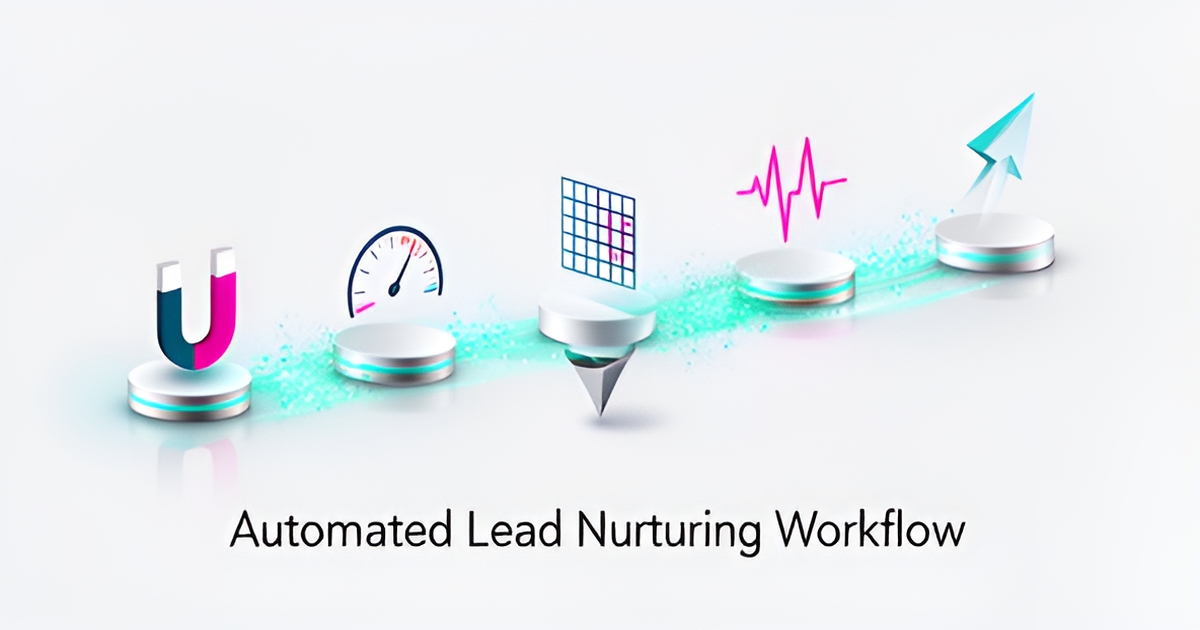
Automated Lead Nurturing AI Workflow Overview
Key Facts
- 79% of marketing leads never convert into sales, commonly due to lack of nurturing
- Contact success with a new lead drops more than tenfold within the first hour after they show interest, per Artisan research
- Top-quartile teams hand off an MQL to sales in a median of 11 minutes, versus 4.8 hours for the bottom quartile, 2026 data shows
- Automated lead nurturing returns a median of $5.44 per $1 spent, rising to $8.71 for fully integrated programs, according to 2026 benchmarks
- Segmented nurture campaigns generate 760% more revenue than broadcast sends, per Marketo benchmark data
- AI intent scoring lifts median MQL-to-SQL conversion by 62%, compared to just 38% for automation alone, 2026 data finds
- Peer-reviewed research shows AI systems achieve roughly 90% precision and recall in lead qualification, according to Frontiers in Artificial Intelligence
One AI employee doing one job, 24/7, for less than a part-time wage.
Receptionist, lead follow-up, intake or dispatch. Trained on your business and fully managed. From $700/mo.
The Lead Leak: Why Most Prospects Never Convert
You lose the deal before the first email lands. The problem isn't your content; it's your speed.
Seventy-nine percent of marketing leads never convert into sales, and the primary driver is slow, inconsistent follow-up rather than weak messaging. Most prospects aren't uninterested; they're just waiting for a response that never comes.
Time is the critical variable. The success rate of contacting a lead drops more than tenfold within the first hour after they show interest. By the time a human team processes the data, the window for meaningful engagement is often closed.
The gap between top-performing teams and the rest is stark. Top-quartile programs achieve an 11-minute median handoff from Marketing Qualified Lead to Sales Development Representative. The bottom quartile sits at 4.8 hours. That difference determines who gets the conversation.
- Slow routing kills momentum before the prospect cools off.
- Manual data entry delays the first meaningful touch.
- Inconsistent follow-up creates a perception of low priority.
- Delayed responses cede the ground to faster competitors.
This is where automation shifts the balance. Automated routing cuts the time from lead capture to first sales touch by 43%. It ensures that high-intent signals trigger immediate action, not a backlog.
For finance and payment automation firms, speed signals reliability. If your follow-up is slow, prospects assume your operations are sluggish. You need a system that treats every new lead as an urgent priority.
AIQ Labs builds end-to-end workflows that eliminate this latency. Our AI Employees handle the initial qualification and routing instantly. They work around the clock, ensuring no lead sits in a queue waiting for a human to catch up.
The goal is simple: remove the friction between interest and action. When you automate the handoff, you protect the pipeline. You stop losing deals to the clock.
Start with a two-minute Fit Check at aiqlabs.ai/apply to see where your current workflow leaks. Then, book a free strategy call to map out your specific automation path.
The Seven-Stage AI Nurturing Workflow That Fixes It
Most lead nurturing fails before the first email goes out. The bottleneck is almost never the platform. It's a slow handoff, a stale score, or a broadcast blast that treats a CFO the same as a curious intern.
The fix is a seven-stage AI workflow that runs continuously: capture, enrich, score, segment, personalize, engage, optimize. This same pattern shows up across Salesforce, Artisan, and practitioner playbooks, because each stage solves a specific failure mode in the one before it.
Stage 1: Capture. A form fill, a chat conversation, a booked call. The lead lands in the CRM, and the clock starts. Contact success drops more than tenfold within the first hour, so the capture event has to trigger enrichment and routing immediately, not on a nightly batch.
Stage 2: Enrich. Raw records are thin. AI pulls in firmographics, technographics, and prior interactions. Peer-reviewed work on systems like Scrapus shows roughly 90% precision and recall in lead qualification, with about 3× higher relevant lead yield when crawling is driven by reinforcement learning.
Stage 3: Score. This is where most pipelines leak. Layering AI intent scoring on behavioral signals lifts median MQL-to-SQL conversion by 62%, versus 38% for automation alone.
Stage 4: Segment. Behavior beats demographics. Segmented nurture generates 760% more revenue than broadcast sends, per Marketo benchmarks compiled by DigitalApplied. One campaign, one message, one segment.
Stage 5: Personalize. Dynamic tokens and AI-generated subject lines drive a 26% lift in open rates. Behavioral trigger personalization pushes CTR 41% higher than static content.
Stage 6: Engage. Omnichannel sequencing across email, SMS, and chat. SMS click rates run 58% higher than email, and seven touches spread across channels read as persistent. Seven emails in seven days reads as stalking.
Stage 7: Optimize. The loop closes with routing latency, scoring thresholds, and message variants. Top-quartile programs hit an 11-minute MQL-to-SDR handoff. Bottom quartile sits at 4.8 hours.
Each stage maps to a concrete capability: AI Lead Generation and Enrichment for stages one and two, a Bespoke AI Lead Scoring System for three, AI-Powered Sales Outreach Intelligence for five and six. For finance and payment-automation teams, where the median MQL-to-SQL already runs at 31.7%, tightening those handoffs is the fastest lever available.
The pattern works because it's built on a simple truth: speed and relevance beat volume every time.
Where AI Should Act Alone and Where Humans Take Over
Most automated lead nurturing programs don't fail because the technology is weak. They fail because of two things: dirty CRM data and unclear boundaries between what the AI handles and what humans handle.
Start with the data problem. Salesforce's guidance on AI lead nurturing makes the point bluntly: AI systems are only as good as the data they're trained on. If your CRM has stale contact records, missing engagement history, or duplicate leads, your AI will score the wrong people, personalize to the wrong context, and route prospects to nowhere. The failure shows up in embarrassing ways, too. OrbitForms points out that nothing screams "generic automation" like an email that opens with "Hi [FIRST_NAME]" because a broken personalization token slipped through. Before any workflow goes live, someone needs to own data hygiene: deduplication, enrichment, and a single source of truth in the CRM.
The second failure mode is harder to see because it's a design decision, not a bug. Where exactly does AI act alone, and where does a human take over? Salesforce frames the best-practice split clearly: AI handles autonomous follow-ups to engaged prospects, while humans step in for objections and negotiations. OrbitForms agrees, advising that when a high-value target account shows strong engagement, the system should notify sales rather than keep running the automated sequence. Their reasoning is worth repeating: automation should enhance human connection, not replace it entirely.
A practical boundary looks like this:
- AI acts alone on enrichment, scoring, segmentation, and follow-up sequences to prospects who are still warming up.
- AI escalates immediately when a lead shows buying intent, because contact success rates drop more than tenfold within the first hour after interest, according to Artisan's research.
- Humans take over for objections, pricing conversations, and negotiations, where trust and judgment decide the outcome.
- Nobody automates nurturing of existing customers with cold-lead sequences, a credibility-damaging mistake OrbitForms specifically calls out.
The escalation layer is what keeps this from feeling robotic. Campaign Creators warns that over-reliance on automation makes processes feel impersonal, so well-designed workflows include validation checks before every action, guardrails that limit what the AI can say or promise, and human-in-the-loop triggers when a conversation exceeds the AI's authority. This is the architecture AIQ Labs builds into its lead nurturing systems: validation layers, role-specific guardrails, configurable escalation, and full audit trails, so a human always knows when the AI handed something off and why.
Get these two things right, clean data and a clear human-AI boundary, and the automation compounds. Get them wrong, and you've built a faster way to lose pipeline.
Building Your Workflow: What Done-For-You Looks Like
Knowing that automated nurturing returns a median of $5.44 for every dollar spent, and up to $8.71 for fully integrated programs, makes the build question a lot easier to answer. The workflow pattern itself is well established: capture, enrich, score, segment, personalize, engage, then optimize. What SMB owners usually struggle with is the implementation, not the concept.
This is where a done-for-you approach changes the math. One solopreneur put it plainly in a small business forum: they wanted a system that "automates as much as possible, from lead qualification to engagement" and stays mostly hands-off after setup. That's exactly the gap a managed build fills.
The practical path maps each workflow stage to a specific AI role, so nothing depends on you remembering to check a dashboard:
- AI Lead Qualifier handles capture and enrichment, scoring leads on behavior rather than job titles, then routes them the moment interest is shown.
- AI Appointment Setter owns speed-to-lead. Contact success drops more than tenfold within the first hour after a lead shows interest, so this role books meetings while intent is still hot.
- AI SDR runs personalized, omnichannel follow-up across email, SMS, and chat, spreading messages over time instead of stacking seven emails in seven days.
- Human handoff rules keep the AI in its lane: it follows up with engaged prospects autonomously but defers to you on objections and negotiations.
The ROI case rests on speed more than content. Top-quartile teams hand off an MQL to sales in a median of 11 minutes, while bottom-quartile teams take 4.8 hours, and automated routing cuts the time from lead capture to first sales touch by 43% according to 2026 marketing automation data. Many teams lose more pipeline to slow handoffs than to weak nurture content, which is why routing and qualification come before anything else in the build.
The delivery model matters as much as the roles. AIQ Labs' Start Monthly approach bundles the build, training on your business, tool integrations, monitoring, and ongoing improvements into one flat monthly plan that costs less than a part-time hire, with the option to pause or adjust anytime. You're hiring roles, not buying software you then have to babysit.
Two setup realities are worth planning for before launch. First, clean CRM data is a prerequisite; AI systems are only as good as the data they're trained on, a point Salesforce makes directly in its guidance on AI lead nurturing. Second, the workflow needs a defined boundary between what the AI does alone and what it escalates to a human. Guardrails, validation layers, and audit trails handle that structurally, so the boundary isn't a matter of hope.
If you want to see what this looks like for your specific funnel, the entry point is a two-minute Fit Check at aiqlabs.ai/apply, followed by a free 30-minute strategy call where an AI engineer maps your biggest bottleneck and tells you honestly whether there's a clear win. If there isn't, they'll say so.
Still paying for 10+ subscriptions that don’t talk to each other?
We build connected AI systems you own. Pay upfront or on a payment plan; the code is yours once it’s paid off.
Frequently Asked Questions
Why do most marketing leads never convert into sales?
What does an AI lead nurturing workflow actually look like?
How fast do I really need to follow up with a new lead?
What's the ROI of automated lead nurturing, is it worth the investment?
Should AI handle everything, or do humans still need to be involved?
Why do so many automated nurturing programs fail?
Stop Losing Deals to the Clock
The pattern is clear: most pipelines don't leak because of weak content, they leak because of slow handoffs, stale scores, and generic blasts. The seven-stage workflow of capture, enrich, score, segment, personalize, engage, and optimize fixes that, but only when it's built on clean CRM data and a clear boundary between what AI handles alone and when a human steps in. Get those two things right, and the automation compounds: teams that excel at nurturing generate 50% more sales-ready leads at 33% lower cost, according to lead nurturing research. For finance and payment-automation firms, speed signals reliability, and that's exactly what AIQ Labs builds for: AI Lead Qualifiers, Appointment Setters, and SDRs that route and engage leads in minutes, not hours, with guardrails and human handoff rules baked in. The next step is simple. Take the two-minute Fit Check at aiqlabs.ai/apply, and book your free 30-minute strategy call. An AI engineer will map your biggest bottleneck, and if there's no clear win, they'll tell you that too.
See what AI would actually do in your business, in 60 seconds.
The planner shows which step fits, the agents we’d build and the published price. No email needed.