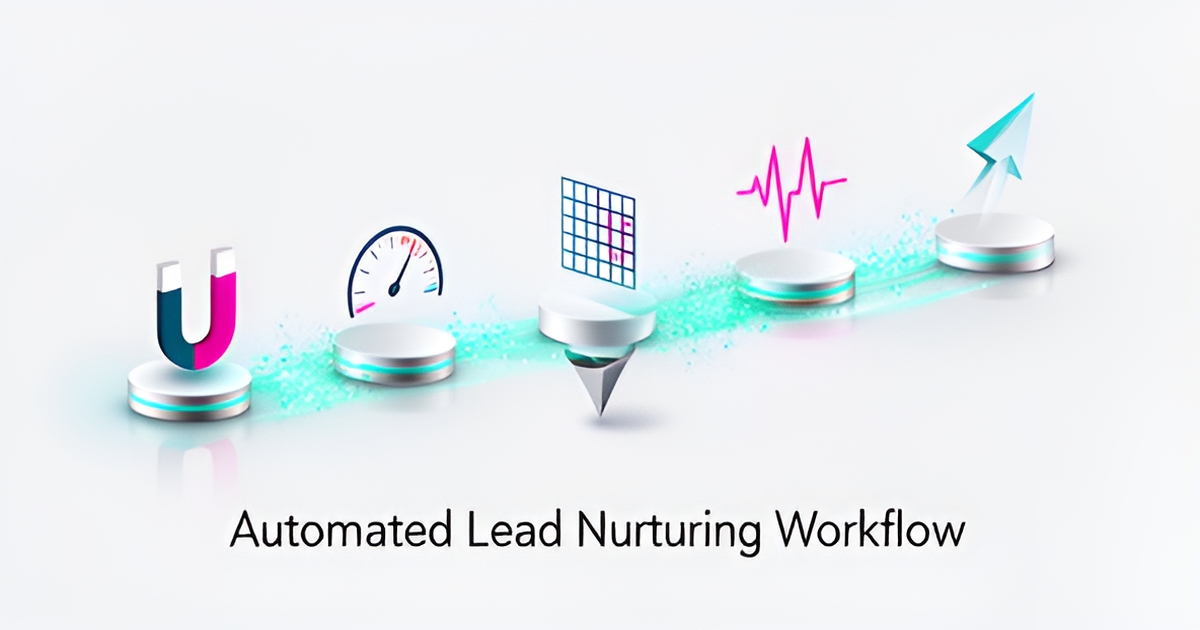
Automated Lead Nurturing AI Workflow Overview
Key Facts
- Behavioral trigger emails deliver 3x higher open rates than day-based drip sequences, per Dashly's customer data.
- AI-nurtured leads show 60–90% meeting show-up rates versus 40–50% for cold-booked meetings, according to Dashly.
- 73% of sales teams juggle three to four platforms at once, per Improvado's analysis.
- Sales reps spend 60% of their week on non-selling work, according to Salesforce's State of Sales data.
- AI personalization can lift conversions by up to 57%, per Martal Group research.
- Only about one-third of B2B organizations have implemented agentic AI at scale, per DemandGen Report.
- An 8% email bounce rate sends 15% of your email to spam, per Improvado's deliverability benchmarks.
One AI employee doing one job, 24/7, for less than a part-time wage.
Receptionist, lead follow-up, intake or dispatch. Trained on your business and fully managed. From $700/mo.
Why Your Leads Go Cold: The Fragmentation Problem
A lead doesn't go cold because nobody cared. It goes cold because nobody saw it happening. By the time a rep notices, the prospect has already talked to a competitor, and the only trace left is a stale record in a tool nobody checked.
That blindness is expensive. According to research on AI lead generation tooling, 73% of sales teams juggle three to four platforms at once, and marketing teams lose 40 to 60% of analyst time just reconciling data between them. Meanwhile, Salesforce's State of Sales data shows reps spend 60% of their week on non-selling work. Every hour spent copying records between systems is an hour a ready buyer waits for a reply.
The root cause isn't effort. It's architecture. Most nurturing stacks are a collection of point tools bolted together, and they don't talk to each other:
- A CRM holds the contact record, but the email platform holds the engagement history.
- The intent tool flags a pricing-page visit, but nobody routes that signal to a rep in real time.
- The enrichment vendor overwrites fields the scoring model depends on, quietly breaking prioritization.
- Static drip sequences keep firing on day 7 regardless of what the prospect actually did on day 3.
Static sequences are the clearest symptom. Behavioral trigger emails produce 3x higher open rates than day-based drips, yet most teams still run on fixed calendars because their tools can't act on behavior they never see. A prospect who visits your pricing page twice this week gets the same Tuesday newsletter as someone who unsubscribed in their head months ago.
Fragmentation doesn't just slow follow-up. It hides intent. Signals that should compound instead cancel each other out, and the handoff from automated nurturing to a live rep becomes the most-cited failure point in B2B programs, precisely because no single system owns the full picture.
This is the gap AIQ Labs builds into. Instead of adding another subscription to the pile, the team designs one connected workflow where capture, scoring, enrichment, outreach, and booking share the same data and the same logic, whether that's a single rebuilt lead follow-up process or a full operating layer. When one system owns the journey from first touch to booked call, leads stop going cold. They get handled.
The Five-Stage AI Nurturing Workflow That Actually Converts
Most lead nurturing still runs on a calendar: send on day 1, day 7, day 14, hope for the best. The workflows that actually convert look different, and both Salesforce's implementation guidance and Dashly's buyer research converge on the same five-stage arc. Here's how it works.
Stage 1: Capture multi-touchpoint data. Everything starts with connected data flowing into one place: form fills, pricing page visits, email opens, chat conversations, call outcomes. Salesforce is blunt about why: AI systems are only as good as the data they're trained on, so clean, accurate CRM data is critical. Fragmented tools sabotage this stage before it begins, which is why 73% of sales teams juggling 3–4 platforms struggle to keep signals aligned.
Stage 2: AI-score on explicit and implicit signals. Explicit data is what a prospect tells you: job title, company size, industry. Implicit data is what they show you: which pages they visit, how often they engage, whether they opened the proposal twice last night. AI scoring models weigh both in real time and rank who deserves attention first.
Stage 3: Segment dynamically. Static lists go stale in days. AI-driven segmentation updates continuously, moving a lead from "researching" to "comparing vendors" the moment their behavior changes. A prospect who suddenly visits your pricing page gets flagged for immediate action rather than waiting out a drip sequence.
Stage 4: Personalize timing, channel, and content. This is where behavioral triggers beat day-based drips decisively. Dashly's customer data across 200+ B2B SaaS accounts shows behavioral trigger emails produce 3x higher open rates than day-7 drip sends. AI personalization goes further, lifting conversions by up to 57% when timing, channel, and message all match the individual prospect.
Stage 5: Convert with a clean handoff. The final stage is where most programs fail. Dashly identifies the AI-to-human handoff as the most-cited failure point in B2B nurturing: hot leads get scored, then sit untouched while automated sequences keep firing. Effective systems notify reps instantly, pass full conversation context, and pull the lead out of automation.
This five-stage arc is exactly what AIQ Labs builds as a single connected system rather than a stack of point tools. Their approach pairs AI lead scoring and automated nurturing with AI SDR and appointment-setter roles, so a hot signal doesn't just trigger an alert, it triggers action. The key numbers to remember from the research:
- Behavioral trigger emails deliver 3x higher open rates than fixed-schedule drips (Dashly customer data).
- AI personalization can lift conversions by up to 57% (Martal research).
- AI-nurtured leads show 60–90% meeting show-up rates versus 40–50% for cold-booked meetings (Dashly).
- Conversational AI responds to inbound leads in under 30 seconds, ending the overnight lead graveyard.
The pattern holds across industries, including finance and payment automation, where speed-to-response and accurate scoring decide which vendor wins the deal. If your current nurturing runs on a calendar instead of behavior, that's the gap your competitors are about to close.
The Handoff Is Where Most Programs Fail (And How to Design Around It)
The moment a lead shows buying intent is the moment most automated nurturing programs break. The AI has done its job, the rep never sees it, and the prospect goes cold while sitting in a sequence that keeps emailing them.
Industry analysis identifies the AI-to-human handoff as the most-cited failure point in B2B SaaS nurturing programs, and the reasons are consistent: reps don't get notified in real time, conversation context gets lost, and the lead stays trapped in automated sequences that now work against the sale (Dashly). Salesforce's guidance points the same direction, stressing clear boundaries between what AI handles autonomously and what requires human judgment, particularly around objections and negotiation (Salesforce).
A well-designed handoff does three things, in order:
- Alerts a rep in real time when hot intent signals appear, like a prospect landing on the pricing page.
- Passes the full conversation context, so the rep knows what the AI already discussed and doesn't restart from zero.
- Removes the lead from automated sequences immediately, so the prospect never gets a drip email an hour after booking a call.
That last item matters more than teams expect. Behavioral triggers outperform day-based drips by a wide margin, with trigger emails producing 3x higher open rates than day-7 sequences, but a rep reaching out manually while the automation is still firing creates mixed signals that erode trust.
This is why we treat the handoff as a designed feature rather than an afterthought. In the lead nurturing systems AIQ Labs builds, human-in-the-loop controls and configurable escalation are built into the architecture: when a situation exceeds what the AI should decide, it routes to a person with everything the person needs. The AI Lead Qualifier and Appointment Setter roles follow the same pattern, booking directly into calendars and documenting everything in the CRM so the rep walks in informed.
Before any of this works, two prerequisites determine whether the workflow survives contact with reality. First, data quality. AI systems are only as good as the data they're trained on, and cold outreach tools lose accuracy on smaller companies, dropping to 60-70% for businesses under 50 employees. Below 80% accuracy, you risk damaging sender reputation with every send (Improvado). Second, deliverability thresholds are unforgiving: an 8% bounce rate sends 15% of your email to spam, and a 15% bounce rate can get your domain blacklisted. Recovery takes roughly three months of sustained sub-5% bounce rates.
Get the handoff right and the data clean, and the automation compounds. Get either wrong, and you've built a faster way to lose leads.
Building Your Workflow: Owned System vs. Tool Stack
The math on stacking point tools rarely works out the way the demos promise. A growing number of sales teams are discovering that the monthly subscriptions add up faster than the results do, and the industry is responding with a shift toward unified, owned systems.
The subscription-stack trap is well documented. According to Improvado's analysis, 73% of sales teams juggle 3–4 platforms at once, Clay API costs can exceed $800/month for 5,000+ enrichments across 4+ providers, and intent platforms like Bombora typically run $30,000+/year. Worse, running Apollo alongside ZoomInfo wastes budget on roughly 70% data overlap between the two tools. Marketing teams lose 40–60% of analyst time just reconciling data across disconnected systems.
That fragmentation is why sales organizations are consolidating point solutions into unified AI-powered platforms, a trend Martal Group identifies as a direct response to cost creep and data silos. The alternative is a single owned system built around your actual workflow, with the architecture to match. Clay's own blog frames winning GTM infrastructure as four layers: data, orchestration, execution, and agents. A custom build applies that same thinking without renting each layer separately.
In practice, an owned lead nurturing build looks like this:
- A multi-agent architecture (LangGraph-style workflows) where specialized agents handle scoring, enrichment, outreach, and follow-up rather than one monolithic tool
- Two-way integrations with your CRM (HubSpot, Salesforce, Pipedrive), calendars, and payment systems so data flows both directions instead of pooling in yet another dashboard
- AI Employee roles like Lead Qualifier and Appointment Setter that work 24/7, book directly into calendars, and cost 75–85% less than equivalent human hires
- Human-in-the-loop controls and configurable escalation, which matters because the AI-to-human handoff is the most-cited failure point in B2B nurturing programs
That last point deserves emphasis. Salesforce's implementation guidance stresses clear boundaries between autonomous AI actions and human touchpoints, since objections and negotiations still require human judgment. An owned system lets you draw those boundaries where they make sense for your sales motion, not where a vendor's feature set happens to stop.
The financial structure matters as much as the architecture. AIQ Labs offers three ways to pay: Start Monthly (one AI Employee on a flat plan that costs less than a part-time hire, with the build, training, and integrations included), Build in Milestones (one workflow, paid per phase, keep everything built if you stop), and Own It Outright (full ownership of the code, agents, and data). The ownership model is the real differentiator: no vendor lock-in, no per-seat creep, and no renewal negotiation every January.
With only about a third of B2B organizations running agentic AI at scale, the teams that consolidate early get cleaner execution and more predictable revenue contribution. If you want to see what that looks like for your workflow, start the two-minute Fit Check at aiqlabs.ai/apply and book a free 30-minute strategy call at aiqlabs.ai/book. If there isn't a clear win, they'll tell you that too.
Still paying for 10+ subscriptions that don’t talk to each other?
We build connected AI systems you own. Pay upfront or on a payment plan; the code is yours once it’s paid off.
Frequently Asked Questions
Why do my leads keep going cold even though we have a CRM and email tool running?
Do behavioral trigger emails really work better than scheduled drip sequences?
What's the biggest reason AI lead nurturing programs fail at the finish line?
Is it better to buy a stack of AI lead tools or build one owned system?
How important is data quality for AI lead scoring to actually work?
Can AI personalization really move the needle on conversions, or is it just hype?
Stop Losing Leads to a Calendar: Own the Workflow That Converts
The pattern is consistent across every source: leads don't go cold because nobody cared, they go cold because fragmented tools hid the signals until it was too late. The five-stage workflow that converts (capture, AI-score, segment dynamically, personalize, hand off cleanly) works because behavior drives action, not a fixed calendar. Behavioral trigger emails deliver 3x higher open rates than day-based drips, and AI-nurtured leads show 60–90% meeting show-up rates versus 40–50% for cold-booked meetings, per Dashly's B2B buyer research. The catch is that a stack of point tools can't execute this arc, only a system that owns the full journey can. That's the gap AIQ Labs builds into: one connected workflow where scoring, enrichment, outreach, and booking share the same data and logic, so hot signals trigger action instead of another drip email. If your nurturing still runs on a calendar, the fastest way to see what's leaking is a two-minute Fit Check at aiqlabs.ai/apply, followed by a free 30-minute strategy call at aiqlabs.ai/book. If there isn't a clear win, they'll tell you that too.
See what AI would actually do in your business, in 60 seconds.
The planner shows which step fits, the agents we’d build and the published price. No email needed.